Best way to pay the CRA as a Canadian business 2026
Best way to pay the CRA as a Canadian business: compare online banking, CRA PAD, My Payment and third-party options to cut fees, avoid errors and meet deadlines.

Trusted by 20,000+ Canadian businesses
Business banking for Canada
Local CAD and USD accounts, corporate cards with cashback, the lowest FX rates in Canada, free local transfers, and more.
Best way to pay the CRA as a Canadian business
Updated June 2026
Why CRA Payment Choices Matter
Paying the CRA is about more than moving money. It is about choosing the right method for the tax type, deadline, cash-flow need, and account details. The best way to pay the CRA as a Canadian business depends on what you need to optimize for in that specific payment cycle — whether you are managing GST/HST, payroll deductions, corporate tax, or instalments.
For many businesses, online banking or CRA pre-authorized debit are the practical defaults. They fit common payment workflows and help teams keep tax payments organized. Other CRA payment options can still make sense, but usually for narrower use cases. To choose well, assess four factors: cost, timing, scheduling, and workflow control.
CRA Payment Methods by Use Case
Short answer: the best way to pay the CRA as a Canadian business depends on the payment pattern, not just the tax type.
| Use case | Practical fit | |---|---| | Everyday low-cost payments | Online banking is the practical default for many businesses. | | Scheduled instalments or repeat remittances | CRA pre-authorized debit is strongest when timing is planned in advance. | | Fast one-off debit payment | CRA My Payment works well for direct debit-based payments. | | Credit card or Interac e-Transfer® flexibility | Third-party providers can help, with fees to review. | | Approvals, records, and reconciliation | A business account or platform layer can support the workflow around CRA payments. |
If your team pays GST/HST, payroll deductions, or corporate tax on a recurring schedule, CRA PAD can reduce last-minute payment pressure. For one-off balances, many businesses still choose to pay through online banking because the process fits familiar bill-payment habits.
When card flexibility matters, a third-party CRA payment provider may be useful — especially for credit card or Interac e-Transfer® payments. For finance teams, the surrounding workflow also matters: approval controls, clean records, and reconciliation support can make tax payment administration significantly easier to manage.
Business Tax Payments This Guide Covers
This guide focuses on the CRA obligations most Canadian businesses manage during the year: GST/HST remittances, payroll deductions, corporate income tax, instalments, and balances owing after filing. Whether you need to pay GST/HST to CRA, pay payroll deductions, pay corporate tax, or make a CRA instalments payment, the details you enter matter as much as the dollar amount.
A business may have more than one CRA program account under the same business number — GST/HST, payroll, and corporate income tax each use different program identifiers. When making a business tax payment, accurate allocation is essential. Choose the CRA payee or payable option that matches the obligation, then confirm the business number and program account before submitting. Getting the payment route right helps CRA apply the funds to the correct account and period.
Pay Through Online Banking
If your business already pays bills from a traditional account, online banking is often the lowest-friction way to pay CRA online. Most Canadian banks and credit unions support CRA business payments through their bill payment or tax payment menus, including RBC, TD Business Banking, Scotiabank Business Banking, and BMO.
The process typically starts in your financial institution's online banking portal. Add or select the CRA business payee, enter the account number or remittance details required by that institution, choose the correct remittance type, enter the amount, and submit. Many institutions also allow future-dated payments, which lets your team prepare ahead of a CRA payment deadline without sending funds immediately.
One thing to watch: payee names can vary by institution, and choosing the wrong remittance type can send a payment to the wrong place. For one-off payments from an existing business account, this familiar workflow is often the simplest default — provided your team verifies the correct payee before confirming.
Use CRA Pre-Authorized Debit
If your business knows a CRA payment is coming, pre-authorized debit can turn that obligation into a scheduled withdrawal instead of a last-minute task. You set up a pre-authorized debit (PAD) payment through CRA online services, including My Business Account, and authorize the CRA to withdraw the amount from your account on a selected date.
This option works well for recurring instalments and planned remittances — particularly when you pay GST/HST to CRA, pay payroll deductions, or manage corporate tax instalments on a predictable schedule. Keep in mind that the first payment date must be at least five business days in the future, so PAD suits businesses that plan ahead rather than those trying to meet a same-day deadline.
For deadline management, PAD gives finance teams meaningful control. Payments are generally treated as paid on the withdrawal date, subject to applicable cutoff timing, which reduces missed-deadline risk when dates are set correctly.
Plan your cash flow carefully. The funds need to be available when the CRA withdraws the payment, and changes are not always instant. If you need to modify, cancel, or skip a scheduled payment, review the CRA's rules and timing requirements before relying on the change.
Use CRA My Payment
CRA My Payment gives your business a direct debit-based route through the Canada Revenue Agency — useful when you want to pay CRA online without setting up a bank bill payment. It works well for one-off scenarios, such as a GST/HST balance, payroll remittance, corporate tax amount, or CRA instalments payment you want to handle directly through CRA.
My Payment accepts Visa Debit and Debit Mastercard, and supports certain wallet-linked debit methods where the underlying payment method qualifies. It does not accept credit cards directly, so it is not a card-rewards route for businesses trying to earn points or cashback on CRA payments.
CRA does not charge a fee to use My Payment, though your financial institution may. Check your account terms before relying on it for larger payments. After you submit, your CRA account update can still take up to three business days — worth factoring in when you are working close to a payment deadline.
Use Third-Party Payment Providers
If your business wants to make a CRA credit card payment, a third-party provider is the route to consider. CRA guidance recognizes third-party providers for certain payment types, and these services can accept credit card, debit card, and Interac e-Transfer® payments.
PaySimply is the provider most business owners will encounter in this category, particularly when searching how to pay the CRA by card. CRA credit card payments currently route through PaySimply or Plastiq, with PaySimply commonly used for business tax payment scenarios such as GST/HST, payroll deductions, and corporate tax balances.
The tradeoff is cost. PaySimply currently advertises a 2.49% processing fee for credit or debit card payments, and a 1.0% fee for Interac e-Transfer® payments. On a large CRA remittance, those fees add up quickly.
This option can still make sense when cash flow is tight, your team wants to use a credit card, or convenience outweighs minimizing fees. It can also fit businesses that specifically want Interac e-Transfer® flexibility for a CRA payment. For most routine remittances, though, third-party providers are a useful fallback rather than the default low-cost choice.
CRA Payment Methods Compared
Use this comparison to choose the best way to pay the CRA as a Canadian business based on cost, scheduling, timing, and payment control.
| Method | Best For | Fees | Scheduling | Processing Notes | Main Risk |
|---|---|---|---|---|---|
| Online Banking | Most businesses, low-friction payments | Usually low/no CRA fee | Often, via bank | Varies by institution | Wrong payee/remittance type |
| CRA PAD | Instalments and scheduled remittances | No CRA fee | Yes | First payment needs setup lead time | Missing setup window |
| CRA My Payment | One-off debit payments | No CRA fee from CRA | Limited vs PAD | Debit only | Assuming credit cards work |
| Third-Party Provider | Card use or Interac e-Transfer® flexibility | Service fees apply | Depends on provider | Provider-dependent | Paying extra for convenience |
How to Choose a CRA Payment Method
Start with the constraint that matters most to your finance team. If cost is the priority, use the CRA payment options that fit cleanly into your existing bank workflow. If predictability matters more, favour scheduled payments that reduce deadline risk. If speed drives the decision, choose a direct online route and build in time for CRA processing. For operational control, focus on approvals, documentation, and matching each payment to the right CRA payee account number before funds move.
Choose Online Banking If...
Your team wants a practical default for routine remittances and already manages cash from a business operating account. This approach works well when you pay CRA online as part of a regular payables process and can verify the correct payee before approval.
Choose CRA PAD If...
Recurring obligations need structure. PAD is often the better fit when CRA payment deadlines are known in advance and your team wants fewer last-minute transfers. It also supports a cleaner review process because payment timing gets planned before cash leaves the account.
Choose CRA My Payment If...
A one-off payment needs a direct CRA debit route. This can suit teams that want to act quickly, provided they still allow for CRA processing times and keep confirmation records with the tax file.
Choose a Third-Party Provider If...
Use this route when payment flexibility matters more than minimizing cost — such as when a card payment or Interac e-Transfer® better fits short-term cash flow. Finance teams should document the reason, approve the tradeoff, and reconcile the payment promptly.
Choose Online Banking If
Use online banking when your business wants a simple, low-cost default for routine CRA payments and already pays bills from a traditional business account. It works well for one-off GST/HST, payroll deductions, corporate tax balances, or instalments that your team handles manually rather than through recurring automated withdrawals.
This fit depends on process discipline. If your bookkeeper or finance lead uses a reliable checklist covering the correct CRA payee, business number, program account, payment amount, and confirmation record, paying CRA through online banking keeps the workflow familiar without adding extra tools.
Choose CRA PAD If
Use CRA PAD when your business has predictable tax obligations and wants fewer manual steps close to CRA payment deadlines. It fits recurring GST/HST remittances, payroll deductions, and corporate tax instalments where amounts and timing are known in advance.
If your team plans cash flow by calendar, PAD lets you schedule ahead and reduce the risk of rushed, last-minute payments. The practical requirement is confidence that enough funds will be available in the account on the scheduled withdrawal date.
Choose CRA My Payment If
Use CRA My Payment when your business wants a direct CRA debit option for a specific amount due, rather than setting up a CRA payee in online banking for a single transaction. It can fit a quick one-off need — such as paying a balance after filing or handling an occasional remittance outside your normal workflow.
For recurring GST/HST, payroll, or corporate tax instalments, PAD usually gives finance teams better planning control.
Choose a Third-Party Provider If
If your business wants a CRA credit card payment option, a third-party provider may fit better than direct CRA tools. This route can also make sense when you want Interac e-Transfer® flexibility, or when short-term cash-flow timing matters more than minimizing transaction costs.
For some teams, card rewards or convenience can justify the added expense. Still, compare the value of that flexibility against provider fees before you pay GST/HST, payroll deductions, or corporate tax this way.
Business Banking Platforms and Tax Workflows
Your CRA payment method handles the transfer. Your business banking platform shapes everything around it: how the payment gets funded, who approves it, where the receipt lives, and how the transaction reconciles in your accounting system.
For many businesses, a traditional bank or credit union remains the familiar route for CRA online banking payments — including broad providers such as RBC, TD Business Banking, Scotiabank Business Banking, and BMO. If your team needs more workflow control, a platform layer can help separate tax funds, route internal approvals, keep supporting records, and sync activity into accounting software after you pay CRA online.
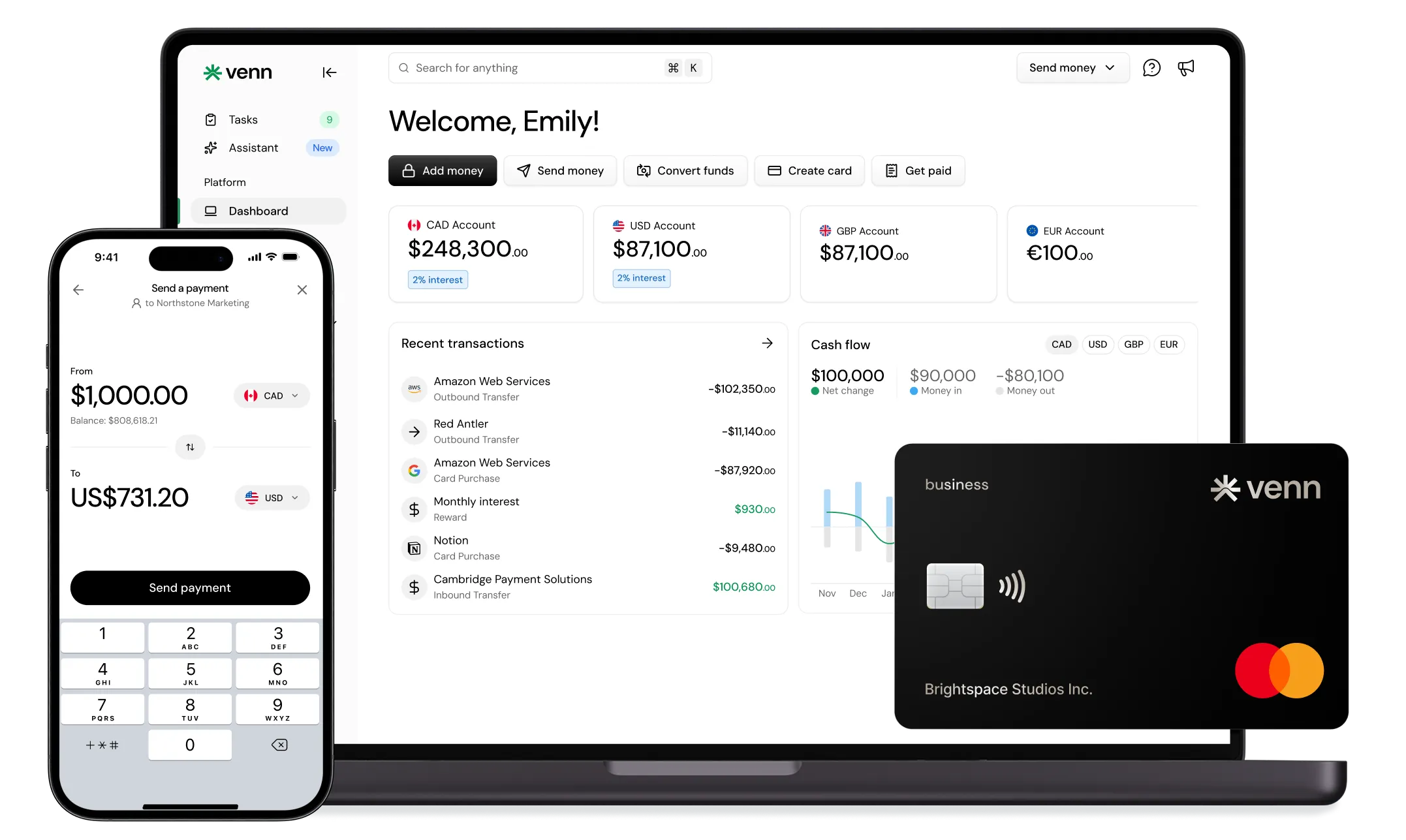
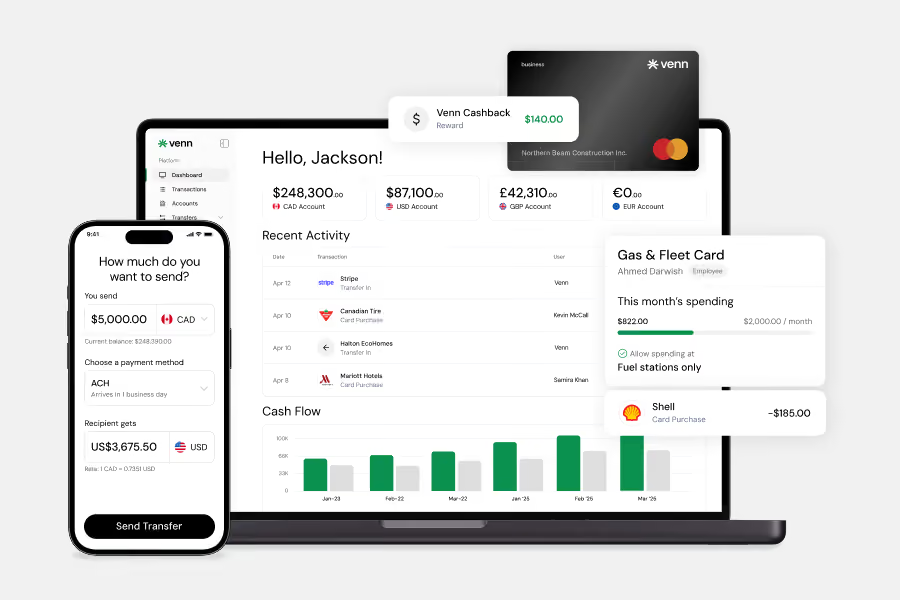
Venn fits here as one option. Venn is a technology company and business banking platform for Canadian businesses — not the default CRA payment route. Eligible funds are covered under CDIC insurance protection through Bank of Montreal. For teams managing broader operations, Venn supports CAD, USD, GBP, and EUR account capabilities. It also includes receipt capture for expense management, direct QuickBooks and Xero integrations for reconciliation, and free unlimited Interac e-Transfer® for vendor payments. Its 1% cashback card can support eligible non-tax spend, with plan terms to verify — though the Venn card should not be used as a direct CRA payment method.
| Option | Best Fit | CRA Payment Angle | Strengths | Limitations |
|---|---|---|---|---|
| Traditional Bank or Credit Union | Businesses that want a familiar operating account | Common route for CRA online banking payments | Widely used and easy for teams already banking there | May require more manual recordkeeping and approval tracking |
| Venn | Businesses that want an operating workflow layer around tax payments | Helps fund, document, approve, and reconcile tax-related activity | Multi-currency account capabilities, receipt capture, QuickBooks and Xero integrations, eligible non-tax card cashback | Not a universal CRA payment route, and the Venn card should not be used as a direct CRA payment method |
| PaySimply | Businesses that want third-party payment flexibility | Third-party CRA payment provider option | Supports alternative payment preferences, including Interac e-Transfer® | Convenience can add cost, and processing depends on the provider |
Common CRA Payment Mistakes
Use this checklist before every business tax payment in Canada, especially for GST/HST, payroll deductions, corporate tax, and CRA instalments:
- Selecting the wrong CRA payee: Payee names can vary by financial institution. Match the payee to the tax type before you submit.
- Entering the wrong CRA account number: Confirm the business number and program account, such as RT for GST/HST or RP for payroll. One wrong digit can send the payment to the wrong place.
- Assuming credit cards work directly with CRA: If you need a CRA credit card payment option, you generally need a third-party provider — not a direct CRA card payment flow.
- Setting up scheduled withdrawals too late: Pre-authorized debit CRA payments require lead time. Do not wait until the due date to create the payment.
- Ignoring weekends and holidays: CRA processing times and bank cutoffs can affect when a payment applies. Schedule early around long weekends.
- Skipping confirmation records: Save receipts, confirmation numbers, dates, amounts, and account details. Finance teams should store them with the related return or remittance file.
Final Recommendation for Canadian Businesses
The best way to pay the CRA as a Canadian business depends on what you value most: cost, timing, predictability, or workflow control. For most teams, the right starting point is a side-by-side look at online banking and CRA pre-authorized debit. Online banking often fits straightforward one-off payments, while PAD tends to suit planned remittances and instalments.
Third-party card-based payments — including options that support credit cards or Interac e-Transfer® — belong in more specific situations where flexibility outweighs added cost.
If CRA payments are exposing gaps in approvals, recordkeeping, or accounting workflows, it may be worth exploring whether Venn fits your broader finance operating setup.
Frequently Asked Questions
Q: Can a business pay the CRA with a credit card? A: Yes, but not directly through CRA My Payment. A Canadian business generally needs to use a third-party CRA payment provider for a CRA credit card payment, and any provider fees should be weighed against convenience, rewards, or short-term cash-flow needs.
Q: Is online banking or CRA PAD better for GST/HST and payroll remittances? A: Online banking is often practical for one-off or routine payments, including when you pay GST/HST to CRA or pay payroll deductions. CRA pre-authorized debit is typically stronger when your business wants scheduled, recurring withdrawals. The better fit depends on timing, internal approvals, and how predictable the obligation is.
Q: How long does a CRA payment take to show up? A: CRA processing times depend on the payment method, your financial institution, and any third-party provider involved. Allow time for weekends, holidays, and account update delays — especially near CRA payment deadlines. Save confirmation numbers and payment receipts in case your team needs to trace the transaction.
Q: What is the cheapest way to pay the CRA? A: For many businesses, online banking or CRA PAD will be the lowest-cost default because third-party providers typically charge service fees. The cheapest option still depends on your financial institution and how your finance team manages approvals, records, and payment scheduling. Cost should always be considered alongside deadline risk.
Q: Can I pay the CRA through Interac e-Transfer®? A: Businesses can use Interac e-Transfer® through certain third-party CRA payment providers — not as a universal direct CRA payment route. Check the provider's current fees, processing terms, and confirmation process before paying. This option may fit specific cash-flow or convenience needs, but it is usually not the default low-cost method.
Q: What details do I need before making a CRA payment? A: Have the correct CRA payee or payment option ready before you submit anything. You should also confirm the business number, program account, tax period, payment amount, and confirmation process. These details matter whether you pay CRA online for GST/HST, payroll deductions, corporate tax, or a CRA instalments payment.
--- **Disclaimer:** This publication is provided for general information purposes only and does not constitute legal, tax, financial, or other professional advice from Venn Software Inc., its subsidiaries, or its affiliates, and is not a substitute for advice from a qualified professional. All comparisons and competitor information reflect publicly available information believed accurate as of November 25, 2026; features, pricing, rates, and terms referenced are subject to change and may differ at the time you read this. All product names, logos, and brands referenced are the property of their respective owners; their mention does not imply affiliation with or endorsement by Venn. Any comparative statements reflect Venn's views and are provided to help readers evaluate options. We make no representations, warranties, or guarantees, express or implied, that the content is accurate, complete, or up to date.
Venn is all-in-one business banking built for Canada
From free local CAD/USD accounts and team cards to the cheapest FX and global payments—Venn gives Canadian businesses everything they need to move money smarter. Join 20,000+ businesses today.
Frequently asked questions
Everything you need to know about the product and billing.
Join 20,000+ businesses banking with Venn today
Streamline your business banking and save on your spend and transfers today
No personal credit check or guarantee.