How to Pay Business Bills in Canada Step by Step Guide
How to Pay Business Bills in Canada with EFT, bill pay, PAD, cards or wires. Learn timelines, CRA tips, fraud controls, and reconciliation steps for teams.

Ahmed Shafik
Co-founder
.png)
Trusted by 15,000+ Canadian businesses
Business banking for Canada
Local CAD and USD accounts, corporate cards with cashback, the lowest FX rates in Canada, free local transfers, and more.
Every Canadian business faces the same operational reality: bills arrive from multiple sources, each with different payment requirements, deadlines, and consequences for getting it wrong. Vendor invoices, utility bills, CRA remittances, software subscriptions, and international supplier payments all demand attention, accuracy, and proper documentation.
This guide provides a practical playbook for paying business bills in Canada. You'll learn which payment method works best for each situation, what information you need before sending money, how to avoid costly mistakes, and how to keep your books clean throughout the process.
If you want one place to manage payments and reconciliation, a modern business banking platform like Venn can simplify the workflow, especially when you pay in CAD and foreign currencies. But regardless of which tools you use, the fundamentals covered here will help you pay bills faster, safer, and with less administrative overhead.
Choose the Right Payment Method: A Simple Decision Framework
Step 1: Identify What Matters Most
Before selecting a payment rail, consider five factors:
Urgency. Does the payment need to arrive today, tomorrow, or within a week? Same-day requirements narrow your options significantly.
Amount and risk. Large payments warrant extra verification steps. Some methods are reversible; others are not.
Payee type. Government remittances, utility companies, and vendors each have preferred or required payment methods.
Proof of payment needs. Some payees require remittance details attached to payments. Others accept a simple confirmation number.
Cash flow timing. Do you need to pay immediately, or can you schedule the payment to align with incoming revenue?
Step 2: Match to the Best Rail
Once you understand your priorities, the right payment method becomes clear:
• Recurring bills → Pre-authorized debit (PAD) or scheduled bill payments
• Invoice-based vendor payments → EFT, bill payment, or wire transfer depending on urgency and amount
• International suppliers → Local currency transfer or wire depending on destination and requirements
• Card-accepting vendors → Credit or charge card for rewards and automatic expense capture
The Main Ways to Pay Business Bills in Canada
Canadian businesses have six primary payment rails available. Each has distinct advantages, limitations, and ideal use cases.
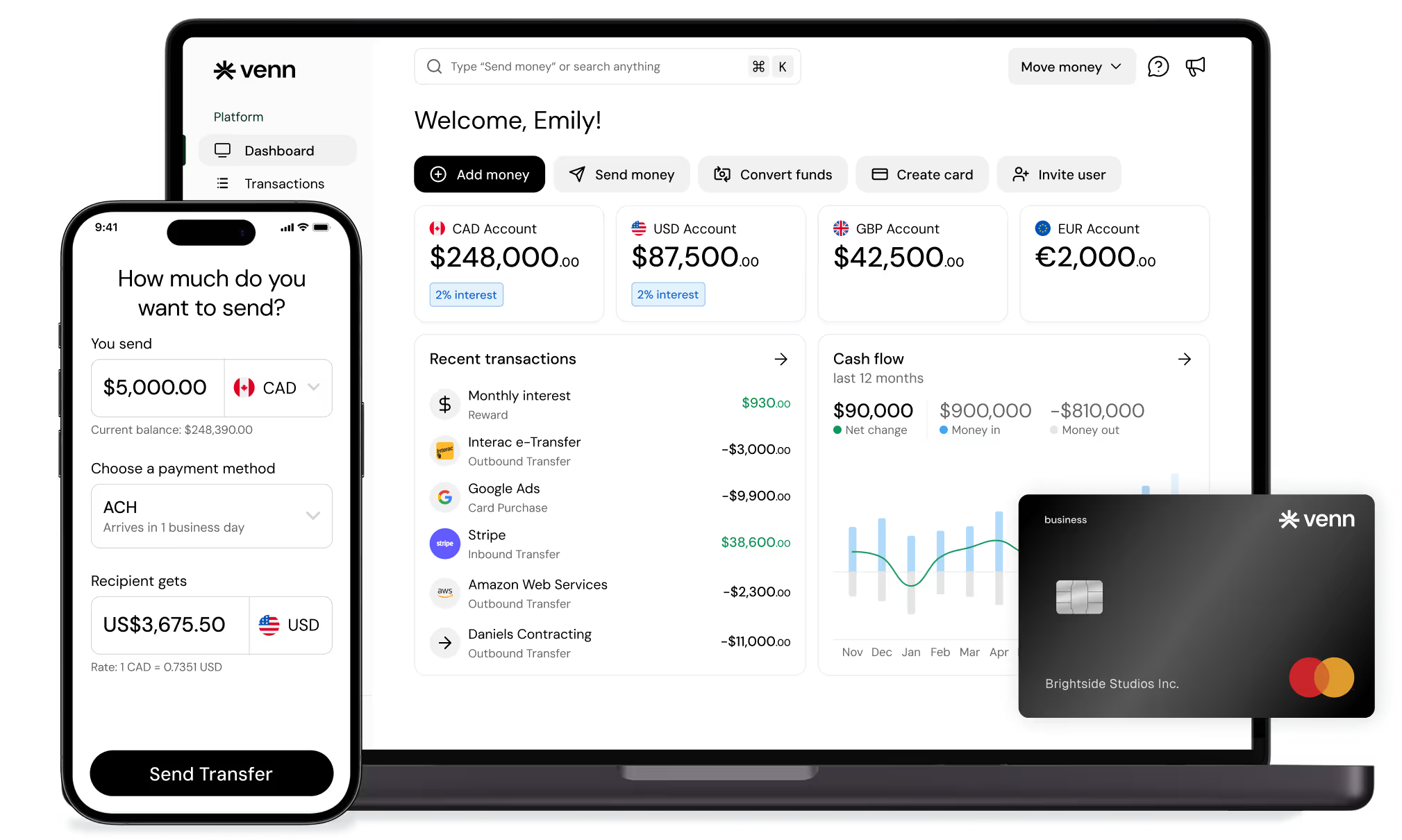
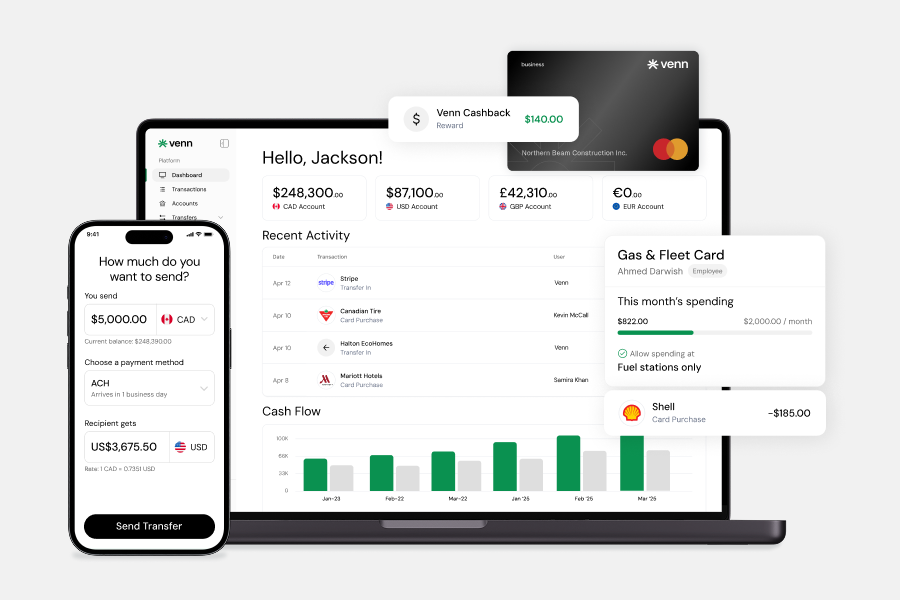
Modern businesses typically use multiple rails and benefit from a platform that centralizes payments, foreign exchange, and reconciliation. Venn supports these business workflows by combining bill payments, spend management via card with 1% unlimited cashback, and direct accounting integrations with QuickBooks and Xero.
Step-by-Step: How to Pay Business Bills Online
1) Gather the Right Bill Details Before You Pay
Missing or incorrect information causes payment delays, misapplied funds, and late fees. Before initiating any payment, confirm you have:
• Legal business name exactly as it appears on the bill
• Invoice number or reference number (critical for proper application)
• Amount due, due date, and any early payment discount terms
• Payee banking details (for EFT/wire) or biller/payee name (for bill pay)
• Remittance email or address if the payee needs proof of payment
Keep a master file of recurring payee details. This saves time and reduces errors on repeat payments.
2) Add and Verify the Payee
Payee verification is your primary defense against business email compromise and payment fraud. These scams cost Canadian businesses millions annually.
Best practices for payee management:
Verify any payee changes through an independent channel. If you receive an email requesting updated banking details, call the vendor at a phone number you already have on file, not the number in the email.
Require two-person approval for new payees or changed banking details. One person enters the information; another confirms it before any payment goes out.
Maintain an internal payee directory with verified contact information and banking details.
A modern platform like Venn supports cleaner payee management and reduces manual back-and-forth, especially when combined with accounting workflows in QuickBooks or Xero.
3) Choose Timing: Pay Now, Schedule, or Set Up Recurring
Scheduling strategically prevents late fees while preserving cash flow. Pay close to due dates rather than immediately upon invoice receipt, but build in buffer time for processing.
Align payments with cash inflows. If your major receivables arrive on the 15th, schedule outgoing payments for the 16th or 17th.
Set up recurring payments for predictable bills like rent, insurance, and subscriptions. This eliminates the risk of forgotten payments and reduces monthly administrative work.
4) Send Payment and Capture Proof
What constitutes adequate proof of payment varies by rail:
• Bill payment: Confirmation number and timestamp from your banking platform
• EFT: Transaction reference number and bank statement entry
• Wire: SWIFT confirmation with reference number
• Card: Transaction receipt showing merchant, amount, and date
• Cheque: Cheque number, cleared cheque image from bank
If a payment doesn't appear on time, check cut-off times first. Payments initiated after daily cut-off process the next business day. Then verify the reference number and contact the payee with your proof of payment.
5) Reconcile in Your Accounting System
Reconciliation closes the loop between what you paid and what your books show.
Map each payment to its corresponding invoice or bill in your accounting software. This prevents duplicate payments and confirms all obligations are met.
Attach receipts and confirmations to transactions. Digital attachments make audits straightforward and reduce year-end scrambling.
Monthly close tips: Block time in the first week of each month to reconcile the prior month. Catching discrepancies early prevents compounding errors.
QuickBooks and Xero compatibility is the operational win here. When your banking platform integrates directly with your accounting software, you get fewer mismatches, faster month-end closes, and a clearer audit trail. Venn's direct integrations with both platforms reduce the manual work of matching payments to invoices.
Common Canadian Payees: What to Expect
Paying CRA (GST/HST, Payroll, Corporate Tax)
Government remittances demand precision. The CRA applies payments based on the reference number you provide. Wrong numbers mean misapplied payments, potential penalties, and time-consuming corrections.
What you need:
• Your Business Number (BN) with the correct program account suffix (RT for GST/HST, RP for payroll, RC for corporate tax)
• The exact amount due
• The period the payment covers
Common methods: Most businesses use online bill payment through their banking platform. The CRA appears in biller directories. PAD is available for businesses wanting automatic withdrawals. Wire transfers work for large amounts or special circumstances.
Common mistakes: Submitting the wrong program account number, initiating payments too close to the deadline without accounting for processing time, and transposing digits in reference numbers.
Venn provides a way to manage business payments from one place while keeping records ready for reconciliation and reporting, making CRA payment tracking straightforward.
Paying Utilities and Telecom Bills
Hydro, internet, and mobile providers typically appear in online banking biller directories, making bill payment the simplest method.
Autopay considerations: Setting up PAD ensures you never miss a payment, but monitor your account to ensure sufficient funds on withdrawal dates. Insufficient funds fees from both your bank and the biller add up quickly.
Posting times: Allow 2-3 business days for payments to post. Payments initiated on Friday afternoon may not post until Tuesday or Wednesday.
Using scheduled payments with clean documentation flow keeps utility payments organized and reconciliation simple.
Paying Vendors and Contractors in Canada
Invoice-based payables require more attention than standardized bills.
EFT works best for most vendor payments. It's faster than bill pay, cheaper than wire transfers, and provides clear documentation.
Bill pay works when vendors appear in your bank's biller directory, though this is less common for smaller suppliers.
Cheques remain necessary for some traditional vendors and landlords who haven't modernized their payment acceptance.
Remittance details matter. Include invoice numbers with your payment. For multiple invoices paid in one transfer, provide a breakdown. This helps vendors apply payments correctly and reduces follow-up inquiries.
Streamlined payable workflows reduce manual work when payments and accounting stay connected through integrated platforms.
Paying International and US Suppliers from Canada
Cross-border payments introduce currency conversion, additional fees, and longer processing times.
When a Card Works vs. When You Need a Transfer
SaaS subscriptions and smaller purchases often accept card payment. This helps cash flow, earns rewards, and automatically captures expense documentation.
Larger invoices typically require bank transfers. Vendors won't absorb card processing fees on substantial amounts.
Why Local Currency Accounts Reduce Friction
The pain of cross-border payments often comes from unnecessary currency conversions. Paying a US vendor from a CAD account means your bank converts CAD to USD, applying their exchange rate and fees. The vendor receives USD, but you've paid a premium for the conversion.
Venn's local CAD, USD, EUR, and GBP account capabilities let businesses that bill, collect, or pay across borders hold funds in the currency they need. This reduces avoidable conversions and simplifies reconciliation across currencies. When you receive USD from a US client, you can hold it in USD and pay US vendors directly without converting twice.
How Venn Fits Into an Optimal Business Financial Stack
Example Stacks by Business Type
Ecommerce businesses pay suppliers in both CAD and USD, manage software subscriptions across multiple platforms, and handle logistics provider invoices. Venn's multi-currency accounts eliminate unnecessary conversions on US supplier payments, while the 1% unlimited cashback card captures value on software and shipping expenses. QuickBooks integration keeps inventory-related payables reconciled automatically.
Agencies and professional services firms pay contractors, subscribe to numerous software tools, and handle recurring operational bills. Approval workflows and audit trails matter for client billing and internal controls. Venn's platform combined with Xero integration provides the documentation and reconciliation these businesses need.
Restaurants and retail operations manage utilities, telecom, POS subscriptions, and vendor payments on predictable cycles. Employee spend controls prevent unauthorized purchases. Scheduled recurring payments through Venn handle predictable bills while the card program with expense management keeps employee spending visible and controlled.
What Venn Provides
1% unlimited cashback on card spend turns operating expenses into ongoing value. Unlike tiered programs that cap rewards, every dollar of card spend earns the same return.
Multi-currency capabilities for businesses operating across borders. Hold, receive, and pay in CAD, USD, EUR, and GBP without forced conversions.
Direct integrations with QuickBooks and Xero reduce month-end close time and eliminate manual transaction matching.
Funds covered under CDIC insurance protection provide security for business deposits.
Conclusion
Paying business bills efficiently comes down to consistent execution: pick the right payment rail for each situation, verify payees before sending money, schedule payments strategically, and reconcile consistently.
Standardizing your payment processes and connecting your banking directly to your accounting software eliminates most of the friction businesses experience with bill payment. The time saved compounds monthly.
FAQ
Q: What's the fastest way to pay business bills in Canada?
A: Electronic Funds Transfer (EFT) typically provides the fastest domestic delivery, often settling the same day or by the next business day. For urgent payments, wire transfers can deliver funds quickly but usually involve higher fees. Card payments also authorize instantly when vendors accept them.
Q: How long do online bill payments take to post?
A: Online bill payments usually take 1–3 business days to post to the biller’s account. Payments submitted late in the day, on weekends, or near holidays may take longer to process.
Q: What information do I need to pay a vendor by EFT?
A: To send an EFT payment in Canada, you typically need the recipient’s financial institution number (3 digits), transit or branch number (5 digits), and account number. It is also helpful to collect the vendor’s legal business name and include invoice numbers or remittance details for accurate recordkeeping.
Q: Should I use PAD for recurring business bills?
A: Pre-Authorized Debit (PAD) works well for predictable recurring expenses such as rent, insurance, and subscription services. Businesses should ensure sufficient funds are available on scheduled withdrawal dates to avoid returned-payment fees or service interruptions.
Q: How do I avoid payee-change fraud?
A: Always verify requests to change banking details through an independent channel. Contact the vendor using a trusted phone number already on file rather than one provided in the email request. Implementing two-person approval for vendor banking changes can add an additional layer of protection.
Q: What's the best way to pay US suppliers from Canada?
A: Holding USD in a multi-currency business account and paying suppliers directly in USD helps avoid double currency conversion. For smaller payments or SaaS subscriptions, paying by card can also be convenient and may provide rewards or cashback benefits.
Q: How do I keep bill payments organized for bookkeeping?
A: Integrating your banking platform with accounting software helps streamline bill payment tracking. Attaching invoices to payments, adding reference numbers in transaction notes, and reconciling accounts monthly can significantly reduce bookkeeping errors.
Q: Can I pay CRA remittances through online banking?
A: Yes. The Canada Revenue Agency (CRA) appears in most online banking biller directories. Use the correct program account number—your Business Number (BN) with the appropriate program suffix—and allow 2–3 business days for the payment to process before the due date.
Venn Mastercard Charge Card is issued by Peoples Trust Company under licence from Mastercard International Incorporated. Mastercard is a registered trademark, and the circles design is a trademark of Mastercard International Incorporated.
---
**Disclaimer:** This publication is provided for general information purposes and does not constitute legal, tax or other professional advice from Venn Software Inc or its subsidiaries and its affiliates, and it is not intended as a substitute for obtaining advice from a financial advisor or any other professional. We make no representations, warranties or guarantees, whether expressed or implied, that the content in the publication is accurate, complete or up to date.
This publication is provided for general information purposes only and does not constitute legal, tax, financial, or other professional advice from Venn Software Inc., its subsidiaries, or its affiliates, and is not a substitute for advice from a qualified professional. All comparisons and competitor information reflect publicly available information believed accurate as of March 5, 2026; features, pricing, rates, and terms referenced are subject to change and may differ at the time you read this. All product names, logos, and brands referenced are the property of their respective owners; their mention does not imply affiliation with or endorsement by Venn. Any comparative statements reflect Venn's views and are provided to help readers evaluate options. We make no representations, warranties, or guarantees, express or implied, that the content is accurate, complete, or up to date.

Venn is all-in-one business banking built for Canada
From free local CAD/USD accounts and team cards to the cheapest FX and global payments—Venn gives Canadian businesses everything they need to move money smarter. Join 15,000+ businesses today.
Frequently asked questions
Everything you need to know about the product and billing.
Join 15,000+ businesses banking with Venn today
Streamline your business banking and save on your spend and transfers today
No personal credit check or guarantee.