Best way to reimburse associates for client costs in Canada
Best way to reimburse associates for client costs in Canada. Use receipt backed approvals, proper coding, and GST HST rules for employees and contractors.

Ahmed Shafik
Co-founder

Trusted by 15,000+ Canadian businesses
Business banking for Canada
Local CAD and USD accounts, corporate cards with cashback, the lowest FX rates in Canada, free local transfers, and more.
Client costs are easy to approve in the moment. A quick message, a verbal go-ahead, and an associate heads out the door with a personal card. The problem surfaces later: missing receipts, ambiguous tax coding, margin that quietly disappears, and associates waiting weeks to be paid back.
Finding the best way to reimburse associates for client costs in Canada starts with recognizing that "associate" is not a single category. The right process depends on whether that person is a salaried employee, an independent contractor, a firm partner, or a professional-services associate working on a client engagement. Each relationship carries different tax treatment, documentation obligations, and payment mechanics.
The core answer is straightforward: a documented, receipt-backed reimbursement process with clear approval rules, accurate expense coding, and clean bookkeeping consistently outperforms vague flat allowances. CRA distinguishes reimbursements from allowances precisely because reimbursements tie repayment to actual, documented costs. That distinction matters for your books, your GST/HST input tax credits, and your ability to pass costs through to clients accurately.
What Counts as a Client Cost Reimbursement?
A client cost reimbursement is repayment to an associate for a specific expense they incurred while performing work for a particular client, matter, engagement, or project. The associate paid out of pocket; the business pays them back. That direct connection between the spend, the associate, the client, and the business purpose is what defines a reimbursement and separates it from general compensation or overhead.
General overhead covers costs the business incurs to operate, such as office rent, software subscriptions used across all clients, or shared administrative tools. A client cost reimbursement is different; it traces back to a specific engagement. Consider a few examples from Canadian service businesses:
• A consultant at a Toronto management consultancy books a flight to a client site in Calgary.
• A junior associate at a Bay Street law firm pays a court filing fee on behalf of a client matter.
• A recruiter at a national staffing firm covers a background check fee for a specific placement.
• An account manager at a Vancouver creative agency purchases stock photography licensed exclusively for one client campaign.
Each of these is a client cost reimbursement. Each one connects a real expense to a named client and a defined business purpose.
Reimbursements also differ from compensation. Paying an associate more because their role involves client travel is a compensation decision. Repaying them for a specific receipt tied to a specific client trip is a reimbursement. CRA treats these differently, and so should your finance team.
This distinction matters beyond bookkeeping. Your client invoicing policy and your reimbursement policy must work together. If your firm bills certain disbursements back to clients, every reimbursable expense needs a clear tag: billable, non-billable, or pending review. Without that connection, client costs slip through unbilled, associates wait too long for repayment, and finance loses the audit trail needed to support both internal records and any CRA review.
Define Client Costs vs Internal Expenses
Not every expense an associate submits belongs in the same category, and misclassifying costs creates problems across approvals, bookkeeping, GST/HST treatment, and client invoicing.
Client disbursements, sometimes called pass-through costs, are expenses incurred directly on behalf of a client and typically re-invoiced to that client. Common examples include courier or filing fees paid to advance a client matter, software purchased specifically for one client project, or materials bought on behalf of a client. These costs often flow through your books differently from general overhead.
Internal operating expenses are costs your business incurs to run its own operations, regardless of which clients you serve. A team subscription used across multiple client engagements, for example, is overhead, not a client disbursement, even if client work drives the usage.
Mixed expenses sit in between. Travel to a client site may be partly billable and partly internal. A meal tied to client work may qualify as a client cost but still falls under meals and entertainment limits for tax purposes.
Why does the distinction matter? Classification determines whether an expense requires client-level approval, how GST/HST applies, whether your business can claim an input tax credit, and whether the cost appears on a client invoice. For edge cases, particularly around re-invoicing and ITC eligibility, confirm the correct treatment with a qualified accountant or tax adviser.
Explain Billable vs Non-Billable Costs
Tag every reimbursable expense as billable, non-billable, or needs review before it enters your approval queue. This single habit eliminates the most common source of confusion for finance teams and engagement leads.
Billable expenses are costs your engagement letter, statement of work, or service agreement permits you to pass to the client. Travel to a client site, courier fees, or software purchased specifically for that engagement are typical examples. Non-billable expenses are internal costs your firm absorbs regardless of client activity.
Aligning your associate reimbursement policy with your client contracts is essential. If a cost cannot be recovered under the governing agreement, reimbursing it internally without flagging that fact creates a margin leak that compounds across engagements. Finance should not approve a reimbursement claim until the billable status is confirmed, and engagement leads should make that determination at the time of submission, not after the fact.
Reimbursement vs Allowance in Canada
The CRA draws a clear line between reimbursements and allowances, and that distinction matters when you're deciding how to handle client costs.
A reimbursement repays an associate for an actual expense they incurred while carrying out their duties. CRA expects that reimbursement to be supported by receipts, vouchers, or other records that confirm the amount and business purpose. An allowance, by contrast, is a fixed or periodic payment made without requiring the associate to account for every dollar spent.
For client costs specifically, receipt-backed reimbursement is the stronger default. It creates a clear audit trail, ties each dollar to a specific client engagement, and gives your finance team the documentation needed to support clean client billing. If CRA ever reviews your records, a reimbursement supported by original receipts is far easier to defend than a flat payment with no supporting documentation.
One common exception worth noting: reasonable per-kilometre vehicle allowances for travel to client sites are widely used and accepted by CRA without requiring associates to submit fuel receipts. Outside of that specific scenario, defaulting to documented reimbursement keeps your client cost records accurate and your books clean.
Employee Associates vs Contractor Associates
Before choosing a reimbursement workflow, classify the associate correctly. Whether someone is an employee, independent contractor, partner, or firm associate determines which process applies, and businesses should never use reimbursement practices to obscure or blur that classification in CRA's eyes.
Employees typically submit expense claims through an internal policy: receipt, business purpose, manager approval, and reimbursement through accounts payable or payroll. The process is internal, documented, and tied to the employment relationship.
Contractors handle reimbursable costs differently. Their service agreement should define which client costs are recoverable, whether pre-approval is required, and how those costs appear on invoices. A contractor generally invoices the business for reimbursable amounts as a separate line item, with supporting receipts attached. GST/HST treatment on those amounts depends on the nature of the cost and how the contract is structured, so both parties should confirm the approach before work begins.
Partners and firm associates at professional services firms follow a third path, governed by partnership agreements and internal disbursement policies rather than employment or contractor frameworks.
Getting this classification right from the start keeps reimbursing employees for expenses and reimbursing contractors for expenses on separate, auditable tracks.
If the Associate Is an Employee
For employees, a structured expense claim workflow keeps reimbursements clean and audit-ready. Require the employee to submit a receipt with the vendor name, date, amount, applicable tax, and a brief business purpose note. Assign each claim a client or matter code so finance can track billable versus non-billable spend. The engagement manager approves client relevance, then finance reviews for policy compliance and correct tax treatment before processing payment through payroll or accounts payable.
CRA distinguishes reimbursements from allowances and from employment income. A valid business expense reimbursement, supported by receipts and tied to duties performed, is generally treated differently from additional compensation. However, documentation determines that outcome. CRA guidance on taxable benefits, travel expenses, and allowances makes clear that facts and records matter, not intent alone.
Finance teams should record expense reimbursements separately from salary, bonuses, and other compensation in the general ledger. Mixing these categories creates confusion during audits, complicates T4 preparation, and can obscure whether a payment was a true reimbursement or a taxable benefit.
If the Associate Is a Contractor or Partner
Reimbursing contractors for client costs follows a different path than reimbursing employees. The service agreement governs the relationship, so that document should define which costs are reimbursable before any expense is incurred.
Build these terms into every contractor agreement or statement of work:
• Pre-approval requirements: which costs need sign-off before the contractor spends
• Eligible costs: travel, filing fees, courier charges, client-specific software, and similar pass-through expenses
• Markup rules: whether the contractor may add a markup to reimbursable costs, and at what rate
• GST/HST handling: who accounts for tax on reimbursed amounts, and how those amounts appear on the invoice
• Backup documentation: original receipts, vendor invoices, and any client-matter coding required
• Submission deadlines: the cutoff date for submitting claims within each billing cycle
Contractor reimbursements should appear on the contractor's invoice or be supported by separate, clearly labelled documentation. Treating contractor claims like employee expense reports creates confusion in your accounts payable records and complicates GST/HST reconciliation.
For partnerships and professional firms, partnership agreements and internal disbursement policies should govern how associate client costs are recorded and recovered. Firms that handle client disbursements regularly should ensure their internal policies align with how those costs are re-invoiced to clients, particularly where agent-versus-principal treatment affects GST/HST obligations.
The Best-Practice Reimbursement Workflow
A repeatable, documented workflow is the clearest answer to how Canadian service businesses should handle associate expense reimbursement for client costs. Informal approvals and after-the-fact payouts create tax exposure, bookkeeping errors, and audit risk. A structured process eliminates those problems.
Step 1: Set a written reimbursement policy. Define who can incur client costs, which expenses qualify, approval thresholds, receipt requirements, submission deadlines, and how foreign-currency expenses are handled. A written policy gives finance a consistent standard to enforce and gives associates clear expectations before they spend.
Step 2: Collect receipts and business purpose at the time of purchase. Require the date, vendor, amount, applicable tax, currency, client or matter code, and a brief business purpose note. Capturing this at purchase, not at month-end, prevents missing documentation and keeps CRA-required records complete.
Step 3: Code each expense correctly. Tag every claim as an employee reimbursement, contractor reimbursement, client-billable disbursement, or internal non-billable expense. Accurate coding drives correct GST/HST treatment and clean financial reporting.
Step 4: Approve based on engagement and finance rules. The engagement lead confirms the expense is client-relevant. Finance confirms it meets policy and tax requirements. Two-stage approval keeps billable and non-billable costs from mixing.
Step 5: Reimburse through the right payment method. Domestic reimbursements typically move through direct deposit or Interac e-Transfer®. Foreign-currency reimbursements require a clear FX rate record and a payment rail that supports the relevant currency.
Step 6: Re-invoice the client correctly where applicable. Whether a reimbursed cost is taxable on re-billing depends on whether your business incurred it as principal or as agent for the client. CRA treats these situations differently, so confirm the tax logic before issuing the client invoice.
The strongest expense reimbursement process is documented, receipt-backed, tax-aware, and structured so finance can audit every claim without chasing down context.
1. Set a Written Reimbursement Policy
A clear written policy is the foundation of any effective client expense reimbursement process. Without one, associates make judgment calls, finance teams chase receipts, and approvals stall.
Your policy should define:
• Who can spend: Which employees, contractors, or firm associates are authorized to incur client costs on behalf of the business
• What qualifies: Specific reimbursable client costs such as travel to a client site, courier fees, filing fees, or software purchased for a specific engagement
• Approval thresholds: Dollar limits that require manager sign-off before or after purchase
• Pre-approval requirements: Which expense categories require written authorization before the associate spends
• Receipt rules: What documentation is required, including vendor name, date, amount, applicable tax, and client or matter code
• Submission deadlines: How many days after an expense is incurred the associate must submit a claim
• Reimbursement timelines: How quickly finance will process approved claims
• Personal card use: Whether associates may use personal cards and, if so, under what conditions
• Foreign-currency expenses: How FX rates are applied and what documentation is required for expenses incurred in USD or other currencies
Tie the policy directly to your client contracts and project budgets. If a client agreement caps disbursements at a set amount, your internal policy should reflect that limit so associates never spend beyond what the engagement supports. Write the rules in plain language that a new associate can follow on day one, without needing to ask finance for clarification on every line item.
2. Collect Receipts, Code Expenses, and Approve Claims
Capture receipts at the time of purchase, not at month-end. Waiting until reconciliation creates gaps in documentation and increases the risk of lost or incomplete records that CRA may not accept.
Each claim should include the date, vendor name, amount, applicable tax, currency, client name, associate name, project or matter code, and a clear business purpose. That last field matters: a vague note like "lunch" tells finance nothing, while "client meeting with Acme Corp re: Q3 contract renewal" creates an auditable record.
Code every expense into one of four categories: employee reimbursement, contractor reimbursement, client-billable disbursement, or internal non-billable expense. Consistent coding keeps your books clean and makes client re-invoicing straightforward.
Approval runs through two checkpoints. The engagement lead confirms the expense is relevant to the client or matter. Finance then confirms policy compliance, correct tax treatment, and bookkeeping accuracy, including whether GST/HST was paid and whether an input tax credit may apply. Both approvals should be documented before reimbursement is processed.
3. Reimburse Quickly and Re-Invoice Clients Correctly
Prompt reimbursement builds associate trust and cuts down on follow-up emails, but speed should not override financial controls. Every payment still needs a receipt, an approval record, and correct expense coding before it goes out.
For domestic reimbursements, a direct deposit or Interac e-Transfer® to the associate's account works well for most Canadian businesses, provided the claim has cleared your approval workflow first. Foreign-currency reimbursements require an additional step: record the original currency, the exchange rate used, and the conversion date. Reimbursing at a rate that differs significantly from the actual rate the associate paid creates a discrepancy that complicates bookkeeping and may affect your ITC calculations.
Card-based spend, where associates use a corporate or business card, removes the out-of-pocket gap entirely. The expense is captured at the point of purchase, coded to the correct client or matter, and reconciled without a separate reimbursement transaction. Post-purchase reimbursement, where associates pay personally and submit a claim, remains common but adds reconciliation steps and delays.
When re-invoicing client costs, the tax treatment depends on a fact that many businesses overlook: whether your business incurred the expense as a principal or as an agent for the client. CRA's guidance on out-of-pocket expenses distinguishes these two scenarios, and the GST/HST treatment can differ accordingly. Avoid assuming that all reimbursed costs flow through to clients tax-free. Confirm the correct treatment for your specific situation with a qualified accountant, particularly for disbursements that cross provincial or international lines.
GST/HST and Tax Considerations
CRA draws a clear line between reimbursements and allowances, and that distinction carries real tax consequences. A reimbursement repays an actual, documented expense. An allowance is a fixed payment made without requiring receipts. For most client cost scenarios, reimbursements are the safer default because they tie directly to supporting records and reduce the risk of the payment being treated as a taxable benefit.
Input tax credits on reimbursed employee expenses
If your business is a GST/HST registrant, you may be able to claim input tax credits (ITCs) on eligible expenses you reimburse to employees, provided those expenses relate to your commercial activities and you hold adequate documentation. The rules are fact-specific. CRA's ITC calculation guidance sets out what records you need and how to calculate the credit. Meals and entertainment expenses are subject to the 50% limitation under the Income Tax Act, and that same restriction generally applies when claiming ITCs on those costs.
Employee vs contractor treatment
The tax treatment differs depending on whether the associate is an employee or an independent contractor. For employees, valid business reimbursements are generally not treated as taxable employment income, but the facts and documentation must support that characterization. For contractors, reimbursed amounts should be clearly defined in the service agreement, and GST/HST may apply to those amounts depending on how the arrangement is structured.
Re-billing client expenses
When you recover a cost from a client, CRA's guidance on out-of-pocket expenses introduces the principal-versus-agent distinction. If your business incurred the expense as a principal, the recovery is generally part of your taxable supply and GST/HST applies. If you incurred the cost strictly as an agent on behalf of the client, the flow-through treatment may differ. This distinction is not always obvious, and the facts of each engagement determine which treatment applies.
Given the complexity of these rules, confirm your specific situation with a qualified accountant before filing.
What Records Should You Keep?
Strong expense reimbursement documentation protects your business during a CRA review, supports accurate client invoicing, and makes month-end close faster. For every client cost reimbursement, keep the following:
• Original receipt or invoice from the vendor
• Payee/vendor name and contact details
• Date of the expense
• Amount, applicable GST/HST, and tax registration number where shown
• Currency and FX rate for any foreign-currency purchases
• Associate name (employee or contractor)
• Client, matter, or project code the cost relates to
• Business purpose written in plain language (for example, "courier fee for executed agreement delivered to client ABC, March 14")
• Approval record showing who authorized the expense and when
• Reimbursement date and payment method
• Proof of re-billing to the client, if the cost was passed through on an invoice
Good records do more than satisfy CRA. They give clients a clear audit trail when you invoice disbursements, help your finance team track margin by engagement, and flag any GST/HST claims that need review before they become a problem. Capture receipts at the time of purchase, not at month-end. A photo taken immediately is far more reliable than a crumpled receipt reconstructed three weeks later.
Common Mistakes to Avoid
Reimbursing without receipts. Require original receipts at the time of purchase. No receipt means no reimbursement, and no ITC claim.
Mixing salary and reimbursement payments. Process expense reimbursements through accounts payable, not payroll. Commingling the two creates tax ambiguity and complicates CRA audits.
Treating contractors and employees identically. Contractor reimbursements belong in the service agreement and should appear on supporting documentation separate from employee expense claims. The tax treatment and approval workflow differ.
Claiming GST/HST twice. If your business already claimed an ITC on a purchase, do not claim it again when re-invoicing the client. Track which party incurred the original tax.
Failing to separate client disbursements from overhead. Tag every expense as client-billable, non-billable, or pending review at the time of submission. Retroactive coding wastes time and introduces errors.
Re-invoicing client costs without clear tax logic. Whether GST/HST applies to a re-billed cost depends on whether your business incurred it as principal or as agent. Confirm the treatment before issuing the invoice.
Delaying submissions until receipts are lost. Set a firm submission deadline, such as five business days after the expense date, and enforce it. Late submissions are the leading cause of missing documentation at audit time.
How to Choose the Right Reimbursement Setup
No single platform works best for every business. The right setup depends on a combination of factors specific to your firm: claim volume, number of associates submitting expenses, the proportion of client-billable spend, whether your team incurs foreign-currency costs, how many approval layers your workflow requires, which accounting software you use, whether you need corporate cards or post-purchase reimbursements, and how much of your payment activity is domestic CAD.
A small consultancy with two employees and low monthly claim volume may manage well with a traditional business bank account and a simple written policy. A growing agency with distributed associates, recurring client disbursements, and USD or EUR supplier costs will likely need a platform that combines multi-currency accounts, card controls, and direct accounting integrations to keep reimbursements accurate and auditable.
Venn is one option worth evaluating for firms with multi-currency needs, accounting sync requirements, or teams that benefit from card-based spend controls. Wealthsimple Business suits incorporated businesses focused on domestic CAD operations with straightforward banking needs. Traditional banks remain a valid baseline, particularly where existing lending relationships or branch access matter.
Assess your actual workflow before selecting tools. The volume and complexity of your reimbursement activity should drive the decision.
Traditional Business Bank + Manual Reimbursement
For small firms with low claim volume, a traditional business bank account paired with a manual reimbursement process is a reasonable starting point. If your team submits a handful of client expense claims per month, all in Canadian dollars, the overhead of adopting a new platform may not be justified.
The main strengths here are familiarity and existing relationships. Many firms already hold operating accounts, credit facilities, or treasury services with a major Canadian bank, and consolidating banking activity in one place has real administrative value. Branch access also matters for businesses that handle cash, certified cheques, or in-person banking regularly.
The limitations become visible as claim volume grows. Receipt tracking typically falls to spreadsheets or email threads, approvals happen outside any structured workflow, and finance teams often reconcile expenses at month-end rather than in real time. There is no automatic coding of client-billable versus internal costs, which creates extra work before each billing cycle. For firms managing multiple client matters or reimbursing both employees and contractors, that manual overhead compounds quickly.
Venn
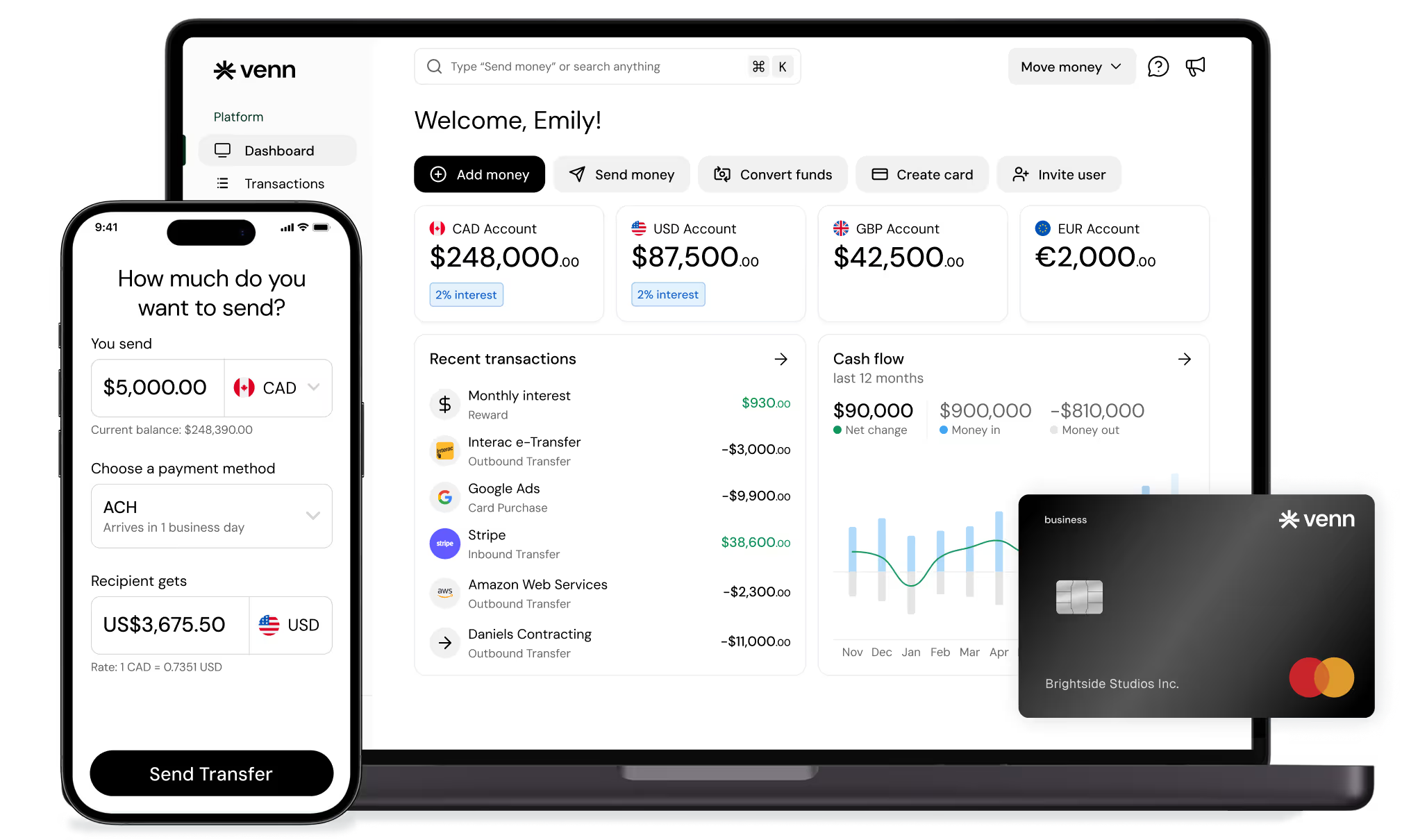
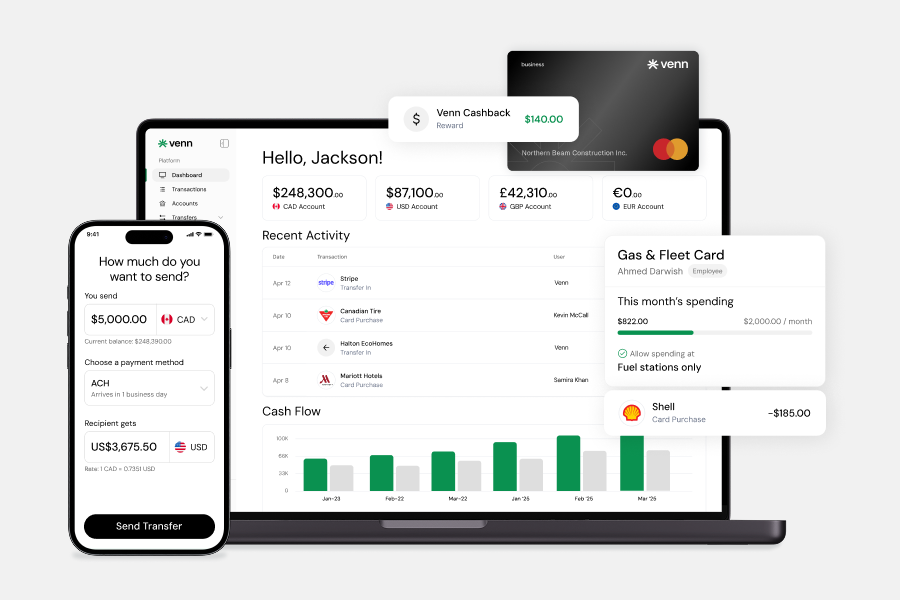
Venn is a Canadian business banking platform built for teams that want accounts, cards, approvals, payments, and accounting integrations in a single workflow rather than across several disconnected tools.
For firms managing client cost reimbursements across currencies, Venn supports CAD, USD, GBP, and EUR accounts, which makes it practical for consultancies, agencies, or professional services teams that regularly incur foreign-currency expenses on behalf of clients. FX rates are competitive, with markups ranging from 0.45% to 0.25% depending on your plan. Domestic vendor payments through Interac e-Transfer® are free and unlimited.
On the expense management side, Venn includes OCR receipt capture, manager approval workflows, and direct integrations with QuickBooks and Xero, so reimbursed costs flow into your books without manual re-entry. Corporate cards earn 1% cashback from the first dollar, with plan-based caps on Core and unlimited eligible spend on Pro.
Venn is a technology company, not a bank. Eligible deposits with Venn are covered by CDIC insurance protection up to applicable limits through Bank of Montreal®. Venn is not currently available to businesses in Quebec.
Wealthsimple Business
Wealthsimple Business offers incorporated businesses a straightforward, no-monthly-fee chequing account built around domestic CAD operations. For firms that need a clean operating account to receive client payments, pay vendors, and settle CRA obligations directly, it covers the basics without adding cost.
The account supports QuickBooks and Wave integrations, which helps keep bookkeeping tidy when processing associate reimbursements. Direct CRA payment support is a practical feature for businesses managing payroll remittances or corporate tax installments alongside their reimbursement workflows.
That said, Wealthsimple Business has meaningful limitations for service firms with more complex needs. It does not support sole proprietorships or partnerships, accepts CAD wires only, and currently offers no business credit card. Businesses that reimburse associates in USD or other foreign currencies, or that want card-based controls to reduce out-of-pocket spending in the first place, will find the account falls short. It suits a simple domestic operating-account role well, but it is not a complete expense management solution on its own.
Dedicated Spend Tools and Other Fintech Context
For businesses managing high card volume, distributed associate teams, or strict per-engagement approval requirements, dedicated spend management tools offer a more granular layer of control than a standard business bank account. These platforms typically let finance teams set individual card limits, restrict merchant categories, and route spend requests through approval workflows before a purchase is made.
Tools like Float or Keep operate in this space and may suit firms that need card-level controls as a primary feature. A factual consideration: these platforms often require a separate operating account to fund card balances, additional integrations to connect with your accounting software, and ongoing stack management to keep everything synchronized.
That added complexity is worth evaluating honestly. A business with straightforward domestic reimbursements and a small team may find the overhead outweighs the benefit. A growing consultancy or agency with multiple client engagements running simultaneously, each with its own billable expense budget, is a stronger candidate for this type of tool. The key question is whether your current approval and coding workflow creates errors or delays that a dedicated spend layer would actually solve.
Comparison Table: Reimbursement Setup Options
No single setup works for every Canadian business. The right choice depends on your claim volume, whether associates incur foreign-currency client costs, and how much manual work your finance team can absorb. Use this table to match your current situation to the option that fits best.
Sample Policy Template Section
Use this framework as a starting point for your client expense reimbursement policy. Adapt it to your firm's structure, then have your finance, legal, or tax advisor review it before you finalize.
This policy governs reimbursement of client-related costs incurred by employees and contractors on behalf of the business or its clients.
Eligible Expenses
• Client travel (transportation, accommodation, meals within CRA-reasonable limits)
• Filing fees, courier costs, and disbursements incurred for a specific client matter
• Software or materials purchased exclusively for a client engagement, with pre-approval
Non-Eligible Expenses
• Personal expenses with no clear client or business purpose
• Costs exceeding pre-approved thresholds without written authorization
• Alcohol, entertainment, or gifts above CRA-allowable limits
Approval Thresholds
• Under $100: engagement lead approval
• $100 to $500: engagement lead plus finance sign-off
• Over $500: senior leadership approval required before the expense is incurred
Conclusion
The best way to reimburse associates for client costs in Canada is a documented, receipt-backed, tax-aware workflow with clear approvals and accurate bookkeeping. That holds whether your associates are employees, contractors, or firm partners.
Review your current policy against the checklist in this guide. Confirm your documentation standards, GST/HST handling, and how you distinguish client disbursements from internal operating expenses. If gaps exist, close them before your next audit or client billing cycle.
Once your process is sound, compare the banking, card, approval, FX, and accounting workflows available to your business. The right setup reduces manual reimbursement work and gives finance teams cleaner records from the start. Sign up for Venn
This content is for general information only and does not constitute legal, tax, or accounting advice. Consult a qualified professional for guidance specific to your business.
FAQ
Q: What is the difference between an allowance and a reimbursement?
A: A reimbursement repays an associate for a specific, documented expense. An allowance is a fixed or periodic payment made without requiring receipts or proof of actual spending. CRA treats these differently for payroll and tax purposes, and allowances that are not considered reasonable can become taxable benefits.
Q: Should contractors be reimbursed the same way as employees?
A: No. Contractor reimbursements should be governed by the service agreement, not an internal payroll or expense policy. Contractors typically invoice for reimbursable costs separately, and GST/HST obligations differ from those that apply to employee expense claims. Define pre-approval rules, required documentation, and markup terms clearly in the contract.
Q: Can my business claim GST/HST on reimbursed expenses?
A: Registered businesses can generally claim input tax credits on eligible employee expense reimbursements tied to commercial activities, provided the original receipts show the GST/HST paid. CRA's ITC calculation methods apply, and supporting records must be retained. Meals, entertainment, and certain other categories carry specific restrictions.
Q: Do I charge GST/HST when I bill reimbursed costs back to a client?
A: It depends on whether your business incurred the cost as a principal or as an agent for the client. Costs incurred as agent may flow through without GST/HST, while costs incurred as part of your own supply are generally taxable when re-billed. CRA's guidance on out-of-pocket expenses covers this distinction, and edge cases warrant professional advice.
Q: What receipts do I need to keep for CRA purposes?
A: Retain the original receipt or invoice showing the vendor, date, amount, and tax paid. Also keep the currency and exchange rate for foreign costs, the associate's name, the client or project code, the approval record, and the reimbursement date. CRA expects these records to be available on audit, so capture them at the time of purchase rather than reconstructing them later.
This article provides general information only and does not constitute legal, tax, or accounting advice. Consult a qualified Canadian accountant or tax professional for guidance specific to your business.
---
**Disclaimer:** This publication is provided for general information purposes and does not constitute legal, tax or other professional advice from Venn Software Inc or its subsidiaries and its affiliates, and it is not intended as a substitute for obtaining advice from a financial advisor or any other professional. We make no representations, warranties or guarantees, whether expressed or implied, that the content in the publication is accurate, complete or up to date.
This publication is provided for general information purposes only and does not constitute legal, tax, financial, or other professional advice from Venn Software Inc., its subsidiaries, or its affiliates, and is not a substitute for advice from a qualified professional. All comparisons and competitor information reflect publicly available information believed accurate as of June 2, 2026; features, pricing, rates, and terms referenced are subject to change and may differ at the time you read this. All product names, logos, and brands referenced are the property of their respective owners; their mention does not imply affiliation with or endorsement by Venn. Any comparative statements reflect Venn's views and are provided to help readers evaluate options. We make no representations, warranties, or guarantees, express or implied, that the content is accurate, complete, or up to date.

Venn is all-in-one business banking built for Canada
From free local CAD/USD accounts and team cards to the cheapest FX and global payments—Venn gives Canadian businesses everything they need to move money smarter. Join 15,000+ businesses today.
Frequently asked questions
Everything you need to know about the product and billing.
Join 15,000+ businesses banking with Venn today
Streamline your business banking and save on your spend and transfers today
No personal credit check or guarantee.