Canadian Business Tax Timeline for 2026 CRA Deadlines
Use the Canadian Business Tax Timeline for 2026 to track CRA due dates for T2 corporate tax, GST and HST filings, and payroll remittances by month with ease.


Trusted by 15,000+ Canadian businesses
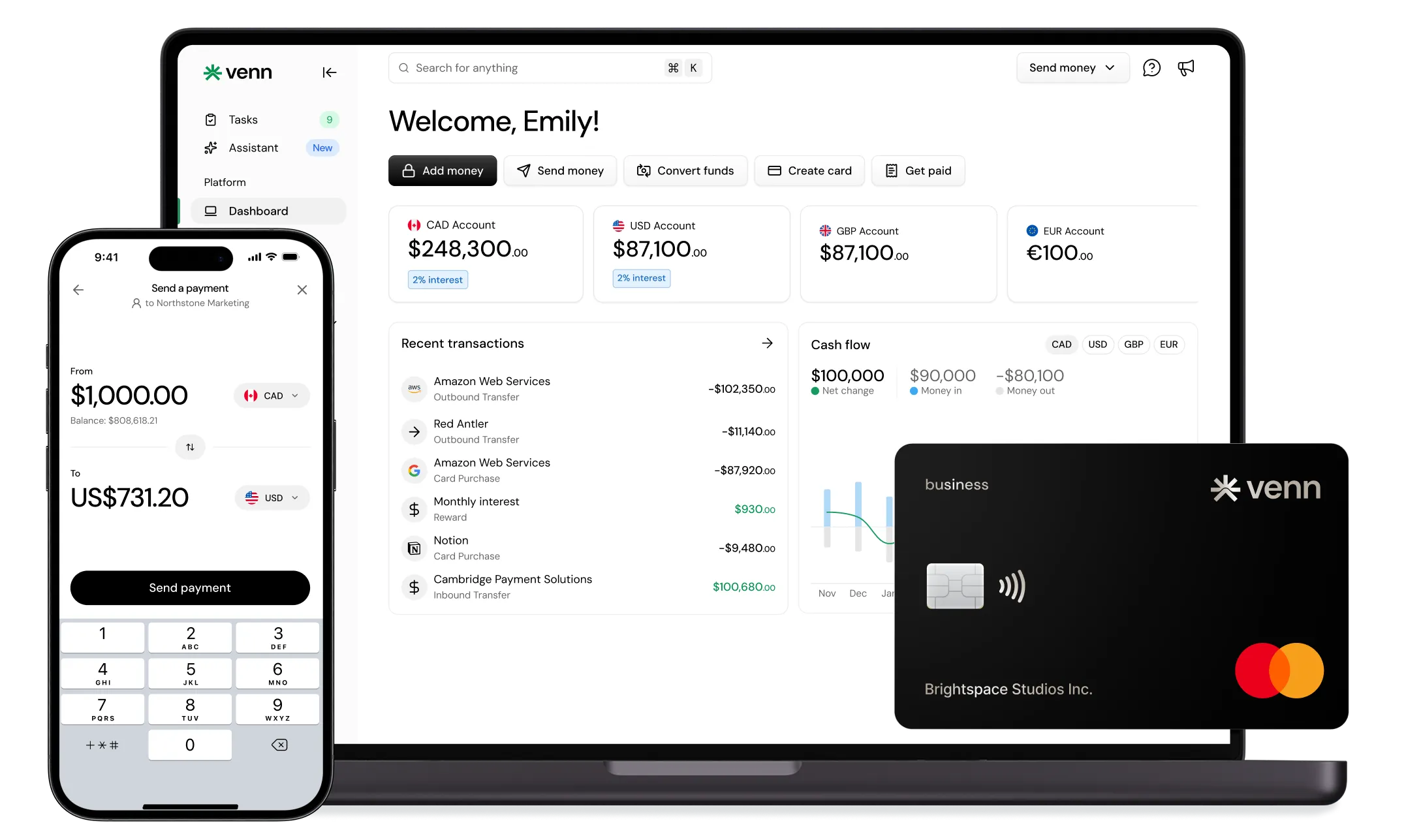
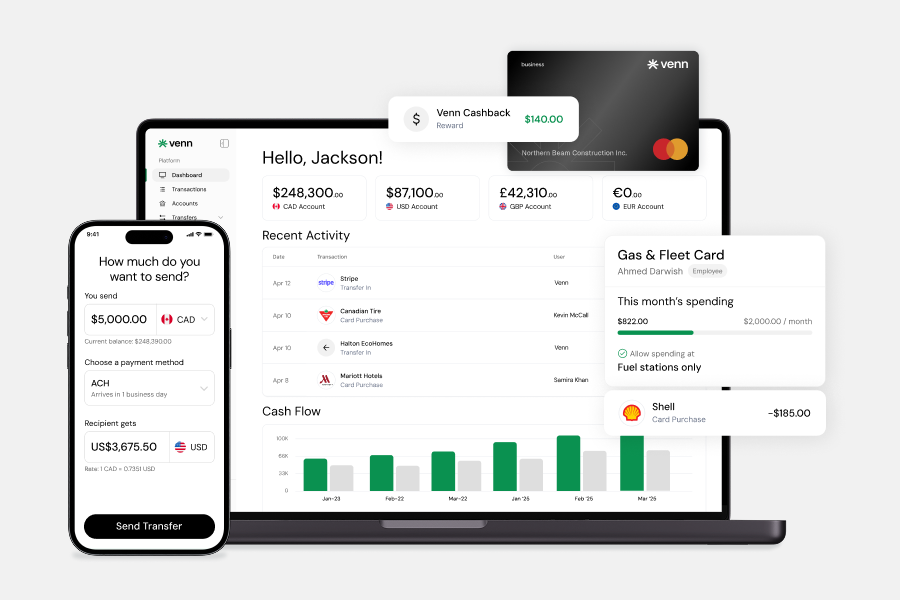
Business banking for Canada
Local CAD and USD accounts, corporate cards with cashback, the lowest FX rates in Canada, free local transfers, and more.
Missing a tax deadline costs more than the penalty itself. Late filings trigger interest charges, damage your standing with the CRA, and create cash flow disruptions that ripple through your operations for months.
This guide covers the three core tax obligations every incorporated Canadian business must track in 2026: corporate income tax (T2), GST/HST, and payroll remittances. Your specific deadlines depend on your fiscal year-end, reporting periods, and remitter type. We'll explain the rules, show you how to calculate your dates, and provide a month-by-month calendar you can actually use.
When deadlines fall on weekends or CRA-recognized public holidays, they shift to the next business day. Building a reliable compliance system means knowing these rules, setting reminders, and keeping your financial records organized. A modern finance stack that combines business banking, expense management, and accounting integrations, like Venn, reduces the manual work that causes missed deadlines.
2026 At-a-Glance: What Most Businesses Need to Track
Every incorporated business in Canada faces three categories of tax obligations:
• Corporate income tax: T2 return filing, balance-due payment, and monthly or quarterly instalments
• GST/HST: Filing and payment based on your reporting period (monthly, quarterly, or annual)
• Payroll: Source deduction remittances based on your remitter type (regular, quarterly, or accelerated)
Bookmark this page and download the 2026 calendar at the end of this guide. The calendar uses rule-based reminders that work regardless of your specific reporting periods.
2026 CRA Public Holidays That Can Shift Due Dates
When a deadline falls on a weekend or CRA-recognized public holiday, your filing or payment is due the next business day. Here are the 2026 dates to watch:
Plan your filings and payments for at least two business days before any deadline that falls near a holiday weekend.
Corporate Tax Deadlines in 2026 (T2 Return, Balance-Due Day, Instalments)
T2 Corporate Income Tax Return Filing Deadline
Your T2 return is due six months after your fiscal year-end. The CRA applies a specific rule: if your year-end falls on the last day of a month, your filing deadline is the last day of the sixth month following. If your year-end falls on any other day, your deadline is the same day six months later.
Examples for 2026:
• December 31, 2025 year-end → Filing deadline: June 30, 2026
• January 15, 2026 year-end → Filing deadline: July 15, 2026
• February 28, 2026 year-end → Filing deadline: August 31, 2026
When your calculated deadline falls on a weekend or holiday, you have until the next business day to file without penalty.
Corporate Tax Payment Deadline (Balance-Due Day)
Your balance-due day, when any remaining corporate tax must be paid, generally falls two months after your fiscal year-end. However, certain Canadian-controlled private corporations (CCPCs) qualify for a three-month deadline if they meet specific conditions in both the current and previous tax year, including taxable income under the small business limit and claiming the small business deduction.
For a December 31, 2025 year-end:
• Standard balance-due day: March 2, 2026 (since February 28 falls on Saturday)
• CCPC extended deadline (if eligible): March 31, 2026
Confirm your eligibility with your accountant. The penalties and interest for late payment start accumulating immediately after your balance-due day passes.
Corporate Instalments (Monthly vs Quarterly)
Most corporations pay instalments monthly, due on the last day of each month. The first instalment for your tax year is due one month minus one day from the start of your tax year.
For a calendar-year corporation (January 1 start):
• First instalment: January 30, 2026
• Subsequent instalments: Last day of each following month
Eligible small CCPCs may pay quarterly instead of monthly. Quarterly instalments are due on the last day of each fiscal quarter. Check with the CRA or your accountant to confirm your instalment requirements and eligibility.
Corporate Income Tax Deadline Cheat Sheet
GST/HST Deadlines in 2026 (By Reporting Period)
GST/HST Filing and Remitting Deadlines
Your GST/HST deadline depends on your assigned reporting period:
Monthly filers: File and pay within one month after the end of each reporting period. January's return is due by February 28, 2026.
Quarterly filers: File and pay within one month after each quarter ends. Q1 (January-March) is due by April 30, 2026.
Annual filers: Most annual filers must file and pay within three months after their fiscal year-end. A December 31 year-end means a March 31, 2026 deadline. Some annual filers have different deadlines based on their business structure, so verify your specific requirements.
GST/HST Instalments for Annual Filers
If you're an annual filer with net tax exceeding $3,000 in the previous year, you may need to pay quarterly instalments. These are due within one month after the end of each fiscal quarter.
For a December 31 fiscal year-end:
• Q1 instalment: April 30, 2026
• Q2 instalment: July 31, 2026
• Q3 instalment: October 31, 2026
• Q4 instalment: January 31, 2027
GST/HST Deadlines by Reporting Frequency
Payroll Remittance Deadlines in 2026 (Source Deductions)
Determine Your Remitter Type
The CRA assigns your remitter type based on your average monthly withholding amount (AMWA) from two calendar years prior. This determines how frequently you must remit source deductions.
• Quarterly remitters: AMWA under $3,000 and perfect compliance history
• Regular remitters: AMWA under $25,000
• Accelerated remitters (Threshold 1): AMWA between $25,000 and $99,999.99
• Accelerated remitters (Threshold 2): AMWA of $100,000 or more
New employers typically start as regular remitters until the CRA establishes their AMWA.
Payroll Remittance Due Dates by Remitter Type
When the 15th falls on a weekend or holiday, remittances are due the next business day.
Month-by-Month 2026 Tax Timeline
This calendar covers common deadlines. Your specific dates depend on your fiscal year-end and reporting periods.
January 2026
• Jan 15: Quarterly payroll remittance (Q4 2025)
• Jan 30: Monthly corporate instalment (calendar year-end)
• Jan 31: GST/HST Q3 instalment (Dec year-end annual filers)
February 2026
• Feb 15: Regular payroll remittance (January)
• Feb 28: Monthly GST/HST filing (January); T4/T4A/T5 information slips deadline; Monthly corporate instalment
March 2026
• Mar 2: Balance-due day for Dec 31 year-end corporations (shifted from Feb 28)
• Mar 15: Regular payroll remittance (February)
• Mar 31: Quarterly GST/HST filing (Q4 2025); CCPC extended balance-due day (if eligible); Monthly corporate instalment
April 2026
• Apr 6: Deadlines shifted from Good Friday (April 3)
• Apr 15: Regular payroll remittance (March); Quarterly payroll remittance (Q1)
• Apr 30: Monthly GST/HST filing (March); Quarterly GST/HST filing (Q1); GST/HST Q1 instalment (Dec year-end annual filers)
May 2026
• May 15: Regular payroll remittance (April)
• May 19: Deadlines shifted from Victoria Day (May 18)
• May 31: Monthly GST/HST filing (April); Monthly corporate instalment
June 2026
• Jun 15: Regular payroll remittance (May)
• Jun 30: T2 filing deadline (Dec 31 year-end); Monthly GST/HST filing (May); Monthly corporate instalment
July 2026
• Jul 15: Regular payroll remittance (June); Quarterly payroll remittance (Q2)
• Jul 31: Monthly GST/HST filing (June); Quarterly GST/HST filing (Q2); GST/HST Q2 instalment (Dec year-end annual filers)
August 2026
• Aug 15: Regular payroll remittance (July)
• Aug 31: Monthly GST/HST filing (July); Monthly corporate instalment
September 2026
• Sep 8: Deadlines shifted from Labour Day (Sep 7)
• Sep 15: Regular payroll remittance (August)
• Sep 30: Monthly GST/HST filing (August); Monthly corporate instalment
October 2026
• Oct 13: Deadlines shifted from Thanksgiving (Oct 12)
• Oct 15: Regular payroll remittance (September); Quarterly payroll remittance (Q3)
• Oct 31: Monthly GST/HST filing (September); Quarterly GST/HST filing (Q3); GST/HST Q3 instalment (Dec year-end annual filers)
November 2026
• Nov 15: Regular payroll remittance (October)
• Nov 30: Monthly GST/HST filing (October); Monthly corporate instalment
December 2026
• Dec 15: Regular payroll remittance (November)
• Dec 28: Deadlines shifted from Christmas/Boxing Day
• Dec 31: Monthly GST/HST filing (November); Monthly corporate instalment; Quarterly GST/HST filing (Q4)
How to Build a "Never Miss a Deadline" System
A Simple Compliance Workflow (15 Minutes per Month)
Following this monthly routine keeps you ahead of every deadline:
• Confirm your settings: Log into your CRA My Business Account and verify your fiscal year-end, GST/HST reporting period, and payroll remitter type.
• Set calendar reminders: Create alerts 14 days and 7 days before each deadline. Include the payment amount if you know it, or a reminder to calculate.
• Categorize weekly: Spend 10 minutes each week categorizing transactions and uploading receipts. This prevents the month-end scramble.
• Reconcile monthly: Match your bank transactions to your accounting records. Review GST/HST collected against your set-aside amount.
• Run a 60-day pre-year-end checklist: Two months before your fiscal year-end, review outstanding receivables, confirm expense categorizations, and identify any missing documentation.
Where Venn Fits in the Modern Business Finance Stack
Tax compliance becomes easier when your financial infrastructure supports it. Venn provides Canadian businesses with a comprehensive platform that addresses the operational challenges behind missed deadlines.
Expense management and cash flow: Venn's corporate card with 1% unlimited cashback turns everyday business spending into working capital. Every ad campaign, software subscription, and supplier payment generates returns you can apply toward tax obligations. The built-in expense management features with OCR receipt capture mean your records stay organized throughout the year, not just at filing time.
Multi-currency operations: If you pay USD vendors, invoice international clients, or subscribe to American SaaS platforms, currency conversion fees eat into your margins. Venn's multi-currency accounts let you hold and pay in CAD, USD, GBP, and EUR without unnecessary conversions. Your bookkeeping stays cleaner because transactions remain in their original currency until you need to convert.
Accounting integrations: Direct connections to QuickBooks and Xero eliminate manual data entry. Transactions sync automatically, categories carry over, and your month-end reconciliation takes minutes instead of hours. When year-end arrives, your books are already organized for your accountant.
Streamlined payments: Free unlimited Interac e-Transfer® for vendor payments means you can pay contractors, suppliers, and service providers without transaction fees cutting into your cash flow. Centralized payee management creates an audit trail that supports your tax filings.
Industry-Specific Scenarios
Marketing agencies: You receive USD payments from American clients and pay contractors across multiple countries. Venn's multi-currency accounts let you hold those USD funds and pay USD contractors without double-converting through CAD.
Ecommerce businesses: Between ad platforms, shipping software, and inventory management tools, you have dozens of recurring charges. Venn's expense categorization and card controls keep these organized for GST/HST input tax credits.
Trades and contracting: Subcontractor payments and material purchases require clean documentation for both income tax deductions and GST/HST tracking. Venn's payment records and receipt capture create the paper trail you need.
Professional services: Quarterly instalments require cash flow discipline. Venn helps you set aside tax obligations systematically while earning cashback on operating expenses.
Restaurants and hospitality: High transaction volumes and frequent payroll runs mean more opportunities for errors. Automated categorization and accounting sync reduce the reconciliation burden.
Conclusion
Tax deadlines follow predictable rules. Your T2 is due six months after year-end. Your balance-due day comes two or three months after year-end. GST/HST and payroll remittances follow your assigned reporting periods. When deadlines fall on weekends or holidays, they shift to the next business day.
The businesses that never miss deadlines share one thing: they build systems that handle compliance automatically. Clean records, automated reminders, and integrated financial tools turn tax obligations from stressful events into routine operations.
Venn provides Canadian businesses with the banking, cards, and integrations to support that system. Sign up at venn.ca to see how a modern finance stack simplifies your 2026 tax compliance.
FAQ
Q: If my corporate year-end is not December 31, how do I find my 2026 T2 deadline?
Your T2 filing deadline is six months after your fiscal year-end. If your year-end falls on the last day of a month, your deadline is the last day of the sixth month following. If your year-end is on any other date, the deadline is the same calendar day six months later. If that date lands on a weekend or CRA public holiday, the deadline moves to the next business day.
Q: When is my corporate tax payment (balance-due day) in 2026?
Your corporate balance-due day is generally two months after your fiscal year-end. Some Canadian-controlled private corporations may qualify for a three-month balance-due deadline if they meet specific criteria, including staying under the small business limit and claiming the small business deduction in both the current and prior year. Confirm eligibility with your accountant, as missing this can trigger interest.
Q: Do I still file GST/HST if I had no sales?
Yes. You must file a GST/HST return for every reporting period, even if you had no sales, collected no tax, or owe nothing. Filing a nil return keeps your account compliant and avoids late-filing penalties.
Q: What happens if a deadline falls on a weekend or CRA public holiday?
If a filing or payment deadline falls on a weekend or CRA-recognized public holiday, it automatically shifts to the next business day. The CRA publishes an annual list of applicable holidays. To reduce risk, aim to file or pay at least two business days before deadlines that fall near long weekends.
Q: How do I know my payroll remitter type and due dates?
Your payroll remitter type is assigned by the CRA based on your average monthly withholding amount from two calendar years earlier. You can confirm your remitter status in CRA My Business Account. Regular remitters pay by the 15th of the following month. Quarterly remitters pay by the 15th after each quarter. Accelerated remitters have more frequent payment schedules depending on their threshold level.
Funds held with Venn are eligible for CDIC insurance protection.
---
**Disclaimer:** This publication is provided for general information purposes and does not constitute legal, tax or other professional advice from Venn Software Inc or its subsidiaries and its affiliates, and it is not intended as a substitute for obtaining advice from a financial advisor or any other professional. We make no representations, warranties or guarantees, whether expressed or implied, that the content in the publication is accurate, complete or up to date.

Venn is all-in-one business banking built for Canada
From free local CAD/USD accounts and team cards to the cheapest FX and global payments—Venn gives Canadian businesses everything they need to move money smarter. Join 15,000+ businesses today.
Frequently asked questions
Everything you need to know about the product and billing.
Join 15,000+ businesses banking with Venn today
Streamline your business banking and save on your spend and transfers today
No personal credit check or guarantee.