CRA business number: What it is and how to get one
CRA business number: What it is and how to get one. Learn who needs a BN, which CRA accounts to open, and how to register online, phone or mail in Canada.

Ahmed Shafik
Co-founder
Trusted by 15,000+ Canadian businesses
Business banking for Canada
Local CAD and USD accounts, corporate cards with cashback, the lowest FX rates in Canada, free local transfers, and more.
New Canadian business owners often hear "business number" early — sometimes while incorporating, setting up taxes, hiring, or preparing to sell across provinces. The confusion is practical: you may not know whether you need one now, what it connects to, or where CRA registration fits into the rest of your setup.
A business number is more than an admin detail. It helps the Canada Revenue Agency identify your business for tax-related accounts and becomes increasingly relevant as your operations grow. A sole proprietor may not need the same setup on day one as an incorporated company preparing payroll, and an importer faces different requirements than a local service provider.
This guide breaks the process into plain English: what the number is, what typically triggers the need for one, the main ways to register, how CRA program accounts fit in, and what to organize after registration so your records, tax workflows, and financial operations start on a cleaner footing.
The Basic Definition
A CRA business number is a unique 9-digit identifier the Canada Revenue Agency uses to recognize your business for tax-related program accounts. Think of it as your business's root ID with the CRA — when your business needs specific tax accounts, those accounts connect back to the same 9-digit BN.
The key distinction: the 9-digit business number is the base identifier, not the full account number for every CRA program. Canada.ca explains that businesses use a BN when dealing with federal, provincial, or municipal government programs that participate in business number registration. If you're searching "what is a CRA business number," this is the simplest answer: it identifies the business first, then related CRA program accounts attach to it as needed.
The 9-Digit BN And 15-Character Account Number
Your CRA business number is the 9-digit base identifier for your business. A CRA program account number adds six more characters to indicate which tax program the account belongs to.
The structure is straightforward: 9-digit BN + two-letter program identifier + four-digit reference number.
Common CRA program identifiers include:
- RT for a GST/HST account
- RP for a payroll deductions account
- RC for a corporation income tax account
- RM for an import/export account
For example, a business with BN 123456789 might have 123456789 RT0001 for GST/HST and 123456789 RP0001 for payroll deductions. The BN stays the same; the program letters and reference number identify each specific account.
Businesses That Usually Need One
A business typically needs a CRA business number when its structure or activities require CRA registration. Incorporation is a common trigger, since corporations generally need a corporation income tax account. You may also need a BN when you register for a GST/HST account, open a payroll deductions account before paying employees, or set up an import/export account to move goods across Canada's border.
When assessing whether you need one, focus on what your business does, how it's structured, and which CRA program accounts apply. Requirements vary by situation, so check CRA guidance or speak with a qualified tax professional if your setup falls outside the standard examples.
Sole Proprietors And Freelancers
Not every sole proprietor or freelancer needs a CRA business number on day one. If you operate under your own name, have no employees, and don't need specific CRA program accounts, you may be able to start without a BN.
The trigger usually comes when your business activity changes. A freelance designer working with Canadian clients and no employees may not need a BN right away — but if that designer later registers for a GST/HST account, the CRA will issue or use a BN tied to that program account. An incorporated startup hiring its first employee will likely need accounts connected to both payroll deductions and corporation income tax, while an e-commerce seller importing inventory may need an import/export account before goods ever cross the border.
Business IDs That Are Often Confused
A CRA business number connects your business to the Canada Revenue Agency for tax-related program accounts. An incorporation number serves a different purpose entirely — federal, provincial, or territorial corporate registries issue it when they create a corporation as a legal entity. It confirms corporate formation, but it does not replace CRA business registration.
Provincial or territorial business registration can also create a separate identifier, which may apply when you operate in a specific jurisdiction, register a sole proprietorship or partnership, or use a trade name that differs from your legal name.
Treat each number as a separate administrative tool, and keep them organized in your records so tax filings, registry updates, banking setup, and legal documents all reference the right identifier.
Common Registration Questions
If you incorporated, you may already have a CRA business number — especially if your incorporation path included CRA business registration. Still, don't assume. Check your incorporation confirmation, CRA correspondence, or online filing receipt for a 9-digit BN or any CRA program accounts that were opened.
Registering a trade name or operating name is not the same as getting a BN. That registration typically happens provincially or territorially, while CRA business registration supports federal tax-related accounts. In many cases, a business needs both: you may register your business name in your province, then register for a business number when you need a GST/HST account, payroll account, or another CRA account. Your official confirmation documents are the best source of truth.
CRA Program Accounts
CRA program accounts are the tax-related accounts connected to your base business number. Which accounts you need depends on what your business does and which obligations apply — you may need one if you collect GST/HST, pay employees, file corporation income tax, or import and export goods. Many businesses add accounts over time as operations evolve. The key is to register for the accounts that match your current activities, then update your CRA business account as your business grows.
GST/HST Account
A GST/HST account is the CRA program account your business uses to collect, report, and remit GST/HST. It attaches to your 9-digit business number as a 15-character account number, commonly ending in RT0001 for the first GST/HST account.
Some businesses register because CRA rules require them to; others register voluntarily for business-specific reasons. Check official CRA guidance for current thresholds, registration timing, and special cases before opening or changing a GST/HST account.
Payroll Deductions Account
A payroll deductions account is generally needed when your business hires employees and must handle source deductions and remittances through the CRA. The payroll program identifier is RP, so the first payroll account usually appears as RP0001 after your 9-digit BN.
A consulting business, for example, may start with contractor-only support and no payroll account. Once it hires its first employee, adding a payroll deductions account becomes necessary to manage employer obligations properly.
Corporation Income Tax Account
If your business is incorporated, the CRA uses a corporation income tax account to connect the corporation to its federal tax filing obligations. This account usually appears as your 9-digit business number followed by the RC identifier — such as RC0001.
This account relates to the corporation as a separate taxpayer, distinct from your personal income tax return and from a sole proprietor reporting business income personally. In plain terms, RC0001 tells the CRA which incorporated business the corporate tax activity belongs to.
Import/Export Account
If your business imports or exports commercial goods, you may need an import/export account linked to your CRA business number. A product business sourcing inventory from overseas suppliers, for instance, may need this account before goods clear the border. The program identifier is RM, so the first import/export account usually ends in RM0001. For customs classifications, duties, permits, and border processes, check official CRA and Canada Border Services Agency guidance.
Information To Gather Before Applying
Before you register for a business number in Canada, have your core details ready so the CRA can match your business to the right tax accounts.
- Legal Business Name: Use the official name tied to your sole proprietorship, partnership, or corporation. If you use a trade name, keep that handy too.
- Business Structure: Confirm whether you operate as a sole proprietor, partnership, corporation, trust, or another structure, as this affects which CRA program accounts may apply.
- Business Start Date: The CRA may ask when your business began or when it expects to begin operating.
- Owner Or Director Details: Have names, contact information, and basic identifying details for owners, partners, or directors.
- Mailing And Physical Address: The CRA uses these for correspondence and to understand where the business operates.
- Business Activity Description: Prepare a plain-English summary of what you sell or provide.
- Fiscal Year-End: Corporations and some other businesses may need to provide their tax year-end date.
- Estimated Sales Or Payroll: If you need a GST/HST account or payroll deductions account, expected revenue or payroll amounts may help determine the right setup.
Why Preparation Speeds Up Registration
Having this checklist ready helps you register with fewer delays. During online or phone registration, missing details can lead to incomplete submissions, follow-up questions, or confusion about which CRA program accounts apply. If you're also setting up invoicing, bookkeeping, payroll, or import workflows, being prepared keeps business number registration from slowing down the rest of your launch.
Registration Methods
You can register for a business number online, by phone, or by mail or fax. The right option depends on your business situation and the CRA program account you need to open. If your setup is straightforward, online registration may suit you best. If you'd benefit from speaking with a CRA agent, phone support is a practical alternative. For some cases, mail or fax still works. Knowing how to get a CRA business number starts with choosing the route that matches what you need.
Register Online
For many businesses, Business Registration Online is the most direct way to register for a business number and open CRA program accounts. Start from official CRA business registration pages — not third-party lookalike sites — so you can confirm you're using the current process. Before you begin, have your core business details ready: ownership information, business activity, start date, address, and the program accounts you need to open.
Register By Phone
Phone registration can help when you want guided support from the Canada Revenue Agency. It's particularly useful if you're unsure which accounts apply to your situation, or if your business has multiple owners, an unusual structure, or more detailed registration questions. Before calling, gather your legal business name, owner or director details, business activity description, and expected account needs. Verify the current CRA phone number and service hours on official CRA sources before you call.
Register By Mail Or Fax
Mail or fax can make sense when CRA business registration requires a specific form, supporting documentation, or a paper trail your business wants to keep on file. It may also help if you can't complete registration through digital channels. Before sending anything, confirm the latest CRA form, mailing address, fax number, and submission instructions on Canada.ca — outdated forms or missing details can delay your registration.
Choosing A Registration Method
Pick the route that matches what your business needs right now. If you run a simple sole proprietorship and only need a BN for one program account, starting online through Business Registration Online is often the most efficient option if you meet the eligibility criteria.
Already incorporated? Check your incorporation documents and CRA correspondence first — many newly incorporated companies receive a BN or corporation income tax account during incorporation. If you're hiring, focus on adding a payroll deductions account to your existing BN. If your business imports or exports goods, you may need an import/export account before you start moving products across the border.
Steps To Take After Registration
Once you receive your CRA business number, connect it to the way your business actually operates. Start by confirming that the correct CRA program accounts were opened — GST/HST, payroll deductions, corporation income tax, or import/export, depending on your situation. Save both your 9-digit BN and any 15-character account numbers in a secure place, then build the number into your admin workflows so invoices, CRA correspondence, filings, and internal approvals all reference the right business identity.
Confirm Your Program Accounts
After registration, review your CRA confirmation documents before you file them away. Check that the program accounts opened match the activities you selected, and that the suffixes on each 15-character account number align with the program account types covered earlier. If you have online access, sign in to your CRA business account and confirm the same accounts appear there. Catching an incorrect or missing account early prevents filing confusion down the road.
Set Up Your Recordkeeping
Save your 9-digit BN and each full 15-character CRA program account number — GST/HST, payroll, corporation income tax, or import/export — in one organized system alongside CRA correspondence, registration confirmations, filing deadlines, and access details. Clean records support better bookkeeping hygiene and make it easier for your accountant or payroll provider to confirm account details, prepare filings, and resolve CRA questions quickly.
Put Core Operations In Place
With your CRA business number confirmed and the right program accounts in place, start turning registration into day-to-day business readiness. Set up invoicing so you can bill customers consistently. Build a bookkeeping workflow that tracks revenue, expenses, taxes, and supporting documents. If you plan to hire, establish payroll workflows before your first pay run. Add expense controls to manage team spending, and open a dedicated business account to keep company activity separate from personal finances.
Financial Setup After Your BN
After you receive your CRA business number, your next financial decisions should match how your business actually moves money. A local services firm may prioritize simple CAD payments and branch support. An e-commerce company paying overseas suppliers may care more about currency exposure, FX costs, and accounting workflow.
Start with these decision points:
- Domestic payments: Consider how often you pay vendors, contractors, or owners, and whether Interac e-Transfer® fits your payment volume.
- International payments: If you receive or send funds in USD, GBP, or EUR, compare account options and FX rates before conversion costs become routine.
- Accounting workflow: Direct QuickBooks or Xero integrations can reduce manual reconciliation as CRA business account activity grows.
- Spend controls: Teams with employees or contractors may need card controls, receipt capture, and approval workflows.
- Operational complexity: More entities, currencies, or locations usually require tighter processes.
Traditional banks such as RBC, TD Business Banking, BMO, and Scotiabank Business Banking may suit businesses that value branch access, established relationships, and conventional banking workflows.
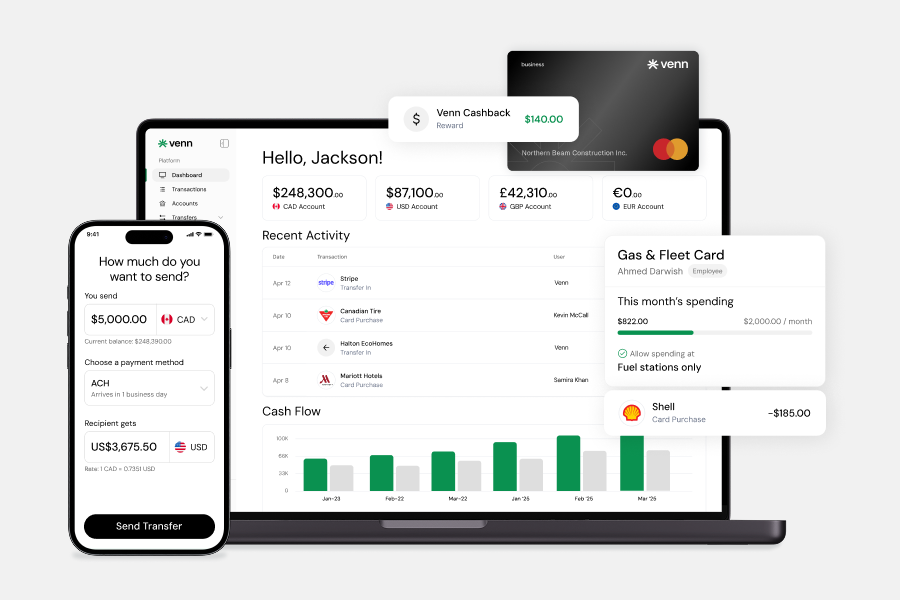
For businesses that want a more software-led setup, Venn is a technology company that supports CAD, USD, GBP, and EUR business accounts. It also offers a Mastercard charge card, expense management with OCR receipt capture, and direct QuickBooks and Xero integrations. Depending on the plan, businesses can access 1% cashback, with unlimited cashback on Pro. Venn also offers competitive FX rates, free unlimited Interac e-Transfer® for vendor payments, and funds covered under CDIC insurance protection.
Mistakes To Avoid
- Assuming a BN means you incorporated. A CRA business number supports CRA business registration and tax administration. Incorporation and provincial or territorial registration can still involve separate steps.
- Opening the wrong CRA program account. Match the account to the obligation you actually have. If you're unsure, confirm before adding accounts you don't need.
- Waiting too long to register when obligations apply. If your business must collect GST/HST or you start paying employees, address the required account promptly.
- Losing track of program account details. Store your BN, CRA correspondence, and each account identifier in one secure place so bookkeeping and filings stay organized.
- Relying on general guidance for complex cases. Cross-border activity, restructuring, multiple owners, or unusual tax situations may require advice from an accountant, tax professional, or lawyer.
Final Takeaway
Getting a CRA business number becomes much simpler once you separate the terms. The 9-digit business number is the base identifier the Canada Revenue Agency uses for your business. CRA program accounts then attach to specific obligations — a GST/HST account, payroll deductions account, corporation income tax account, or import/export account — as your activities require them.
For many Canadian businesses, registration can be completed through official CRA channels, including Business Registration Online, phone, mail, or fax. The right path depends on your structure and the accounts you need, but the process is manageable when you prepare your legal name, ownership details, business activities, and start date in advance.
After registration, keep your BN and full program account numbers organized, then focus on the operating systems that support compliance and cash flow: reliable finance workflows, bookkeeping, invoicing, and payroll. For more practical guidance on setting up business finance operations in Canada, explore Venn's educational resources at Venn.ca.
Frequently Asked Questions
Q: Is a CRA business number the same as an incorporation number?
A: No. A BN identifies your business for CRA program accounts, while an incorporation number relates to creating a corporation. Some incorporation processes may result in a BN being assigned, but the numbers serve different purposes.
Q: Do sole proprietors need a CRA business number?
A: Not always. A sole proprietor may need one when registering for GST/HST, hiring employees, importing or exporting goods, or opening another CRA program account. If you operate a small sole proprietorship with no employees and no CRA program account obligations, you may not need a BN right away.
Q: Can one business have more than one CRA account?
A: Yes. One business can have one 9-digit BN connected to multiple CRA program accounts, such as GST/HST, payroll, corporation income tax, or import/export. Each program account uses the same BN, plus a program identifier and reference number.
Q: What do RT, RP, RC, and RM mean?
A: They are CRA program identifiers. RT is for GST/HST, RP is for payroll deductions, RC is for corporation income tax, and RM is for import/export. For example, a GST/HST account may appear as your 9-digit business number followed by RT0001.
Q: How long does it take to get a CRA business number?
A: Timing depends on how you register and whether the CRA needs more information. Online registration through CRA Business Registration Online may be faster for straightforward cases, while phone, mail, or fax registrations can take longer. Keep your legal name, business activity, address, and ownership details ready before you apply.
Q: Can I register for a GST/HST account later?
A: In many cases, a business can add a GST/HST account later when it becomes relevant, but timing depends on the business's obligations. Confirm current CRA rules or speak with a qualified tax professional. If your sales, business model, or province of operation changes, review your GST/HST registration status promptly.
Legal Disclaimer
This article provides general information about the CRA business number and related business registration topics in Canada. It does not provide legal, tax, financial, accounting, or other professional advice, and it may not address your specific circumstances. For guidance about your obligations, CRA program accounts, or registration requirements, consult official CRA resources or speak with a qualified professional.
---
**Disclaimer:** This publication is provided for general information purposes only and does not constitute legal, tax, financial, or other professional advice from Venn Software Inc., its subsidiaries, or its affiliates, and is not a substitute for advice from a qualified professional. All comparisons and competitor information reflect publicly available information believed accurate as of September 24, 2026; features, pricing, rates, and terms referenced are subject to change and may differ at the time you read this. All product names, logos, and brands referenced are the property of their respective owners; their mention does not imply affiliation with or endorsement by Venn. Any comparative statements reflect Venn's views and are provided to help readers evaluate options. We make no representations, warranties, or guarantees, express or implied, that the content is accurate, complete, or up to date.

Venn is all-in-one business banking built for Canada
From free local CAD/USD accounts and team cards to the cheapest FX and global payments—Venn gives Canadian businesses everything they need to move money smarter. Join 15,000+ businesses today.
Frequently asked questions
Everything you need to know about the product and billing.
Join 15,000+ businesses banking with Venn today
Streamline your business banking and save on your spend and transfers today
No personal credit check or guarantee.