Start a Consulting Business in Canada in 2026 Avoid Mistakes
How to start a consulting business in Canada in 2026 things to avoid with guidance on structure, GST HST, pricing, contracts, and banking setup for consultants.

Ahmed Shafik
Co-founder

Trusted by 15,000+ Canadian businesses
Business banking for Canada
Local CAD and USD accounts, corporate cards with cashback, the lowest FX rates in Canada, free local transfers, and more.
How to Start a Consulting Business in Canada in 2026: Things to Avoid
Starting a consulting business in Canada in 2026 offers tremendous opportunity. Remote delivery has become the norm, cross-border engagements with US clients are increasingly common, and the barriers to entry have never been lower. Yet the same accessibility that makes consulting attractive also creates traps for the unprepared.
This guide walks you through the essential steps from idea to first invoice, with a critical difference: every stage includes the specific mistakes that derail new Canadian consultants. You will learn the correct order of operations for registration, tax considerations, pricing, and contracts. You will also build a financia
l stack that keeps your business clean, compliant, and ready to scale.
Think of your consulting business as four interconnected layers: your offer and positioning, your legal and tax structure, your contracts and pricing, and your financial operations. Get any one of these wrong, and you create problems that compound over time.
Step 1: Choose a Consulting Niche and Offer
What to Do
Define your ideal client profile with precision. Specify the industry, company size, and the buyer role you serve best. A management consultant targeting Series A SaaS companies with 20-50 employees and selling to founders has a far easier time than one offering "business strategy for anyone."
Build your offer around 1-3 clear outcomes and deliverables. Decide whether you provide advisory calls, audits, implementation support, training, or fractional leadership. Each delivery model carries different pricing implications and client expectations.
Things to Avoid
Generic positioning destroys your pricing power. When you offer "anything for anyone," you compete on price alone. Clients cannot understand your value, so they default to hourly rate comparisons.
Copying competitor service menus leads to undifferentiated offerings. Instead, identify a specific business pain you solve better than alternatives.
Single-client dependency creates both business risk and tax risk. If 80% of your revenue comes from one client, you have a job disguised as a business. This setup also triggers Personal Services Business concerns that we address in Step 3.
Step 2: Validate Demand and Set a Simple Go-To-Market Plan
What to Do
Start with minimum viable marketing: one channel, one offer, one proof asset. This might be LinkedIn content plus a case study, or a referral system plus a one-page capability deck.
Prepare for procurement realities. In 2026, mid-market buyers increasingly require vendor onboarding, insurance certificates, and security questionnaires before engaging consultants. Have these ready before you need them.
Things to Avoid
Building before selling wastes precious runway. A polished website and brand identity mean nothing without an offer that converts. Validate demand with conversations and small engagements first.
Over-investing in tools before revenue creates unnecessary overhead. You need a way to invoice, a way to get paid, and a way to track expenses. Everything else can wait.
No written positioning leads to discounting and extended sales cycles. If you cannot articulate your value in two sentences, prospects will not understand why they should pay premium rates.
Step 3: Pick a Business Structure Without Guessing
Decision Framework
| Factor | Sole Proprietorship | Corporation |
|---|---|---|
| Setup Complexity | Low | Moderate to High |
| Ongoing Admin | Minimal | Annual filings, corporate records |
| Liability Protection | None | Limited (with proper maintenance) |
| Tax Planning Options | Limited | Income splitting, dividend timing |
| Perceived Credibility | Varies by client | Often preferred by enterprise |
| Annual Costs | Minimal | $1,000–3,000+ (accounting, filings) |
Things to Avoid
Incorporating for credibility alone adds complexity without benefit if your income does not justify it. Most consultants earning under $100,000 annually gain little from incorporation.
Staying unincorporated too long when your risk profile, client requirements, or income level suggest otherwise. Enterprise clients often require incorporated vendors. High earners miss tax planning opportunities.
Personal Services Business Risk
If you incorporate but function like an employee of one client, CRA may classify your company as a Personal Services Business. This eliminates most corporate tax advantages and deductions.
Practical behaviors that reduce PSB risk:
• Maintain multiple clients throughout the year
• Control your own hours and work methods
• Provide your own tools and equipment
• Bear genuine business risk (fixed-fee projects, for example)
• Have the ability to subcontract work where appropriate
• Use contract language that reflects an independent relationship
This guidance is educational, not legal advice. Consult a qualified accountant or lawyer for advice specific to your situation.
Step 4: Register and Set Up Your CRA Accounts
What to Do
Choose a business name that works for your market. Register your Business Number through the CRA portal. This number becomes the foundation for all your tax accounts.
Understand GST/HST timing. In 2026, the small supplier threshold remains $30,000 in revenue over four consecutive calendar quarters. Once you exceed this threshold, you must register and begin collecting GST/HST.
Things to Avoid
Ignoring GST/HST until tax season creates scrambling and potential penalties. Make the registration decision early, even if you start below the threshold.
Missing registration timing after exceeding the threshold exposes you to liability for uncollected tax. Track your trailing four-quarter revenue.
Collecting GST/HST without registration or failing to charge when required both create compliance problems.
Registration Checklist
• Business Number created with CRA
• GST/HST decision documented (register now or monitor threshold)
• Recordkeeping method established for invoices, receipts, and expenses
• Dedicated business account and card set up
Step 5: Price Your Consulting Services
What to Do
Understand three core pricing models:
Hourly billing works for ongoing advisory relationships and situations where scope genuinely cannot be defined. It penalizes efficiency but provides flexibility.
Fixed-fee projects reward your expertise and efficiency. They require clear scope definition and change control processes.
Retainers provide predictable revenue and deeper client relationships. They work best when clients need ongoing access rather than discrete deliverables.
Calculate your pricing floor: target annual income plus tax set-asides (25-35% for most consultants) plus overhead plus realistic utilization (50-70% of available hours for billable work).
Things to Avoid
Hourly billing for outcome-based work leaves money on the table. If you can deliver a $50,000 result in 10 hours, hourly billing caps your upside.
No written assumptions leads to scope creep and endless revisions. Document what is included, what is excluded, and what triggers additional fees.
Forgetting tax, benefits, and admin time results in effective hourly rates far below your target. A $150/hour rate becomes $75/hour after accounting for unbillable time, taxes, and self-funded benefits.
Pricing Worksheet Fields
• Target annual gross income
• Tax set-aside percentage
• Annual business overhead (software, insurance, professional development)
• Realistic billable utilization rate
• Minimum project size threshold
• Standard payment terms
Step 6: Write a Contract and Statement of Work That Protects You
What to Include
Your consulting agreements should address scope and deliverables with specificity, timeline and client dependencies, payment terms with late fee provisions, change control procedures, intellectual property ownership, confidentiality requirements, privacy and security expectations (increasingly important in 2026), limitation of liability, and dispute resolution process.
Things to Avoid
Starting work on verbal agreements creates disputes you cannot win. Even for small projects, get written confirmation of scope and payment terms.
No change order process means scope creep becomes your problem. Define how changes are requested, approved, and priced.
"Unlimited revisions" language guarantees unprofitable projects. Specify revision rounds and what happens when clients exceed them.
Step 7: Set Up a Consulting Financial Stack
Your financial operations need to be clean from day one. This means getting paid efficiently, paying expenses without friction, tracking everything automatically, and staying tax-ready year-round.
The Recommended Stack
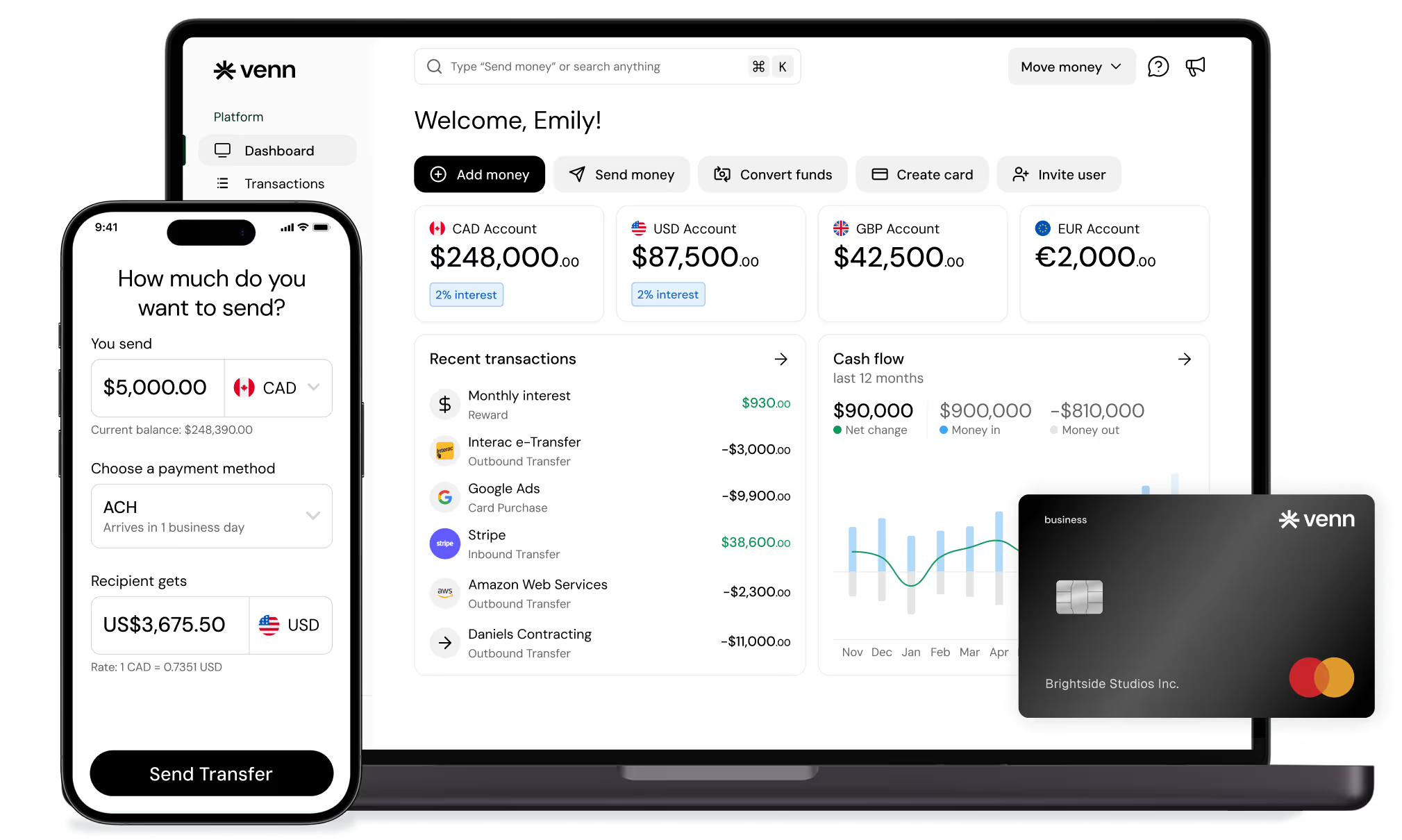
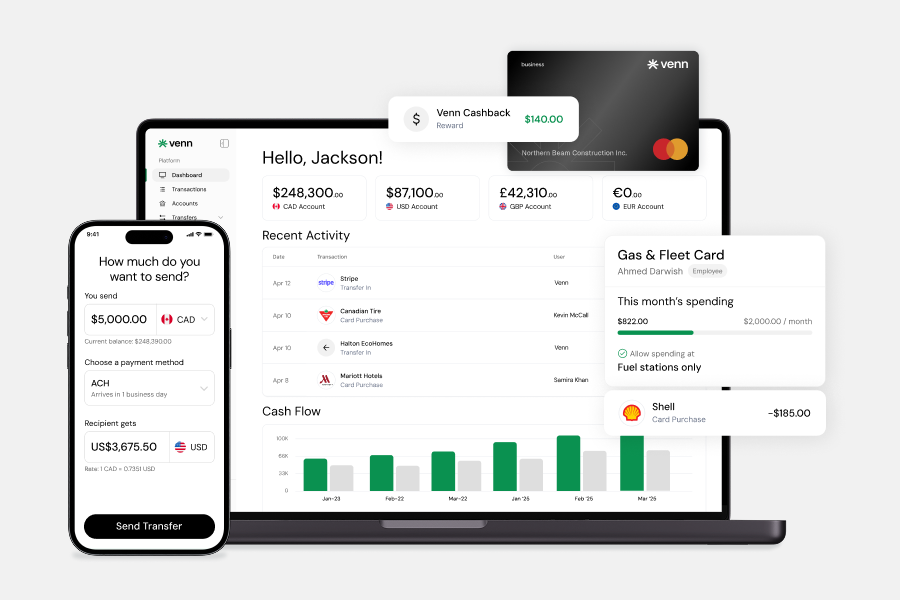
Banking and Spend: Venn provides the foundation for your consulting financial operations. As a business banking platform built for Canadian businesses, Venn offers dedicated CAD accounts, multi-currency capabilities for USD, EUR, and GBP, and a corporate card with 1% unlimited cashback on all purchases.
For consultants with US clients, Venn's local US account enables you to receive ACH payments directly in USD. This eliminates the friction of wire transfers and avoids forced currency conversions on every payment.
Accounting: QuickBooks or Xero handle your books. Venn integrates directly with both platforms, which means your transactions sync automatically and reconciliation becomes a weekly task rather than a month-end scramble.
Invoicing: Use your accounting software's built-in invoicing or a dedicated tool. The key is consistency and professional presentation.
Receipt Capture: Venn's expense management features include OCR receipt capture, reducing the "shoebox of receipts" problem that plagues consultants at tax time.
What to Look for in a Consulting Banking Setup
| Feature | Why It Matters |
|---|---|
| Dedicated CAD Account | Clean separation from personal finances |
| USD Receivables | Accept US client payments without conversion friction |
| Accounting Integrations | QuickBooks and Xero sync for automated bookkeeping |
| Multi-Currency Support | Pay global vendors in their currency |
| Transparent FX Costs | Know what you pay on every conversion |
| Cashback on Spend | 1% return on subscriptions, travel, and tools |
| CDIC Protection | Funds covered under CDIC insurance protection |
Things to Avoid
Mixing business and personal transactions creates bookkeeping nightmares and audit risk. Open a dedicated business account before your first invoice.
Personal credit card for everything means manual expense tracking and missed deductions. Use a business card that integrates with your accounting software.
Forced conversions on every payment erodes margins on cross-border work. If you invoice US clients regularly, hold and receive USD directly with a platform like Venn that offers local US account capabilities.
Step 8: Build a Tax-Ready Operating Rhythm
What to Do
Weekly: Reconcile transactions in your accounting software, tag expenses to appropriate categories, upload receipts for any business purchases.
Monthly: Review your profit and loss statement, check cash runway, verify tax set-asides are adequate, update your pipeline forecast.
Quarterly: If registered for GST/HST, review obligations and file as required. Evaluate whether installment payments apply to your situation.
Things to Avoid
Year-end bookkeeping transforms a simple task into an expensive, stressful project. Fifteen minutes weekly beats fifteen hours in March.
No tax set-asides leads to cash crunches when payments come due. Transfer 25-35% of every payment to a separate account or sub-account immediately.
Untracked expenses and missing receipts mean lost deductions and potential audit problems. Capture receipts at point of purchase using your banking platform's mobile app.
Step 9: Get Clients Consistently
What to Do
Choose one repeatable channel and master it before adding others. This might be referral partnerships, content marketing, direct outreach, or marketplace platforms. Consistency beats variety.
Build a simple pipeline with defined stages and follow-up cadence. Know where every opportunity stands and what action moves it forward.
Productize at least one offer. A defined scope, timeline, and price point makes selling easier and delivery more profitable.
Things to Avoid
Custom proposals for every lead consumes time and reduces close rates. Create templates you can customize rather than starting from scratch.
No follow-up system means opportunities die from neglect. Most consulting sales require 3-7 touches before closing.
Overdelivering for free as a substitute for marketing attracts clients who expect free work to continue. Demonstrate value through content and conversations, not unpaid labor.
Conclusion
Starting a consulting business in Canada in 2026 does not require perfection. It requires a clean setup and consistent execution across your offer, structure, contracts, and financial operations.
The biggest avoidable mistakes cluster around a few themes: mixing personal and business finances, unclear scope and pricing, ignoring GST/HST obligations until they become problems, and blind spots around PSB risk for incorporated consultants.
Your financial stack forms the operational backbone of your consulting practice. Venn provides the business banking foundation, with dedicated CAD accounts, multi-currency capabilities for US and international clients, corporate cards with 1% cashback, and direct integrations with QuickBooks and Xero. Combined with solid contracts and disciplined weekly habits, this stack keeps you focused on client work rather than administrative chaos.
Ready to build your consulting financial foundation? Sign up for a Venn account and start with the banking infrastructure that grows with your practice.
FAQs
Q: Do I need to register for GST/HST as a consultant in Canada?
A: You must register once your worldwide taxable supplies exceed $30,000 over four consecutive calendar quarters. Below this threshold, registration is optional but may benefit you if you have significant business expenses with GST/HST. Check current CRA guidance and consult a tax professional for your specific situation.
Q: Should I incorporate as a consultant in Canada?
A: Incorporation makes sense when your income justifies tax planning opportunities, your clients require incorporated vendors, or your liability exposure warrants protection. For most consultants earning under $100,000 annually, sole proprietorship offers simplicity without significant tax disadvantage. Evaluate your specific circumstances with a qualified accountant.
Q: What is PSB risk and why does it matter for incorporated consultants?
A: Personal Services Business classification applies when an incorporated consultant would reasonably be considered an employee of their client if not for the corporation. PSB status eliminates most corporate tax advantages and expense deductions. Reduce risk by maintaining multiple clients, controlling your work methods, providing your own tools, and structuring contracts appropriately.
Q: How do I invoice US clients from Canada in USD?
A: Use a business banking platform like Venn that provides USD invoicing, multi-currency accounts, and low-cost foreign exchange conversion. Clearly state payment terms, currency, and accepted payment methods on your invoices. Keep records of exchange rates and converted amounts for accurate bookkeeping and tax reporting.
Q: What is the simplest way to stay on top of bookkeeping as a solo consultant?
A: Establish a weekly 15-minute routine: reconcile transactions, categorize expenses, and upload any outstanding receipts. Use a business banking platform that integrates with QuickBooks or Xero so transactions sync automatically. Keep business and personal finances completely separate to eliminate sorting and reduce errors.
This article is for informational purposes only and does not constitute legal, tax, or accounting advice. Consult qualified professionals for advice specific to your situation.
---
**Disclaimer:** This publication is provided for general information purposes and does not constitute legal, tax or other professional advice from Venn Software Inc or its subsidiaries and its affiliates, and it is not intended as a substitute for obtaining advice from a financial advisor or any other professional. We make no representations, warranties or guarantees, whether expressed or implied, that the content in the publication is accurate, complete or up to date.
This publication is provided for general information purposes only and does not constitute legal, tax, financial, or other professional advice from Venn Software Inc., its subsidiaries, or its affiliates, and is not a substitute for advice from a qualified professional. All comparisons and competitor information reflect publicly available information believed accurate as of May 7, 2026; features, pricing, rates, and terms referenced are subject to change and may differ at the time you read this. All product names, logos, and brands referenced are the property of their respective owners; their mention does not imply affiliation with or endorsement by Venn. Any comparative statements reflect Venn's views and are provided to help readers evaluate options. We make no representations, warranties, or guarantees, express or implied, that the content is accurate, complete, or up to date.

Venn is all-in-one business banking built for Canada
From free local CAD/USD accounts and team cards to the cheapest FX and global payments—Venn gives Canadian businesses everything they need to move money smarter. Join 15,000+ businesses today.
Frequently asked questions
Everything you need to know about the product and billing.
Join 15,000+ businesses banking with Venn today
Streamline your business banking and save on your spend and transfers today
No personal credit check or guarantee.