How to start a consulting business in Canada in 2026: Full Guide
How to start a consulting business in Canada in 2026: Complete guide to niche, pricing, registration, GST/HST, and a clean money system for CAD and USD clients.

Ahmed Shafik
Co-founder
.png)
Trusted by 15,000+ Canadian businesses
Business banking for Canada
Local CAD and USD accounts, corporate cards with cashback, the lowest FX rates in Canada, free local transfers, and more.
Starting a consulting business in Canada offers one of the lowest-barrier paths to entrepreneurship. You need expertise, a clear offer, and the discipline to set things up properly from day one. The overhead stays minimal. The margins can be excellent. The flexibility is real.
But success depends on three things: clarity about what you sell and to whom, compliance with Canadian registration and tax requirements, and systems that keep your finances clean without eating your billable hours.
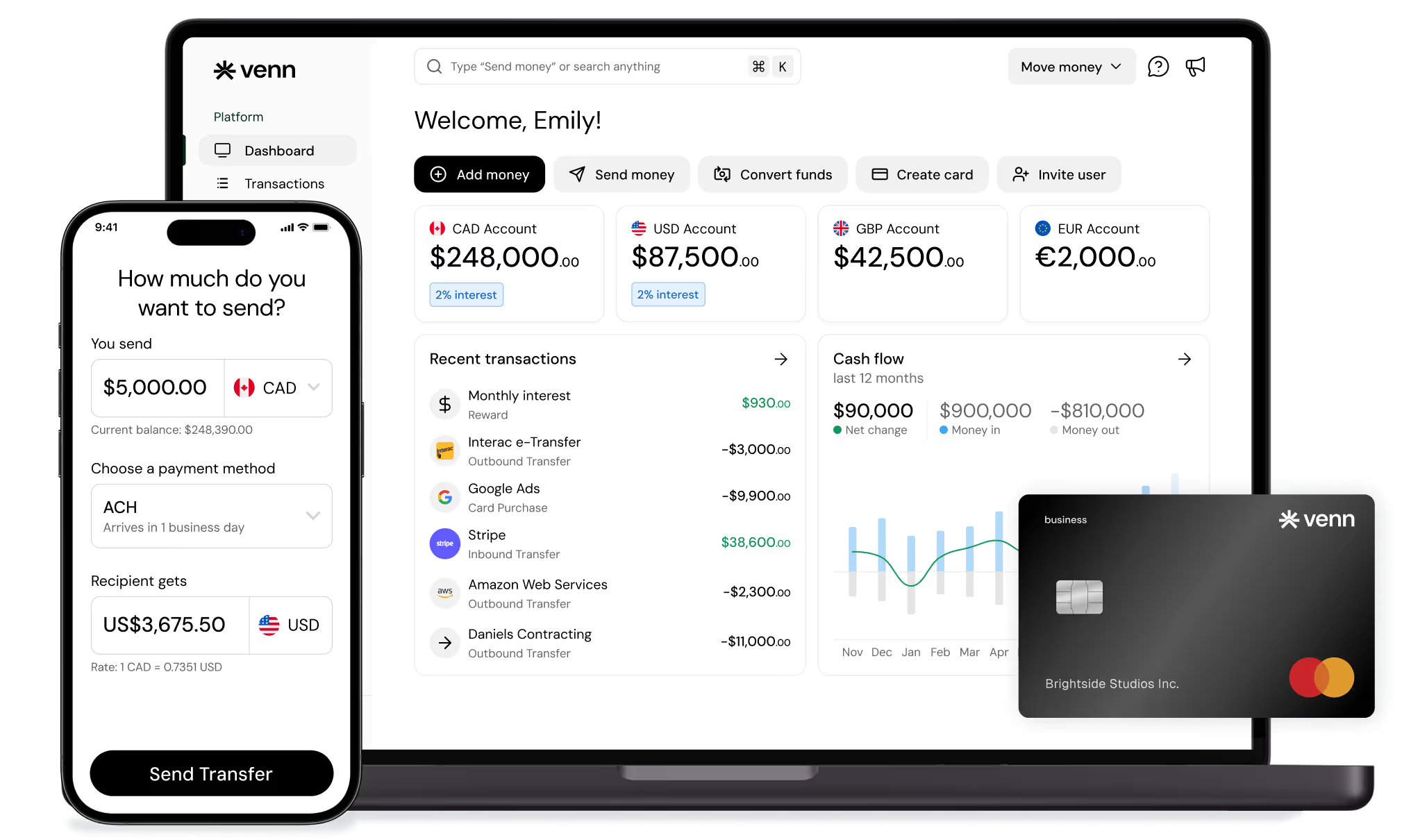
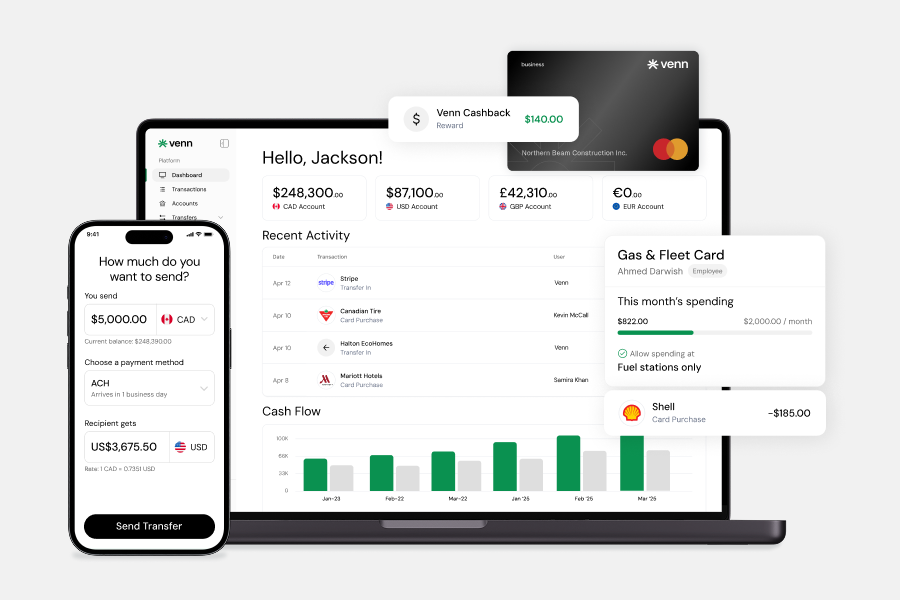
This guide walks you through the complete process for 2026, from choosing your niche to landing your first clients. You will learn how to structure your business, register correctly, price your services, and build a modern financial stack that separates business from personal and handles multi-currency clients with ease. Platforms like Venn make this straightforward by combining business banking, a cashback card, and accounting integrations in one place.
Step 1: Choose Your Consulting Niche and Offer
Every successful consulting business starts with a specific problem you solve for a specific buyer. Generalists struggle to stand out. Specialists command premium rates.
Common consulting categories in 2026 include marketing strategy, operations improvement, finance and fractional CFO services, HR and talent acquisition, IT and cybersecurity, product management, sustainability, and AI implementation. The AI implementation space has grown significantly as businesses seek help adopting new tools.
Use this simple filter to define your niche: Industry + Problem + Buyer + Outcome. For example: "I help B2B SaaS companies (industry) reduce customer churn (problem) by working with customer success leaders (buyer) to implement retention systems that improve renewal rates by 20% (outcome)."
Validate your niche before committing. Conduct 10 conversations with potential buyers to understand their pain points and willingness to pay. Scan competitor offerings to identify gaps. Search LinkedIn for people with your target title and study what they post about. Review job postings in your space to see what skills companies are hiring for internally.
Step 2: Package Services in a Way Clients Can Buy
Clients need to understand exactly what they are buying. Vague offerings create friction. Clear packages close deals.
Three packaging models work well for consultants:
• Project-based: Fixed scope, fixed price, defined deliverables. Best for specific outcomes like an audit, strategy document, or implementation plan.
• Retainer: Ongoing monthly support with defined hours or availability. Works well for advisory relationships and fractional roles.
• Productized services: Workshops, advisory days, or templated engagements with standardized pricing. Scales better than custom work.
Scope control prevents endless revisions. Every proposal should define deliverables, assumptions, exclusions, and how change requests are handled. Be explicit about what is included and what costs extra.
Operational simplicity matters from the start. Clean packaging leads to clean invoicing, which leads to clean books. This becomes important when you set up your financial stack later.
Step 3: Set Pricing with a Simple Framework
Pricing consulting services intimidates many new consultants. Start with a practical method rather than guessing.
Calculate your baseline:
• Determine your target monthly income (what you need to earn)
• Estimate your realistic billable capacity (typically 60-70% of working hours)
• Divide income by billable hours to get your minimum hourly rate
• Multiply by 8 for your day rate, by project scope for project rates
Add value-based adjustments for:
• Urgency (rush work costs more)
• Risk you are taking on
• Specialized expertise required
• Quality of alternatives available to the client
Set a minimum engagement size. Small projects consume disproportionate admin time. A $2,000 minimum project fee or two-day minimum engagement protects your profitability.
Payment terms matter for cash flow. Net 15 works better than net 30 for consultants. Require 50% deposits on projects over $5,000. Use milestone billing for longer engagements.
Common mistake: Many consultants mix personal and business finances during their first months, then spend hours untangling transactions at tax time. Separate your finances immediately. A business platform like Venn lets you track income and spend cleanly from day one, with dedicated accounts and a card that categorizes expenses automatically.
Step 4: Choose a Business Structure in Canada
Canadian consultants typically choose between sole proprietorship and incorporation. Neither is universally better. The right choice depends on your situation.
Sole proprietorship:
• Simplest to start and maintain
• Business income reported on your personal tax return
• You are personally liable for business debts and obligations
• Works well for testing demand or lower revenue consulting
Incorporation:
• Creates a separate legal entity
• Potential tax planning advantages at higher income levels
• More administrative requirements and costs
• Better liability separation
A practical decision framework:
If you are testing demand with a few clients and revenue under $50,000, sole proprietorship offers faster setup with less overhead. If you have consistent revenue above $75,000-100,000, significant liability exposure, or want to retain earnings in the business, incorporation may offer advantages worth the added complexity.
This is not legal or tax advice. Consult with a lawyer or accountant who understands your specific situation before deciding.
Step 5: Register Your Consulting Business
Registration requirements depend on your structure and province.
Name decision: You can operate under your personal name or register a business name. A business name requires a name search and registration. Operating under your personal name as a sole proprietor is simpler but may limit branding options.
Registration steps:
• For sole proprietorship, register your business name with your provincial registry (requirements vary by province)
• For incorporation, choose between federal (Canada Business Corporations Act) or provincial incorporation
• Federal incorporation allows you to operate across all provinces under one registration
• Provincial incorporation may be simpler if you only operate in one province
Permits and licensing: Most consulting services do not require special permits. However, some regulated fields have specific requirements. Immigration consulting, for example, is regulated by the College of Immigration and Citizenship Consultants. Verify requirements for your specific niche and province before starting.
Step 6: Set Up CRA and Sales Tax Basics
Getting your tax setup right early prevents headaches later.
CRA Business Number: Register for a Business Number (BN) with the Canada Revenue Agency. This is your identifier for tax accounts including GST/HST, payroll, and corporate income tax. Confirm current registration processes on the CRA website.
GST/HST registration: You must register once your revenue exceeds $30,000 in a single calendar quarter or over four consecutive calendar quarters. Confirm the current threshold on the CRA website, as rules may change.
Some consultants register voluntarily before reaching the threshold. This allows you to claim input tax credits on business expenses, which can offset costs. However, it adds administrative requirements and means charging clients GST/HST on every invoice. Consider your client base (B2B clients typically claim back the GST/HST anyway) and expense levels before deciding.
Common deductible expenses for consultants:
• Software subscriptions (project management, communication, design tools)
• Home office expenses (if you meet CRA eligibility requirements)
• Travel and meals (partial deduction, confirm current rules)
• Professional development and courses
• Marketing and advertising costs
• Contractor and subcontractor payments
• Professional liability insurance premiums
Keep receipts for everything. Digital receipt capture makes this manageable.
Step 7: Set Up Your Consulting Money System
Your financial stack determines how much time you spend on admin versus billable work. Get this right from the start.
The Minimal Financial Stack for a Solo Consultant
You need four components:
• A business account for deposits and bill payments
• A corporate card for expenses with receipt tracking
• An accounting system (QuickBooks or Xero)
• A simple monthly close routine
Why Venn Fits Consulting Businesses in 2026
Venn combines these components into one platform designed for Canadian businesses with cross-border needs.
Business banking layer: Venn provides CAD and USD accounts that separate business finances from personal. Funds are covered under CDIC insurance protection. This separation is essential for clean tax filing and understanding your true profitability.
Get paid in USD efficiently: Many Canadian consultants serve US clients. Venn offers a real local USD account that can send and receive ACH payments. This eliminates the friction and fees of wire-based workarounds. Clients pay you like a domestic vendor, and funds arrive faster.
Multi-currency operations: If you pay for international SaaS tools, contractors, or travel, Venn provides local GBP and EUR accounts plus the ability to send payments globally. The multi-currency card includes auto-currency matching, so spending in USD, EUR, or GBP draws from your balance in that currency without unnecessary conversions.
Card and expense control: The Venn card earns 1% unlimited cashback on all spend. For consultants paying for software subscriptions, travel, advertising, and contractor costs, this adds up quickly. Receipt capture workflows and automatic categorization reduce bookkeeping time.
Accounting automation: Direct integrations with QuickBooks and Xero sync transactions automatically. This means less manual data entry and faster month-end closes.
Payments You Will Actually Use as a Consultant
| Payment Type | Common Use Case | What to Look For |
|---|---|---|
| Receiving CAD payments | Canadian clients paying invoices | Interac e-Transfer® or EFT |
| Receiving USD payments | US clients paying invoices | Local ACH (not wires) |
| Paying subcontractors | Canadian contractors | Free Interac e-Transfer® |
| Paying international contractors | US or global contractors | ACH, local rails, competitive FX |
| Software and subscriptions | Monthly SaaS tools | Card with receipt capture |
Ready to set up your financial stack? Sign up for a Venn account to separate your finances, track expenses, and handle multi-currency consulting work from one platform.
Step 8: Client Acquisition in 2026
Consistent client acquisition separates thriving consultants from struggling ones. Choose one primary channel and one secondary channel rather than spreading thin across many.
Effective channels for consultants:
• LinkedIn content and outreach: Share insights, engage with your target buyers, and reach out directly to decision-makers
• Partnerships: Build referral relationships with agencies, accountants, fractional CFOs, and others who serve your target clients
• Referrals: Systematically ask satisfied clients for introductions
• Webinars and workshops: Demonstrate expertise while building your email list
Build a lightweight funnel:
• A clear offer page or lead magnet that explains what you do
• A discovery call script that qualifies prospects and uncovers needs
• A proposal template you can customize quickly
• An onboarding checklist that creates a professional first impression
Proof assets accelerate trust: Create one case study showing a client's before state, what you did, and the measurable outcome. Collect testimonials that speak to specific results. These assets do selling work for you.
Step 9: Deliver, Retain, and Scale
Standardized delivery creates consistent results and frees mental energy for high-value work.
Create templates for:
• Client onboarding questionnaire
• Weekly or monthly reporting format
• Project closeout and handoff
When to bring on subcontractors: Once you have more demand than capacity, consider subcontracting overflow work. Start with project-based contractors before committing to employees. Ensure your contracts allow for subcontractors and define confidentiality requirements.
Treasury basics: Build a cash buffer of three to six months of expenses. Set aside 25-30% of revenue for taxes in a separate account. Review your cash position monthly.
30-Day Launch Checklist
Week 1:
• Define your niche using the Industry + Problem + Buyer + Outcome filter
• Draft your core offer and pricing
• Create a list of 50 potential clients to contact
Week 2:
• Decide on business structure (sole proprietorship vs incorporation)
• Begin registration process (business name, provincial or federal registration)
• Research insurance requirements for your niche
Week 3:
• Set up your financial stack (Venn account, card, accounting integration)
• Create expense categories in your accounting system
• Build your invoice template
Week 4:
• Start outreach to your prospect list
• Book and conduct discovery calls
• Send your first proposal
• Deliver your first milestone
Conclusion
Starting a consulting business in Canada in 2026 requires clarity about your offer, compliance with registration and tax requirements, and systems that keep your finances organized without consuming your time.
The path forward is straightforward: choose a specific niche, package your services clearly, set pricing that reflects your value, register your business correctly, and build a financial stack that handles both Canadian and cross-border clients efficiently.
Your next steps: finalize your niche and pricing model, complete your business registration, and set up your financial infrastructure. Sign up for a Venn account to separate your business finances, manage multi-currency payments, and keep your books clean with QuickBooks or Xero integration.
FAQ
Q: Do I need a license to be a consultant in Canada?
A: Most consulting services are unregulated and do not require a license. However, certain fields like immigration consulting, financial advising, and some healthcare-related consulting have specific licensing or professional requirements. Verify the requirements for your specific niche and province before starting.
Q: When should I register for GST/HST as a consultant?
A: Registration is mandatory once your revenue exceeds $30,000 in a single quarter or over four consecutive quarters (confirm the current threshold on the CRA website). Some consultants register voluntarily before reaching this threshold to claim input tax credits on business expenses. This can make sense if you have significant deductible expenses and primarily serve B2B clients who can claim back the GST/HST.
Q: Should I incorporate my consulting business or stay a sole proprietor?
A: Consider sole proprietorship if you are testing demand, expect lower revenue, and want minimal administration. Consider incorporation if you have consistent revenue above $75,000–100,000, want better liability separation, or see tax planning advantages. Consult with a lawyer or accountant for advice specific to your situation.
Q: What expenses can consultants typically deduct in Canada?
A: Common deductible expenses include software subscriptions, home office costs (if eligible), business travel and meals (partial), professional development, marketing and advertising, contractor payments, and professional liability insurance. Keep detailed records and receipts. Rules vary, so confirm current CRA guidelines and consider working with an accountant.
Q: What is the simplest way to manage consulting income and expenses?
A: Use a dedicated business platform like Venn that combines banking, a corporate card with expense tracking, and direct integration with QuickBooks or Xero. This keeps business and personal finances separate, automates receipt capture, and reduces bookkeeping time significantly.
Disclaimer: This guide provides general information and is not legal, tax, or accounting advice. Consult qualified professionals for advice specific to your situation. Venn is not a bank and does not hold deposits. Funds are covered under CDIC insurance protection.
---
**Disclaimer:** This publication is provided for general information purposes and does not constitute legal, tax or other professional advice from Venn Software Inc or its subsidiaries and its affiliates, and it is not intended as a substitute for obtaining advice from a financial advisor or any other professional. We make no representations, warranties or guarantees, whether expressed or implied, that the content in the publication is accurate, complete or up to date.
This publication is provided for general information purposes only and does not constitute legal, tax, financial, or other professional advice from Venn Software Inc., its subsidiaries, or its affiliates, and is not a substitute for advice from a qualified professional. All comparisons and competitor information reflect publicly available information believed accurate as of May 7, 2026; features, pricing, rates, and terms referenced are subject to change and may differ at the time you read this. All product names, logos, and brands referenced are the property of their respective owners; their mention does not imply affiliation with or endorsement by Venn. Any comparative statements reflect Venn's views and are provided to help readers evaluate options. We make no representations, warranties, or guarantees, express or implied, that the content is accurate, complete, or up to date.

Venn is all-in-one business banking built for Canada
From free local CAD/USD accounts and team cards to the cheapest FX and global payments—Venn gives Canadian businesses everything they need to move money smarter. Join 15,000+ businesses today.
Frequently asked questions
Everything you need to know about the product and billing.
Join 15,000+ businesses banking with Venn today
Streamline your business banking and save on your spend and transfers today
No personal credit check or guarantee.