Mercury alternatives for Canadian Startups in 2026
Mercury alternatives for Canadian Startups: compare Venn, RBC, TD, BMO and Wise for CAD and USD banking, FX, cards and accounting fit in Canada and eligibility.

Trusted by 15,000+ Canadian businesses
Business banking for Canada
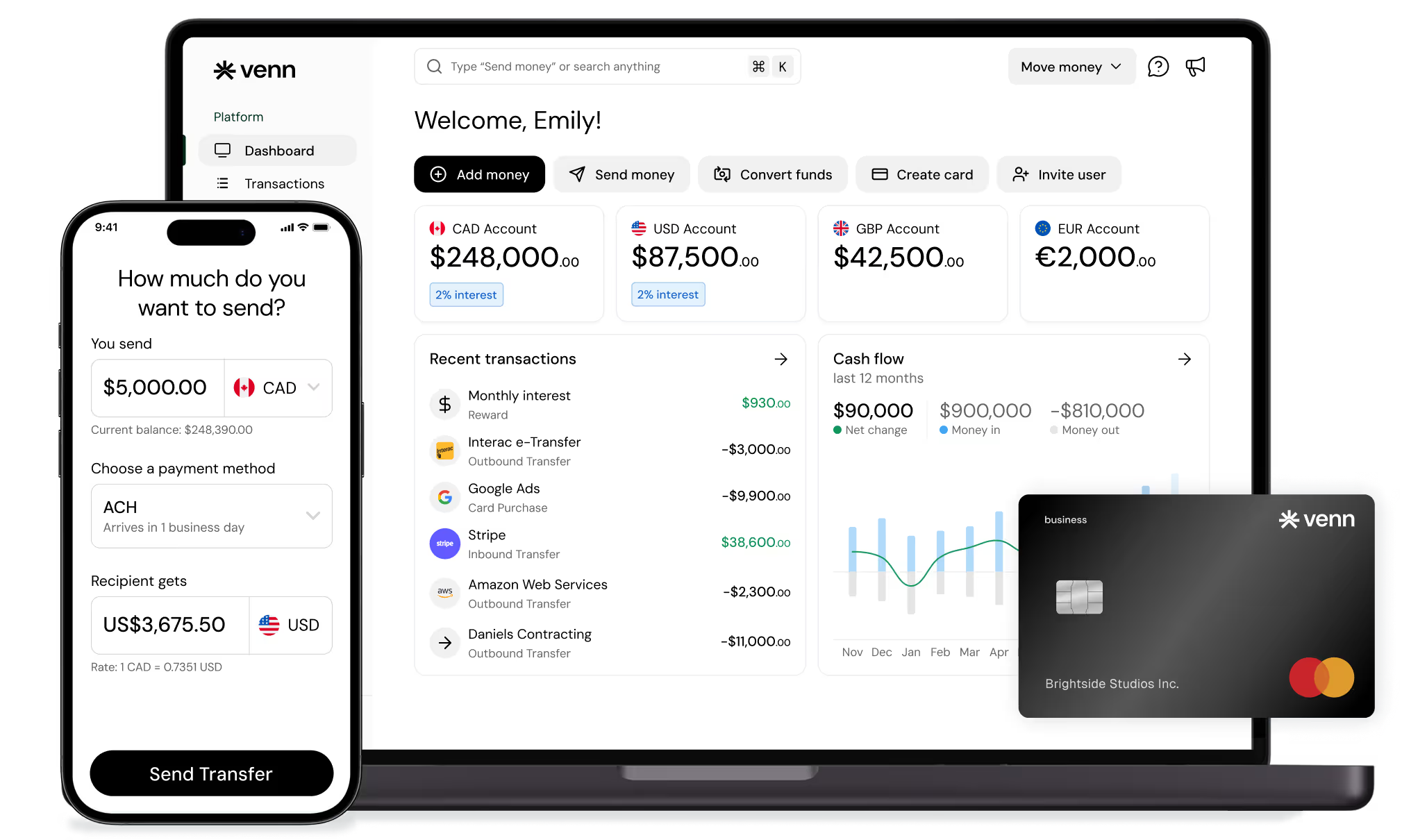
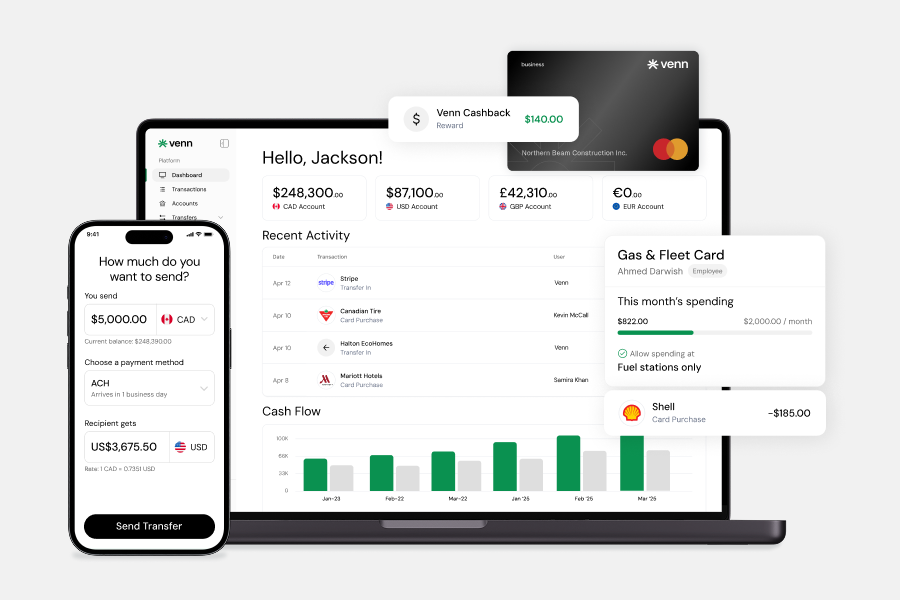
Local CAD and USD accounts, corporate cards with cashback, the lowest FX rates in Canada, free local transfers, and more.
Step 1: Identify Repeated Facts, Statistics, Features, or Claims
Mercury eligibility rule (US incorporation required):
• Intro section: mentioned
• "Why Canadian Startups Look for Mercury Alternatives" section: mentioned again
• FAQ Q1: mentioned again
• Decision: Keep fullest explanation in "Why Canadian Startups Look for Mercury Alternatives" > "Mercury Is Not a Direct Fit for Every Canadian Startup." Intro can keep a brief reference. FAQ can keep a brief reference.
CAD business account + USD workflow needs:
• Intro: mentioned
• "Why Canadian Startups Look for Mercury Alternatives": mentioned
• "What Canadian Founders Usually Need Instead": mentioned
• "How To Choose" section: mentioned multiple times
• Decision: Keep fullest in "What Canadian Founders Usually Need Instead." Other sections can reference briefly.
Accounting integrations for business banking:
• Mentioned in intro, "What Canadian Founders Usually Need Instead," comparison table, Venn section, "How To Choose" section
• Decision: Keep fullest in Venn section. Other mentions can be brief callbacks.
Cross-border business banking:
• Repeated throughout many sections
• Decision: Keep as a theme but avoid full restatements.
Venn FX rates (0.45%, 0.35%, 0.25%):
• Only in Venn pricing section — no repetition issue.
Venn cashback (1% from first dollar):
• Only in Venn pricing section — no repetition issue.
Venn CDIC protection:
• Only in Venn pricing section — no repetition issue.
Venn interest rates (2.75% CAD, 3.00% USD, up to 3.50%):
• Only in Venn pricing section — no repetition issue.
Venn currencies (CAD, USD, GBP, EUR):
• Comparison table: "CAD/USD/GBP/EUR"
• Venn features section: "local CAD, USD, GBP, and EUR accounts"
• Decision: Both mentions are appropriate in their context (table vs. prose). Keep both but don't repeat in other sections.
Venn QuickBooks and Xero:
• Comparison table: listed
• Venn features section: mentioned
• Decision: Both appropriate in context.
RBC USD Business Account $9 USD monthly fee:
• Only in RBC section — no repetition issue.
TD USD Business Basic Account $7 U.S. monthly fee, five transactions:
• Only in TD section — no repetition issue.
BMO Essential Business Account (unlimited electronic/ATM, six Interac e-Transfer® per month):
• Only in BMO section — no repetition issue.
Wise Business 40+ currencies:
• Comparison table: "40+ currencies"
• Wise Business section: "hold 40+ currencies"
• Decision: Both appropriate in context.
"Which Mercury Alternative Fits Different Startup Needs?" section has duplicate subsections:
• "Best for Canadian Startups That Need Both CAD and USD Operations" appears TWICE (once as a brief header, once as a full subsection)
• "Best for Founders Who Want a Traditional Bank Relationship" appears TWICE
• "Best for Cross-Border and Multi-Currency Workflows" appears TWICE
• This is a significant structural issue. The section starts with three brief one-liners, then repeats all three as full subsections. The brief versions should be removed or merged into the full subsections.
"Use the same filter across every option" language:
• Appears in "How To Choose" section
• Similar language appears in conclusion
• Decision: Keep in "How To Choose," simplify in conclusion.
"Start with entity eligibility" / "Prioritize Entity Eligibility First":
• Mentioned in intro, "How To Choose" section, FAQ
• Decision: Keep fullest in "Prioritize Entity Eligibility First" subsection.
"Multi-currency business account" phrase:
• Repeated many times throughout
• Decision: Keep where most relevant, vary phrasing elsewhere.
"Mercury-style" / "Mercury-style operating experience":
• Repeated in Venn section, BMO section, conclusion
• Decision: Keep where most relevant.
"Cross-border business banking without unnecessary friction":
• Intro: "without adding unnecessary operational friction"
• "What Canadian Founders Usually Need Instead": "without creating unnecessary onboarding friction"
• Decision: Keep one, remove the other.
"The right choice depends on...":
• Appears in intro, "How To Choose," conclusion, FAQ
• Decision: Vary the phrasing.
"Use your operating model to narrow the shortlist, then see the table above":
• This is a meta-reference to the table. Keep it but make it flow naturally.
Step 2: Duplicate Subsections in "Which Mercury Alternative Fits Different Startup Needs?"
The section has:
• A brief intro paragraph
• Three brief one-liner subsections (### Best for...)
• Then the SAME three subsections repeated with full paragraphs
The brief one-liners at the top are redundant with the full subsections below. I should remove the brief one-liners and keep only the full subsections, OR merge them. Looking at the structure, the brief ones appear first without full content, then the full ones appear. I'll remove the brief one-liners (they're essentially just the heading + one sentence) and keep the full subsections.
Wait, let me re-read. The structure is:
## Which Mercury Alternative Fits Different Startup Needs?

Use your operating model to narrow the shortlist, then see the table above for the detailed comparison.

### Best for Canadian Startups That Need Both CAD and USD Operations
[one-liner]

### Best for Founders Who Want a Traditional Bank Relationship
[one-liner]

### Best for Cross-Border and Multi-Currency Workflows
[one-liner]

### Best for Canadian Startups That Need Both CAD and USD Operations
[full paragraph]

### Best for Founders Who Want a Traditional Bank Relationship
[full paragraph]

### Best for Cross-Border and Multi-Currency Workflows
[full paragraph]
So the headings are literally duplicated. I need to merge each pair. The one-liners are brief callbacks; the full paragraphs are the substantive content. I'll merge them by keeping the full paragraphs and incorporating any unique info from the one-liners.
Looking at the one-liners vs. full paragraphs:
• "Best for CAD and USD": One-liner says "Venn or a major Canadian bank can fit, depending on whether your team values a modern business banking platform or an established branch relationship." Full paragraph says essentially the same thing with more detail. Merge: the full paragraph already covers this.
• "Best for Traditional Bank": One-liner says "RBC, TD, or BMO suit founders who prefer incumbent-bank processes, in-person support, and familiar Canadian business banking structures." Full paragraph says the same with more detail. Merge.
• "Best for Cross-Border": One-liner says "Venn or Wise Business may suit teams comparing Mercury alternatives for Canadian Startups with international customers, suppliers, or distributed spend needs. Choose based on whether you want a broader operating stack or a more payment-focused tool." Full paragraph covers this. Merge.
I'll remove the brief one-liner subsections and keep only the full subsections.
Step 3: Meta-Language and Drafting Artifacts
• "For a Canada-specific comparison, the most useful shortlist spans different operating models rather than a single winner." — This is slightly meta but reads as reader-facing. Keep but rephrase slightly.
• "Use this Mercury alternatives Canada snapshot to narrow your shortlist before reviewing each Mercury Canada alternative in more depth." — This is a bit meta/instructional but acceptable as reader guidance.
• No literal "keyword," "SEO," "brief" references found.
Step 4: Internal Competitive-Positioning Language
• "Venn may suit Canadian startups that want multi-currency business account functionality, cards, and accounting integrations in one platform." — The "may suit" hedging is appropriate for legal compliance (not making definitive claims). Keep.
• "BMO's own materials indicate its U.S. dollar setup is not the same as a U.S.-domiciled fintech experience" — This reads fine as a factual claim.
• "It is useful for bank familiarity and flexible account structures, but it is not the closest Mercury-style user experience." — This is slightly sales-enablement-y but reads as reader-facing. Keep.
• "Fit still depends on business location, eligibility, required payment rails, and whether your team values software-led finance operations more than branch-based support." — Fine.
Step 5: Repetitive Sentence Openings
• Many sections start with "For Canadian founders comparing Mercury alternatives..." — need to vary.
• Multiple sections start with "For startups..." — vary.
• Multiple paragraphs start with "The right choice depends on..." — vary.
• Multiple paragraphs start with "The tradeoff is..." — vary.
• Multiple paragraphs start with "For founders..." — vary.
Step 6: Abrupt Transitions
• Between "Quick Comparison Table" and "How To Choose" — needs a smoother bridge.
• Between "How To Choose" and "The Best Mercury Alternatives" — needs a bridge.
• Between platform sections — each is self-contained, which is fine for a comparison article.
• Between "The Best Mercury Alternatives" and "Which Mercury Alternative Fits Different Startup Needs?" — needs a bridge.
Step 7: Em-Dashes
Scanning the article... I see no em-dashes (—) in the article. The table uses hyphens (-) for the separator row, which is correct Markdown syntax. No em-dashes to replace.
Wait, let me check again... No, I don't see any em-dashes. The article uses regular hyphens in the table. Good.
Step 8: Confirm Table, Platform, FAQ Structure Preserved
• Comparison table: preserve exactly
• Platform sections: preserve structure, tighten prose
• FAQ: preserve Q: A: format exactly
Step 9: Interac e-Transfer® Formatting
Current mentions:
• Venn features: "free unlimited Interac e-Transfer®" — correct
• BMO section: "six Interac e-Transfer® transactions each month" — correct
• FAQ: no mention
These look correct.
Step 10: Legal Compliance
• No superlative claims without disclaimers
• CDIC mention is correct: "Eligible deposits are covered under CDIC protection"
• No "holding deposits" language
• No "bank" claims for Venn
• Interac e-Transfer® formatted correctly
Now Planning the Edits
Intro Section
• Remove the redundant mention of cross-border friction (keep "without adding unnecessary operational friction" or move to "What Canadian Founders Usually Need Instead")
• The intro is fine overall, just tighten the repetition of "accounting integrations for business banking"
"Why Canadian Startups Look for Mercury Alternatives" Section
• First paragraph is somewhat redundant with the intro. Tighten.
• "Mercury Is Not a Direct Fit" subsection: keep as the canonical Mercury eligibility explanation
• "What Canadian Founders Usually Need Instead": keep as canonical for Canadian needs
Quick Comparison Table
• Keep exactly as-is
"How To Choose" Section
• Tighten repetitive "Mercury alternatives for Canadian startups" mentions
• The three subsections are good but have some repetition with the intro
"The Best Mercury Alternatives" Section
• Intro paragraph is fine
• Each platform section: tighten where needed
"Which Mercury Alternative Fits Different Startup Needs?" Section
• Remove the three brief one-liner subsections
• Keep the three full subsections
• Smooth the intro
Conclusion
• Tighten; remove redundancy with "How To Choose" section
FAQ
• Keep exactly as-is (Q: A: format)
Detailed Edit Plan
Intro:
• "A startup selling into the U.S. may also need a USD business account Canada workflow that handles cross-border business banking without adding unnecessary operational friction." — This is fine, keep.
• Remove "accounting integrations for business banking" from intro since it's covered in "What Canadian Founders Usually Need Instead"
"Why Canadian Startups Look for Mercury Alternatives" opening:
• "Many comparison pages treat this search as a generic list of Mercury alternatives." — This is slightly meta. Rewrite: "The search for a Mercury alternative is often framed as a generic software comparison, but Canadian founders need a more operational lens."
• Remove "Bookkeeping and spend management matter too..." paragraph — it's largely repeated in "What Canadian Founders Usually Need Instead"
"What Canadian Founders Usually Need Instead":
• "Strong Mercury alternatives for Canadian startups should also support cross-border business banking without creating unnecessary onboarding friction for Canadian entities." — Remove "unnecessary onboarding friction" since it's similar to the intro's "unnecessary operational friction." Keep one version.
"How To Choose" section:
• "For many founders, Mercury alternatives for Canadian startups fall into three practical paths..." — fine
• "Use the same filter across every option: local CAD rails versus cross-border business banking convenience..." — this is a good summary, keep
Venn section:
• Features: good, keep
• Pricing: good, keep
• Limitations: "Venn may suit Canadian startups that want multi-currency business account functionality, cards, and accounting integrations in one platform." — fine
"Which Mercury Alternative Fits Different Startup Needs?" section:
• Remove the three brief one-liner subsections (first occurrence of each heading)
• Keep the three full subsections
• The intro "Use your operating model to narrow the shortlist, then see the table above for the detailed comparison." — keep but rephrase slightly since the table is above
Conclusion:
• "Use a simple decision lens. Start with Canadian eligibility, then assess CAD and USD operations, payment workflows, cards, FX, and accounting." — This repeats "How To Choose" section. Tighten to a brief callback.
Now let me write the edited article.
Key changes I'll make:
•
Intro: Tighten slightly, remove "accounting integrations for business banking" (covered later), keep the Mercury eligibility brief mention.
•
"Why Canadian Startups Look for Mercury Alternatives" opening paragraph: Rewrite to remove meta-language ("Many comparison pages treat this search..."). Merge/tighten the opening paragraph with the bookkeeping paragraph since they're redundant with each other and the intro.
•
"What Canadian Founders Usually Need Instead": Remove the "unnecessary onboarding friction" phrase (already covered in intro). Keep the rest.
•
"How To Choose" section: Tighten repetitive "Mercury alternatives for Canadian startups" mentions. The section is good overall.
•
"The Best Mercury Alternatives" intro paragraph: Tighten slightly.
•
"Which Mercury Alternative Fits Different Startup Needs?": Remove the three brief one-liner subsections. Keep only the full subsections. Smooth the intro.
•
Conclusion: Tighten to avoid repeating the "How To Choose" framework.
•
FAQ: Keep exactly as-is.
•
Vary sentence openings throughout.
•
Smooth transitions between sections.
Let me now draft the full edited article.
Actually, let me reconsider the "Which Mercury Alternative Fits Different Startup Needs?" section more carefully.
The current structure:
## Which Mercury Alternative Fits Different Startup Needs?

[intro line]

### Best for Canadian Startups That Need Both CAD and USD Operations
Venn or a major Canadian bank can fit, depending on whether your team values a modern business banking platform or an established branch relationship.

### Best for Founders Who Want a Traditional Bank Relationship
RBC, TD, or BMO suit founders who prefer incumbent-bank processes, in-person support, and familiar Canadian business banking structures.

### Best for Cross-Border and Multi-Currency Workflows
Venn or Wise Business may suit teams comparing Mercury alternatives for Canadian Startups with international customers, suppliers, or distributed spend needs. Choose based on whether you want a broader operating stack or a more payment-focused tool.

### Best for Canadian Startups That Need Both CAD and USD Operations
[full paragraph]

### Best for Founders Who Want a Traditional Bank Relationship
[full paragraph]

### Best for Cross-Border and Multi-Currency Workflows
[full paragraph]
The first three are brief one-liners under the headings. The second three are full paragraphs under the same headings. I need to merge these. The simplest approach: remove the first three brief subsections (they're redundant with the full ones), and keep only the full subsections. The full paragraphs already contain the information from the brief ones.
Let me verify:
• Brief "Best for CAD and USD": "Venn or a major Canadian bank can fit, depending on whether your team values a modern business banking platform or an established branch relationship." → Full paragraph says: "If your team prefers an integrated, software-led experience, Venn may be a practical Mercury Canada alternative to consider. If you value branch access, relationship managers, and conventional bank processes, RBC, TD, or BMO may fit better." — Same info, more detail. ✓
• Brief "Best for Traditional Bank": "RBC, TD, or BMO suit founders who prefer incumbent-bank processes, in-person support, and familiar Canadian business banking structures." → Full paragraph says: "RBC, TD, or BMO can make sense for founders who prefer a familiar Canadian banking experience over a Mercury-style software-first platform. These institutions suit teams that value branch access, established business banking infrastructure, and account-opening processes that feel familiar to directors, bookkeepers, or advisors." — Same info, more detail. ✓
• Brief "Best for Cross-Border": "Venn or Wise Business may suit teams comparing Mercury alternatives for Canadian Startups with international customers, suppliers, or distributed spend needs. Choose based on whether you want a broader operating stack or a more payment-focused tool." → Full paragraph says: "Venn may suit teams that want cross-border business banking connected to day-to-day operating needs, spend oversight, and accounting workflows, as outlined above. Wise Business may fit startups that mainly need a focused tool for international transfers and multi-currency payments. For Canadian founders comparing Mercury alternatives for Canadian startups, the practical question is scope: operating stack or payment specialist." — Same info, more detail. ✓
So I'll remove the first three brief subsections and keep only the full ones.
Now let me also look at the "as outlined above" reference in the Cross-Border full paragraph: "Venn may suit teams that want cross-border business banking connected to day-to-day operating needs, spend oversight, and accounting workflows, as outlined above." — This is a reference to the Venn platform section above. It's fine to keep.
Now let me think about transitions:
After intro → "Why Canadian Startups Look for Mercury Alternatives": The intro ends with "...so you can assess the right fit based on entity structure, currency needs, finance workflows, and how your team manages money day to day." Then the next section starts with "Many comparison pages treat this search as a generic list of Mercury alternatives." This is a bit abrupt and meta. I'll rewrite the opening of that section.
After "Why Canadian Startups Look for Mercury Alternatives" → "Quick Comparison Table": The section ends with "Strong Mercury alternatives for Canadian startups should also support cross-border business banking without creating unnecessary onboarding friction for Canadian entities." Then the table section starts with "For founders comparing Mercury alternatives for Canadian startups, the right fit depends on entity setup..." — This is a reasonable transition. I'll smooth it slightly.
After "Quick Comparison Table" → "How To Choose": The table section ends with "...before reviewing each Mercury Canada alternative in more depth." Then "How To Choose" starts with "Start with the workflow, then narrow the category." — This is a decent transition. I'll smooth it.
After "How To Choose" → "The Best Mercury Alternatives": The section ends with "...and accounting integrations for business banking versus manual reconciliation." Then "The Best Mercury Alternatives" starts with "For a Canada-specific comparison, the most useful shortlist spans different operating models rather than a single winner." — This is a reasonable transition. I'll smooth it.
After "The Best Mercury Alternatives" → "Which Mercury Alternative Fits Different Startup Needs?": The Wise Business section ends with "It fits teams that prioritize international payments and FX efficiency over a broader Canadian operating-account setup." Then "Which Mercury Alternative Fits Different Startup Needs?" starts with "Use your operating model to narrow the shortlist, then see the table above for the detailed comparison." — This is a decent transition. I'll smooth it.
After "Which Mercury Alternative Fits Different Startup Needs?" → "Conclusion": The last subsection ends with "...the practical question is scope: operating stack or payment specialist." Then "Conclusion" starts with "The right choice among Mercury alternatives for Canadian startups depends on three practical factors..." — This is a reasonable transition. I'll smooth it slightly.
Now let me also check for repetitive sentence openings:
In "How To Choose":
• "Start with the workflow..."
• "First, confirm the platform fits..."
• "Use the same filter..."
• "Start with a simple question..."
• "Confirm eligibility early..."
• "Choose around how money actually moves..."
• "Fundraising stage also matters..."
• "The right choice depends on..."
• "Depth also matters..."
These are varied enough. Good.
In platform sections:
• "Venn is a Canadian business banking platform..."
• "RBC is a traditional-bank benchmark..."
• "TD is a practical Mercury alternative..."
• "BMO is a practical Canadian bank benchmark..."
• "Wise Business is a cross-border payments and multi-currency specialist..."
These are fine — they're parallel by design for a comparison article.
In "Which Mercury Alternative Fits Different Startup Needs?" full subsections:
• "For startups running payroll..."
• "RBC, TD, or BMO can make sense..."
• "Choose based on how much of the finance workflow..."
These are varied. Good.
Now let me also check: the "Why Canadian Startups Look for Mercury Alternatives" section has two paragraphs before the subsections:
Para 1: "Many comparison pages treat this search as a generic list of Mercury alternatives. Canadian founders need a more operational lens. The right choice often depends on how the company is incorporated, whether it needs a CAD business account for local expenses, and how it receives USD revenue from customers, marketplaces, or investors."
Para 2: "Bookkeeping and spend management matter too. A startup that runs payroll, pays vendors, issues team cards, and syncs transactions into accounting software needs more than a familiar interface. It needs business banking for Canadian companies that fits the way money actually moves."
Para 1 is somewhat redundant with the intro. Para 2 is somewhat redundant with "What Canadian Founders Usually Need Instead." I'll tighten these two paragraphs into one, removing the meta-language ("Many comparison pages...").
Let me now write the full edited article. I'll be careful to:
• Preserve all headings exactly
• Preserve the table exactly
• Preserve FAQ format exactly
• Remove duplicate subsections in "Which Mercury Alternative Fits Different Startup Needs?"
• Smooth transitions
• Vary sentence rhythm
• Remove meta-language
• No em-dashes
• Keep Interac e-Transfer® formatting
• Keep all legal compliance elements
Here's my draft:
Mercury alternatives for Canadian Startups
Updated June 2026
Intro: 5 Mercury Alternatives for Canadian Startups
Mercury alternatives for Canadian startups deserve a Canada-specific decision guide, not a generic software roundup. If you are evaluating a Mercury Canada alternative, the key question is not simply "Which platform looks most like Mercury?" It is "Which option actually fits how a Canadian-incorporated company operates?"
For founders, that means looking beyond the interface. Your banking setup needs to support Canadian incorporation, a practical CAD business account, USD flows for U.S. customers or vendors, foreign exchange, team cards, and accounting integrations. A startup selling into the U.S. may also need a USD business account Canada workflow that handles cross-border business banking without adding unnecessary operational friction.
Mercury's eligibility rules matter here, and we address them in the next section. From there, this guide compares five options through a Canadian operating lens, so you can assess the right fit based on entity structure, currency needs, finance workflows, and how your team manages money day to day.
Why Canadian Startups Look for Mercury Alternatives
The search for a Mercury alternative is often framed as a generic software comparison, but Canadian founders need a more operational lens. The right choice depends on how the company is incorporated, whether it needs a CAD business account for local expenses, and how it receives USD revenue from customers, marketplaces, or investors. Bookkeeping and spend management factor in too: a startup that runs payroll, pays vendors, issues team cards, and syncs transactions into accounting software needs business banking that fits the way money actually moves.
Mercury Is Not a Direct Fit for Every Canadian Startup
Mercury's eligibility guidance states that a business must be formed and registered in the United States or a U.S. territory to apply. That does not exclude every Canadian founder. If a Canadian founder operates through a U.S.-registered company, Mercury may still be an option, subject to its other requirements. The gap appears when the startup is incorporated in Canada. In that case, founders often need Mercury alternatives for Canadian startups that align with Canadian entity status and operating needs.
What Canadian Founders Usually Need Instead
Canadian startups typically need a finance setup that matches how they actually operate: a CAD business account for payroll, taxes, vendor payments, and day-to-day cash flow, plus USD receiving and payment capability for U.S. customers or suppliers. For many teams, that means lower-friction FX, business cards with spend controls, and accounting integrations. Strong Mercury alternatives for Canadian startups should also support cross-border business banking without creating unnecessary onboarding friction for Canadian entities.
Quick Comparison Table
The table below covers the five options in this guide across the dimensions that matter most for Canadian founders: entity fit, CAD and USD account support, multi-currency capability, cards and spend controls, accounting integrations, and key tradeoffs. Use it to narrow your shortlist before reviewing each option in more depth.
How To Choose a Mercury Alternative in Canada
Start with the workflow, then narrow the category. For most founders, Mercury alternatives for Canadian startups fall into three practical paths: a modern business banking platform, a traditional Canadian bank, or a cross-border payments specialist.
First, confirm the platform fits your entity type and day-to-day operating needs. Then map your money movement: local payroll, a CAD business account, U.S. customer receipts, vendor payments, card spend, and bookkeeping. A startup that mainly needs domestic banking will evaluate tradeoffs differently than one searching for a USD business account Canada option or a multi-currency business account.
Apply the same filter across every option: local CAD rails versus cross-border business banking convenience, branch access versus software-led controls, built-in spend management versus separate tools, and accounting integrations versus manual reconciliation.
Prioritize Entity Eligibility First
Begin with a simple question: can the provider actually serve your business structure? For Canadian founders, this comes before cards, FX, integrations, or account design. A platform may look ideal on paper, but it is not usable if it cannot support a Canadian corporation, or a sole proprietor where that structure applies.
Confirm eligibility early with the provider's current requirements, then compare features only among options your business can realistically open and operate.
Match the Product to the Real Workflow
Choose around how money actually moves through the company. A startup with mostly Canadian customers may need a clean CAD business account for domestic payments, while a company selling into the U.S. should pressure-test how it receives USD and pays U.S. vendors. Add team spend, bookkeeping cadence, and month-end controls to the review.
Fundraising stage also matters. Pre-seed teams often value simple business banking and low operational friction. Later-stage teams may need tighter approval paths, cleaner reporting, and support for more complex cross-border workflows. This is where Mercury alternatives for Canadian startups should be judged against daily finance work, not surface-level similarity.
Compare the Tradeoffs That Actually Matter
Where money moves most often should drive the decision. If most revenue, payroll, and taxes run in Canada, prioritize local CAD rails and a dependable CAD business account. If U.S. customers or vendors drive the workflow, cross-border convenience and a USD business account Canada setup may matter more.
Depth also matters. A multi-currency business account can simplify FX, collections, and vendor payments, while branch access may suit founders who value in-person support. Built-in cards and expense controls can reduce the need for separate tools, but only if they match your approval and bookkeeping process. For transaction-heavy teams, fixed platform pricing may feel cleaner than plans that scale with payment volume.
The Best Mercury Alternatives for Canadian Startups
The five options below span different operating models: one Canadian business banking platform, three traditional Canadian bank benchmarks, and one international payments specialist. Together, they cover the range of approaches Canadian founders typically consider when looking for a Mercury alternative, from modern software-led finance to established bank relationships and cross-border payment tools.
Venn
Venn is a Canadian business banking platform for startups that want a Mercury-style operating experience with local Canadian needs built into the workflow.
Features
Venn offers local CAD, USD, GBP, and EUR accounts, making it a practical fit for teams managing a CAD business account while receiving U.S. revenue or paying international vendors. USD workflows can use ACH, while EFT and SEPA support apply depending on the account and plan. Venn also includes free unlimited Interac e-Transfer®.
For spend management, Venn offers corporate cards with expense controls, virtual and physical cards, policies, approvals, OCR receipt capture, and reconciliation support. Finance teams can connect directly with QuickBooks and Xero, which helps keep card spend, transfers, and bookkeeping in sync.
Pricing
FX is plan-tiered at 0.45%, 0.35%, and 0.25%. Card cashback starts at 1% from the first dollar, with unlimited cashback on higher tiers and capped cashback on lower tiers. Eligible deposits are covered under CDIC protection. Venn also lists featured balance interest of 2.75% on CAD balances and up to 3.5% on USD balances, with a funding deadline of October 15, 2026 and a rate term through July 15, 2027 (learn more).
Limitations and fit
Venn may suit Canadian startups that want multi-currency account functionality, corporate cards, and accounting integrations in one platform. Fit still depends on business location, eligibility, required payment rails, and whether your team values software-led finance operations more than branch-based support.
RBC
RBC is a traditional-bank benchmark for startups that value U.S. dollar account support, established infrastructure, and branch access.
For Canadian founders comparing Mercury alternatives, RBC offers a familiar route into USD business account Canada workflows through a major bank relationship. Its international business banking materials emphasize U.S. dollar business accounts for depositing U.S. dollars, making U.S. dollar payments, collecting receivables, and accessing accounts online. That makes RBC relevant for startups with U.S. customers, U.S. vendors, or recurring USD receivables that they prefer to manage inside a conventional banking environment.
RBC's U.S. Dollar Business Account lists a $9 USD monthly fee, giving founders a clear baseline cost for holding and operating a dedicated USD account.
The tradeoff is product experience. RBC may suit teams that want branch access and bank familiarity, but it may feel less attractive for startups seeking an all-in-one modern software layer for day-to-day finance operations.
TD
TD is a practical Mercury alternative for Canadian startups that want a familiar Canadian bank relationship and a straightforward U.S. dollar business account.
TD's U.S. Dollar Business Basic Account keeps the structure simple: a $7 U.S. monthly fee and five included transactions, which can suit early-stage companies with modest U.S. dollar activity and predictable banking needs. TD also provides business account opening support through TD specialists, a useful feature for founders who want guidance rather than a fully self-directed application process.
TD's onboarding paths cover both sole proprietorships and corporations, making it relevant across common Canadian startup structures. The tradeoff is product depth. TD may feel less attractive for teams that prioritize built-in automation, integrated finance workflows, or deeper multi-currency operations beyond a conventional U.S. dollar account setup.
BMO
BMO is a practical Canadian bank benchmark for startups that want a branch-backed relationship with either a digital everyday account or a pay-as-you-go account structure.
For day-to-day Canadian operations, BMO's Essential Business Account is positioned as a low-fee digital option. It includes unlimited electronic and ATM transactions, plus six Interac e-Transfer® transactions each month, which can suit founders who manage most banking online and want predictable everyday account access.
For startups comparing USD business account Canada options, BMO's Business Current Account is available in Canadian or U.S. dollars. Its pay-as-you-go structure may appeal to companies with lower or less predictable transaction volumes, especially if they want to keep CAD and USD banking inside a major Canadian bank.
The main limitation is experience fit. BMO's own materials indicate its U.S. dollar setup is not the same as a U.S.-domiciled fintech experience, so it may not match
---
**Disclaimer:** This publication is provided for general information purposes only and does not constitute legal, tax, financial, or other professional advice from Venn Software Inc., its subsidiaries, or its affiliates, and is not a substitute for advice from a qualified professional. All comparisons and competitor information reflect publicly available information believed accurate as of June 1, 2026; features, pricing, rates, and terms referenced are subject to change and may differ at the time you read this. All product names, logos, and brands referenced are the property of their respective owners; their mention does not imply affiliation with or endorsement by Venn. Any comparative statements reflect Venn's views and are provided to help readers evaluate options. We make no representations, warranties, or guarantees, express or implied, that the content is accurate, complete, or up to date.

Venn is all-in-one business banking built for Canada
From free local CAD/USD accounts and team cards to the cheapest FX and global payments—Venn gives Canadian businesses everything they need to move money smarter. Join 15,000+ businesses today.
Frequently asked questions
Everything you need to know about the product and billing.
Join 15,000+ businesses banking with Venn today
Streamline your business banking and save on your spend and transfers today
No personal credit check or guarantee.