Best US-Bank alternatives for Canadian Businesses in 2026
Best US-Bank alternatives for Canadian Businesses in 2026: compare ACH access, U.S. account details, FX costs, and integrations to cut fees for Canadian corps.

Ahmed Shafik
Co-founder
.png)
Trusted by 15,000+ Canadian businesses
Business banking for Canada
Local CAD and USD accounts, corporate cards with cashback, the lowest FX rates in Canada, free local transfers, and more.
Canadian businesses selling into the U.S. market face a frustrating reality: most "USD accounts" offered by Canadian financial institutions aren't actually U.S.-domiciled. This limitation forces companies into expensive SWIFT wire transfers when a simple ACH payment would suffice.
The consequences add up quickly. Inbound wire fees of $15-25 per transaction. Multi-day settlement delays. FX spreads that quietly erode margins on every conversion. For businesses receiving regular USD payments from American customers or paying U.S. vendors monthly, these costs compound into thousands of dollars annually.
This guide compares the best alternatives available to Canadian businesses in 2026. You'll find a practical comparison focused on what actually matters: eligibility for Canadian corporations, ACH access, transparent FX pricing, and integration with your accounting workflows.
Comparison Table: Best U.S. Bank Alternatives for Canadian Businesses (2026)
| Provider | Best For | Canadian Corp Eligible? | Receive ACH? | Send ACH? | FX Model | Accounting Integration |
|---|---|---|---|---|---|---|
| Venn | All-in-one stack (USD + CAD + multi-currency) | Yes | Yes | Yes | 0.25%–0.45% markup | QuickBooks, Xero |
| RBC Bank (U.S.) | Traditional bank-led cross-border setup | Yes | Yes | Yes | Varies (typically 1.5%+) | Limited |
| Airwallex | Multi-currency collections + global payouts | Yes | Yes | Limited | 0.5%–1% typical | QuickBooks, Xero |
| Payoneer | Marketplace sellers + freelancer payments | Yes | Yes | Limited | 0.5%–2% varies | Limited |
| Revolut Business | International workflows (verify eligibility) | Depends | Varies | Varies | 0.4%–1% | QuickBooks, Xero |
| Mercury | U.S.-incorporated companies only | No (U.S. entity required) | Yes | Yes | N/A (USD only) | QuickBooks, Xero |
How to Choose a U.S. Bank Alternative (What Matters Most)
Eligibility: Canadian Corporation vs. U.S. Entity Required
This is the first filter that eliminates many popular options. Mercury, Brex, and several other U.S. fintech platforms require your company to be formed or registered in the United States. A Canadian corporation, even one with significant U.S. revenue, doesn't qualify.
Before researching features or comparing fees, confirm the platform accepts Canadian-incorporated businesses. Several providers in this guide specifically serve Canadian corporations, while others require you to establish a U.S. subsidiary first.
"Real" U.S. USD Account vs. Canada-Based USD Account
The distinction matters more than most business owners realize. A Canada-based USD account holds U.S. dollars, but it operates on Canadian banking rails. When someone sends you an ACH payment, it can't reach that account directly. The payment must route through correspondent banks, often arriving as a wire with associated fees.
A U.S.-domiciled USD account comes with actual U.S. routing and account numbers. Your American customers can pay you via ACH, the same way they'd pay any domestic U.S. vendor. Settlement happens in 1-2 business days rather than 3-5. No inbound wire fees apply.
The practical rule: if your customers or vendors mention "send ACH," you need U.S. rails, not just a USD-denominated account.
Payment Rails That Actually Move Money
Understanding the difference between ACH and wire transfers saves significant money over time.
ACH (Automated Clearing House) processes payments through the U.S. domestic network. Costs typically range from $0-3 per transaction. Settlement takes 1-2 business days. This is how most U.S. businesses pay each other.
Domestic wires move faster (same-day possible) but cost $25-40 per transaction. They make sense for urgent, large payments but become expensive for routine vendor payments.
SWIFT international wires connect banks globally but carry the highest fees: $15-50 per transaction plus potential intermediary bank charges. When a Canadian business with a Canada-based USD account receives payment from a U.S. company, it often arrives via SWIFT, even though both parties think they're doing a simple USD transfer.
When wires remain necessary: Large transactions over $100,000, payments to countries without local rail access, or situations requiring same-day settlement still justify wire costs.
FX Costs (The Hidden Margin Killer)
Foreign exchange fees hide in the spread between what you see quoted and what you actually receive. A bank might advertise "no FX fees" while marking up the exchange rate by 2-3%. On $50,000 monthly USD revenue converted to CAD, that's $1,000-1,500 disappearing into the spread.
Transparent providers quote a specific markup over the mid-market rate. You can verify this by checking the mid-market rate on Google or XE at the time of conversion. Markups ranging from 0.25% to 0.5% represent competitive pricing in 2026. Anything above 1% warrants shopping around.
Accounting Ops and Controls (The CFO Test)
Modern finance teams need more than payment processing. They need approval workflows, receipt capture, expense categorization, and clean data flowing into QuickBooks or Xero.
Evaluate whether the platform offers multi-user access with role-based permissions, automated receipt matching, and real-time sync with your accounting software. These features determine whether your month-end close takes two days or two weeks.
The Best U.S. Bank Alternatives for Canadian Businesses (2026 Shortlist)
Venn (Best All-in-One Stack for Canadian Businesses Managing USD + CAD + More)
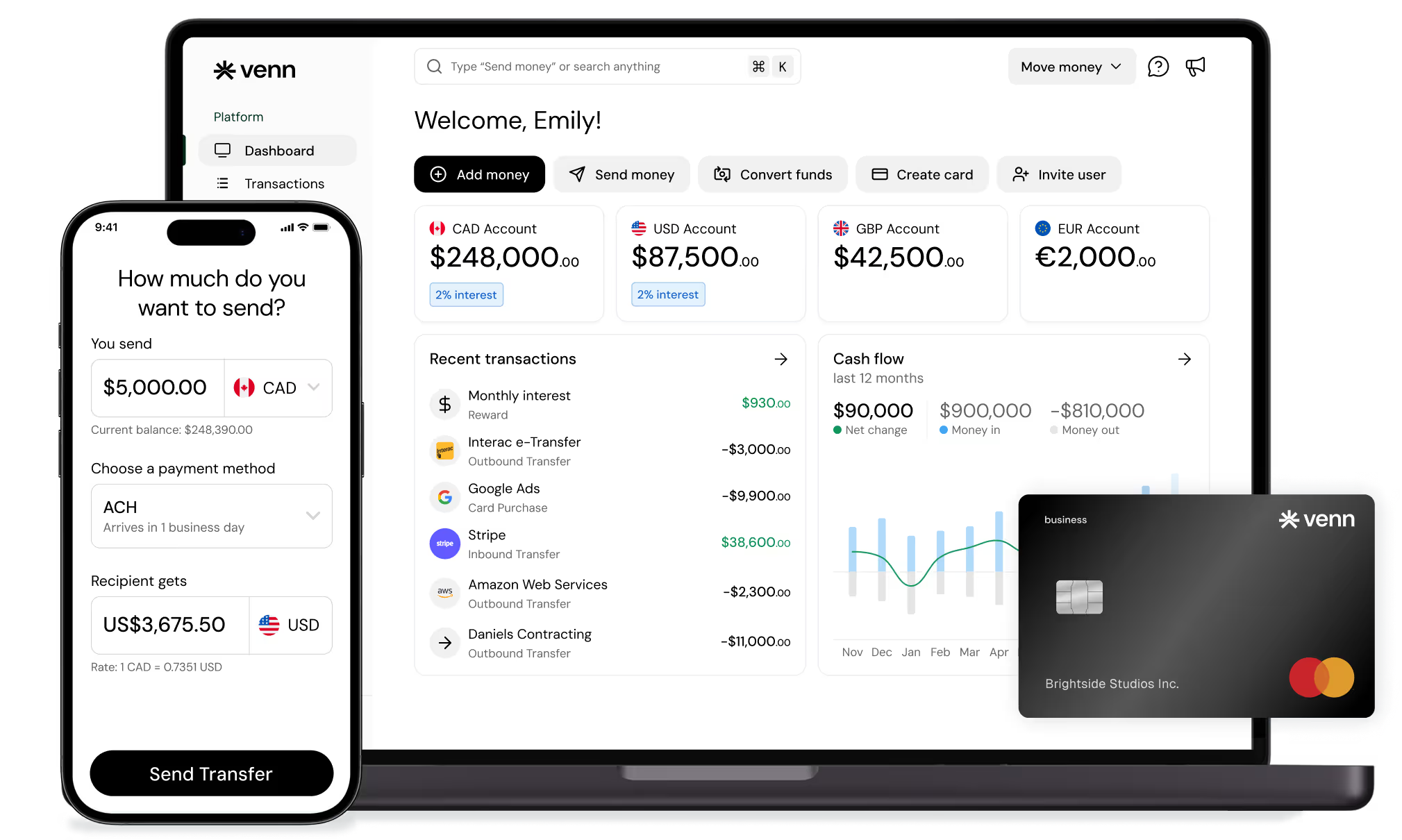
Venn functions as a complete business financial layer rather than a single-purpose tool. Canadian businesses get real local U.S. account details, including routing and account numbers, enabling both sending and receiving ACH payments. This capability remains rare among Canadian-focused providers.
The multi-currency architecture extends beyond USD. Local CAD accounts operate through Peoples Trust Company, meaning you can pay taxes, run payroll, and handle domestic obligations without maintaining a separate traditional bank account. Local GBP and EUR accounts enable SEPA and Faster Payments for businesses with European operations.
Pricing and FX
FX rates range from 0.25% to 0.45% depending on your plan, positioning Venn among the most competitive options available to Canadian businesses. ACH and EFT costs run $0-2 per transaction. Global wires cost $6-10. Interac e-Transfer® transactions are unlimited and free on all plans.
Corporate Card and Expense Management
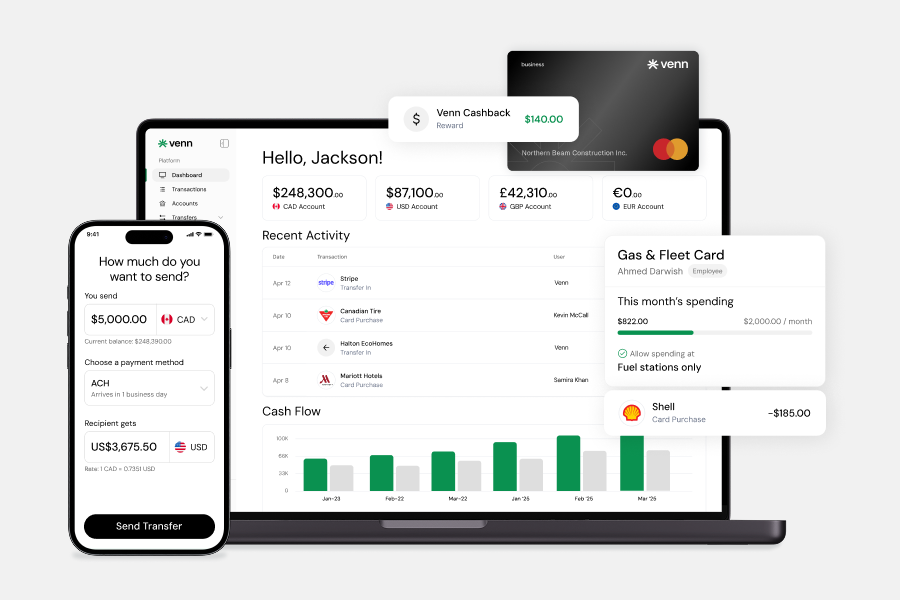
The Venn card earns 1% unlimited cashback with no minimum spend requirements. The card operates in multiple currencies, automatically using the currency you're paying in first, which eliminates unnecessary FX conversions on international purchases. On mobile, teams can access account funds, send transfers, and issue cards without leaving their phone.
Built-in expense management includes OCR receipt capture and invoice matching. Employees can submit expenses directly, and the data syncs to QuickBooks or Xero without manual entry.
Ideal Use Cases
• eCommerce sellers receiving USD payouts from Stripe or Shopify can deposit directly into their U.S. account, avoiding the 1.5% cross-border fee
• Agencies and SaaS companies billing U.S. clients can provide ACH payment instructions, improving collection speed and reducing payment friction
• Importers paying U.S. suppliers can send ACH payments at minimal cost instead of expensive wires
• Professional services firms paying U.S. contractors can automate recurring payments through the payables workflow
Venn also offers up to 3.5% interest (learn more) on USD and CAD balances with no minimum requirements, adding passive income to operational accounts.
RBC Bank (U.S.) (Best Traditional Cross-Border Option for Bank-Led Setup)
RBC Bank (U.S.) operates as a separate entity from RBC Royal Bank in Canada, specifically serving cross-border banking needs. Canadian businesses can open accounts that support ACH origination and receipt, providing legitimate U.S. banking rails.
The traditional bank structure appeals to businesses that prefer established institutions or need services like commercial lending alongside their deposit accounts. The cross-border relationship between RBC entities can simplify some administrative processes.
Considerations and Limitations
Monthly fees run approximately $150 for business accounts, significantly higher than fintech alternatives. The banking experience follows traditional patterns: branch visits may be required for certain transactions, and digital capabilities lag behind modern platforms.
This option makes sense for businesses already banking with RBC in Canada who want institutional continuity, or those requiring traditional banking services that fintechs don't offer.
Airwallex (Best for Multi-Currency Collections and Global Payout Operations)
Airwallex positions itself as a global payments infrastructure provider. Canadian businesses can access USD accounts with local U.S. details for receiving payments, plus collection accounts in numerous other currencies.
The platform excels at managing complex international payment flows. Businesses paying contractors across multiple countries or receiving payments from global marketplaces benefit from the consolidated view and batch payment capabilities.
Considerations and Limitations
Verify which specific rails are available for your Canadian entity and use case. Some features advertised globally may have restrictions for Canadian-incorporated businesses. The platform focuses primarily on payments rather than serving as a complete banking replacement, so you'll likely need additional accounts for domestic Canadian operations.
Payoneer (Best for Marketplaces and Cross-Border Seller Ecosystems)
Payoneer built its reputation serving Amazon sellers and freelancers receiving international payments. The platform integrates directly with major marketplaces, enabling automatic transfers of sales proceeds.
For businesses heavily invested in marketplace ecosystems, Payoneer's direct integrations reduce friction. The platform also handles mass payouts efficiently, useful for businesses paying large numbers of international contractors.
Considerations and Limitations
Fee structures can be complex, varying by payment method, currency, and withdrawal option. Conversion fees and receiving methods differ significantly depending on how funds arrive. Evaluate the total cost for your specific payment patterns rather than relying on headline rates.
Revolut Business (Best for Certain International Workflows)
Revolut Business offers multi-currency accounts and international payment capabilities. Canada appears among eligible residences for account opening, though specific requirements for Canadian-registered corporations warrant verification before committing.
The platform provides competitive FX rates and a modern interface. Businesses with diverse international payment needs may find the currency coverage useful.
Considerations and Limitations
Product availability and feature scope vary by region and entity type. Before relying on Revolut as your primary USD or ACH solution, confirm that the specific capabilities you need are available for Canadian corporations. Requirements and features have shifted over time, making direct verification essential.
U.S. Fintech Accounts (Mercury and Similar): Only If You Have a U.S. Entity
Mercury, Brex, and similar U.S. fintech banks appear frequently in searches for business banking alternatives. Their modern interfaces, startup-friendly features, and competitive pricing attract attention.
However, these platforms require U.S. formation. Mercury's eligibility requirements specify that the company must be formed or registered in the United States or a U.S. territory. A Canadian corporation, regardless of U.S. revenue or operations, doesn't qualify.
If you've incorporated a U.S. subsidiary, these platforms become viable options for that entity's banking needs. Otherwise, focus on providers that explicitly serve Canadian corporations.
Recommendations by Use Case (Decision Shortcuts)
Receiving ACH from U.S. customers: Venn provides the most complete solution for Canadian corporations, combining real U.S. account details with competitive FX and accounting integration. RBC Bank (U.S.) offers a traditional alternative if you prefer established banking relationships.
Paying U.S. contractors monthly: Venn's payables automation and low ACH fees ($0-2) make recurring payments efficient. The QuickBooks and Xero integrations eliminate double-entry.
eCommerce with Stripe or Shopify payouts: Venn's local U.S. account eliminates the 1.5% cross-border fee on payouts. You can hold USD until conversion makes sense or pay USD expenses directly.
Operating a U.S. subsidiary: Mercury or similar U.S. fintechs serve that entity well. Consider Venn for your Canadian parent company to manage cross-border treasury efficiently.
Total Cost Scenario Examples
Scenario 1: Agency receiving $25,000 USD monthly, paying 10 U.S. vendors
With a traditional Canadian bank USD account, expect approximately $170 in inbound wire fees (assuming some payments arrive via SWIFT), $250-400 in outbound wire fees for vendor payments, and 1.5-2.5% FX spread on conversions. Monthly cost: $500-1,000+.
With Venn, ACH receipts arrive free, vendor payments cost $0-20 total, and FX conversion costs 0.25-0.45%. Monthly cost: approximately $60-115.
Scenario 2: eCommerce brand with $50,000 weekly USD revenue
Stripe's cross-border payout fee (1.5%) costs $750 weekly or $3,000 monthly. Depositing to a Venn U.S. account eliminates this fee entirely. Even accounting for eventual CAD conversion at 0.25-0.45%, monthly savings exceed $2,500.
Conclusion: Build a Modern Cross-Border Stack
Selecting a U.S. bank alternative requires evaluating four factors in order: eligibility for Canadian corporations, access to real U.S. payment rails, transparent FX pricing, and integration with your accounting workflows.
The best solutions in 2026 go beyond holding USD. They connect payments, expense management, corporate cards, and accounting into a unified system that reduces manual work and closes books faster.
Venn serves as this operational hub for Canadian businesses managing cross-border finances. Multi-currency accounts, competitive FX, unlimited cashback on card spend, and direct accounting integrations create a complete financial stack rather than a collection of disconnected tools.
Ready to simplify your cross-border finances? Sign up for a Venn account and access real U.S. banking rails designed for Canadian businesses.
FAQ
Q: What's the difference between ACH and wire transfers for Canadian businesses?
A: ACH processes through the U.S. domestic payment network and typically costs $0–3 per transaction with 1–2 business day settlement. Wire transfers can move funds faster but usually cost $25–50 or more per transaction. Canadian businesses using Canada-based USD accounts often receive U.S. payments via SWIFT wire—even from U.S. senders—resulting in fees on both the sending and receiving sides.
Q: Can a Canadian business get a U.S. routing number?
A: Yes, through providers offering U.S.-domiciled accounts to Canadian corporations. Venn provides real U.S. routing and account numbers, enabling ACH send and receive capabilities. Traditional Canadian bank USD accounts typically do not include U.S. routing numbers.
Q: Do I need a U.S. address to open a U.S. account?
A: Requirements vary by provider. Venn and several other platforms serve Canadian corporations without requiring a U.S. address. Some U.S. fintech banks require U.S. incorporation, which typically involves maintaining a registered agent address.
Q: How do I avoid unnecessary FX conversions when getting paid in USD?
A: Maintain a U.S.-domiciled USD account and provide those details to American customers. Hold USD for paying U.S. expenses or convert to CAD only when needed. Platforms like Venn let you receive, hold, and spend USD without automatic conversion.
Q: What documents do platforms typically ask for?
A: Most platforms require articles of incorporation, proof of business address, and government-issued ID for directors and beneficial owners. Depending on anticipated transaction volume and risk profile, you may also need to provide recent financial statements or bank statements. Requirements vary by provider.
Venn safeguards all funds and is a registered PSP in Canada. Funds are covered under CDIC insurance protection and Venn is compliant with RPAA legislation.
Interac e-Transfer® is a registered trademark.
---
**Disclaimer:** This publication is provided for general information purposes and does not constitute legal, tax or other professional advice from Venn Software Inc or its subsidiaries and its affiliates, and it is not intended as a substitute for obtaining advice from a financial advisor or any other professional. We make no representations, warranties or guarantees, whether expressed or implied, that the content in the publication is accurate, complete or up to date.
This publication is provided for general information purposes only and does not constitute legal, tax, financial, or other professional advice from Venn Software Inc., its subsidiaries, or its affiliates, and is not a substitute for advice from a qualified professional. All comparisons and competitor information reflect publicly available information believed accurate as of March 3, 2026; features, pricing, rates, and terms referenced are subject to change and may differ at the time you read this. All product names, logos, and brands referenced are the property of their respective owners; their mention does not imply affiliation with or endorsement by Venn. Any comparative statements reflect Venn's views and are provided to help readers evaluate options. We make no representations, warranties, or guarantees, express or implied, that the content is accurate, complete, or up to date.

Venn is all-in-one business banking built for Canada
From free local CAD/USD accounts and team cards to the cheapest FX and global payments—Venn gives Canadian businesses everything they need to move money smarter. Join 15,000+ businesses today.
Frequently asked questions
Everything you need to know about the product and billing.
Join 15,000+ businesses banking with Venn today
Streamline your business banking and save on your spend and transfers today
No personal credit check or guarantee.