Manage Cash Flow for Small Businesses Selling Internationally
How to manage cash flow for small businesses selling internationally using 13 week forecasts, local payment rails, and FX controls built for Canadian firms.

Ahmed Shafik
Co-founder
.png)
Trusted by 15,000+ Canadian businesses
Business banking for Canada
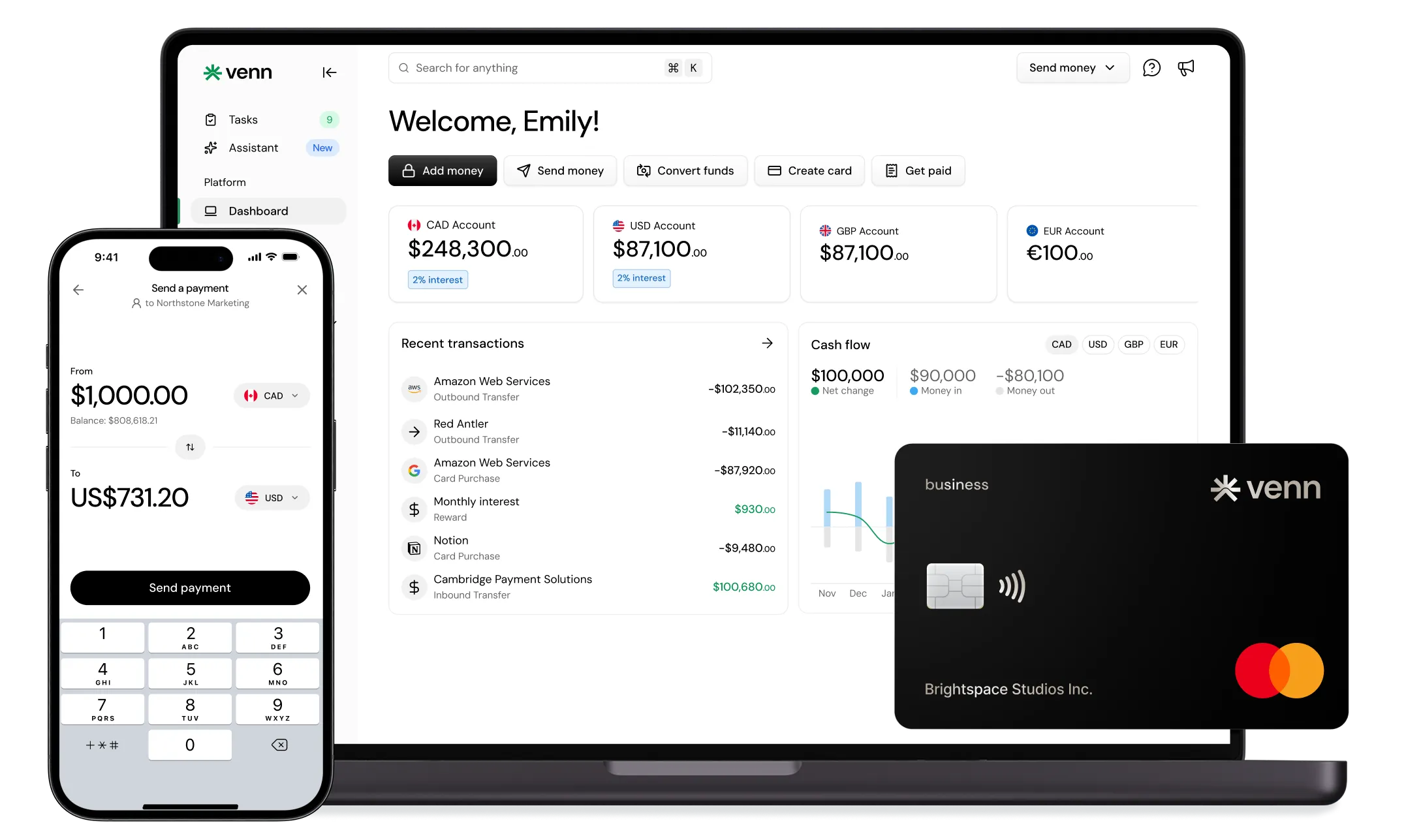
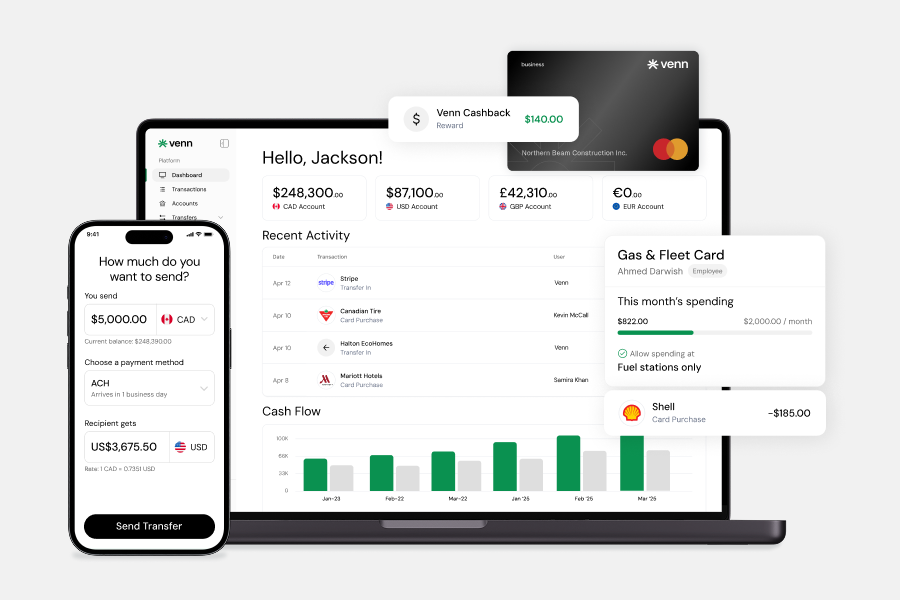
Local CAD and USD accounts, corporate cards with cashback, the lowest FX rates in Canada, free local transfers, and more.
Selling across borders opens revenue streams that domestic-only competitors can't access. It also introduces cash flow challenges they never face: settlement delays that stretch your cash conversion cycle, fees that chip away at margins on every transaction, and exchange rate swings that can erase profits overnight.
For Canadian small businesses selling internationally in 2026, managing cash flow requires more than spreadsheets and good intentions. You need a system that accounts for timing gaps, minimizes fee leakage, and provides visibility across multiple currencies.
This guide delivers that system. You'll learn how to diagnose where your cross-border cash flow breaks, build a rolling 13-week forecast that handles multi-currency complexity, get paid faster through smarter terms and collections, choose the right payment rails for each use case, and reduce FX exposure without hiring a treasury team.
The approach centers on building a modern financial stack where your banking layer, payment infrastructure, accounting software, and forecasting work together. Platforms like Venn, which provides multi-currency accounts, local payment rails, and direct accounting integrations, serve as the foundation for this kind of system.
1) Diagnose Where International Cash Flow Breaks
International selling creates three distinct pressure points that compound each other. Understanding these helps you prioritize fixes.
Timing Gaps
When you sell domestically, payment settlement is predictable. International transactions add variables: shipping times, customs clearance, longer payment terms demanded by overseas buyers, marketplace payout schedules, and chargeback windows that can freeze funds for weeks.
A product shipped to a US customer might take 5 days in transit, sit in customs for 2 days, then face a 14-day return window before the marketplace releases your payout. That's 21+ days of cash tied up before you see a dollar.
Fee Leakage
Every cross-border transaction attracts fees: wire transfer charges, intermediary bank deductions, card processing surcharges for international transactions, platform fees, and FX markups that often hide in the exchange rate itself. A single $10,000 USD payment can lose $150-300 to fees before reaching your Canadian account.
FX Volatility
When your costs are in CAD but revenue arrives in USD, EUR, or GBP, exchange rate movements directly impact margins. A 3% currency swing on $500,000 in annual foreign revenue equals $15,000 gained or lost, often without warning.
Your Cross-Border Cash Conversion Cycle
The Cash Conversion Cycle (CCC) measures how long cash is tied up in operations. For international sellers, the formula expands:
CCC = Days Sales Outstanding + Inventory Days + Shipping/Customs Days − Days Payable Outstanding
Consider an ecommerce business with 45-day DSO (invoice to payment), 30 days of inventory, 12 days for international shipping and customs, and 30-day supplier terms. Their CCC is 57 days. That means nearly two months of operating expenses need funding before revenue converts to usable cash.
Reducing any component of this equation improves cash flow. When businesses receive and pay using local rails (like ACH in the US or SEPA in Europe) rather than international wires, they often shave days off settlement times and improve cash visibility. This is where multi-currency accounts through platforms like Venn become operationally valuable.
2) Build a Rolling 13-Week Cash Forecast in Multiple Currencies
Static monthly forecasts miss the week-to-week cash crunches that sink businesses. A rolling 13-week forecast provides enough runway to spot problems and enough granularity to act on them.
What to Forecast Weekly
Inflows by channel: marketplace payouts, card payment settlements, invoice payments, subscription renewals, refund reversals.
Outflows by category: supplier payments, payroll, duties and taxes, shipping costs, software subscriptions, advertising spend, refund reserves.
Separate committed cash movements (invoices sent, orders placed) from forecasted ones (expected sales, anticipated renewals). Committed items get higher confidence weighting.
Handling Multi-Currency Complexity
Track currency exposure by week. If you expect $50,000 USD inflow and €15,000 EUR outflow in week 6, record both in their native currencies plus a CAD-equivalent column.
Use a "budget rate" for forecasting, a conservative exchange rate assumption that protects against unpleasant surprises. Compare against actual rates achieved to measure variance.
3) Get Paid Faster: Invoice Terms, Deposits, and Collections
Improving collections velocity directly shortens your cash conversion cycle. The tactics vary by business model.
Billing Models by Business Type
Professional services: Require 30-50% deposits before work begins. Structure milestone payments tied to deliverables. Include clear change-order policies that trigger additional deposits.
SaaS businesses: Offer annual prepay discounts (15-20% off) to pull forward cash. Implement automated dunning sequences that trigger before and after payment failures.
Ecommerce: Set aside refund reserves based on historical return rates. Negotiate faster marketplace payout schedules where possible. Consider payment processors with faster settlement.
Payment Terms That Protect Cash Flow
Net 30 remains standard for established relationships. For new international customers, start with Net 15 or require payment before shipping. Net 60-90 terms should be reserved for high-volume buyers who justify the cash flow cost.
Early payment discounts (2/10 Net 30, meaning 2% discount for payment within 10 days) can accelerate collections. Late payment fees are harder to enforce internationally but establish expectations.
Collections Workflow Template
Day 1 (Invoice date): Send invoice with clear payment instructions including your banking details for their region.
Day 21 (9 days before due): Friendly reminder with invoice attached and payment link.
Day 32 (2 days past due): Firm reminder noting the overdue status and requesting immediate payment.
Day 45 (15 days past due): Final notice indicating potential service suspension or collections action.
Day 60: Escalate to collections or write off based on amount and relationship value.
Using local receiving accounts reduces payment friction. A US customer paying to a US account via ACH faces less friction than initiating an international wire, which often means faster payment.
4) Cross-Border Payment Methods: Choose Rails That Match Your Use Case
Not all payment methods serve the same purpose. Your choice should balance speed, cost, reconciliation effort, and risk.
| Payment Method | Best For | Typical Speed | Fee Types | FX Impact | Chargeback Risk | Reconciliation |
|---|---|---|---|---|---|---|
| Wire (SWIFT) | High-value, low-frequency | 1–5 business days | $15–50 + intermediary fees | High (bank FX rates) | None | Moderate |
| ACH (US) | Regular US payments | 1–3 business days | $0–5 | Low if USD account | None | Easy |
| SEPA (EU) | European payments | 1–2 business days | €0–2 | Low if EUR account | None | Easy |
| Faster Payments (UK) | UK payments | Same day | £0–2 | Low if GBP account | None | Easy |
| Card payments | Consumer sales, subscriptions | 1–3 business days | 2.5–3.5% + FX fee | Moderate | High | Easy |
| Marketplace payouts | Platform sales | 7–14+ days | Platform fees | Varies | Platform-managed | Platform-dependent |
| Interac e-Transfer® | Canadian payments | Same day | $0–1.50 | None | Low | Easy |
The rule of thumb: Use local rails whenever possible. Reserve international wires for high-value, low-frequency payments where speed justifies cost.
Venn enables Canadian businesses to access local payment infrastructure that's typically unavailable: a real local US account that can send and receive ACH, plus local GBP and EUR accounts for SEPA and Faster Payments. This means your US customers pay you like a domestic vendor, and your European suppliers receive payment without wire fees.
The platform offers global wires from $6-10 depending on plan, ACH and EFT transfers from $0-2, transfers to 180 countries in 36+ currencies, and free unlimited Interac e-Transfer® on all plans.
Sign up for a Venn account to access local payment rails across your key markets.
5) Reduce FX Fees and Manage Currency Risk
FX costs compound silently. A 2% markup on every conversion, applied to $300,000 in annual foreign revenue, costs $6,000 per year. Most businesses don't track this.
Identify Your FX Exposure
Start with three questions:
• What percentage of revenue arrives in USD, EUR, GBP, or other currencies?
• What percentage of costs are paid in those same currencies?
• How often do you convert between currencies, and why?
If 60% of revenue is USD and 40% of costs are USD, you have natural matching. If 60% of revenue is USD but only 10% of costs are USD, you're converting constantly and bleeding fees.
Natural Hedging First
Before considering financial hedges, optimize operationally:
Match currencies where possible. Pay USD suppliers with USD revenue. Pay EUR contractors with EUR income.
Maintain multi-currency balances. Keep operating reserves in currencies you regularly spend rather than converting everything to CAD.
Time conversions strategically. Convert larger amounts less frequently rather than small amounts constantly.
When to Consider Hedging
Formal hedging (forward contracts, options) makes sense when FX swings could materially impact margins. A rough threshold: if a 5% currency movement would eliminate more than 20% of your margin on the next 90 days of receivables or payables, hedging deserves evaluation.
For most small businesses, natural hedging through multi-currency accounts handles 80% of the exposure. Venn's multi-currency accounts and card (which automatically uses the currency you're paying in first) reduce unnecessary conversions and help preserve margins.
Sign up for a Venn account to reduce FX conversions across your operations.
6) Control Outflows: Pay Suppliers, Payroll, and Taxes Strategically
Cash flow management isn't just about getting paid faster. Controlling when and how money leaves matters equally.
Build an Outflow Calendar
Map every recurring payment: payroll dates, tax deadlines (GST/HST remittances, corporate installments, US sales tax), supplier payment terms, subscription renewals, and annual expenses.
Identify clusters where multiple payments hit the same week. Negotiate payment dates with suppliers to smooth cash requirements across the month.
Payables Automation
Manual bill payment creates errors and delays reconciliation. Automating payables from your accounting system reduces both.
Venn integrates directly with QuickBooks and Xero, enabling automated payables workflows. OCR receipt capture and invoice matching reduce admin time while improving cash visibility. You see what's owed, what's paid, and what's pending in real time rather than waiting for month-end reconciliation.
7) Use Corporate Cards Strategically for Working Capital
Corporate cards extend your cash runway by shifting expenses from immediate payment to statement cycles. Used strategically, they also simplify tracking and reduce reimbursement friction.
What to Look For
Multi-currency support: Cards that transact in the local currency without automatic conversion avoid double FX hits.
Expense management features: Real-time spend visibility, receipt capture, and category coding reduce month-end chaos.
Rewards that scale: Many card programs gate meaningful rewards behind spend thresholds that small businesses can't reach.
Venn's card offers 1% unlimited cashback with no minimum spend requirements, providing a predictable offset to operating costs. The multi-currency card uses the transaction currency first (spending USD when you have USD balance), reducing unnecessary conversions. Pricing is per account rather than per user, making it practical for growing teams.
8) Stack Blueprint: A Modern Financial System for International Selling
Individual tools solve individual problems. A connected stack solves cash flow systematically.
Recommended Components
Banking layer: Multi-currency accounts, local payment rails, corporate cards, and expense management. This is your operational foundation.
Accounting: QuickBooks or Xero for bookkeeping, reporting, and tax preparation.
Commerce and payments: Stripe, Shopify, or PayPal depending on your sales channels.
Forecasting: Rolling 13-week cash model updated weekly.
How It Works by Business Type
Ecommerce: Collect USD from US marketplaces into a USD account. Pay US suppliers in USD. Convert only what you need for CAD expenses. Reconcile automatically through accounting integrations.
SaaS: Invoice in USD to reduce customer friction. Hold USD for US-based contractors and software subscriptions. Sync subscription revenue and expenses to accounting automatically.
Professional services: Use milestone billing with deposits. Accept payment via local rails (ACH for US clients, SEPA for European). Track project profitability in real time.
Why Venn Fits
Venn serves as the banking layer in this stack: local accounts in CAD, USD, GBP, and EUR; global transfers to 180 countries; 1% unlimited cashback card; direct QuickBooks and Xero integration; and free unlimited Interac e-Transfer®. It's the infrastructure that makes the rest of the stack work together.
Conclusion
Managing cash flow for international selling comes down to five disciplines: forecast accurately in multiple currencies, accelerate collections through better terms and processes, choose payment rails that match each use case, reduce FX leakage through natural hedging and multi-currency accounts, and systematize outflows to avoid surprises.
The businesses that execute this well don't just survive international expansion. They use it as a competitive advantage, operating with better margins and more predictable cash than competitors still wrestling with wire transfers and manual reconciliation.
Building this system requires the right infrastructure. A business banking platform designed for multi-currency operations, like Venn, provides the foundation: local accounts, competitive FX, integrated expense management, and accounting automation.
Sign up for a Venn account to build your international cash flow system.
FAQ
Q: Should I invoice international customers in CAD or their local currency?
A: Invoice in your customer's local currency when possible. It reduces friction for them and often accelerates payment. Use a multi-currency account (such as USD, EUR, or GBP accounts) to receive and hold funds without forced conversion.
Q: What's the fastest way to receive US payments as a Canadian business?
A: The fastest way to receive US payments is to use a US-dollar account with local US banking details that support ACH transfers. ACH payments typically settle within 1–3 business days and cost significantly less than international SWIFT wires. Using a multi-currency account with US routing and account numbers allows you to receive funds like a local business without cross-border delays.
Q: How do I reduce FX fees when getting paid in USD?
A: Hold USD in a USD account rather than converting immediately. Pay USD expenses from that balance. Convert only what you need for CAD obligations, and do so in larger batches rather than small, frequent conversions.
Q: How do I forecast cash flow with multiple currencies?
A: Track inflows and outflows by currency, then apply a conservative “budget rate” when estimating CAD equivalents. Compare actual exchange rates achieved to your budget rates monthly to measure variance and refine your assumptions over time.
Q: When does FX hedging make sense for a small business?
A: Consider hedging when currency swings could materially impact margins—for example, when a 5% FX movement would eliminate 20% or more of your margin on 90 days of receivables or payables. For most small businesses, natural hedging through multi-currency accounts manages the majority of exposure without complex instruments.
---
**Disclaimer:** This publication is provided for general information purposes and does not constitute legal, tax or other professional advice from Venn Software Inc or its subsidiaries and its affiliates, and it is not intended as a substitute for obtaining advice from a financial advisor or any other professional. We make no representations, warranties or guarantees, whether expressed or implied, that the content in the publication is accurate, complete or up to date.
This publication is provided for general information purposes only and does not constitute legal, tax, financial, or other professional advice from Venn Software Inc., its subsidiaries, or its affiliates, and is not a substitute for advice from a qualified professional. All comparisons and competitor information reflect publicly available information believed accurate as of February 24, 2026; features, pricing, rates, and terms referenced are subject to change and may differ at the time you read this. Competitor information is drawn from publicly available sources and has not been independently verified by Venn — we encourage readers to confirm current details directly with each provider. All product names, logos, and brands referenced are the property of their respective owners; their mention does not imply affiliation with or endorsement by Venn. Any comparative statements reflect Venn's views and are provided to help readers evaluate options. We make no representations, warranties, or guarantees, express or implied, that the content is accurate, complete, or up to date.
This publication is provided for general information purposes only and does not constitute legal, tax, financial, or other professional advice from Venn Software Inc., its subsidiaries, or its affiliates, and is not a substitute for advice from a qualified professional. All comparisons and competitor information reflect publicly available information believed accurate as of February 24, 2026; features, pricing, rates, and terms referenced are subject to change and may differ at the time you read this. Competitor information is drawn from publicly available sources and has not been independently verified by Venn — we encourage readers to confirm current details directly with each provider. All product names, logos, and brands referenced are the property of their respective owners; their mention does not imply affiliation with or endorsement by Venn. Any comparative statements reflect Venn's views and are provided to help readers evaluate options. We make no representations, warranties, or guarantees, express or implied, that the content is accurate, complete, or up to date.

Venn is all-in-one business banking built for Canada
From free local CAD/USD accounts and team cards to the cheapest FX and global payments—Venn gives Canadian businesses everything they need to move money smarter. Join 15,000+ businesses today.
Frequently asked questions
Everything you need to know about the product and billing.
Join 15,000+ businesses banking with Venn today
Streamline your business banking and save on your spend and transfers today
No personal credit check or guarantee.