The Best No Fee Business Credit Card for Canadians in 2026
The Best No Fee Business Credit Card for Canadians in 2026 compared. Review rewards, FX fees, employee cards, payment fees, and expense tools to cut costs.

Ahmed Shafik
Co-founder

Trusted by 15,000+ Canadian businesses
Business banking for Canada
Local CAD and USD accounts, corporate cards with cashback, the lowest FX rates in Canada, free local transfers, and more.
Finding the right business credit card without an annual fee can save your company hundreds of dollars each year while still delivering valuable rewards and features. But "no annual fee" doesn't always mean "no cost." Many cards marketed as free still charge foreign transaction fees, employee card fees, and other expenses that can quickly add up for Canadian businesses.
This guide compares the top no annual fee business credit card options available to Canadian businesses in 2026, including traditional bank cards and modern business banking platforms. We'll help you understand the true cost of each option and match the right card to your business needs.
Quick Take: What "No Fee" Usually Means (and What It Doesn't)
When we say "no fee business credit card," we're specifically referring to cards with no annual fee. This is the most common fee business owners want to avoid, and it's the baseline requirement for every option in this guide.
However, no annual fee doesn't mean no costs. Most cards still charge foreign transaction fees when you pay suppliers in USD or other currencies. Some charge for employee cards, cash advances, late payments, or wire transfers. The real cost of a "free" card depends on how your business spends money and manages payments.
No Annual Fee Business Card Options at a Glance
How We Chose These Cards (Methodology)
We evaluated no annual fee business cards based on several criteria that matter to Canadian businesses:
Eligibility for Canadian businesses. Every option accepts applications from Canadian sole proprietors, partnerships, or corporations operating in Canada.
True "no annual fee" status. We focused on cards that genuinely charge $0 annually, not promotional offers that waive fees temporarily.
Reward value and simplicity. We considered both the earning rate and how easy it is to understand and use the rewards program.
Cost transparency. We examined the full fee schedule, including foreign transaction fees, employee card costs, and payment processing fees.
Expense management capabilities. We evaluated features like receipt capture, accounting integrations, and team spending controls.
Support for CAD versus USD spending. We assessed how each option handles cross-border payments and multi-currency operations, a critical consideration for many Canadian businesses.
Best No Annual Fee Business Credit Cards in Canada (2026 List)
RBC Business Cash Back Mastercard
RBC offers a straightforward cash back card with no annual fee, backed by one of Canada's largest banks.
Best for: Businesses that value a traditional banking relationship and want simple cash back rewards without complexity.
Standout features: The card delivers 1% cash back on eligible purchases with no annual fee. As an RBC product, it integrates with RBC business banking services and provides access to branch support across Canada. The application process is familiar to businesses already banking with RBC.
Potential drawbacks: The 2.5% foreign transaction fee significantly increases costs when paying USD suppliers or international vendors. Employee cards may carry additional fees. Expense management features are limited compared to modern platforms, requiring separate tools for receipt tracking and accounting reconciliation.
Fees to confirm before applying: Foreign transaction fees (2.5%), employee card fees, cash advance fees, interest rates on carried balances, and late payment charges.
Who should choose it: Businesses with primarily domestic CAD spending that want the stability and familiarity of a major Canadian bank.
TD Business Travel Visa
TD's no annual fee business card focuses on travel rewards through the TD Points program.
Best for: Businesses that frequently book travel and want to earn points without paying an annual fee.
Standout features: Earn TD Points on all purchases, which can be redeemed for travel, merchandise, or gift cards. The card includes travel insurance benefits and integrates with TD business banking accounts. No annual fee makes it accessible for businesses just starting to build credit.
Potential drawbacks: Points-based rewards require more effort to maximize value compared to straightforward cash back. The 2.5% foreign transaction fee applies to all non-CAD purchases. Travel rewards may not align with businesses that rarely travel or prefer cash back simplicity.
Fees to confirm before applying: Foreign transaction fees (2.5%), employee card fees, interest rates, and any fees associated with points redemption.
Who should choose it: Businesses that book regular travel and prefer points flexibility over cash back, with primarily domestic spending patterns.
Venn (Business Banking Platform + Card for Cash Back and Multi-Currency Operations)
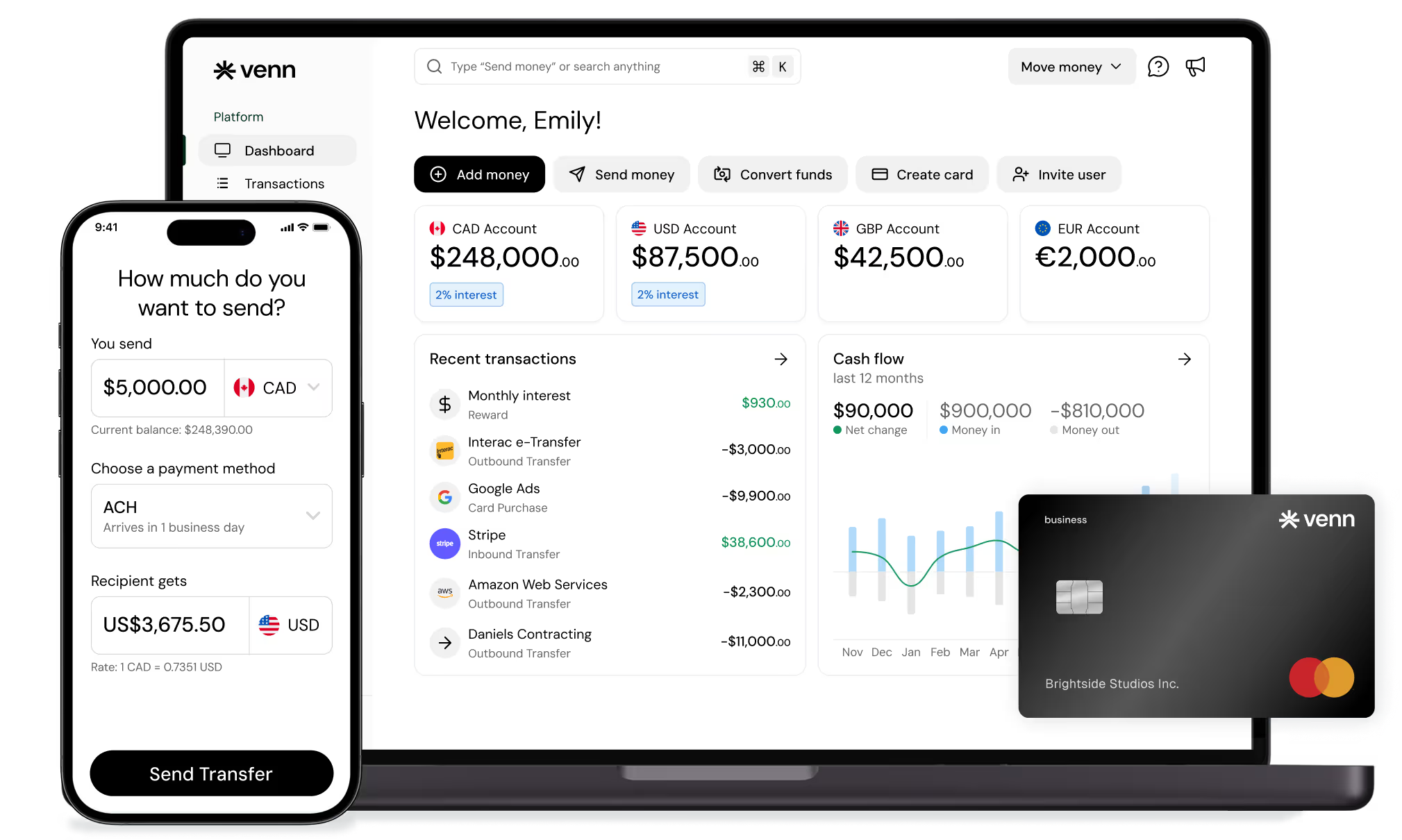
Venn is a Canadian business banking platform that combines accounts, payments, and a business card designed for companies operating across currencies.
Best for: Businesses managing multi-currency operations, paying USD suppliers, or needing integrated expense management and accounting workflows.
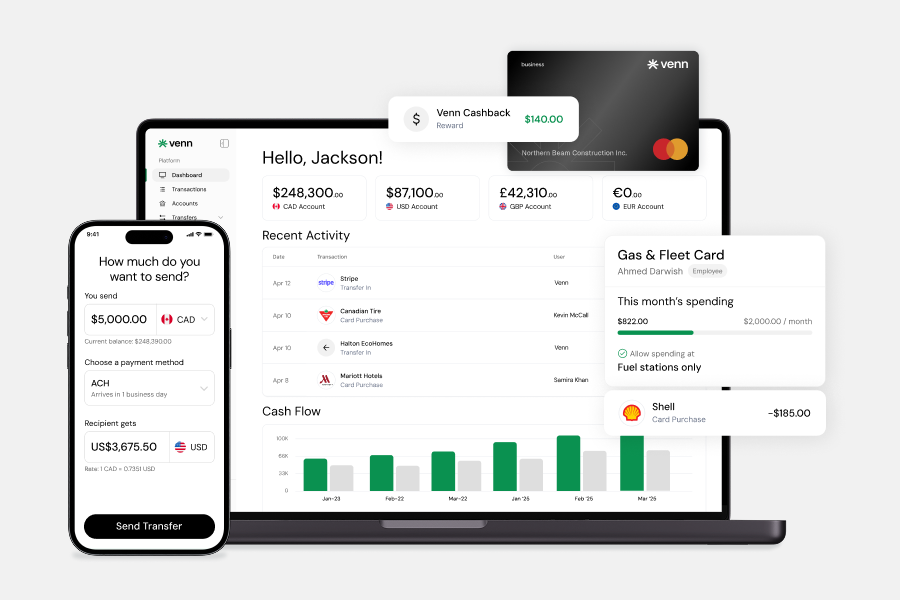
Standout features: Venn offers 1% unlimited cash back on all card purchases with no annual fee option. The platform provides local CAD and USD accounts that can send and receive ACH transfers, a rare capability among Canadian providers. Businesses also gain access to local GBP and EUR accounts enabling Faster Payments and SEPA transfers, avoiding expensive wire fees for international payments.
The multi-currency card automatically uses the currency you're paying in first, eliminating unnecessary foreign exchange conversions. FX markups range from 0.25% to 0.45% depending on your plan, significantly lower than traditional bank rates of 2.5% or higher.
Venn integrates directly with QuickBooks and Xero, offering OCR receipt capture and invoice matching to streamline accounting work. The platform enables free unlimited Interac e-Transfer® payments for vendor payments, and pricing is per account rather than per user, making it cost-effective for growing teams. From the mobile app, teams can check available funds, send transfers, and issue cards directly from their phones.
Potential drawbacks: Venn operates as a business banking platform rather than a traditional revolving credit card product. Businesses seeking conventional credit terms should verify the payment structure aligns with their needs. The platform works best for companies with cross-border operations or multi-currency requirements; purely domestic businesses may not need the full feature set.
Fees to confirm before applying: Plan-based pricing for transfers (ACH/EFT costs $0-2, global wires $6-10 depending on plan), FX markup rates (0.25%-0.45% based on plan), and any account maintenance fees.
Who should choose it: Teams wanting an integrated spend and payments workflow, especially businesses paying USD suppliers, receiving Stripe or Shopify payouts, managing contractors internationally, or needing robust expense management alongside their business card.
Scotiabank Business Advantage Card
Scotiabank's no annual fee option focuses on Scene+ rewards, appealing to businesses that use the Scene+ ecosystem.
Best for: Businesses that can maximize Scene+ points through partner spending and redemptions.
Standout features: Earn Scene+ points on purchases, which can be redeemed at Scotiabank partners including Cineplex, Sobeys, and other retailers. No annual fee makes it accessible for small businesses. Integration with Scotiabank business banking provides a unified banking experience.
Potential drawbacks: Scene+ points have limited appeal outside the partner network. The 2.5% foreign transaction fee applies to all USD and international purchases. Expense management features require third-party tools. Employee card fees may apply.
Fees to confirm before applying: Foreign transaction fees (2.5%), employee card costs, interest rates, and Scene+ program terms.
Who should choose it: Businesses that regularly spend with Scene+ partners and prefer points over cash back, with minimal cross-border payment needs.
BMO Business Cash Back Mastercard
BMO offers a tiered cash back structure with no annual fee, rewarding higher spending in specific categories.
Best for: Businesses with concentrated spending in categories that earn higher cash back rates.
Standout features: Tiered cash back rewards different spending categories at varying rates. No annual fee keeps costs low. BMO's business banking integration provides a complete banking relationship. The card includes purchase protection and extended warranty coverage.
Potential drawbacks: Tiered rewards require tracking spending categories to maximize value. The 2.5% foreign transaction fee impacts businesses with USD suppliers. Employee cards may carry additional fees. Expense tracking requires separate software.
Fees to confirm before applying: Foreign transaction fees (2.5%), employee card fees, interest rates, and category-specific earning caps or limitations.
Who should choose it: Businesses with predictable spending patterns in high-earning categories, primarily operating in CAD.
How to Compare No Annual Fee Business Cards (A Practical Checklist)
Rewards: Simple Cash Back vs Points
Cash back wins when you want predictability and simplicity. You earn a percentage back on every purchase, and the value is transparent. Smaller teams often prefer cash back because it requires no strategy or redemption planning.
Points can deliver higher value when you frequently travel or shop with program partners. However, points valuations vary significantly based on redemption choices. A point worth 1 cent toward travel might be worth only 0.5 cents toward merchandise. Calculate the realistic value based on how you'll actually redeem points, not theoretical maximum values.
The "No Annual Fee" Fine Print Audit (Fees That Still Matter)
Foreign transaction fees and FX markup represent the largest hidden cost for many Canadian businesses. Traditional banks typically charge 2.5% on every USD or international purchase. If you spend $50,000 USD annually on software, ads, or suppliers, that's $1,250 in fees. Platforms with lower FX markups (0.25%-0.45%) can save thousands annually for businesses with cross-border spending.
Interest rates matter if you carry balances month to month. Business credit cards often charge 19%-21% APR. Calculate the true cost of financing purchases through your card versus other options.
Employee card fees add up quickly. Some banks charge $50-100 per additional card annually. If you have five team members, that's $250-500 in fees that eliminate the "no annual fee" benefit.
Cash advance fees typically run 3%-5% plus immediate interest charges. Avoid using business cards for cash advances.
Late payment fees range from $25-50 per occurrence and can trigger penalty interest rates.
Wire transfer fees for international payments often cost $15-30 per transaction at traditional banks. Businesses making frequent international payments should consider platforms with lower wire costs or alternative transfer methods.
FX and Cross-Border: The Make-or-Break for Many Canadian Businesses
Canadian businesses face foreign exchange costs constantly. You pay USD for software subscriptions, advertising platforms, cloud services, and international suppliers. You might receive USD revenue through Stripe, Shopify, or PayPal.
Paying USD with a CAD card triggers two costs: the foreign transaction fee (typically 2.5%) and the FX conversion markup. A $10,000 USD payment could cost $250 in fees alone, before considering unfavorable exchange rates.
Holding USD in a local US account and paying directly eliminates these conversion costs. However, most Canadian banks offer "US accounts" that are actually based in Canada, meaning you cannot send or receive ACH transfers and still pay wire fees for US-to-US transfers.
Platforms that provide true local US accounts enable ACH transfers, avoiding wire fees and reducing payment times from 3-5 days to same or next business day. This capability matters for businesses paying US contractors, suppliers, or managing US revenue streams.
The same logic applies to GBP and EUR operations. Local accounts enabling Faster Payments and SEPA transfers are cheaper and faster than international wires.
Team Spend: Controls, Receipts, and Reconciliation
Free employee cards only matter if they come with proper controls. Can you set spending limits per card? Can you restrict categories or merchants? Can you turn cards on and off instantly?
Receipt capture and bookkeeping workflow determine how much time your team spends on expense management. Manual receipt collection and entry costs hours each month. OCR receipt capture automatically extracts data from photos. Invoice matching connects card transactions to bills in your accounting system.
QuickBooks and Xero integrations sync transactions automatically, eliminating manual data entry. Verify integration depth before choosing a card. Some "integrations" only export CSV files, while others sync transactions, categorize spending, and match receipts in real-time.
What Counts as a "Business" in Canada (Eligibility Basics)
Sole Proprietor vs Corporation: What You Typically Need
Most business credit cards accept applications from sole proprietors, partnerships, and corporations. You'll typically need:
• Business name and operating address
• Nature of business and industry
• Estimated monthly or annual spending
• Business Number (BN) from CRA, though some issuers accept sole proprietors without formal registration
• Owner identification and personal information
Sole proprietors often apply using their Social Insurance Number and personal credit history. Corporations may need to provide incorporation documents and business financial information.
Credit Score Considerations
Business credit cards for small businesses typically rely on the owner's personal credit score for approval decisions. Issuers evaluate both personal creditworthiness and business financial health.
Check specific issuer requirements before applying. Some cards require minimum credit scores or time in business. Don't assume approval based on business revenue alone.
Recommendations by Scenario (Help Readers Self-Select)
Freelancer with low monthly spend: Choose simple cash back with no annual fee and minimal administrative overhead. RBC or BMO cash back cards work well if you spend primarily in CAD. Venn makes sense if you pay USD suppliers or want integrated invoicing and payment tools.
Marketing-heavy startup paying USD for ads: FX costs will dominate your card expenses. A platform with low FX markups (0.25%-0.45%) and multi-currency capabilities saves significantly more than higher cash back rates. Venn's multi-currency card and local USD account eliminate conversion fees on ad spend.
Team of 10+ managing receipts: Expense management features matter more than reward rates. Look for free employee cards, OCR receipt capture, and direct accounting integrations. Venn's per-account pricing and QuickBooks/Xero integration streamline team expense workflows.
Importer/exporter managing international payments: Local currency accounts and low-cost transfer options reduce payment friction. Traditional bank wires cost $15-30 per transaction. Platforms offering ACH, SEPA, and Faster Payments at $0-10 per transfer save thousands annually on payment fees alone.
Professional services with predictable spending: Simple cash back and clean reconciliation matter most. Choose based on your primary spending currency and whether you need team cards. Traditional bank cards work well for domestic operations; multi-currency platforms suit cross-border client work.
Conclusion
The best no annual fee business credit card for your Canadian business depends on how you spend money, where your suppliers are located, and what administrative tools you need.
Start by confirming the card truly charges no annual fee, then audit the real costs: foreign transaction fees, employee card fees, and payment processing charges. Match rewards to your actual spending profile rather than theoretical maximum values. Choose an administrative experience you can maintain without adding hours of manual work each month.
For businesses operating across currencies, paying USD suppliers, or managing team expenses, platforms that combine cards with accounts and accounting workflows often deliver more value than traditional credit cards alone. Evaluate your complete payment and expense management needs, not just the card in isolation.
FAQs
Q: What is the best no annual fee business credit card in Canada for 2026?
A: There is no single best no annual fee business credit card for every company. The right choice depends on your spending patterns, currency exposure, and administrative needs. Businesses with primarily domestic CAD spending often consider traditional bank cash back cards from institutions like RBC or BMO. Companies managing USD suppliers, cross-border payments, or team expenses may benefit from platforms like Venn that combine corporate cards with multi-currency accounts and built-in expense management tools. Evaluate total cost carefully, including foreign exchange (FX) fees, employee card fees, and administrative overhead.
Q: Do no annual fee business cards still charge foreign transaction fees?
A: Yes, most traditional bank-issued business credit cards charge approximately 2.5% in foreign transaction fees on non-CAD purchases. This fee applies when paying USD suppliers, purchasing international software subscriptions, or transacting in other currencies. Some modern financial platforms offer lower FX markups (often 0.25%–0.45%) or allow payments directly from local currency accounts to reduce or eliminate conversion fees. Calculate your total annual USD and international spending to determine whether FX fees outweigh other card benefits.
Q: Can I get a business credit card as a sole proprietor in Canada?
A: Yes, most business credit card issuers in Canada accept applications from sole proprietors. You can typically apply using your personal information and Social Insurance Number instead of formal incorporation documents. Issuers usually assess your personal credit score and may request information about business revenue and projected spending. Eligibility criteria vary by issuer, so confirm specific requirements before applying.
Q: Is a corporate or charge card the same as a business credit card?
A: No, they differ in repayment structure and underwriting. A traditional business credit card provides revolving credit, allowing you to carry a balance month to month while paying interest. A charge card generally requires full payment of the statement balance each billing cycle. Corporate cards may also offer enhanced spending controls, reporting features, and underwriting based on company financials rather than personal credit. Always review repayment terms and approval criteria before selecting a card.
Q: What’s the easiest way to track receipts and expenses?
A: The simplest approach is to choose a card or financial platform with built-in expense management tools. Look for OCR receipt capture that automatically extracts data from receipt photos, reducing manual entry. Direct integrations with accounting software like QuickBooks or Xero can sync transactions in real time and enable automatic categorization. Some platforms also match card transactions to invoices, simplifying reconciliation. Compare the depth of accounting integrations carefully, as some solutions only provide basic CSV exports while others offer full two-way syncing.
Legal Disclaimer: Venn is a Canadian business banking platform. Funds are safeguarded and covered under CDIC insurance protection. Venn is a registered Payment Service Provider in Canada, compliant with RPAA legislation. Venn Mastercard Charge Card is issued by Peoples Trust Company under licence from Mastercard International Incorporated. Mastercard is a registered trademark, and the circles design is a trademark of Mastercard International Incorporated. Interac e-Transfer® is a registered trademark of Interac Corp.
---
**Disclaimer:** This publication is provided for general information purposes and does not constitute legal, tax or other professional advice from Venn Software Inc or its subsidiaries and its affiliates, and it is not intended as a substitute for obtaining advice from a financial advisor or any other professional. We make no representations, warranties or guarantees, whether expressed or implied, that the content in the publication is accurate, complete or up to date.
This publication is provided for general information purposes only and does not constitute legal, tax, financial, or other professional advice from Venn Software Inc., its subsidiaries, or its affiliates, and is not a substitute for advice from a qualified professional. All comparisons and competitor information reflect publicly available information believed accurate as of February 11, 2026; features, pricing, rates, and terms referenced are subject to change and may differ at the time you read this. Competitor information is drawn from publicly available sources and has not been independently verified by Venn — we encourage readers to confirm current details directly with each provider. All product names, logos, and brands referenced are the property of their respective owners; their mention does not imply affiliation with or endorsement by Venn. Any comparative statements reflect Venn's views and are provided to help readers evaluate options. We make no representations, warranties, or guarantees, express or implied, that the content is accurate, complete, or up to date.

Venn is all-in-one business banking built for Canada
From free local CAD/USD accounts and team cards to the cheapest FX and global payments—Venn gives Canadian businesses everything they need to move money smarter. Join 15,000+ businesses today.
Frequently asked questions
Everything you need to know about the product and billing.
Join 15,000+ businesses banking with Venn today
Streamline your business banking and save on your spend and transfers today
No personal credit check or guarantee.