How to transfer money between banks in Canada fast
How to transfer money between banks in Canada with Interac e-Transfer, EFT, wires and linked accounts. Compare fees, limits and timelines for business.

Ahmed Shafik
Co-founder
Trusted by 15,000+ Canadian businesses
Business banking for Canada
Local CAD and USD accounts, corporate cards with cashback, the lowest FX rates in Canada, free local transfers, and more.
Transferring money between banks in Canada sounds straightforward until you actually need to do it under pressure. A supplier invoice is due today. A contractor needs payment before the weekend. You need to move operating funds between your business accounts at two different institutions. Suddenly, the method you choose matters quite a bit.
The right approach depends on several factors: how urgently the funds need to arrive, the amount involved, whether the recipient is a person or a business, and whether the transfer is domestic or crosses a border. Most Canadian businesses end up using a mix of methods depending on the situation, commonly Interac e-Transfer®, electronic funds transfer (EFT), wire transfers, and linked account transfers between their own accounts.
Each method works differently, carries different fees and limits, and settles on its own timeline. This guide breaks down how each one works, what information you need to send a transfer, how long it typically takes, and how to match the right method to your specific business scenario.
What Counts as a Bank Transfer in Canada?
"Bank transfer" is a broad term, not a single payment method. Canadians use it to describe several distinct actions: moving funds between their own accounts at different institutions, sending money to another person or business, paying vendors, running payroll, or wiring funds to an overseas supplier.
Each of these scenarios may use a different payment rail. An Interac e-Transfer® works well for domestic payments between individuals or small businesses. An electronic funds transfer (EFT) suits recurring operational payments. A wire transfer handles large or time-sensitive transactions, including cross-border ones. Linking external accounts covers straightforward moves between your own holdings at separate banks.
Understanding which method applies to your situation determines how fast the money arrives, what it costs, and what information you need to provide before sending.
Define the Main Transfer Types in Plain Language
"Bank transfer" covers several distinct payment methods, each with different speeds, costs, and requirements.
Interac e-Transfer® moves money between Canadian bank accounts using an email address or phone number. No routing information is required. Most transfers settle within minutes, making it a practical choice for paying contractors or splitting business expenses quickly.
Electronic funds transfer (EFT) moves money between accounts using a combination of transit number, institution number, and account number. Businesses use EFT for payroll, pre-authorized debits, and recurring supplier payments. Settlement typically takes one to three business days.
Wire transfer is a formal, direct payment between financial institutions. It requires full recipient banking details, including routing information and account number, and sometimes a SWIFT code for international transfers. Wires settle faster than EFT for large or urgent transactions, but carry higher fees.
Linked external account transfers let you move money between your own accounts at different institutions. You connect the accounts once, verify ownership, and then initiate transfers through your online banking portal. This method suits businesses managing funds across multiple accounts.
Cheques and bank drafts remain relevant for specific situations, such as large real estate transactions or payments to recipients who cannot accept electronic transfers. They are slower and require physical handling, but a certified bank draft guarantees funds in a way a personal cheque does not.
Quick Comparison of Bank Transfer Methods
Each transfer method suits different business needs. Use this table to identify which option fits your situation before initiating a transfer.
Verify current fees, limits, and processing times directly with your financial institution before initiating any transfer, as these details change and vary across providers.
How to Transfer Money Between Your Own Bank Accounts
Canadian businesses routinely move funds across multiple accounts at different financial institutions: an operating account at one bank, a tax savings account at another, a USD account for cross-border collections, or a separate payroll or reserve fund account. Two practical workflows cover most of these situations.
The first is linking external accounts. You connect accounts from two different institutions through your online banking portal, verify ownership through a small test deposit or document confirmation, and then initiate transfers directly between them. This approach works well for scheduled or recurring moves between a CAD operating account and a reserve fund, for example.
The second is using an EFT or pre-authorized debit workflow. Rather than a direct link, funds move through the electronic funds transfer network using your institution number, transit number, and account number. Businesses often use this method to pull funds into a central operating account from a separate payroll account or to fund a USD account on a set schedule. Processing typically takes one to three business days, which is slower than an Interac e-Transfer®, so plan accordingly when timing matters.
Option 1: Link External Accounts
Linking an external account lets you move money between bank accounts you own at different institutions, making it a practical option for businesses that maintain a separate operating account, savings reserve, or payroll account.
The process follows a consistent pattern across most online banking platforms:
• Log into your online banking or business banking platform.
• Navigate to the external accounts or linked accounts section.
• Enter the account details for the second institution, including the institution number, transit number, and account number.
• Complete ownership verification, typically through two small test deposits or by uploading a void cheque or bank statement.
• Initiate the transfer once verification clears.
• Wait for settlement, which can range from one to several business days.
Verification timelines, transfer limits, fund holds, and settlement windows vary by institution. Some platforms confirm ownership within hours; others take two to three business days just to complete the verification step. Transfer limits can also differ significantly, so confirm your institution's current thresholds before scheduling a large transfer between your own accounts.
Option 2: Move Money Using EFT
Electronic funds transfer (EFT) gives businesses a structured way to move money between accounts at different institutions without relying on email or phone-based payment flows. Finance teams commonly use EFT to fund payroll, collect customer payments through pre-authorized debit arrangements, or shift funds between operating accounts held at separate banks.
Unlike Interac e-Transfer®, which routes payments through a recipient's email or phone number, EFT moves money directly between account numbers using banking identifiers such as institution numbers, transit numbers, and account numbers. Wire transfers, by contrast, are typically reserved for larger or more time-sensitive transactions and carry higher fees. EFT sits between these two options: more structured than Interac e-Transfer® and more cost-effective than a wire, but not instant. Depending on your institution and the time of submission, EFT transactions can take one to three business days to settle.
How to Send Money to Someone at Another Bank in Canada
When you need to send money to another person or organization, the right method depends on four factors: who the recipient is, how much you are sending, how quickly they need the funds, and what documentation the transaction requires.
For everyday business payments, such as reimbursing an employee or paying a contractor for a completed project, Interac e-Transfer® is often the most practical choice. It is fast, widely accepted, and requires only the recipient's email address or phone number to initiate. Most transfers arrive within minutes.
For recurring operational payments, such as paying a supplier on net-30 terms or processing payroll withdrawals, EFT is typically the better fit. It handles higher volumes and integrates cleanly with accounting workflows, though settlement can take one to three business days.
For large or time-sensitive payments, such as a formal deposit to a vendor or a significant supplier invoice, a wire transfer provides the speed and traceability that the transaction demands. Wire transfers require full recipient banking details, including institution number, transit number, and account number, and carry higher fees than other methods. Entering those details accurately is critical, as errors can delay or misdirect funds.
Matching the method to the recipient and the context saves time, reduces friction, and protects both parties in the transaction.
Interac e-Transfer®
Interac e-Transfer® works well for fast domestic payments, contractor reimbursements, and small to mid-sized business transactions where speed matters more than scale. To send funds, you register the recipient using their email address or mobile phone number through your online banking portal. Most Canadian financial institutions set daily sending limits between $3,000 and $10,000, though business accounts often carry higher thresholds. Fees vary by institution and account plan, typically ranging from $0 to $1.50 per transaction.
Auto-deposit removes the need for a security question by depositing funds directly into the recipient's account upon arrival. Without auto-deposit enabled on the recipient's end, you must create a security question and share the answer through a separate, secure channel, never by email or text alongside the transfer itself.
Timing is generally fast. Most Interac e-Transfer® transactions complete within 30 minutes, though some may take up to 30 minutes to several hours depending on the receiving institution.
On the security side, confirm the recipient's contact details before sending, use a strong and unique security question answer, and stay alert to fraud attempts that impersonate legitimate payees. Never include account numbers or sensitive financial details in the transfer message field.
EFT for Business Payments
Electronic funds transfer suits recurring and operational payments well. Supplier payments, pre-authorized debits, customer collections, and payroll-related withdrawals all fit naturally into an EFT workflow because the payment details stay consistent and the process can be batched or automated over time.
To initiate an EFT, you typically need the recipient's institution number, transit number, and account number. Errors in any of these details can cause a return, which adds delays and reconciliation work.
Finance teams should account for processing windows and cut-off times. Unlike Interac e-Transfer®, EFT does not settle instantly. Depending on when a file is submitted, funds may take one to three business days to arrive. Returns, reversals, and NSF notifications also require tracking, making EFT a payment method that rewards organized reconciliation processes rather than one-off transactions.
Wire Transfers for Large or Urgent Transactions
Wire transfers suit situations where amount, formality, or timing rules out other methods: large supplier payments, formal real estate transactions, urgent cross-border remittances, or cases where the recipient explicitly provides wire instructions.
To initiate a wire, you need the recipient's full legal name, address, account number, and institution information. International wires also require a SWIFT code and, for U.S. payments, a routing number. Some institutions ask for a payment purpose, particularly for cross-border transactions above certain thresholds.
Wire transfers cost more than Interac e-Transfer® or EFT, with fees typically ranging from $15 to $50 or more per transaction depending on your institution and whether the transfer is domestic or international. The accuracy of recipient details matters significantly. Entering incorrect account or routing information can delay settlement or trigger a recovery process that takes days and may involve additional fees.
Which Transfer Method Should You Use?
No single transfer method works best for every situation. The right choice depends on a combination of factors: whether the transfer is domestic or international, one-time or recurring, a small routine payment or a large urgent transaction, and whether you are moving money between your own accounts or sending funds to a vendor, contractor, or supplier.
A business paying a Canadian contractor quickly has different needs than a finance team running weekly payroll or a company collecting USD from a U.S. client. The sections below match each common scenario to the method that fits it best, so you can make a practical decision based on your actual transfer needs rather than a one-size-fits-all recommendation.
Match the Method to the Scenario
The right transfer method depends on who you're paying, how fast you need funds to arrive, and how much you're sending.
Sending money to your own account at another bank: Link the external account through your online banking portal and initiate an EFT. It takes one to three business days but costs little to nothing for routine moves between your own accounts.
Paying a Canadian contractor: Interac e-Transfer® works well for amounts under your institution's daily limit. Funds typically arrive within minutes, and setup requires only the recipient's email or phone number.
Sending a large amount urgently: Use a wire transfer. It carries higher fees, but same-day or next-business-day settlement makes it the right tool when timing and amount both matter.
Paying an overseas supplier: A domestic wire or Interac e-Transfer® will not reach a foreign bank account. You need an international wire or a platform that supports multi-currency payments to the destination country.
Collecting USD from a U.S. customer: A standard Canadian business account cannot receive U.S. ACH payments directly. Businesses that regularly collect USD benefit from a local U.S. account with real ACH routing details.
Handling regular operating transfers: EFT and pre-authorized debit arrangements suit recurring payroll, vendor pulls, and scheduled supplier payments. Cross-border and multi-currency needs, however, require capabilities that go beyond what a basic domestic business account provides.
What Information You Need Before Sending a Transfer
Gathering accurate recipient and account details before initiating a transfer is one of the most consequential steps in the process. A single transposed digit in an account number or transit number can delay funds, trigger a return, or in rare cases, send money to the wrong account entirely.
The details you need depend on the transfer method. An Interac e-Transfer® requires only the recipient's email address or mobile number. An EFT requires the recipient's institution number, transit number, and account number. A wire transfer, particularly for large or international payments, demands a more complete set of instructions, including the recipient's full legal name, financial institution details, and in some cases a SWIFT code or intermediary bank information.
Accuracy matters more as the payment size, urgency, or cross-border complexity increases. A domestic Interac e-Transfer® for a few hundred dollars is relatively easy to recover if something goes wrong. A large international wire sent with incorrect recipient details is far harder to reverse and may involve fees, delays, and coordination between multiple financial institutions.
Before submitting any transfer, confirm the following based on your method:
• Interac e-Transfer®: Recipient's registered email address or mobile number
• EFT or linked account transfer: Institution number, transit number, and account number
• Wire transfer: Full legal name of the recipient, complete bank details, SWIFT or BIC code, and any intermediary bank instructions provided by the recipient's institution
Verify these details directly with the recipient rather than relying on previously saved records, particularly for large or infrequent payments where account information may have changed.
Recipient and Account Details Checklist
Before initiating any bank transfer in Canada, gather the following information:
• Full legal name of the recipient (individual or business)
• Business name, if the account is held under a registered entity
• Institution number (3 digits), transit number (5 digits), and account number (7 to 12 digits)
• Email address or mobile number for Interac e-Transfer® payments
• Wire transfer instructions for large or urgent domestic transfers, including the receiving institution's full name and address
• SWIFT code or ABA routing number for international wire transfers
• Currency the recipient expects to receive
Double-check every digit before submitting. A single transposed number can send funds to the wrong account, and recovery is not guaranteed. Always confirm wire instructions or account changes by calling the recipient directly using a phone number you already have on file, not one provided in the same email or invoice. Invoice fraud and last-minute payment instruction changes are common tactics used to redirect business payments. If a supplier or contractor sends updated banking details close to a payment deadline, treat that as a reason to verify, not a reason to act quickly.
Fees, Limits, and Transfer Times
Costs, caps, and processing times vary considerably depending on your financial institution, account plan, transfer method, transaction amount, currency, and whether the destination is domestic or international. A business account at a traditional bank may carry different fee structures than a modern business banking platform, and international wire transfers typically involve separate pricing from domestic Interac e-Transfer® transactions.
Interac e-Transfer® is generally faster for domestic transfers, while EFT processing can take longer depending on the institution and time of submission. Wire transfers, particularly international wires, may involve correspondent bank fees that neither the sender nor recipient fully anticipates upfront.
Before initiating any transfer, verify current fees, daily or monthly limits, and expected settlement times directly with your financial institution or platform. This is especially important for business accounts, high-value transactions, and any cross-border or foreign currency transfers, where pricing and processing rules can differ significantly from standard domestic transfers.
What Affects Cost and Speed
Several variables determine how quickly a bank transfer settles and what it costs. Institution pricing policies vary widely, so the same EFT or wire transfer can carry different fees depending on your provider. Transfer type matters too: an Interac e-Transfer® typically settles faster than a standard EFT, while a wire transfer moves quickly but costs more.
Timing shapes outcomes in practical ways. Transfers initiated after a bank's cut-off time, on weekends, or on statutory holidays process the next business day. Fraud reviews and holds can delay funds further, particularly for large or unfamiliar transactions. Recipient verification adds another step when sending to a new payee for the first time.
Destination affects both cost and timeline. Domestic transfers stay within Canadian payment rails and settle faster. International transfers involve currency conversion, correspondent banking fees, and longer processing windows.
For businesses, additional factors come into play. Approval workflows require sign-off before a transfer initiates, which adds time if the right authority is unavailable. Batch payment runs have their own scheduling requirements. Account setup for new vendors or suppliers must be completed before any funds move. Reconciliation requirements, particularly for teams syncing payments with accounting software, can also influence how and when transfers are structured.
Include Practical Expectations
Interac e-Transfer® tends to be one of the faster options for domestic payments, particularly for smaller business transactions like contractor payments or reimbursements. EFT supports higher-volume operational use cases such as payroll and supplier payments, but processing typically takes one to three business days. Wire transfers suit larger or more formal transactions where speed and finality matter.
No method is immune to delays. Holds, fraud reviews, and verification checks can slow any transfer, regardless of the rail you choose. Before sending a time-sensitive or high-value payment, confirm current fees, transfer limits, and expected settlement times directly with your financial institution.
Best Options for Canadian Businesses
Canadian companies rarely fit a single mold when it comes to moving money between accounts. The right solution depends on transfer volume, whether payments cross borders, how approvals are structured, and how closely payment data needs to connect with accounting software.
Traditional business bank accounts at major Canadian institutions offer familiar workflows, established wire processes, and branch access. They suit businesses that prioritize long-standing banking relationships and standard domestic transfers. The tradeoff is often higher fees, slower onboarding, and limited integration with modern accounting tools.
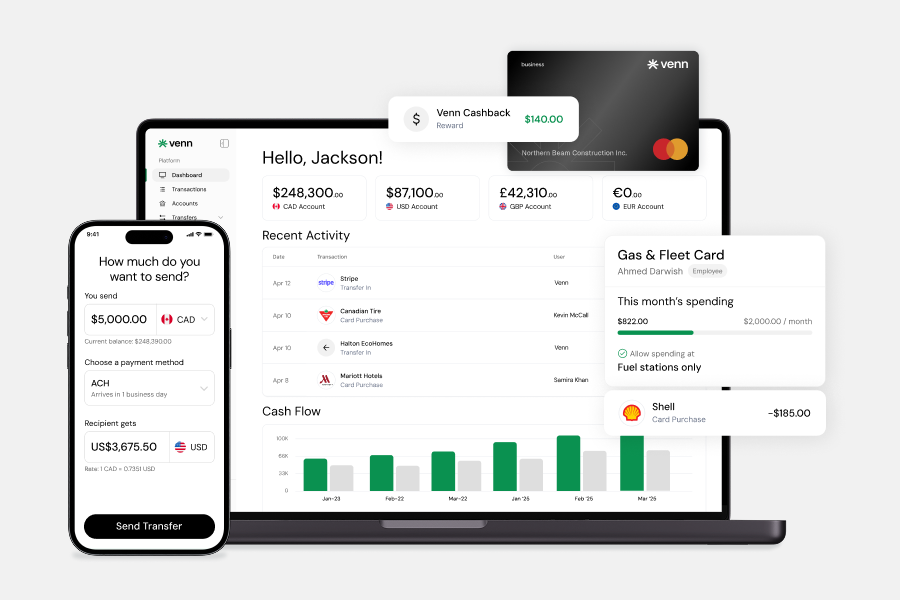
Venn, a Canadian business banking platform, serves businesses that manage cross-border payments, multi-currency expenses, or operational complexity. It offers local CAD and USD accounts with real U.S. ACH capabilities, local GBP and EUR accounts, Interac e-Transfer® support, QuickBooks and Xero integrations, and a 1% cashback Mastercard Charge Card. Free local transfers are available on Plus and Pro plans. Venn supports Canadian businesses outside Quebec and is not a bank. Funds are covered under CDIC insurance protection.
Wealthsimple Business Chequing works well for businesses that want a straightforward, low-cost domestic operating account without the need for multi-currency features or advanced payment workflows.
Choosing between these options comes down to how your business actually moves money: the currencies involved, the frequency of transfers, and whether your finance team needs payments and reconciliation to work together in one place.
Compare Traditional Banks and Modern Business Platforms
Traditional Canadian business bank accounts at institutions like RBC, TD, or BMO offer familiar workflows, branch support, and established domestic and wire services. For businesses that prioritize in-person banking relationships or need access to a broad suite of lending products, these accounts remain a practical choice. The tradeoffs are real, though: setup can be slower, monthly fees tend to be higher, and the tooling for expense management or accounting sync is often limited or requires third-party workarounds.
Venn is a Canadian business banking platform serving businesses outside Quebec. It offers local CAD and USD accounts, real U.S. ACH capabilities, and local GBP and EUR accounts for businesses managing cross-border payments. The platform includes multi-currency accounts, competitive FX rates, OCR receipt capture, direct QuickBooks and Xero integrations, and corporate card functionality. Businesses on eligible plans benefit from free unlimited Interac e-Transfer® for vendor payments and a 1% unlimited cashback card. Funds are covered under CDIC insurance protection. Venn suits businesses that need payments, expense controls, and accounting reconciliation in one place. Sign up for a Venn account to see how it fits your operations.
Wealthsimple Business Chequing offers a straightforward, low-cost domestic operating account. It works well for businesses with simple needs, but it carries fewer multi-currency capabilities and less operational finance tooling than platforms built for businesses managing cross-border transfers or complex payment workflows.
Common Problems and How to Fix Them
Transfer issues are more common than most people expect, and they almost always have a straightforward explanation. Before assuming something went wrong, check the most likely causes first.
Delays typically stem from verification holds, fraud screening, or the timing of when the transfer was submitted. Transfers initiated after business hours or on weekends often settle the next business day.
Failed transfers usually trace back to incorrect recipient details. A wrong account number, transit number, or institution number will cause the transfer to reject. Double-check every field before submitting, especially for wire transfers where errors are harder to reverse.
Pending status can indicate that your financial institution placed a temporary hold on the funds. This is common for large transfers, new payees, or accounts flagged for a security review.
Recipient setup issues affect Interac e-Transfer® payments in particular. If the recipient has not registered their email or phone number with their bank, the deposit may sit unclaimed until they complete that step.
Transfer limit errors occur when a single transaction or daily total exceeds your account's allowed threshold. Contact your institution to confirm your current limits or request a temporary increase for larger payments.
When a transfer does not behave as expected, contact your bank or business banking platform directly. Most issues resolve quickly once the right team reviews the transaction.
Troubleshooting Transfers
Transfer pending: Most pending transfers are waiting on fraud screening or end-of-day batch processing. Check your payment platform or online banking for an approval status before resubmitting. Duplicate submissions create reconciliation headaches.
Recipient did not receive funds: Confirm the transfer shows as completed on your end, then ask the recipient to check with their institution. Processing delays at the receiving bank are common, particularly with EFT. Document your confirmation number and share it with the recipient so their bank can trace the payment.
Wrong details entered: Stop the transfer immediately if the option exists. Contact your financial institution's support line with your confirmation number. For supplier or vendor payments, notify the payee proactively rather than waiting for funds to bounce back. Review your accounting or payment platform logs to identify whether the error originated from a saved recipient profile that needs correcting.
Transfer exceeded the daily limit: Daily limits on Interac e-Transfer® and EFT vary by institution and account type. If a payment is time-sensitive, contact your institution to request a temporary limit increase or split the payment across methods.
Hold placed on funds: Holds typically apply to large deposits or first-time transfers to new recipients. Your institution can confirm the hold duration. Notify affected vendors in advance to avoid late payment disputes.
Security verification triggered: Complete the verification step promptly. If you cannot, call your institution directly. Do not resubmit the payment until the original transaction is fully cancelled, or you risk sending the amount twice.
Conclusion
No single method works best for every business. The right way to transfer money between banks in Canada depends on how fast you need funds to arrive, how much you're sending, whether the recipient is domestic or international, and how your finance team manages payments day to day.
For businesses that move money occasionally, a standard Interac e-Transfer® or EFT through a traditional bank account may be enough. For companies handling frequent transfers across currencies, paying overseas suppliers, running payroll, or reconciling expenses against accounting software, a more integrated setup often makes sense.
Platforms that combine multi-currency accounts, local CAD and USD transfers, expense controls, and accounting integrations with QuickBooks and Xero can reduce the manual work that builds up when your banking and finance tools operate separately.
If your current setup creates friction around payments, reconciliation, or cross-border transfers, it's worth comparing what you're using now against newer business banking platforms. Sign up for a Venn account to see whether it fits your workflow.
Legal and Compliance Notes
Venn is a Canadian business banking platform, not a bank. Venn does not hold deposits. Funds are covered under CDIC insurance protection.
Fee and limit information for third-party institutions referenced in this article should be verified against current primary sources before acting, as rates and policies change. This article does not constitute financial or legal advice.
Venn Mastercard Charge Card is issued by Peoples Trust Company under licence from Mastercard International Incorporated. Mastercard is a registered trademark, and the circles design is a trademark of Mastercard International Incorporated. Sign up for a Venn account
FAQ
Q: What Is The Fastest Way To Transfer Money Between Banks In Canada?
A: Interac e-Transfer® is typically the fastest option for domestic transfers under the sending limit, with many arriving within minutes. For large or time-sensitive payments, a wire transfer may be more appropriate, as it moves funds directly between institutions with same-day or next-business-day settlement depending on timing and destination.
Q: What Is The Cheapest Way To Transfer Money Between Banks In Canada?
A: Costs vary by institution and account plan. Linked account transfers, EFT, and Interac e-Transfer® are often the lowest-cost options, and some business banking plans include a set number of transfers at no additional charge. Review your account terms before choosing a method.
Q: Is Interac e-Transfer® The Same As An EFT?
A: No. Interac e-Transfer® is a specific payment service that sends funds using an email address or phone number, typically settling quickly. An EFT (electronic funds transfer) is a broader category that includes pre-authorized debits, payroll deposits, and batch payments, and generally takes one to three business days to settle.
Q: What Should Businesses Look For In A Bank Transfer Solution?
A: Evaluate fees per transfer type, daily and monthly limits, supported currencies, and whether the platform handles both domestic and international payments. Also consider accounting integrations with tools like QuickBooks or Xero, approval workflows for larger payments, security controls, and how well the solution fits your team's day-to-day operational needs.
---
**Disclaimer:** This publication is provided for general information purposes only and does not constitute legal, tax, financial, or other professional advice from Venn Software Inc., its subsidiaries, or its affiliates, and is not a substitute for advice from a qualified professional. All comparisons and competitor information reflect publicly available information believed accurate as of June 1, 2026; features, pricing, rates, and terms referenced are subject to change and may differ at the time you read this. All product names, logos, and brands referenced are the property of their respective owners; their mention does not imply affiliation with or endorsement by Venn. Any comparative statements reflect Venn's views and are provided to help readers evaluate options. We make no representations, warranties, or guarantees, express or implied, that the content is accurate, complete, or up to date.

Venn is all-in-one business banking built for Canada
From free local CAD/USD accounts and team cards to the cheapest FX and global payments—Venn gives Canadian businesses everything they need to move money smarter. Join 15,000+ businesses today.
Frequently asked questions
Everything you need to know about the product and billing.
Join 15,000+ businesses banking with Venn today
Streamline your business banking and save on your spend and transfers today
No personal credit check or guarantee.