How to Save Money on Business Wire Transfers in Canada
How to save money on wire transfers in Canada with proven steps to cut FX markups, avoid SWIFT fees, and pay globally via local rails using Venn today.

Trusted by 15,000+ Canadian businesses
Business banking for Canada
Local CAD and USD accounts, corporate cards with cashback, the lowest FX rates in Canada, free local transfers, and more.
Wire transfers feel straightforward. You enter the details, click send, and the money moves. What catches most finance teams off guard is the gap between what they sent and what their recipient actually received.
That gap represents a stack of fees: the sending charge, the FX markup, intermediary deductions, and sometimes a receiving fee on the other end. For Canadian businesses making regular international payments, these costs compound into thousands of dollars annually.
This guide breaks down where wire transfer costs actually come from and gives you practical ways to reduce them. The goal is simple: help you keep more of your money while maintaining payment speed and compliance. Using local payment rails and multi-currency accounts through platforms like Venn can significantly reduce both bank fees and foreign exchange costs, often by 50% or more compared to traditional bank wires.
What A Wire Transfer Is (And When It Makes Sense)
A wire transfer moves funds electronically between financial institutions. For international payments, this typically happens through the SWIFT network, a messaging system connecting banks worldwide. Domestic wires exist in Canada but are less common for small and medium business workflows.
Wires make sense for:
• Large, time-sensitive payments requiring same-day or next-day settlement
• Transactions where the beneficiary only accepts SWIFT or requires an IBAN
• One-time high-value payments like equipment purchases, legal settlements, or M&A transactions
Wires are often overkill for routine vendor bills, subscription payments, or frequent smaller cross-border transfers. In these cases, alternative rails deliver the same result at a fraction of the cost.
The True Cost Of A Wire Transfer (The Fee Stack Most Teams Miss)
Most businesses focus on the wire transfer fee their institution charges. That number tells only part of the story. The true cost includes five distinct components:
1. Sending fee: Your financial institution's charge to initiate the transfer. This typically ranges from $15 to $50 for domestic wires and $25 to $80 for international transfers, depending on your provider.
2. FX spread or exchange-rate markup: Often the largest hidden cost. When your institution converts CAD to another currency, they apply a markup above the mid-market rate. A 1.5% to 3% spread on a $50,000 payment means $750 to $1,500 in additional costs.
3. Intermediary or correspondent fees: International wires often route through multiple banks before reaching the destination. Each intermediary may deduct a fee, sometimes called a "lifting fee."
4. Receiving fee: The recipient's financial institution may charge to accept an incoming wire. This amount gets deducted from the transfer, meaning your recipient receives less than you sent.
5. Repair, amend, or trace fees: When payment details are incorrect or a transfer gets delayed, investigation and correction fees can add $25 to $100 per incident.
Why Recipients Sometimes "Get Less Than You Sent"
Here's what catches many teams off guard: you send $10,000 USD, but your supplier receives $9,950. The missing $50 disappeared through intermediary deductions.
SWIFT transfers often route through correspondent banks. Each bank in the chain may deduct a processing fee before forwarding the funds. The more banks involved, the more fees accumulate.
When initiating a wire, you may see fee instruction options:
• SHA (Shared): Sender pays outgoing fees; recipient pays incoming fees
• OUR: Sender pays all fees (though intermediary deductions may still occur)
• BEN: Recipient pays all fees
Even selecting "OUR" doesn't guarantee your recipient gets the full amount. Intermediary banks operate independently and may still deduct their charges.
Minimize friction with accurate details:
• Verify the correct SWIFT/BIC code and IBAN where applicable
• Confirm the exact account number format required
• Include complete beneficiary bank address
• For US payments, clarify whether you need a routing number, SWIFT code, or both
• Add invoice or reference numbers for easier reconciliation
Worked Examples: What Wire Transfers Really Cost
These illustrative examples show how costs accumulate across common business scenarios.
Example 1: CAD to USD Supplier Payment
A Canadian business needs to pay a US supplier $25,000 USD.
Using local USD rails through a platform with a multi-currency USD account, the same payment might cost $5 to $15 in transfer fees plus a 0.5% to 1% FX markup, bringing total costs under $300.
Example 2: Receiving USD From US Customers
A Canadian company invoices US clients in USD. When those payments arrive via SWIFT wire, the Canadian institution may charge an incoming wire fee of $15 to $25 per transfer. Some "USD accounts" at major Canadian institutions still process these as cross-border transactions.
With a local US account that can receive ACH payments, the same funds arrive without SWIFT involvement. No incoming wire fee, no intermediary deductions. Venn provides local USD account details that allow US customers to pay via ACH, eliminating the SWIFT fee stack entirely.
Example 3: CAD to EUR Contractor Payment
Paying a European contractor €5,000 via bank wire might incur:
• $50 wire fee
• 2.5% FX spread (approximately €125)
• €15 intermediary deduction
• €10 receiving fee
The contractor receives €4,850 instead of €5,000. Using SEPA rails through a local EUR account reduces fees dramatically and ensures the full amount arrives.
10 Practical Ways To Save Money On Wire Transfers In Canada
1. Avoid wires when a local rail will do
EFT for Canadian payments, ACH for US payments, SEPA for European payments, and Faster Payments for UK transfers all cost less than SWIFT wires. Match the rail to the corridor.
2. Reduce FX costs first
The exchange rate markup often exceeds the wire fee itself. Compare your institution's rate against the mid-market rate on Google or XE. A platform offering rates closer to mid-market can save more than eliminating the wire fee entirely.
3. Send and receive using local account details
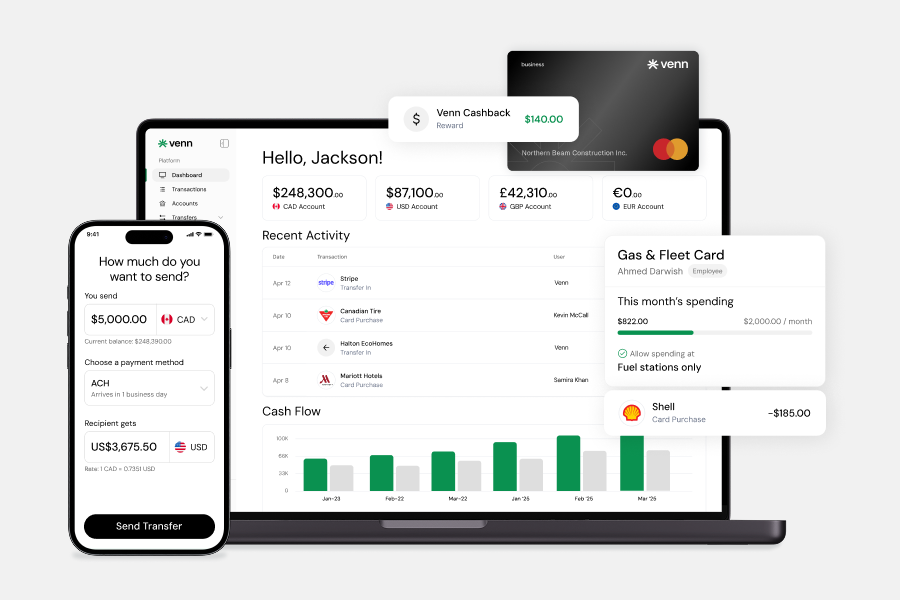
When you hold local currency accounts with local banking details, you reduce SWIFT dependency. Venn provides local account details for CAD, USD, GBP, and EUR, allowing you to send and receive through domestic rails in each region.
4. Batch payments to reduce per-transfer fees
If you pay multiple vendors weekly, consolidating into a single payment run reduces the number of transactions and associated fees.
5. Choose the right payment method by urgency and amount
Not every payment needs same-day settlement. For non-urgent transfers, slower rails with lower fees often make more sense.
6. Confirm beneficiary details before sending
Incorrect account numbers, wrong SWIFT codes, or missing information trigger repair fees and delays. Verify details with your recipient before initiating transfers.
7. Ask about intermediary fees upfront
Some corridors have predictable intermediary costs. Knowing these in advance helps you quote accurate amounts to recipients or adjust invoicing accordingly.
8. Use consistent payment references and invoices
Standardized references reduce reconciliation time and prevent duplicate payments. This operational efficiency translates to real cost savings.
9. Negotiate bank fees if you must stay with a bank
High-volume businesses can often negotiate reduced wire fees. Ask your relationship manager about volume-based pricing.
10. Build a repeatable payables workflow
Establish approval processes, dual controls, and audit trails. Platforms like Venn provide built-in approval workflows that reduce errors and unauthorized payments.
Best Method By Scenario
For most recurring business payments, local rails through a multi-currency platform deliver better value than traditional bank wires.
Where Venn Fits: A Modern Stack To Reduce Transfer Costs
Reducing wire transfer costs isn't about finding one-off hacks. It requires building a financial infrastructure that routes payments through the most efficient channels by default.
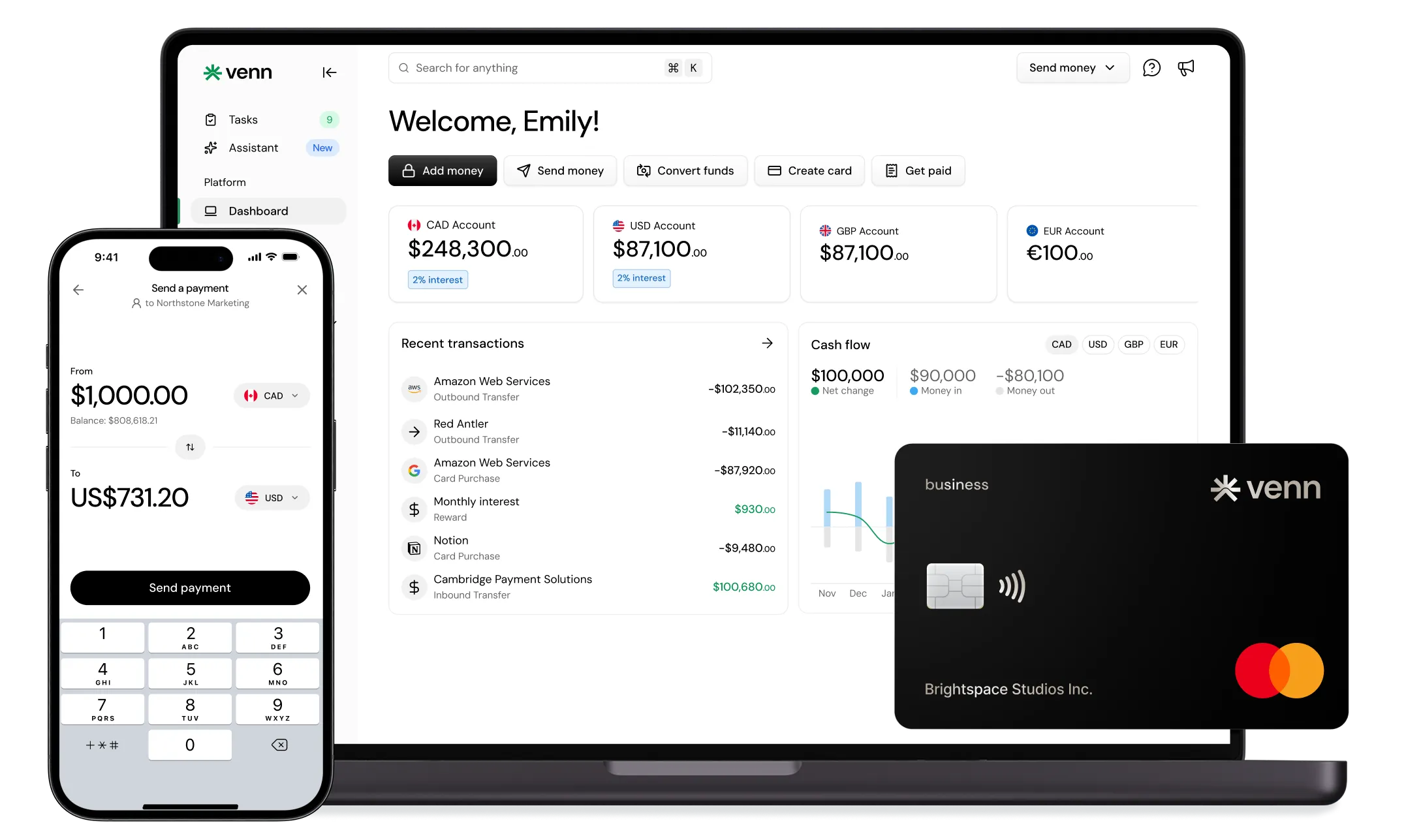
Venn functions as a business banking platform for Canadian businesses, combining multi-currency accounts, expense management, and accounting automation in one place. This integrated approach reduces both direct transfer costs and the operational overhead of managing payments across multiple systems.
Multi-Currency Capabilities That Reduce SWIFT Fees
Venn provides local account details for CAD, USD, GBP, and EUR. This means:
• Your US customers can pay you via ACH instead of wire
• You can pay US suppliers through ACH rather than SWIFT
• European payments flow through SEPA rails
• UK payments use Faster Payments
Fewer SWIFT transfers means fewer intermediary fees, lower FX costs, and faster settlement times. Funds held in Venn accounts are covered under CDIC insurance protection.
Expense Management That Reduces Total Business Costs
Wire transfer fees represent just one category of financial leakage. Venn's corporate card program offers 1% unlimited cashback on all card spend, directly offsetting operational costs. Combined with OCR receipt capture and expense tracking, teams reduce both payment costs and administrative time.
The multi-currency card capability means employees can pay in the transaction currency, avoiding unnecessary FX conversions on everyday business expenses.
Accounting Automation For Faster Reconciliation
Venn integrates directly with QuickBooks and Xero, automating transaction sync and reducing manual data entry. Payables workflows, invoice matching, and approval processes happen within the platform, cutting close time and reducing errors.
For finance teams spending hours each month reconciling wire transfers across multiple bank statements, this consolidation represents significant time savings.
Venn supports businesses in all Canadian provinces except Quebec.
Comparison: Wires vs Local Rails vs Multi-Currency Platform
Implementation Checklist
• Audit your last 10 international payments for wire fees, FX rates used, and intermediary deductions
• Identify your top 2-3 payment corridors (CAD to USD, CAD to EUR, etc.)
• Determine which payments can move from SWIFT to local rails
• Standardize beneficiary data collection with a consistent template
• Establish approval controls for adding new payees and releasing payments
• Set reconciliation cadence and accounting sync rules
• Evaluate a multi-currency platform like Venn to consolidate accounts and reduce total costs
Conclusion
Most wire transfer savings come from three changes: avoiding SWIFT when local rails work, reducing FX spread through transparent pricing, and preventing intermediary surprises with accurate payment details.
The businesses seeing the biggest cost reductions aren't chasing individual fee negotiations. They're building modern financial stacks that route payments efficiently by default. Multi-currency accounts, local payment rails, and integrated expense management create compounding savings over time.
FAQs
Q: Why did my recipient receive less than I sent via wire transfer?
International wire transfers often pass through intermediary (correspondent) banks before reaching the recipient. Each intermediary may deduct a processing fee, and the recipient’s bank may also charge an incoming wire fee. These deductions occur after you send the payment, which is why the final amount received can be lower than the amount sent.
Q: What is a lifting fee on a wire transfer?
A lifting fee is a charge taken by an intermediary or correspondent bank for handling an international wire transfer. Instead of being billed separately, the fee is “lifted” directly from the transfer amount as it moves through the banking network.
Q: Is EFT the same as a wire transfer in Canada?
No. EFT (Electronic Funds Transfer) uses the Payments Canada network for domestic transfers and is significantly cheaper than a wire. EFTs typically settle in 1–2 business days. Wire transfers move through the SWIFT network, settle faster in some cases, but carry much higher fees and intermediary deductions.
Q: What details do I need to send an international wire?
You’ll need the recipient’s full legal name, bank name and address, account number, SWIFT/BIC code, and—if sending to Europe—an IBAN. Including a payment reference or invoice number is strongly recommended to help the recipient reconcile the payment.
Q: How can Canadian businesses reduce FX costs on international payments?
Use platforms that offer exchange rates close to the mid-market rate instead of bank-marked rates. Where possible, hold and pay funds in the destination currency using multi-currency accounts. Platforms like Venn provide competitive FX rates and local currency accounts to reduce unnecessary conversions and overall FX costs.
---
**Disclaimer:** This publication is provided for general information purposes and does not constitute legal, tax or other professional advice from Venn Software Inc or its subsidiaries and its affiliates, and it is not intended as a substitute for obtaining advice from a financial advisor or any other professional. We make no representations, warranties or guarantees, whether expressed or implied, that the content in the publication is accurate, complete or up to date.

Venn is all-in-one business banking built for Canada
From free local CAD/USD accounts and team cards to the cheapest FX and global payments—Venn gives Canadian businesses everything they need to move money smarter. Join 15,000+ businesses today.
Frequently asked questions
Everything you need to know about the product and billing.
Join 15,000+ businesses banking with Venn today
Streamline your business banking and save on your spend and transfers today
No personal credit check or guarantee.