What Are EFT Payments? Guide for Canadian Business Owners
What Are EFT Payments? Everything Canadian Business Owners Need To Know. Learn direct deposit vs PAD, processing times, fees, cutoffs, and fraud controls.

Ahmed Shafik
Co-founder

Trusted by 15,000+ Canadian businesses
Business banking for Canada
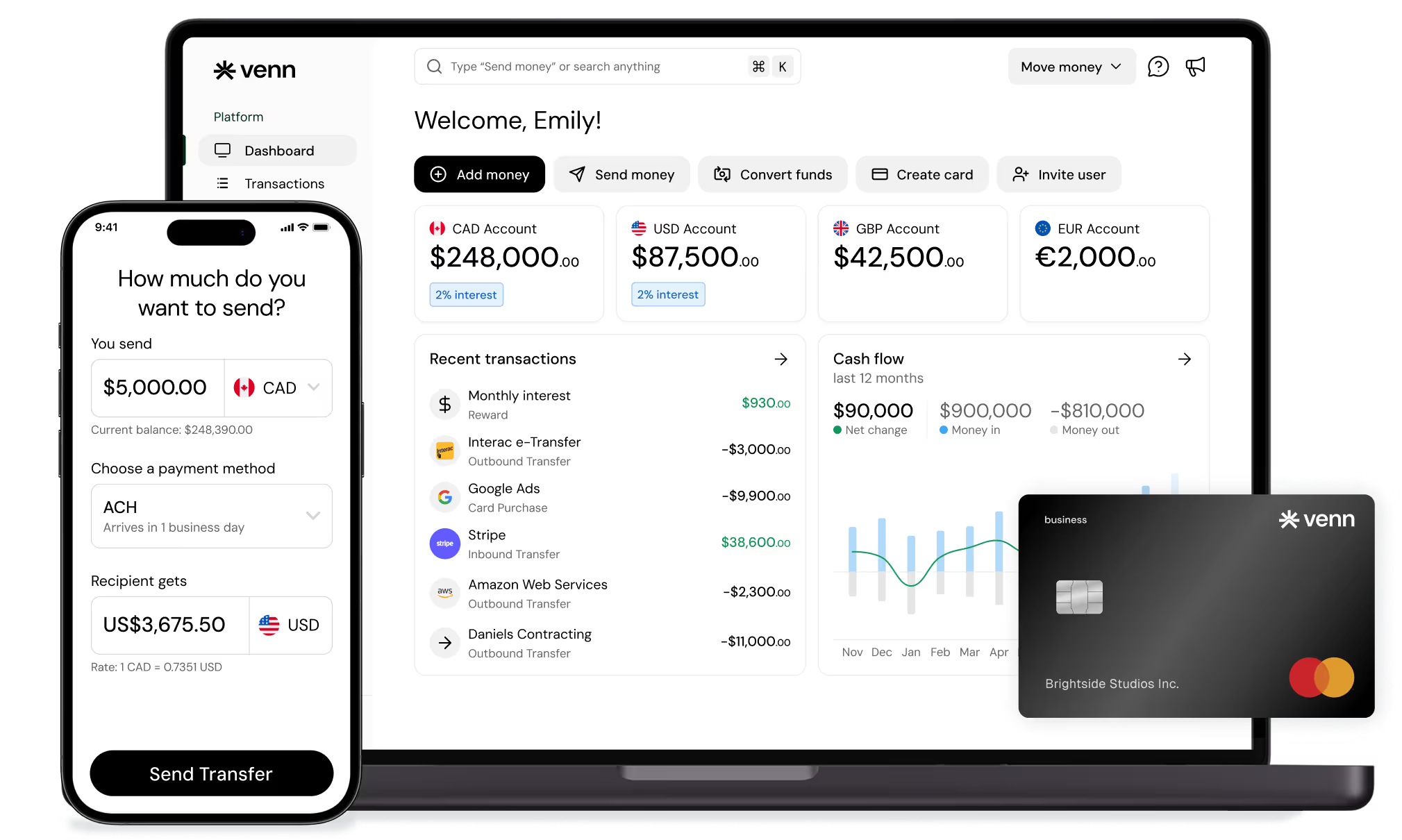
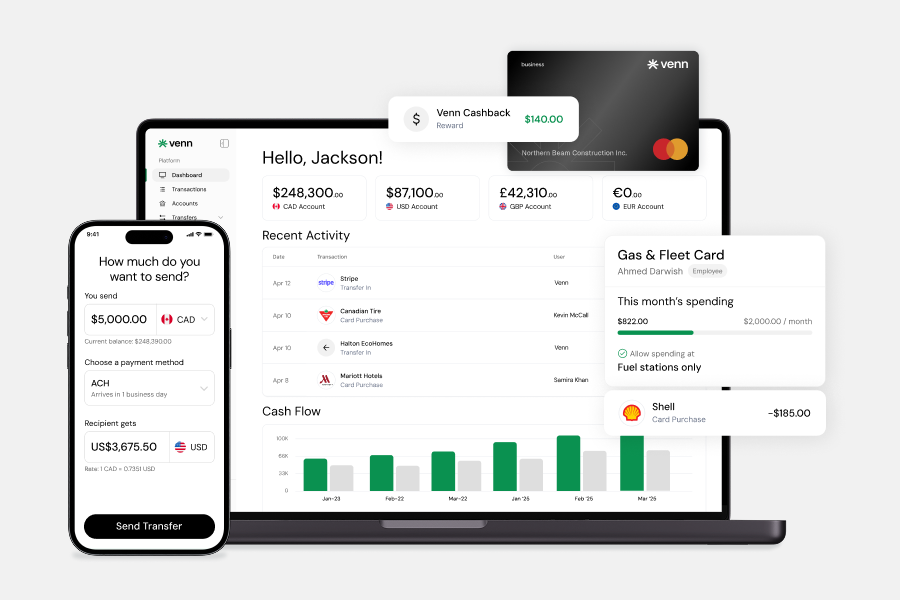
Local CAD and USD accounts, corporate cards with cashback, the lowest FX rates in Canada, free local transfers, and more.
Electronic Funds Transfer (EFT) moves money between bank accounts without paper cheques, cash, or card swipes. For Canadian business owners, understanding EFT payments is essential to running efficient operations, whether you're processing payroll, paying suppliers, or collecting recurring revenue from customers.
Here's what trips up many operators: EFT is not the same as a wire transfer. It's not Interac e-Transfer®. And it differs from ACH, which is the American equivalent. Each method has distinct timelines, costs, and use cases. Conflating them leads to missed payments, frustrated vendors, and reconciliation headaches.
Why does EFT matter for your business? Three reasons: lower costs than cheques and wires, faster settlement than mailing paper, and a cleaner audit trail for your accounting records. When you combine EFT with a modern business banking platform like Venn, you gain centralized control over payments, spend, and multi-currency operations, all connected to your accounting software.
This guide breaks down how EFT works in Canada, when to use it versus alternatives, and how to set up reliable payment workflows that scale with your business.
What Is An EFT Payment In Canada?
An EFT payment is the electronic movement of funds from one bank account to another. When you pay your employees via direct deposit, that's EFT. When a customer authorizes you to withdraw their monthly subscription fee, that's also EFT.
In Canadian business contexts, EFT functions as an umbrella term covering two primary types:
EFT Credit (Direct Deposit): You push money out to someone else's account. Payroll, vendor payments, and contractor fees typically use EFT credit.
EFT Debit (Pre-Authorized Debit / PAD): You pull money in from someone else's account with their authorization. Subscription billing, membership fees, and invoice collection often use PAD.
Quick Glossary:
• EFT: Electronic Funds Transfer, the umbrella term for electronic account-to-account payments
• PAD: Pre-Authorized Debit, a specific type of EFT where you collect funds from a customer's account
• Direct Deposit: Common term for EFT credit payments, especially for payroll
• ACSS: Automated Clearing Settlement System, the Payments Canada infrastructure that processes EFT transactions
How EFT Works (A Simple Step-By-Step)
Understanding the mechanics helps you plan payment timing and troubleshoot issues when they arise.
The parties involved: Every EFT transaction involves the payer, the payee, their respective financial institutions, and the payment rails (ACSS in Canada) that connect them.
The process flow:
• Payment instruction created: You or your platform generates a payment file containing recipient details, amounts, and dates.
• Submission to your financial institution: The file transmits to your financial institution or payment service provider before the daily cutoff time.
• Processing and settlement: Payments Canada's ACSS batches and clears transactions between financial institutions, typically overnight.
• Funds posted: The recipient's account reflects the deposit, and both parties receive confirmation for reconciliation.
When you use a platform like Venn that centralizes payee management, approvals, and bookkeeping in one place, you maintain operational control throughout this process. You can see payment status, match transactions to invoices, and sync everything to QuickBooks or Xero without manual data entry.
Types Of EFT Payments Canadian Businesses Use
EFT Credit (Direct Deposit / Vendor Payments)
EFT credit is the workhorse of business payments. You initiate the transfer, pushing funds from your account to someone else's.
Common use cases:
• Payroll and direct deposit for employees
• Paying suppliers and contractors
• Refunds to customers
• Intercompany transfers between your own accounts
What you need to send an EFT credit:
• Recipient's legal name (must match their bank records)
• Financial institution number (3 digits)
• Transit/branch number (5 digits)
• Account number
• Payment amount and date
• Reference or remittance information
Common pitfalls: Wrong account details cause returns and delays. A single transposed digit means the payment bounces back days later, creating reconciliation work and potentially damaging supplier relationships. Mismatched remittance information makes it harder for recipients to apply payments correctly.
EFT Debit (Pre-Authorized Debit / PAD)
PAD lets you collect funds directly from a customer's bank account. It's ideal for recurring billing, membership fees, and invoice collection where you want predictable cash flow without chasing payments.
The critical difference from EFT credit: you need explicit authorization from the payor before you can debit their account.
PAD Authorization Checklist:
Your PAD agreement must include:
• Payor's identity and complete banking details
• Clear authorization language specifying what you're collecting
• Payment timing and frequency (one-time, weekly, monthly, variable)
• The amount or how amounts will be determined
• Cancellation terms and how the payor can revoke authorization
• Date and signature (physical or electronic)
• Your business contact information for disputes
Record retention: Keep PAD authorizations on file for at least 12 months after the last transaction. Many businesses retain them longer for audit purposes.
Operational considerations: PAD disputes and revocations happen. Customers can contest unauthorized debits, and NSF (non-sufficient funds) returns create extra work. Build processes to handle these exceptions without disrupting your operations.
EFT Processing Times, Cutoffs, Fees, And Limits
Typical timing: Standard EFT payments in Canada often settle within one to three business days. Same-day processing exists but depends on your financial institution and cutoff compliance.
Cutoff times matter: If you submit a payment file at 4:30 PM but your institution's cutoff was 3:00 PM, your payment won't process until the next business day. This pushes the recipient's posting date forward accordingly.
Fees vary: EFT fees depend on your financial institution, transaction volume, and account type. Some platforms charge per transaction, others offer bundled pricing. High-volume businesses often negotiate better rates.
Volume and amount limits: Many institutions cap daily or per-transaction EFT amounts. Verify limits with your provider before scheduling large payments.
When your business runs multi-currency operations and high-volume payables, predictability becomes critical. A consolidated platform like Venn helps you manage CAD, USD, EUR, and GBP accounts in one place, reducing the friction of cross-border payments while maintaining clear records for reconciliation.
EFT Returns, Reversals, And Error Handling
Returns happen. Understanding why and how to prevent them saves time and money.
Common return reasons:
• NSF (non-sufficient funds) in the payor's account
• Closed or frozen accounts
• Invalid transit or account numbers
• Account holder name mismatches
• Unauthorized PAD disputes
What can and can't be reversed: Once an EFT credit settles, you generally cannot reverse it unilaterally. Recovery requires the recipient's cooperation. PAD transactions have dispute windows where payors can request reversals through their financial institution.
Recommended operating procedures:
• Verify before the first payment: Confirm banking details through a test transaction or verification service
• Implement payee onboarding controls: Require documentation before adding new beneficiaries
• Use approval workflows: Separate who can add payees from who can release payments
• Communicate PAD failures promptly: Contact customers immediately when debits fail to maintain relationships and arrange alternative payment
With Venn, your payments and records live together. When a return occurs, you can trace it back to the original transaction, update your records, and adjust your accounting without switching between systems.
EFT Security And Fraud Prevention For Canadian Businesses
EFT fraud is real and growing. Business email compromise, vendor impersonation, and payroll diversion schemes target companies of all sizes.
Common threats:
• Fraudulent requests to change vendor banking details
• Fake invoices from impersonated suppliers
• Unauthorized PAD enrollments
• Internal payroll manipulation
Essential controls:
• Dual approvals for payments: Require two authorized users to release funds above certain thresholds
• Verify payee changes out-of-band: When a vendor requests new banking details, confirm via phone using a known number, not one from the email
• Implement least-privilege access: Staff should only access what they need for their role
• Review audit logs regularly: Catch anomalies before they become losses
• Reconcile frequently: Monthly reconciliation catches errors; weekly or daily catches fraud faster
• Segregate accounts: Separate operating, payroll, and tax funds to limit exposure
Venn supports modern controls with role-based access, approval workflows, and complete audit trails. Combined with Venn's corporate card for employee spend, you gain visibility across both EFT payments and card transactions, simplifying expense management while maintaining security.
EFT vs Other Payment Methods (What To Use When)
Most businesses use multiple payment methods. The key is matching each method to its optimal use case.
| Method | Best For | Speed (Typical) | Cost (Typical) | Reversibility | Reconciliation | Notes |
|---|---|---|---|---|---|---|
| EFT | Payroll, recurring vendor payments, PAD collections | 1–3 business days | Low ($0.50–$2 per transaction) | Limited; requires recipient cooperation for credits | Good with proper references | Workhorse for routine payments |
| Wire Transfer | Urgent, high-value, international | Same day to 1–2 days | High ($15–$50+ domestic; more international) | Very difficult to reverse | Excellent | Use sparingly due to cost |
| Interac e-Transfer® | Ad-hoc payments, small to mid-value | Minutes to hours | Low to moderate | Deposit-based are difficult; request-based vary | Moderate | Great for speed; less suitable for high volume |
| Corporate Card | Employee expenses, subscriptions, travel | Immediate authorization | Interchange fees (merchant pays) | Strong dispute rights | Excellent with expense tools | Venn's 1% unlimited cashback adds value |
| Cheque | Legacy vendors, specific requirements | 5–10+ business days | Moderate (printing, mailing, processing) | Stop payments possible but not guaranteed | Poor; manual matching | Declining use; avoid when possible |
Building your payment stack: The most efficient businesses use EFT for routine payables and payroll, reserve wires for urgent or high-value international transfers, deploy Interac e-Transfer® for ad-hoc needs, and issue corporate cards for employee spend. The best stack supports all methods with unified accounting.
Venn integrates these payment types into a single platform. Your team can manage EFT payables, issue cards with built-in controls, and sync everything to QuickBooks or Xero, eliminating the reconciliation burden of juggling multiple systems.
How To Set Up EFT Payments For Your Business
Setup Checklist
• Are you sending payroll, paying vendors, or collecting from customers via PAD? Each has different requirements.
• Use encrypted forms or secure portals. Never accept banking changes via unverified email.
• Define remittance references that map to invoices or payroll runs. Establish chart-of-accounts rules before your first transaction.
• Sync with QuickBooks or Xero to automate categorization and reduce manual matching.
Where Venn Fits In Your EFT Workflow
Venn functions as the operating system layer connecting your banking, payments, spend management, and accounting.
Business accounts and payments: Run your day-to-day Canadian payables from one platform with clear visibility into payment status and history. Funds held with Venn are covered under CDIC insurance protection.
Corporate card with 1% unlimited cashback: Issue Venn cards to employees for expenses, subscriptions, and travel. Every purchase earns cashback while your finance team maintains real-time visibility and control.
Multi-currency accounts: Maintain CAD, USD, EUR, and GBP balances for international clients and suppliers. Pay and receive in local currencies without unnecessary conversions eating into margins.
Accounting integrations: Connect directly to QuickBooks and Xero. Transactions categorize automatically, reducing month-end close from days to hours.
Industry examples:
• Ecommerce importing inventory: Pay overseas suppliers in USD from your Venn USD account, avoiding double conversion fees while tracking landed costs accurately.
• Agency billing US clients: Receive USD payments directly, pay Canadian contractors via EFT credit, and maintain clean books across currencies.
• Restaurant group managing multiple locations: Issue cards to each location manager with spending limits, collect daily deposits, and reconcile everything centrally.
If you're scaling operations and want payments, spend, and accounting in one place, explore what Venn offers at venn.ca.
Common EFT Mistakes (And How To Avoid Them)
Treating EFT like instant money movement: EFT takes time. Schedule payments with buffer days, especially before weekends and holidays.
Weak payee verification: One fraudulent banking change can cost thousands. Always verify through trusted channels.
Poor remittance hygiene: Vague references like "Payment" make reconciliation painful. Use invoice numbers, PO references, or other identifiers.
Ignoring returns and NSF: Build exception handling into your process. Know who follows up on failed payments and how quickly.
Disconnecting payment ops from accounting: When payments and books live in separate systems, errors multiply. Integrate early.
Conclusion
EFT payments form the foundation of Canadian business operations. Whether you're running payroll, paying suppliers, or collecting recurring revenue, understanding how EFT works, and how it differs from wires, Interac e-Transfer®, and cards, helps you build reliable financial workflows.
The businesses that operate most efficiently treat payments as part of a connected stack: treasury management, payment execution, spend control, and accounting automation working together. Venn provides that integrated layer for Canadian businesses, combining business accounts, multi-currency capabilities, corporate cards with 1% unlimited cashback, and direct QuickBooks and Xero integrations.
Ready to streamline your payment operations? Sign up for a Venn account.
FAQs
Q: What is an EFT payment in Canada?
A: An EFT (Electronic Funds Transfer) payment is the electronic movement of money between bank accounts. In Canada, this includes direct deposits (EFT credit) for payroll and vendor payments, and pre-authorized debits (PAD) for collecting customer payments. EFT transactions are processed through Payments Canada's ACSS infrastructure.
Q: How long do EFT payments take in Canada?
A: Standard EFT payments typically settle within one to three business days. Processing time depends on your financial institution, when you submit the payment relative to cutoff times, and whether weekends or holidays intervene. Some providers offer same-day options, but availability varies.
Q: What’s the difference between EFT and Interac e-Transfer®?
A: EFT moves funds directly between bank accounts using account and transit numbers, typically for scheduled or recurring payments. Interac e-Transfer® uses an email address or mobile number to send funds and often settles within minutes, making it better suited for one-time or ad-hoc payments. EFT is generally more cost-effective for high-volume business transactions.
Q: Is EFT the same as ACH?
A: No. EFT refers to electronic transfers in Canada processed through Payments Canada's ACSS, while ACH (Automated Clearing House) is the U.S. equivalent. Although they are conceptually similar, they operate on different infrastructure, follow different rules, and are not directly interoperable. Cross-border payments require dedicated international transfer methods.
Q: Can EFT payments be reversed or cancelled?
A: EFT credits are difficult to reverse once settled and typically require the recipient’s cooperation to return funds. PAD transactions, however, have defined dispute windows during which payors can request reversals through their financial institution. To cancel a pending EFT, you must contact your financial institution before the applicable cutoff time.
Q: What is a PAD agreement and what do I need to keep on file?
A: A PAD (Pre-Authorized Debit) agreement is a customer’s authorization allowing you to debit their bank account. It must include the payor’s identity and banking details, clear authorization language, payment amounts and timing, cancellation terms, and a dated signature. You should retain PAD agreements for at least 12 months after the last transaction.
Venn Mastercard Charge Card is issued by Peoples Trust Company under licence from Mastercard International Incorporated. Mastercard is a registered trademark, and the circles design is a trademark of Mastercard International Incorporated.
---
**Disclaimer:** This publication is provided for general information purposes and does not constitute legal, tax or other professional advice from Venn Software Inc or its subsidiaries and its affiliates, and it is not intended as a substitute for obtaining advice from a financial advisor or any other professional. We make no representations, warranties or guarantees, whether expressed or implied, that the content in the publication is accurate, complete or up to date.
This publication is provided for general information purposes only and does not constitute legal, tax, financial, or other professional advice from Venn Software Inc., its subsidiaries, or its affiliates, and is not a substitute for advice from a qualified professional. All comparisons and competitor information reflect publicly available information believed accurate as of April 24, 2026; features, pricing, rates, and terms referenced are subject to change and may differ at the time you read this. All product names, logos, and brands referenced are the property of their respective owners; their mention does not imply affiliation with or endorsement by Venn. Any comparative statements reflect Venn's views and are provided to help readers evaluate options. We make no representations, warranties, or guarantees, express or implied, that the content is accurate, complete, or up to date.

Venn is all-in-one business banking built for Canada
From free local CAD/USD accounts and team cards to the cheapest FX and global payments—Venn gives Canadian businesses everything they need to move money smarter. Join 15,000+ businesses today.
Frequently asked questions
Everything you need to know about the product and billing.
Join 15,000+ businesses banking with Venn today
Streamline your business banking and save on your spend and transfers today
No personal credit check or guarantee.