Banking for Contractors: What Canadian Construction Businesses Need
Discover efficient banking for contractors, trades, and general contractors. Learn how Canadian construction businesses can simplify cash flow, holdbacks, and payments.

.png)
Trusted by 15,000+ Canadian businesses
Business banking for Canada
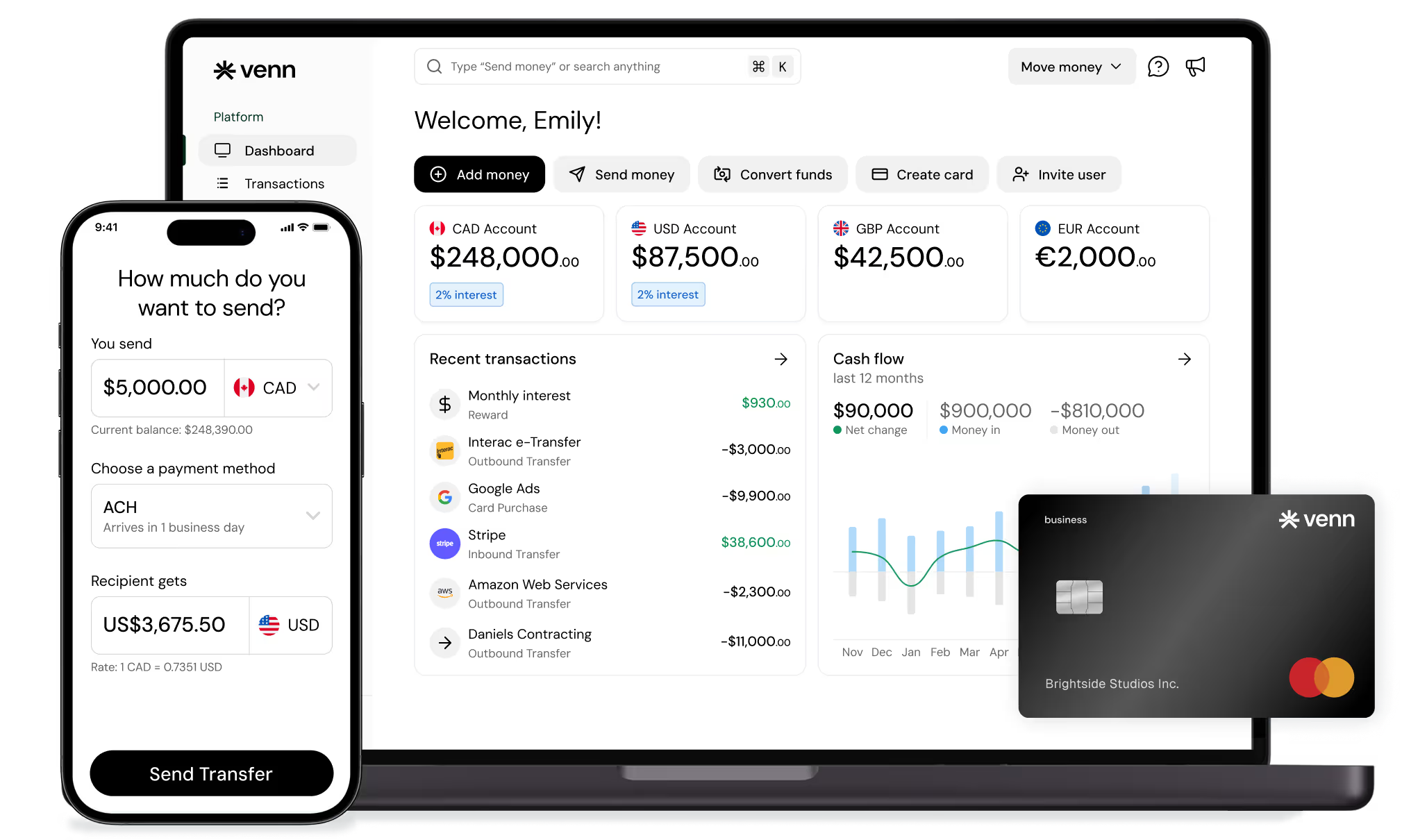
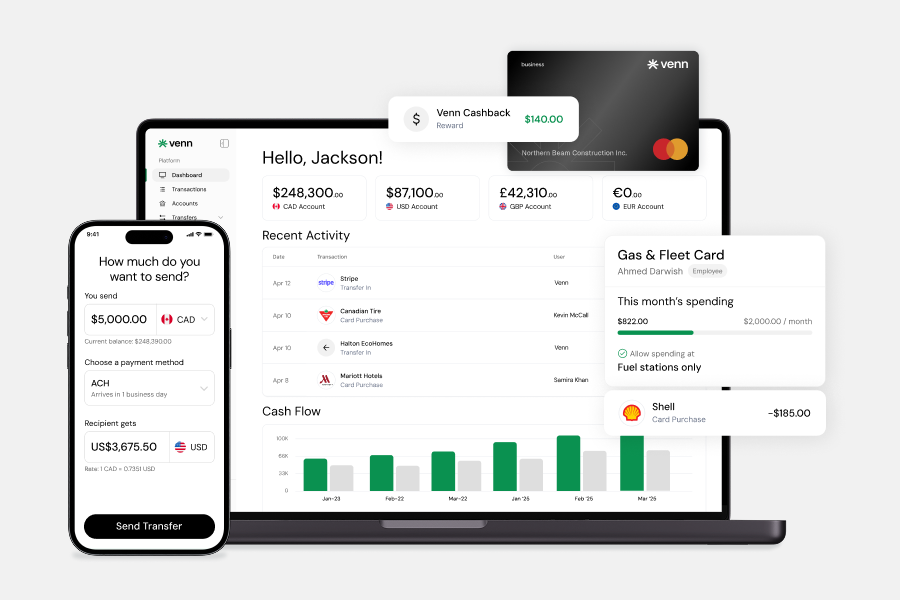
Local CAD and USD accounts, corporate cards with cashback, the lowest FX rates in Canada, free local transfers, and more.
Running a construction business means juggling countless moving parts. You're waiting 30 to 60 days for payment while covering materials, labour, and equipment costs upfront. Your cash flow swings wildly between feast and famine. Yet most banks treat your contracting business like any other small company, completely missing the unique financial challenges you face every day.
The truth is, contractors need more than a basic business account. You need banking that understands holdback requirements, trust accounts, and the project-based nature of construction cash flow. You need payment systems that work as hard as you do, whether you're paying subcontractors on Friday afternoon or ordering materials from US suppliers.
This guide cuts through generic banking advice to deliver what Canadian contractors actually need to know. We'll cover the real costs of traditional banking, the specific features that matter for construction businesses, and how to choose banking that supports your growth rather than holding you back. From managing provincial holdback requirements to maximizing cash flow between projects, you'll discover banking solutions designed for how contractors really work.
Why Construction and Trades Banking Is Different From Other Industries
Construction businesses operate in a financial world unlike any other industry. While retailers enjoy predictable daily revenue and service businesses bill monthly, contractors navigate a complex landscape of project-based income, regulatory requirements, and cash flow challenges that generic business banking simply doesn't address.
1. Project-based cash flow cycles define the contractor experience. Unlike businesses with steady revenue streams, your income arrives in chunks tied to project milestones, progress billing, and completion schedules. You might invoice $50,000 this week and nothing for the next three, creating cash flow gaps that require careful management and often bridge financing.
2. Holdback and trust account requirements add another layer of complexity. Canadian construction lien legislation mandates that 10% of contract value (7.5% in some provinces) must be held back for 45 days or more after substantial completion. This isn't optional. It's a legal requirement that protects subcontractors and suppliers, but it also ties up significant capital that you can't access for over a month after finishing the work.
3. Upfront material and labour costs mean you're essentially financing every project before seeing a dollar of revenue. You pay for lumber on Monday, cover payroll on Friday, and rent equipment for the month, all while waiting for progress payments that might be weeks away. Traditional business banking treats this as a credit problem rather than recognizing it as the standard operating model for construction.
4. Subcontractor and supplier payment management creates complex payment chains. You're not just paying a handful of vendors. You're managing relationships with framers, electricians, plumbers, material suppliers, equipment rental companies, and more. Each expects prompt payment to maintain good relationships and secure future availability. One delayed payment can cascade through your entire project schedule.
5. Seasonal fluctuations hit many trades particularly hard. Roofers, concrete contractors, and landscapers might see 70% of annual revenue compressed into six months. This creates unique challenges for maintaining year-round operations, managing tax obligations, and ensuring adequate cash reserves for slow periods.
Regulatory and compliance requirements demand meticulous financial record-keeping. The Canada Revenue Agency scrutinizes construction businesses closely, expecting proper GST/HST remittance, accurate payroll deductions, and clear separation of trust funds. Provincial licensing bodies require demonstrated financial responsibility. One compliance failure can threaten your entire business.
These factors combine to create banking needs that go far beyond simple checking accounts and credit cards. Contractors need financial infrastructure designed for their reality, not generic small business solutions that force them to work around system limitations.
What are Core Banking Needs for Canadian Contractors?
Understanding what contractors actually need from banking starts with recognizing the daily financial challenges of running a construction business. These aren't theoretical concerns. They're the practical realities that determine whether you can take on that next big project or pay your crew on time.
Cash Flow Management Tools
Cash flow remains the single biggest challenge for contractors, and for good reason. You're constantly balancing incoming progress payments against ongoing expenses, all while maintaining reserves for the unexpected. Effective cash flow management requires more than just checking your balance each morning.
Multiple account structures help you separate operating funds from tax reserves and project-specific budgets. When you're managing a $200,000 renovation project alongside three smaller jobs, mixing all funds in one account invites chaos. You need clear visibility into what money belongs to which project, what's earmarked for GST remittance, and what's truly available for operations.
Real-time visibility matters when you're making decisions on the fly. Can you take advantage of that bulk material discount? Do you have enough to cover next week's payroll after buying that equipment? Traditional banking often provides delayed information, showing yesterday's balance when you need to know your position right now.
Access to credit facilities provides the bridge between expenses and revenue. Whether it's a line of credit for covering payroll during slow periods or short-term financing for equipment purchases, contractors need flexible credit options that understand construction cash cycles. Generic small business loans with rigid repayment schedules don't match project-based revenue.
High-yield accounts help maximize returns on funds waiting deployment. That $50,000 sitting in your account for next month's material purchase should be earning interest, not gathering dust. With traditional business accounts offering 0.05% interest, you're losing money to inflation on every dollar held.
Fast, Affordable Payment Processing
Payment processing sits at the heart of contractor operations. You're not sending a few invoices monthly. You're managing constant flows of money to subcontractors, suppliers, and service providers. The speed and cost of these payments directly impact your relationships and bottom line.
Paying suppliers and subcontractors quickly maintains the relationships that keep your projects moving. When your framer knows payment arrives the same day they submit an invoice, they prioritize your jobs. When material suppliers get paid promptly, they extend better terms and ensure stock availability. In construction, payment speed equals operational efficiency.
The cost implications of traditional payment methods add up fast. Banks typically charge $1.50 to $2.00 per Electronic Funds Transfer, $15 to $30 for domestic wires, and similar amounts for receiving wires. A mid-sized contractor making 50 EFT payments monthly faces $75 to $100 in fees before considering other payment types. Over a year, that's $900 to $1,200 in pure transaction costs.
Free or low-cost Interac e-Transfer® capabilities matter for smaller payments. Paying a subcontractor $500 shouldn't cost you $1.50 in fees. When you're making dozens of these payments monthly, free unlimited transfers save hundreds annually while providing instant payment confirmation.
ACH and EFT capabilities handle recurring payments efficiently. Equipment leases, insurance premiums, and regular supplier payments need automated processing. Manual payment entry wastes time and invites errors. Modern banking should handle these routine transactions seamlessly.
International payment capabilities become crucial for contractors importing materials or specialized equipment. The exchange rate markup alone can add thousands to project costs. Traditional banks often charge 2.5% to 3% above market rates, meaning that $20,000 equipment purchase from the US actually costs $20,500 to $20,600 after hidden FX fees.
Trust and Holdback Account Management
Provincial construction lien legislation isn't optional. It's a fundamental requirement that shapes how contractors must structure their banking. Understanding and properly managing trust accounts protects both your business and your license to operate.
Each province mandates specific holdback percentages and timelines. Ontario requires 10% holdback for 60 days post-substantial completion. Manitoba sets it at 7.5%. These funds must be held in separate trust accounts, not commingled with operating funds. This isn't just good practice. It's the law.
Contractors must demonstrate proper trust accounting for compliance audits. When provincial regulators or the CRA review your books, they expect clear separation of trust funds with detailed transaction records. Mixing holdback money with operating funds, even temporarily, can result in serious consequences including personal liability for directors.
Banking partners need to understand these requirements and provide appropriate account structures. Generic business accounts don't cut it. You need accounts specifically designated for trust purposes with proper documentation and reporting capabilities. Some contractors have lost banking relationships because their bank didn't understand construction trust requirements.
The consequences of improper trust accounting extend beyond fines. You can face forced double payment if you can't prove proper holdback handling, license suspension that halts your ability to work, and personal liability that pierces corporate protection. Your banking structure must support compliance from day one.
Integration With Accounting Software
Modern contractors run their businesses on QuickBooks, Xero, or specialized construction software like BuilderTrend. Your banking should integrate seamlessly with these tools rather than creating additional data entry work.
Automated transaction categorization and syncing eliminates hours of manual bookkeeping. When every transaction flows directly into your accounting system with proper categorization, you maintain real-time financial visibility. This matters for job costing, project profitability analysis, and tax preparation.
Reduced manual data entry means fewer errors and more time for revenue-generating activities. The average contractor spends 5 to 10 hours monthly on transaction reconciliation. That's time better spent estimating new projects or managing job sites. Integration transforms banking from administrative burden to automated infrastructure.
Better financial visibility enables smarter business decisions. When you can instantly see project profitability, cash flow projections, and expense trends, you bid more accurately and manage resources more effectively. Integration provides the data foundation for growth.
Business Credit and Financing Options
Access to appropriate credit products can make or break a construction business. Traditional lenders often misunderstand contractor needs, offering rigid products that don't match project-based revenue cycles.
Lines of credit provide essential cash flow flexibility. Unlike term loans with fixed payments, credit lines let you draw funds as needed and repay as projects complete. This matches the natural rhythm of construction work. You need $30,000 for materials this week, nothing next week, then $50,000 for equipment the following month.
Equipment financing helps you acquire tools and vehicles without depleting operating capital. Whether it's a new excavator or upgraded power tools, proper financing preserves cash for project expenses while building business assets.
Credit cards with appropriate limits handle daily material purchases and travel expenses. But contractor needs differ from typical businesses. You might charge $10,000 in materials one week, requiring higher limits and more flexible payment terms than standard small business cards offer.
Interest rates should reflect actual business risk, not generic small business rates. Established contractors with strong payment histories deserve better rates than high-risk startups. Yet many banks apply one-size-fits-all pricing that penalizes successful construction businesses.
What Should Contracting Businesses Look For in a Business Bank?
Selecting the right banking partner requires looking beyond marketing promises to examine real costs and capabilities. These criteria will help you evaluate options based on what actually matters for construction businesses.
Fee Structure and Transparency
Monthly account fees tell only part of the story. That $30 account with "unlimited" transactions might limit you to 50 EFTs before charging $1.50 each. For contractors making 100 or more payments monthly, those excess fees dwarf the base account cost.
Calculate your true monthly costs based on actual transaction volume. Include monthly fees, per-transaction charges for different payment types, wire transfer fees both incoming and outgoing, foreign exchange markups on international transactions, and hidden fees like paper statements or minimum balance penalties.
Foreign exchange markups deserve special attention for contractors buying US materials. Banks rarely advertise their FX markup, instead promoting "competitive rates" that hide 2% to 3% margins. On $200,000 in annual US purchases, that's $4,000 to $6,000 in hidden costs. Transparent providers clearly state their markup, typically 0.25% to 0.75% for business accounts.
Payment Speed and Reliability
Payment processing speed directly impacts your operations. Same-day processing lets you respond to urgent needs, while next-day or slower processing forces you to plan days ahead.
Weekend and after-hours capabilities matter when projects don't follow banker's hours. If you can't pay a supplier Saturday morning for emergency materials, you're stuck until Monday. Modern banking operates 24/7, not 9 to 5.
Payment tracking and confirmation features provide peace of mind and audit trails. You need to know when payments are sent, when they're received, and have documentation for disputes. Email confirmations and real-time tracking should be standard, not premium features.
The recipient experience matters as much as your own. If your payments take three days to reach subcontractors or arrive without proper remittance information, you create friction in critical relationships. Fast, clear payments build trust and efficiency.
Account Features and Flexibility
Multiple accounts without additional fees enable proper financial organization. You need operating accounts, tax reserve accounts, and project-specific accounts at minimum. Paying $30 per additional account makes proper structure prohibitively expensive.
Sub-account capabilities take organization further, allowing granular project budgeting without full account separation. Track individual project cash flows while maintaining consolidated reporting and simpler banking management.
Minimum balance requirements lock up working capital you need for operations. A $5,000 minimum to waive fees is $5,000 not available for materials or payroll. Modern banking eliminates these outdated requirements.
Interest rates on account balances help your money work harder. Even 2.75% interest on CAD balances and up to 3.5% interest on USD balances (learn more) on average balances of $50,000 generates significant returns yearly. That covers several months of banking fees while keeping funds fully liquid.
Customer Support and Expertise
Support availability must match contractor schedules. Problems don't wait for business hours. Whether it's a payment issue Friday evening or account access problems Saturday morning, you need responsive support.
Understanding of contractor-specific needs separates adequate support from excellent support. Generic call center staff won't understand holdback requirements or construction payment cycles. You need support teams trained in construction business realities.
Dedicated account management versus call center roulette impacts problem resolution speed. When issues arise, explaining your business model repeatedly wastes time. Dedicated support that knows your business resolves issues faster.
Regulatory Compliance Support
Proper trust account structures aren't optional. Your bank must provide accounts that meet provincial construction lien requirements with appropriate documentation and reporting.
CRA-compliant reporting and documentation simplifies tax filing and audits. Proper transaction categorization, detailed statements, and year-end summaries reduce accounting costs and audit stress.
Support for GST/HST remittance includes both payment capabilities and reporting features. You need to track input tax credits, separate taxable and exempt transactions, and remit accurately to avoid penalties.
Comparing Traditional Banks vs. Modern Banking Solutions for Contractors
The gap between traditional banking and modern platforms becomes clear when you examine specific features and costs relevant to contractors. This comparison highlights key differences that impact your bottom line.
| Feature | Traditional Banks (Big 5) | Modern Banking Platforms |
|---|---|---|
| Monthly Account Fees | $30–125/month (waived with $5,000–65,000 minimum balance) | $0–20/month, no minimum balance requirements |
| EFT/Transfer Costs | $1.00–2.00 per transaction | $0–2 depending on plan |
| Interac e-Transfer® | Limited free transfers, then $1–1.50 each | Unlimited free (select platforms) |
| Wire Transfers | $15–30 outbound, $15–17 inbound | $6–10 outbound, free inbound |
| Foreign Exchange Markup | 1.5–3% above mid-market rate | 0.25–0.75% (best platforms) |
| Multi-Account Capability | Additional fees per account | Free sub-accounts for project budgeting |
| Accounting Software Integration | Manual CSV exports, limited automation | Direct QuickBooks/Xero sync, automated categorization |
| Interest on Balances | 0–0.05% on business accounts | Up to 2–4% on select platforms |
For a mid-sized contractor processing 50 EFTs monthly, paying 10 subcontractors via Interac e-Transfer®, and making 2 to 3 wire transfers, the monthly cost difference between traditional banking ($150 to $250) and modern platforms ($20 to $50) represents $1,500 to $2,400 in annual savings. These aren't theoretical numbers. They're based on real transaction patterns from actual construction businesses.
The foreign exchange difference proves even more dramatic for contractors buying materials from US suppliers. On $200,000 in cross-border purchases, the FX savings alone can exceed $5,000 annually when comparing traditional bank markups to transparent platform pricing. That's pure profit returned to your business simply by choosing better banking infrastructure.
Why Venn Is Purpose-Built for Canadian Contractors
While many financial platforms claim to serve small businesses, Venn specifically addresses the unique challenges Canadian contractors face daily. Built on real Canadian banking infrastructure through partnership with Peoples Trust Company, Venn provides the foundation contractors need for efficient operations and growth.
Real Canadian Banking Infrastructure That Actually Works for Payroll and Taxes
Most fintech platforms operate as payment overlays, requiring you to maintain a traditional bank account for essential functions like payroll and tax remittance. Venn's partnership with Peoples Trust Company provides true Canadian banking rails, eliminating the need for multiple accounts.
Full EFT capabilities mean you can pay subcontractors and employees directly from your Venn account. No more maintaining a separate traditional bank account just for payroll runs. Process payments when you need to, not when your bank allows.
Pre-authorized debit setup enables seamless payroll processing with ADP, Ceridian, or your preferred provider. Your payroll company can pull funds directly, maintaining the workflows you've already established while eliminating traditional banking friction.
Direct CRA payment capabilities handle GST/HST remittance and payroll taxes without workarounds. While competitors force you to use bill payment services or maintain separate accounts for tax obligations, Venn handles CRA payments natively. Remit taxes directly, maintain proper audit trails, and simplify compliance.
Proper account structures support trust and holdback compliance from day one. Create dedicated trust accounts that meet provincial requirements, maintain clear separation of funds, and generate the reporting needed for regulatory compliance. Venn understands construction-specific banking needs because we built our platform with contractors in mind.
You can find more information about the future of contruction business banking in our 2026 guide.
Payment Flexibility That Matches Contractor Workflows
Venn's payment options align with how contractors actually operate, not how banks think they should operate.
Free, unlimited Interac e-Transfer® stands out as a game-changer for contractor payments. As the only Canadian fintech offering this feature, Venn eliminates the $1 to $1.50 per transfer fees that add up to hundreds monthly. Pay your framer instantly on Friday afternoon, send progress payments to subcontractors, or handle emergency supplier payments without calculating transaction costs.
EFT costs of $0 to $2 depending on your plan make regular supplier payments affordable. Whether you're paying material suppliers, equipment rental companies, or service providers, low-cost EFTs keep more money in your business.
Global wires at $6 to $10 beat traditional banking costs by 60% or more. When you need to wire payment for specialized equipment or materials, save $20 or more per transaction compared to big bank pricing.
Same or next-day payment delivery ensures your payments arrive when promised. Traditional bill payment services taking 3 to 5 days force you to plan payments a week ahead. Venn's direct payment rails deliver funds quickly, maintaining the supplier relationships critical to your operations.
Real-world application brings these features together seamlessly. Pay your framing crew Friday afternoon via free Interac e-Transfer®. Remit GST/HST to CRA Monday morning through direct debit. Wire payment to your US equipment supplier Tuesday for next week's delivery. Handle it all from one account with transparent, predictable costs.
Multi-Currency Accounts for Cross-Border Material Purchases
Contractors buying from US suppliers face a hidden tax through traditional banking structures. Banks offer "USD accounts" that aren't really US accounts at all. They're Canadian accounts holding US dollars, forcing expensive SWIFT wire transfers for every transaction.
Every inbound payment from US clients incurs a $17 wire fee, even though it's USD to USD. Outbound payments face similar costs plus foreign exchange markups. A contractor doing $500,000 in cross-border business annually might pay $5,000 just in wire fees, plus thousands more in FX spreads.
Venn provides real local US accounts with ACH capabilities, eliminating these unnecessary costs. Receive payments from US clients with no inbound fees. Pay US suppliers via ACH in 1 to 2 days instead of expensive wires. Hold USD without forced conversion, exchanging only when rates favor your business.
The same benefits extend to EUR and GBP accounts for international equipment purchases. Buy that specialized German equipment or British machinery without multiple currency conversions eating into your margins. Hold funds in the currency you need, pay in local currency, and eliminate unnecessary FX exposure.
Project-Based Budgeting With Multiple Accounts
Contractors juggle multiple simultaneous projects, each with unique budgets, timelines, and cash flows. Traditional banks make proper project accounting expensive or impossible by charging $30 to $60 per additional account.
Venn allows unlimited sub-accounts at no additional cost, transforming how you manage project finances. Create separate accounts for each major project, tracking revenue and expenses independently. Maintain dedicated holdback accounts for regulatory compliance. Establish tax reserve accounts ensuring GST/HST and payroll remittances are always covered. Keep your operating account clean and focused on general business expenses.
This structure provides clarity impossible with single-account banking. Know instantly whether the Smith renovation is profitable. Track material costs against budget for the new commercial build. Ensure holdback funds remain untouched until release dates. Professional financial organization shouldn't cost extra.
Expense Management and Receipt Capture Built In
Material purchases, equipment rentals, and subcontractor payments generate hundreds of receipts monthly. Traditional expense tracking means boxes of fading receipts and hours of data entry. Venn's corporate cards include integrated expense management that transforms this administrative burden.
Earn 1% unlimited cash back on all purchases with no spending minimums or category restrictions. Every material purchase, every tank of fuel, every tool acquisition returns money to your business. Unlike competitors requiring $50,000 monthly spending for rewards, Venn rewards your business from dollar one.
Multi-currency cards automatically use the correct currency for each transaction. Buy from US suppliers without FX conversion fees. Purchase equipment in Europe using EUR directly. The card intelligently selects the right currency, saving 2% to 3% on every international transaction.
OCR receipt capture via mobile app eliminates paperwork. Snap a photo at the lumber yard, and advanced scanning technology extracts vendor, amount, and tax information automatically. No more lost receipts or manual entry.
Automatic invoice matching and categorization maintains accurate job costing. Assign expenses to specific projects, track material costs by category, and maintain real-time project profitability data. When integrated with your accounting software, expense data flows seamlessly into job costing reports.
Real-time expense tracking provides immediate visibility into project costs. Know instantly if material expenses are exceeding budget. Identify cost overruns before they impact profitability. Make informed decisions based on actual data, not estimates.
Accounting Software Integration That Actually Saves Time
Venn syncs directly with QuickBooks and Xero, but goes beyond basic transaction import to provide true automation.
Automated transaction import and categorization eliminates manual bookkeeping. Set rules once, and transactions categorize automatically. Material purchases assign to the correct project. Subcontractor payments match to appropriate expense categories. Tax transactions separate cleanly for remittance tracking.
Payables automation from accounting software streamlines supplier payments. Create bills in QuickBooks, approve for payment, and Venn processes them automatically. No duplicate entry, no manual payment creation, no reconciliation headaches.
The ability to create recipients without invoices solves a common contractor frustration. Pay that new subcontractor or one-time supplier without complex setup requirements. Add recipients on the fly, process payments immediately, and let accounting catch up later.
Real-time reconciliation reduces month-end accounting time by 60% to 70%. When transactions sync automatically with proper categorization, reconciliation becomes verification rather than investigation. Your bookkeeper spends minutes confirming accuracy rather than hours hunting discrepancies.
Transparent Pricing That Respects Contractor Margins
Construction operates on tight margins. Every dollar spent on banking fees reduces profitability. Venn's pricing model reflects this reality with per-account pricing that scales affordably.
Unlike competitors charging per-user fees, Venn charges per account. Give access to project managers, bookkeepers, and accountants without calculating seat licenses. A 10-person team costs the same as a solo operation, encouraging proper financial controls rather than penalizing growth.
The lowest FX rates in Canada mean real savings on cross-border transactions. At 0.25% to 0.45% depending on plan, Venn's transparent FX pricing beats traditional banks by 2% or more. Calculate the savings on your international purchases, and the numbers speak for themselves.
Earn 2.75% interest on CAD balances and up to 3.5% interest on USD balances (learn more) with no minimum requirements. Your operating funds, tax reserves, and holdback accounts all earn competitive returns. On average balances of $100,000, that's $2,000 annually, enough to cover months of banking costs while maintaining full liquidity.
How to Set Up Banking for Your Contracting Business: A Step-by-Step Guide
Transitioning to better banking doesn't require disrupting your operations. Follow this systematic approach to upgrade your financial infrastructure while maintaining business continuity.
Step 1: Assess Your Current Banking Costs
Most contractors underestimate their true banking expenses by focusing only on monthly account fees. Calculate your complete costs including all transaction fees, wire transfer charges both incoming and outgoing, foreign exchange losses on international purchases, and the opportunity cost of minimum balance requirements.
Pull last month's bank statement and add up every fee. Include that $1.50 per EFT, the $30 wire to your US supplier, and the hidden FX markup on material purchases. Most contractors discover they're paying $150 to $300 monthly without realizing it. That's $1,800 to $3,600 annually that should be funding growth, not banking profits.
Step 2: Determine Your Account Structure Needs
Map out the accounts you need for proper financial organization. Start with your operating account for daily transactions and vendor payments. Add a holdback or trust account to meet provincial regulatory requirements. Include a tax reserve account for GST/HST and payroll remittances, preventing the cash flow crunch when taxes come due. Consider project-specific accounts for major contracts, enabling accurate job costing and budget tracking.
This structure isn't about complexity. It's about clarity. When each dollar has a designated purpose and place, financial management becomes straightforward rather than stressful.
Step 3: Evaluate Payment Volume and Types
Document your monthly payment patterns to understand your true needs. Count the number of subcontractor payments and whether you prefer Interac e-Transfer® or EFT. Track supplier payments, separating domestic from international transactions. Note employee payroll requirements and frequency. Record tax remittance schedules for accurate planning.
This analysis reveals the features that matter most for your business. If you're sending 20 Interac e-Transfers® monthly at $1.50 each, free unlimited transfers save $360 annually on just one payment type.
Step 4: Consider Integration Requirements
Your banking should enhance your existing systems, not require wholesale changes. Identify your current software stack starting with accounting software like QuickBooks, Xero, or Sage. Note your payroll provider whether it's ADP, Ceridian, or Wagepoint. List project management tools like BuilderTrend, CoConstruct, or Procore.
Choose banking that integrates seamlessly with these systems. Forced software changes disrupt operations and require retraining. The right banking platform enhances your existing workflows rather than replacing them.
Step 5: Plan Your Transition
Never rush to close existing accounts. Banking transitions require careful orchestration to avoid disrupting cash flow or vendor relationships. Plan for 1 to 2 months of parallel operation where both old and new accounts remain active.
Set up your new account and verify all functionality before making any changes. Test every feature you'll need: EFT payments, Interac e-Transfer®, wire capabilities, and accounting integration. Redirect new revenue streams to the new account first, allowing you to build balance while maintaining existing operations. Migrate recurring payments gradually, updating one or two vendors weekly rather than all at once. Maintain minimum balance in your old account until fully transitioned to avoid surprise fees.
Update your CRA banking information for tax remittances last, after confirming all other functions work properly. Tax payment failures create immediate problems you want to avoid.
Step 6: Optimize Your Account Structure
Once your new banking is established and verified, leverage advanced features to improve operations. Set up sub-accounts for major projects, providing instant visibility into project-specific cash flow. Configure automated transfers to tax reserve accounts, ensuring remittance funds are always available. Implement receipt capture workflows for field teams, maintaining accurate expense records from day one. Connect accounting software for automated reconciliation and real-time financial reporting.
These optimizations transform banking from necessary evil to competitive advantage. When financial infrastructure supports rather than hinders operations, growth becomes possible.
Wondering what you need to be approved? Check out our comprehensive guide here.
Common Banking Mistakes Contractors Make (And How to Avoid Them)
Learning from common mistakes helps you avoid costly errors that plague many construction businesses. These aren't theoretical concerns but real issues that impact contractor profitability and operations daily.
Mixing Personal and Business Finances
Even sole proprietors need separate business accounts. The temptation to use personal accounts for simplicity creates massive problems during tax season and CRA audits. When personal and business transactions intermingle, proving legitimate business expenses becomes a forensic accounting exercise. Separate accounts provide clear audit trails, simplify tax filing, and demonstrate professional operations that suppliers and clients expect. The convenience of mixed accounts isn't worth the complications they create.
Underestimating Transaction Costs
Contractors often focus on monthly account fees while ignoring per-transaction costs that dwarf those base fees. A $30 monthly account fee seems reasonable until you add $1.50 per transaction for 100 monthly payments. Suddenly you're paying $180 monthly, with $150 in transaction fees invisible until you analyze statements. A contractor making 100 transactions monthly at $1.50 each pays $1,800 annually in transaction fees alone. Choose banking based on total costs, not headline account fees.
Ignoring Holdback Compliance Requirements
Provincial construction lien legislation isn't optional. Ontario mandates 10% holdback in trust accounts, while Manitoba requires 7.5%. Starting January 1, 2026, Ontario's Construction Act changes require mandatory annual holdback release, fundamentally changing cash flow timing. Improper holdback accounting can result in personal liability and forced double payment. If you can't prove proper trust accounting, you might have to pay subcontractors twice. Use dedicated accounts and maintain meticulous records.
Paying Excessive Foreign Exchange Fees
Contractors buying US materials often lose 2% to 3% on every transaction without realizing it. Banks hide FX markups in the exchange rate, showing you a rate that includes their profit margin. On $200,000 in annual US purchases, that's $4,000 to $6,000 in unnecessary costs, enough to buy a new truck or hire an apprentice. Platforms with transparent FX pricing at 0.25% to 0.75% save thousands annually on international transactions.
Failing to Separate Tax Reserves
The biggest cash flow crisis happens when GST/HST or payroll remittances come due without reserved funds. Many contractors commingle operating funds with tax obligations, spending money that belongs to the CRA. When remittance deadlines arrive, they scramble for funds or face penalties. Set up automatic transfers to a separate tax account with each payment received. A simple 5% to 13% automatic transfer (depending on your tax obligations) prevents this entirely.
Frequently Asked Questions:
Q: Do Canadian construction companies need a dedicated business bank account?
A: Yes. A dedicated business bank account is essential for separating job income, subcontractor payments, equipment purchases, payroll, and CRA tax remittances. Mixing personal and business funds complicates audits, makes GST/HST tracking harder, and can create liability risks. Most lenders, bonding companies, and general contractors also require a proper business banking setup.
Q: What banking features matter most for construction businesses in Canada?
A: Look for unlimited low-cost transactions, support for progress billing deposits, the ability to create multiple accounts or sub-accounts for retainage and project budgeting, fast payments for subcontractors, strong integrations with QuickBooks or Xero, multi-currency accounts for US suppliers, and secure fund protection such as CDIC coverage.
Q: How can contractors manage holdbacks and retainage more effectively with banking?
A: The best approach is using a separate account for holdbacks so those funds remain protected, visible, and interest-earning until release. Modern digital business banking platforms let contractors create additional accounts at no extra cost, helping maintain clean records and avoid accidentally spending retained funds before release deadlines.
Q: What’s the fastest way to pay subcontractors in Canada?
A: Interac e-Transfer® is the fastest method, typically completing within 30 minutes and working 24/7. For larger payments above typical e-Transfer limits, EFT is usually the best balance of speed and cost, often arriving within 1–2 business days. Avoid relying on cheques— they delay cash flow, increase admin work, and cause reconciliation headaches.
Q: Do Canadian construction companies really need multi-currency banking?
A: Many do. Contractors frequently buy equipment, vehicles, software, or materials from the US or overseas. Traditional banks charge 2–3% FX markup and $15–30 wire fees. Platforms like Venn provide real USD accounts with ACH capability and FX rates as low as 0.25–0.45%, saving thousands annually while simplifying cross-border payments.
--
**Disclaimer:** This publication is provided for general information purposes and does not constitute legal, tax or other professional advice from Venn Software Inc or its subsidiaries and its affiliates, and it is not intended as a substitute for obtaining advice from a financial advisor or any other professional. We make no representations, warranties or guarantees, whether expressed or implied, that the content in the publication is accurate, complete or up to date.

Venn is all-in-one business banking built for Canada
From free local CAD/USD accounts and team cards to the cheapest FX and global payments—Venn gives Canadian businesses everything they need to move money smarter. Join 15,000+ businesses today.
Frequently asked questions
Everything you need to know about the product and billing.
Join 15,000+ businesses banking with Venn today
Streamline your business banking and save on your spend and transfers today
No personal credit check or guarantee.