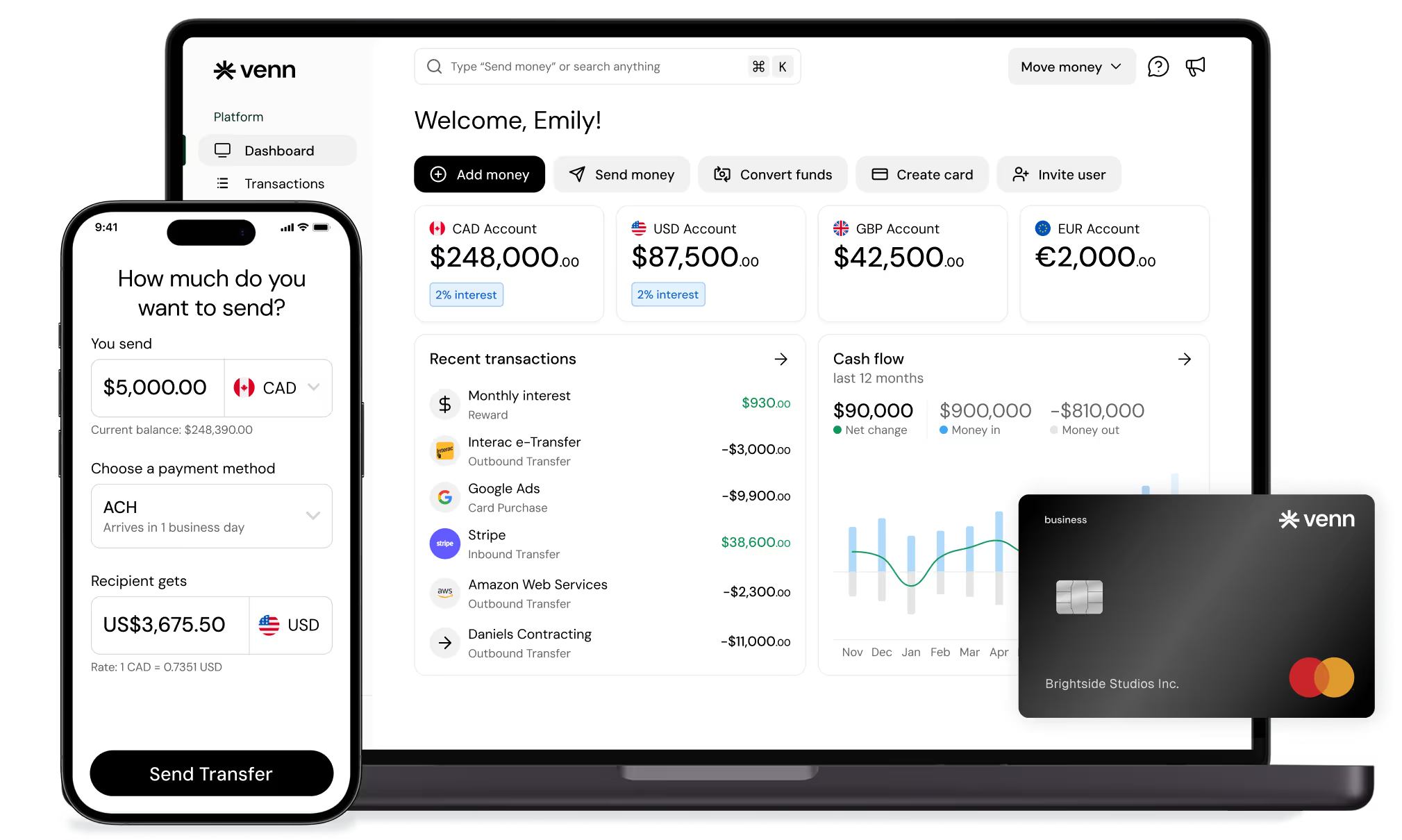
How to Get Approved for a Business Bank Account as a Construction Company in Canada
Learn how to get approved for a business bank account as a construction company in Canada. Discover key requirements and tips for a fast, smooth approval process.

Trusted by 15,000+ Canadian businesses
Business banking for Canada
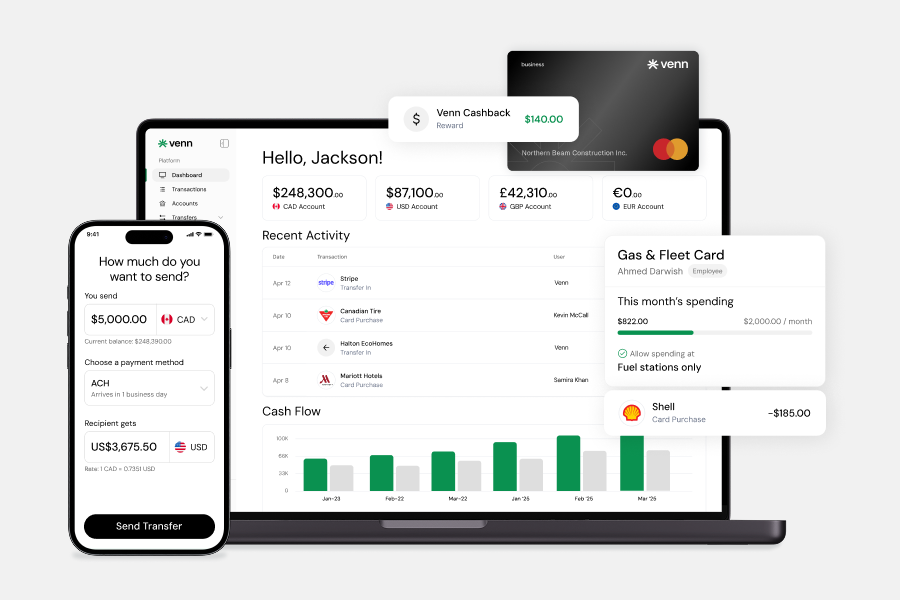
Local CAD and USD accounts, corporate cards with cashback, the lowest FX rates in Canada, free local transfers, and more.
Getting approved for a business bank account shouldn't stop your construction company from breaking ground on new projects. Yet many contractors face frustrating delays, unexpected rejections, or endless documentation requests that can disrupt operations and damage client relationships.
The construction industry faces unique banking challenges. Financial institutions view construction businesses through a different lens than other sectors, often requiring additional verification and stronger documentation. Cash flow volatility, project-based revenue, and complex payment structures all influence how providers assess your application.
Success isn't about luck. It's about preparation and understanding exactly what financial institutions need to see. This guide walks you through the complete approval process, from gathering the right documents to troubleshooting common roadblocks. You'll learn strategies specific to construction businesses and discover how to position your company for quick approval.
Beyond just getting approved, choosing the right banking partner matters. Construction companies need specific features like managing holdbacks, processing progress payments, and handling multi-project cash flow. The right provider understands these needs and builds their approval process accordingly.
Why Construction Companies Face Unique Approval Challenges
Financial institutions approach construction business applications with heightened scrutiny, and understanding why helps you prepare a stronger application. The construction sector presents specific risk factors that traditional banks carefully evaluate.
Cash flow volatility tops the list of concerns. Unlike businesses with steady monthly revenue, construction companies experience significant fluctuations based on project timelines, weather delays, and payment schedules. Progress billing creates irregular income patterns that make risk assessment more complex. Seasonal work adds another layer of unpredictability, particularly for exterior contractors in Canada's climate.
The industry's payment structure creates additional complications. Holdbacks, where clients retain 10% of payment until project completion, can strain cash flow for months. Lien risks and subcontractor payment chains introduce potential liabilities that banks must consider. Large material purchases and equipment costs mean construction companies often process high-value transactions that trigger anti-money laundering reviews.
Business failure rates in construction exceed many other sectors. Economic downturns hit construction particularly hard, and project delays or disputes can quickly destabilize smaller contractors. Financial institutions factor these statistics into their approval decisions.
Modern fintech platforms approach these challenges differently than traditional banks. While banks often apply rigid risk models designed decades ago, digital providers like Venn use updated criteria that better reflect how modern construction businesses operate. They understand that project-based revenue doesn't equal instability when properly managed.
These approval challenges aren't insurmountable. They simply require construction companies to present stronger documentation and clearer business narratives than other industries might need.
We've also created the best guide for construction companies looking to better understand what the financial landscape looks like in 2026. Check it out here now!
Business Structure Matters: What You Need to Know Before Applying
Your business structure fundamentally shapes the approval process and determines which banking features you can access. Construction companies must carefully consider this decision before applying for accounts.
1. Sole Proprietorship Construction Businesses:
Operating as a sole proprietor offers the simplest path to account approval. Documentation requirements remain minimal, typically just government ID, your CRA Business Number, and proof of business address. Personal credit history heavily influences approval decisions, making this structure ideal for contractors with strong credit scores.
However, simplicity comes with limitations. Transaction volumes may face caps that restrict larger projects. Banking features often remain basic, without access to multiple users or advanced cash management tools. Most critically, sole proprietorships blur the line between personal and business finances, creating liability concerns for construction companies handling significant contracts.
1. Incorporated Construction Companies:
Incorporation requires more complex documentation but opens doors to comprehensive banking relationships. Financial institutions view incorporated businesses as more established and professional. You'll need Articles of Incorporation, corporate resolutions, and beneficial ownership declarations. The approval process takes longer but results in access to full business banking features.
Corporate structure provides crucial liability protection for construction businesses. It separates personal assets from business risks, essential when managing large projects or multiple subcontractors. Incorporated companies can add multiple users, open various account types, and access higher transaction limits without scrutiny.
Most construction companies benefit from incorporating before seeking business banking, especially if planning to bid on commercial projects or work with larger clients who prefer dealing with corporations. If you're currently a sole proprietor handling more than $100,000 in annual revenue, consider incorporating before your banking application. The extra preparation time pays dividends in banking features and business credibility.
For more information about all the information needed to incorporate in Canada, read our guide here.
Essential Documents Construction Companies Need for Approval
Preparation prevents delays. Construction companies that gather complete documentation before starting their application typically receive approval 50% faster than those who submit incomplete packages.
For All Construction Businesses:
• Government-issued photo ID for all signing authorities (driver's license or passport)
• CRA Business Number (BN) and GST/HST registration confirmation
• Proof of business address dated within 60 days (lease agreement, utility bill, or property tax statement)
• Business license or trade certification required by your province or municipality
• Contractor license or registration specific to your trade (electrician, plumber, general contractor)
For Incorporated Construction Companies (Additional Requirements):
• Articles of Incorporation from your provincial or federal registry
• Corporate bylaws and any shareholder agreements
• Certificate of Good Standing issued within the last 60 days
• Corporate resolution specifically authorizing account opening and identifying signing authorities
• Beneficial ownership declaration listing all individuals owning 25% or more of the company
• Complete director and officer information including names, addresses, and dates of birth
Construction-Specific Documents That Strengthen Applications:
Smart construction companies include additional documentation that demonstrates business legitimacy and financial stability. These aren't always required but significantly improve approval odds:
• WSIB clearance certificate proves you're current with workplace safety insurance
• General liability insurance certificate shows responsible business practices
• Bonding capacity letter from your surety company (particularly valuable for larger contractors)
• Recent financial statements or tax returns demonstrate business stability and cash flow patterns
• Sample contracts or purchase orders proving active projects and revenue pipeline
Digital platforms like Venn streamline document submission through secure upload portals, eliminating the need to visit branches with paper copies. Traditional banks may require original documents or certified copies, adding time and complexity to the process.
Step-by-Step: The Business Bank Account Approval Process for Construction Companies
Understanding each stage of the approval journey helps set realistic expectations and prevents unnecessary anxiety. Construction companies that know what to expect navigate the process more successfully.
Step 1: Choose Your Banking Provider
Selection criteria extend beyond just fees. Evaluate transaction limits against your typical payment volumes. Consider whether you need multi-currency capabilities for equipment imports or US suppliers. Check integration options with your accounting software for accurate job costing. Most importantly, research approval timelines. Traditional banks quote standard timelines but construction applications often take longer. Digital platforms like Venn typically provide faster decisions with more predictable timelines.
Step 2: Gather Your Documentation
Reference the comprehensive checklist above and collect everything before starting your application. Missing documents cause 70% of approval delays. Create digital copies of all documents for easy upload. Ensure corporate registry information matches exactly across all documents. Even minor discrepancies trigger additional verification.
Step 3: Complete the Application
Online applications offer 24/7 accessibility and faster processing. Upload documents immediately when requested rather than waiting for follow-up emails. Answer all questions thoroughly, especially those about business operations and transaction patterns. Transparency accelerates approval.
In-branch applications provide personal guidance but require appointments and travel time. Branch staff can review documents immediately and identify potential issues. However, construction companies often find scheduling branch visits during business hours challenging.
Some providers offer hybrid approaches. You might start online then visit a branch for identity verification. Venn's fully digital process eliminates branch visits entirely while maintaining security through advanced verification technology.
Step 4: Identity Verification and KYC Compliance
Know Your Customer (KYC) and Anti-Money Laundering (AML) requirements apply to all financial institutions. Construction companies face additional scrutiny due to cash-intensive operations and high-value transactions. Providers verify identity through government databases and credit bureaus.
Traditional banks typically take 5-10 business days for KYC verification of construction companies. Digital platforms complete the same verification in 1-3 business days using automated systems. Be prepared to provide additional information about large or unusual transactions in your business history.
Step 5: Business Verification
Financial institutions verify your construction business through multiple channels. They check corporate registries to confirm your company exists and remains in good standing. CRA databases verify your Business Number and GST registration. Third-party services may verify your business address and phone number.
Construction-specific verification might include checking contractor licenses with provincial authorities or confirming insurance coverage. Providing these documents upfront prevents delays during this stage.
Step 6: Approval Decision and Account Activation
Once approved, account activation timelines vary. Traditional banks may require an initial deposit via certified cheque or wire transfer before activating services. Card production and mailing add another 7-10 business days. Online banking access might require separate activation.
Digital platforms typically activate accounts immediately upon approval. Virtual cards provide instant purchasing power while physical cards arrive by mail. Initial funding happens through Interac e-Transfer® or wire transfer, with funds available the same day.
Plan for total timelines of 7-14 business days with traditional banks, or 2-5 business days with digital-first platforms like Venn. Construction companies needing immediate banking access should prioritize providers with faster approval processes.
How to Strengthen Your Application and Avoid Rejection
Proactive preparation dramatically improves approval rates. Construction companies that follow these strategies rarely face rejection.
1. Prepare Financial Documentation
Even when not explicitly required, recent financial statements or tax returns demonstrate business stability. Construction companies with seasonal revenue patterns should include a brief explanation of their business cycle. Show how you manage cash flow during slower periods. If you're a newer business, provide contracts or purchase orders proving your revenue pipeline.
2. Ensure Corporate Registry Information is Current
Outdated director information causes countless delays. Before applying, verify all corporate registry filings reflect current addresses, directors, and contact information. Update any changes through your provincial registry. Order a fresh Certificate of Good Standing dated within 30 days of application.
3. Address Credit Concerns Proactively
Personal or business credit issues don't automatically mean rejection. Provide context for any negative items. If past financial difficulties resulted from industry downturns or specific project issues, explain the circumstances and demonstrate current stability. Recent bank statements showing healthy cash flow can offset historical credit concerns.
4. Choose the Right Account Type
Avoid over-applying for premium accounts with high minimum balances. Start with an account matching your current needs. You can upgrade later as your business grows. Digital platforms like Venn offer scalable solutions without minimum balance requirements.
5. Be Transparent About Business Operations
Clearly explain your construction niche, typical project sizes, and client types. Describe your payment cycles including progress billing and holdback schedules. Ambiguity triggers additional questions and delays. The more complete your initial application, the faster the approval.
6. Consider Starting with Digital-First Providers
Platforms like Venn understand modern construction businesses and design approval processes accordingly. Their risk models account for project-based revenue and seasonal patterns common in construction. This often results in faster approvals with less documentation burden than traditional banks require.
What to Do If Your Application is Delayed or Rejected
Delays and rejections happen, but they're rarely permanent roadblocks. Understanding common issues helps you respond effectively.
Common Reasons for Delays:
• Incomplete documentation missing key pages or signatures
• Corporate registry information not matching application details
• Beneficial ownership verification requiring additional documentation
• Business address verification failing due to new locations or home offices
• Enhanced due diligence triggered by transaction patterns
Steps to Take:
Contact the provider immediately when notified of delays. Request specific information about missing items or concerns. Provide requested documentation within 24 hours to maintain momentum. If corporate registry updates are needed, initiate them immediately as processing takes time.
Never submit multiple applications simultaneously. This raises red flags across the financial system and can result in all applications being rejected. Focus on one provider at a time.
If Rejected:
Request specific rejection reasons in writing. Generic responses like "doesn't meet our criteria" aren't helpful. Push for actionable feedback. Common rejection reasons include incomplete incorporation, credit issues, or insufficient business history.
Address underlying issues before reapplying. If incorporation documents were problematic, work with a corporate lawyer to ensure proper filing. For credit issues, focus on improving scores and gathering evidence of current financial stability.
Consider alternative providers with different risk models. Traditional bank rejection doesn't mean digital platforms will reach the same decision. Venn, for example, evaluates construction businesses using criteria designed for modern companies, not outdated risk models from decades past.
Choosing the Right Business Bank Account for Your Construction Company
Approval is just the beginning. Construction companies need banking features that support their unique operational requirements.
Essential Features for Construction Businesses:
High transaction limits accommodate progress payments and material purchases without hitting daily caps. Construction companies processing multiple subcontractor payments need unlimited or high-volume Interac e-Transfer® capabilities. Free transfers become crucial when paying dozens of workers weekly.
Multi-currency support matters more than many contractors realize. Equipment purchases, specialized materials, or tools often come from US suppliers. Real USD accounts eliminate conversion fees on every transaction. For companies importing materials, competitive foreign exchange rates significantly impact project profitability.
Integration with accounting software like QuickBooks or Xero enables accurate job costing. When every transaction automatically syncs with your project tracking, you maintain real-time profitability visibility. Multiple account capability allows separate accounts for different projects or operating expenses versus holdback reserves.
Cost Considerations:
Monthly fees are just the starting point. Calculate total costs including:
• Per-transaction fees (especially for high-volume periods)
• Interac e-Transfer® costs (can add up quickly with multiple subcontractor payments)
• Wire transfer fees for equipment purchases or international suppliers
• Foreign exchange markups on USD transactions
• Additional user fees for bookkeepers or project managers needing access
Construction companies processing 200+ transactions monthly often pay $300-500 in transaction fees alone with traditional banks. Digital platforms with different fee structures can reduce these costs dramatically.
Modern Banking Solutions for Construction Companies:
Digital platforms address construction-specific pain points traditional banks ignore. Venn exemplifies this approach with features designed for how construction businesses actually operate:
• Real local CAD and USD accounts eliminate foreign exchange fees on US supplier payments
• Unlimited free Interac e-Transfer® removes per-payment costs for subcontractor payments
• Competitive FX rates reduce costs on imported materials and equipment by thousands annually
• Multiple accounts at no additional cost enable project-specific budgeting and holdback management
• Corporate cards with 1% unlimited cashback help offset material costs
• Per-account pricing instead of per-user fees makes it affordable to give access to project managers and bookkeepers
These aren't just nice-to-have features. They solve real problems construction companies face daily, from managing project cash flow to reducing payment processing costs.
How Venn Simplifies Approval and Banking for Construction Companies
Venn built its platform understanding that construction companies need banking that works as hard as they do. This starts with an approval process designed for modern businesses, not outdated banking models.
Streamlined Approval Process:
Venn typically approves construction companies in 2-3 business days, not weeks. The digital-first application eliminates branch visits and paper shuffling. Upload your documents once, track your application status in real-time, and receive clear communication throughout the process.
Venn understands construction business models. Project-based revenue, seasonal fluctuations, and complex payment structures don't trigger automatic rejections. The approval criteria reflect how successful construction companies actually operate in 2026, not how banks thought they operated in 1990.
Built for Construction Business Needs:
Every Venn feature addresses real construction company challenges:
Real local CAD and USD accounts mean you pay US suppliers without conversion fees. When purchasing equipment from American dealers or importing specialized materials, you save 2-3% on every transaction compared to traditional bank exchange rates.
Unlimited free Interac e-Transfer® transforms subcontractor payments. Instead of paying $1-1.50 per transfer, you process unlimited payments at no charge. For construction companies paying 20-30 subcontractors weekly, this saves hundreds monthly.
Multiple accounts at no additional cost enable proper project accounting. Separate operating expenses from project funds. Isolate holdback amounts. Track individual job profitability without complex spreadsheet gymnastics.
Integration with QuickBooks and Xero means every payment automatically appears in your job costing. No manual entry, no reconciliation headaches, just accurate real-time project profitability data.
Corporate cards with 1% unlimited cashback put money back in your pocket on every material purchase, equipment rental, and fuel fill-up. No categories to track, no caps to hit, just simple cashback on all business spending.
Transparent Pricing:
Venn charges per account, not per user. Add your bookkeeper, project managers, and office administrator without extra fees. Everyone who needs access gets it, improving efficiency and reducing payment bottlenecks.
Security and Compliance:
As a registered Payment Service Provider in Canada, Venn operates under strict regulatory oversight. Your funds receive CDIC insurance protection through Peoples Trust Company. The platform uses bank-grade encryption and multi-factor authentication to protect your business.
Ready to experience banking built for construction companies? See if you qualify for a Venn account today and join thousands of Canadian businesses who've simplified their banking.
Frequently Asked Questions
Q: How long does it take to get approved for a business bank account as a construction company in Canada?
A: Approval timelines vary by provider. Traditional banks typically take 7–14 business days due to enhanced verification requirements. Digital-first platforms like Venn often approve construction businesses in 2–3 business days. Timelines depend on business structure, document completeness, and AML review processes.
Q: Can I open a business bank account for my construction company if I’m a sole proprietor?
A: Yes. Sole proprietors can open business accounts with simpler requirements than corporations, typically needing government ID, CRA Business Number, and proof of business address. Incorporated construction companies may access higher limits and broader banking features.
Q: Do construction companies need special licenses or certifications to open business bank accounts?
A: Not always required, but contractor licenses, WSIB clearance, liability insurance, and trade certifications strengthen your application. Requirements vary by province and financial institution, and some banks may request these documents to verify business legitimacy.
Q: Can I open a business bank account online, or do I need to visit a branch?
A: Many providers now support online account opening. Digital platforms like Venn offer fully remote onboarding. Traditional banks may still require an in-branch visit for identity verification, especially for incorporated construction businesses.
Q: What are the typical fees for construction company business bank accounts in Canada?
A: Traditional banks charge $15–$50+ monthly, plus per-transaction fees, $15–$30 wire fees, and 1.5–3% FX markups. Digital platforms like Venn offer lower transaction costs, transparent pricing, and competitive FX, making them more cost-effective for construction cash flow and supplier payments.
---
**Disclaimer:** This publication is provided for general information purposes and does not constitute legal, tax or other professional advice from Venn Software Inc or its subsidiaries and its affiliates, and it is not intended as a substitute for obtaining advice from a financial advisor or any other professional. We make no representations, warranties or guarantees, whether expressed or implied, that the content in the publication is accurate, complete or up to date.

Venn is all-in-one business banking built for Canada
From free local CAD/USD accounts and team cards to the cheapest FX and global payments—Venn gives Canadian businesses everything they need to move money smarter. Join 15,000+ businesses today.
Frequently asked questions
Everything you need to know about the product and billing.
Join 15,000+ businesses banking with Venn today
Streamline your business banking and save on your spend and transfers today
No personal credit check or guarantee.