Construction Business Banking in Canada: Complete Financial Guide for 2026
Discover expert strategies for construction business banking in Canada. Optimize cash flow, manage holdbacks, and streamline payments with this complete guide.


Trusted by 15,000+ Canadian businesses
Business banking for Canada
Local CAD and USD accounts, corporate cards with cashback, the lowest FX rates in Canada, free local transfers, and more.
Running a construction business in Canada means juggling complex financial demands that most industries never face. You're managing 10% holdbacks on every project, waiting 30 to 90 days for progress payments, coordinating subcontractor payments across multiple job sites, and somehow maintaining positive cash flow through it all.
Traditional business banking advice falls short because it wasn't written for contractors dealing with statutory liens, progress billing complexities, or the seasonal nature of Canadian construction work. Generic small business guides won't help you navigate Ontario's new mandatory holdback release requirements or explain why your bank charges $17 for receiving a wire transfer from your US equipment supplier.
This comprehensive guide addresses the real financial challenges facing Canadian construction companies in 2026. You'll learn how to structure your banking for optimal cash flow management, implement job costing systems that actually work, handle GST/HST on progress billings, and choose financial partners who understand construction-specific needs. We've included actionable templates, compliance checklists, and strategies that successful contractors use to maintain profitability in Canada's $359.80 billion construction industry.
Understanding the Canadian Construction Industry's Financial Landscape
Industry Overview and Market Dynamics
Canada's construction industry represents a massive economic force, valued at CAD $359.80 billion in 2025 and projected to reach $422 billion by 2030 with a steady 4.2% compound annual growth rate. Residential construction dominates the market, accounting for 58.1% of total output in 2024, followed by commercial and infrastructure projects.
The industry operates through various business structures. Sole proprietorships remain common among specialized trades and smaller contractors, while partnerships allow shared resources and expertise. Corporations provide liability protection and tax advantages for larger operations, though they require more complex financial management and regulatory compliance.
Cash flow cycles in construction differ dramatically from other industries. Payment timelines typically stretch 30 to 90 days from invoice submission, creating significant working capital pressures. Provincial regulations add another layer of complexity, with each province maintaining distinct lien legislation, holdback requirements, and payment prompt legislation that directly impacts your banking needs.
Unique Financial Challenges Construction Businesses Face
Construction companies face a perfect storm of financial pressures that standard business banking can't adequately address.
Irregular cash flow tops the list of challenges. Projects generate revenue in unpredictable waves through progress billing, while expenses like payroll and materials demand steady outflows. This mismatch creates constant cash management headaches, especially for growing businesses juggling multiple projects.
Holdback requirements compound these pressures. Ontario mandates 10% statutory holdbacks on construction contracts, while Manitoba requires 7.5%. These funds remain frozen until project completion or lien expiry, typically 60 days after substantial completion. Recent Ontario Construction Act amendments now require mandatory annual holdback releases, changing how contractors must plan their cash positions.
Managing multiple projects simultaneously multiplies complexity exponentially. Each project operates on its own timeline, budget, and payment schedule. Subcontractor coordination becomes critical, as you're responsible for paying trades and suppliers even when client payments are delayed. Materials financing adds another dimension, requiring upfront capital for purchases that won't generate revenue for months.
Seasonal revenue fluctuations hit Canadian contractors particularly hard. Winter slowdowns affect residential and commercial projects differently across provinces, making year-round cash flow planning essential. Progress billing and percentage-of-completion accounting create additional administrative burdens that traditional banks rarely help address.
The industry faces a growing labour crisis, with 22% of the construction workforce approaching retirement. This drives wage inflation and makes retaining skilled workers through competitive compensation packages increasingly important for financial planning.
Essential Banking Requirements for Construction Companies
Core Account Features Every Construction Business Needs
Choosing the right banking partner can mean the difference between smooth operations and constant financial friction. Construction businesses need specific features that address their unique operational realities.
1. Multi-Currency Capabilities
Construction relies heavily on cross-border commerce. Equipment often comes from US manufacturers, specialized materials may require European suppliers, and some contractors work on international projects. You need more than just the ability to receive foreign currency. Real local currency accounts that can send and receive payments in USD, EUR, and GBP eliminate expensive conversion fees and payment delays.
Most Canadian banks offer "US dollar accounts" that are actually Canadian-based accounts with limited functionality. These accounts can't send or receive ACH transfers, forcing you to use expensive wire transfers for every US transaction. True local US accounts, like those offered by modern fintech platforms including Venn, provide full ACH capability and eliminate the $17+ CAD fees for receiving US wires.
2. Payment Flexibility and Speed
Subcontractor relationships depend on reliable, timely payments. Free, unlimited Interac e-Transfer® capability lets you pay individual trades quickly without transaction fees eating into margins. For larger payments, you need affordable EFT and ACH transfers, ideally at $0-2 per transaction rather than the $30+ some banks charge for domestic wires.
International wire capabilities matter too. When you're paying overseas suppliers or equipment manufacturers, the difference between a $50 wire fee and a $6-10 fee adds up quickly. Same-day or next-day payment processing keeps projects moving, compared to the 3-5 day delays common with traditional banking.
3. Cash Flow Management Tools
Every construction business needs tools to maximize cash efficiency. Competitive interest rates on account balances help offset the impact of holdbacks and payment delays. Look for accounts offering 2.75% interest on CAD balances and up to 3.5% interest on USD balances (learn more) without minimum balance requirements.
Sub-account functionality transforms project financial management. Creating separate accounts or sub-accounts for each major project allows precise budget tracking, simplifies job costing, and provides clear audit trails. Integration with accounting software like QuickBooks or Xero eliminates manual data entry and reduces errors. Automated payables management streamlines supplier payments and improves cash flow forecasting.
4. Security and Compliance
Your banking partner must provide rock-solid security and regulatory compliance. Funds should be protected under CDIC insurance. Look for institutions registered as Payment Service Providers (PSPs) with proper oversight from Canadian financial regulators. Compliance with anti-money laundering regulations and ability to handle construction-specific requirements like lien holdbacks are non-negotiable.
Why Traditional Banks Fall Short for Construction Businesses
Traditional banks weren't designed for modern construction operations, and it shows in their fee structures, technology limitations, and service models.
High fees plague every aspect of traditional banking. International payments routinely cost $30-50 per wire, with additional fees for currency conversion at rates 2-3% above market rates. Even receiving payments costs money, with inbound wire fees of $17 or more for US transfers. These fees quickly erode profit margins on materials purchases and equipment rentals.
Limited multi-currency support forces unnecessary conversions. Most banks can hold foreign currencies but can't actually use them effectively. You'll receive USD payments, convert them to CAD to pay Canadian expenses, then convert back to USD to pay American suppliers, losing money on each conversion.
Poor integration with modern accounting tools creates administrative nightmares. Manual entry of transactions, limited transaction details, and batch processing delays make accurate job costing nearly impossible. Physical branch visits for large transactions waste valuable time and disrupt job site supervision.
Perhaps most frustrating, major Canadian banks often can't send EFTs between each other, forcing expensive wire transfers for routine payments. This limitation alone can cost construction businesses thousands in unnecessary fees annually.
For more information about how to be approved for a business bank account in Canada, check out our guide for construction companies here.
Managing Construction Cash Flow: Strategies and Best Practices
Understanding the Construction Cash Flow Cycle
Construction cash flow operates unlike any other industry. Understanding these unique patterns is essential for financial survival and growth.
Projects demand significant upfront investment. Materials must be purchased, workers paid, and equipment rented or maintained before any revenue arrives. This negative cash flow period can last weeks or months depending on project scope and billing arrangements. Delayed revenue from progress billing compounds the challenge, as invoices submitted today won't be paid for 30-90 days.
Holdback retention creates an additional cash drag. That 10% holdback in Ontario or 7.5% in Manitoba represents money you've earned but can't access, sometimes for months after project completion. Seasonal variations add another variable, with winter slowdowns requiring careful reserve management.
Managing multiple project timelines simultaneously multiplies these challenges. Project A might be in the heavy expense phase while Project B awaits final payment and Project C hasn't broken ground. Each project's cash profile affects your overall position, making consolidated cash management critical.
Cash Flow Management Strategies
Project-Based Account Management
Smart contractors separate project finances using dedicated sub-accounts or multiple business accounts. This approach provides crystal-clear visibility into each project's profitability and cash position. You can track whether that downtown condo development is actually profitable or if the suburban retail renovation is draining resources.
Budget by project from day one. Allocate specific amounts for labour, materials, equipment, and overhead. Set aside holdback amounts in separate accounts so you're never tempted to use funds that aren't really available. Maintain operating reserves in a central account for overhead and emergency expenses.
Payment Terms Optimization
Negotiating favourable payment schedules with clients can transform your cash position. Structure progress billing to align with your major expense periods. If you know foundation work requires significant material purchases, ensure your billing schedule provides payment shortly after those expenses hit.
Deposit structures help cover initial costs. Many successful contractors require 10-25% deposits on signing, with progress payments tied to specific milestones. Balance this with competitive market practices, but don't be afraid to protect your cash flow through smart contract terms.
Leveraging Technology for Cash Flow Visibility
Modern banking technology eliminates cash flow surprises. Real-time account monitoring shows exactly where you stand at any moment. Set up alerts for large deposits, low balances, or unusual transactions. Automated invoicing through integrated accounting systems ensures bills go out immediately upon milestone completion.
OCR receipt capture and invoice matching streamline expense tracking. Instead of boxes of paper receipts, every purchase gets digitally captured and categorized. This technology, built into platforms like Venn, transforms construction bookkeeping from a nightmare into a manageable process.
Managing Holdbacks Effectively
Holdback management requires strategic planning and careful tracking. Ontario's 10% requirement means $100,000 of every million-dollar project sits frozen. Recent amendments requiring mandatory annual holdback release help, but you still need systems to track release dates and ensure timely collection.
Create separate holdback tracking spreadsheets or use accounting software features specifically for this purpose. Set calendar reminders for holdback release dates, typically 60 days after substantial completion. Plan project budgets assuming holdback funds aren't available, treating eventual release as a bonus rather than counting on it for operations.
Understanding provincial variations matters. Manitoba's 7.5% holdback comes with different release conditions than Ontario's rules. If you work across provincial borders, maintain clear documentation of which rules apply to each project.
Construction Accounting Fundamentals for Canadian Contractors
How Construction Accounting Differs from Other Industries
Construction accounting operates on fundamentally different principles than retail or service businesses. These differences directly impact your banking needs and financial management strategies.
Job costing forms the foundation of construction accounting. Unlike businesses that track overall revenue and expenses, construction companies must monitor costs for each individual project. Every hour of labour, piece of lumber, and equipment rental gets assigned to specific jobs. This granular tracking reveals which projects generate profits and which drain resources.
Percentage-of-completion revenue recognition adds complexity. You can't simply record revenue when you send an invoice. Instead, revenue must be recognized based on project progress, requiring careful tracking of costs incurred versus total estimated costs. Work-in-progress (WIP) reporting becomes essential for accurate financial statements.
Contract assets and liabilities create unique balance sheet considerations. Costs incurred but not yet billed appear as contract assets, while billings exceeding costs create contract liabilities. Retainage accounting adds another layer, tracking amounts held back by clients as separate receivables with different collection timelines.
Essential Accounting Practices
Job Costing
Effective job costing starts with accurate estimates. Break down each project into phases: site preparation, foundation, framing, mechanical, finishing. Track direct costs including labour hours at specific wage rates, materials purchased for each phase, and equipment rental or usage charges.
Indirect costs require careful allocation. Office overhead, project management salaries, and general equipment maintenance must be distributed fairly across active projects. Many contractors use labour hours or direct costs as allocation bases. The key is consistency, pick a method and stick with it.
Real-time profitability tracking prevents nasty surprises. Modern accounting software integrated with your banking platform can show project profitability daily. If a project starts bleeding money, you'll know immediately and can take corrective action.
Progress Billing and Revenue Recognition
Creating effective progress billing schedules requires balancing cash flow needs with client expectations. Front-load schedules where possible to improve cash flow, but remain competitive with market standards. Document work completed thoroughly with photos, sign-offs, and detailed descriptions to prevent payment disputes.
Change orders demand special attention. Track them separately from base contracts, ensuring proper authorization before proceeding. Bill change orders promptly—don't wait until project completion to submit additional charges.
Revenue recognition under Canadian accounting standards requires matching revenue with costs incurred. This means maintaining accurate estimates of total project costs and regularly updating percentage-of-completion calculations.
Managing Construction Payroll
Construction payroll complexity stems from multi-project work and varying wage requirements. Workers might split time between multiple projects in a single day, requiring precise time tracking for accurate job costing. Mobile time-tracking apps that integrate with your accounting system simplify this process.
Prevailing wage requirements on public projects add another dimension. Track these separately and ensure compliance with specific wage determinations. Union versus non-union considerations affect both wages and benefit contributions, requiring careful attention to collective agreements.
Statutory requirements include standard deductions for CPP and EI, plus provincial workers' compensation premiums that vary by trade classification. Construction typically faces higher workers' compensation rates due to injury risks, making safety programs financially valuable beyond their human benefits.
Subcontractor Management
Subcontractor relationships require careful financial management. Track every subcontractor agreement, including holdback amounts, payment terms, and lien waiver requirements. Maintain organized files with contracts, insurance certificates, and WSIB clearances.
T5018 reporting obligations kick in when construction businesses pay subcontractors $500 or more annually. You must report these payments to CRA, making accurate record-keeping essential. Many contractors discover T5018 requirements only when facing penalties, so build proper tracking into your systems from day one.
Lien waiver documentation protects against double payment obligations. Require statutory declarations from subcontractors confirming payment of their suppliers and sub-subcontractors. While paperwork-intensive, this practice prevents costly lien claims that can freeze project payments.
GST/HST Compliance for Construction Businesses
Understanding GST/HST in Construction
Tax compliance in construction involves unique challenges that catch many contractors off guard. Understanding these rules prevents costly mistakes and maximizes your input tax credit recovery.
GST/HST registration becomes mandatory once your taxable supplies exceed $30,000 over four consecutive calendar quarters. Most construction businesses hit this threshold quickly, making registration essential from startup. Voluntary registration before hitting the threshold allows input tax credit claims on startup expenses.
Charging GST/HST on construction services follows standard rules—you charge tax based on where services are provided. However, determining the place of supply for construction can be complex. Generally, construction services are supplied where the real property is located, but exceptions exist for design, engineering, and consulting services.
Input Tax Credit (ITC) recovery represents a major cash flow opportunity. Every dollar of GST/HST paid on business expenses can be recovered, but only with proper documentation. This includes materials, subcontractor services, equipment rentals, and overhead expenses.
Provincial variations matter significantly. Ontario charges 13% HST, while Alberta splits 5% GST federally with no provincial sales tax. These differences affect both pricing and cash flow planning, especially for contractors working across provincial borders.
New housing rebates add complexity for residential contractors. Clients may qualify for rebates on new home construction, affecting how you structure contracts and handle tax collection.
For more information about GST/HST rules for construction companies, check out our guide here.
Special GST/HST Rules for Construction
Place of Supply Rules
Construction services are generally supplied where the real property is located. Building an Ontario warehouse means charging Ontario HST rates, regardless of where your business is based. This rule applies to all services directly related to real property construction, renovation, or repair.
Multi-provincial projects require careful analysis. If you're based in Alberta but working on a BC project, you'll charge BC rates. Design and consulting services may have different place of supply rules if performed remotely.
Import considerations affect material purchases. Importing construction materials triggers GST at the border, but you can claim ITCs if properly documented. Some contractors miss these credits by not tracking import documentation carefully.
Timing of Tax Collection
Progress billing creates specific GST/HST timing requirements. You must charge and remit tax based on the earlier of invoice date or payment receipt. This means issuing tax invoices promptly to avoid remittance obligations before collecting payment.
Holdback amounts include GST/HST, creating a cash flow challenge. You'll remit tax on the full invoice amount, including holdbacks, even though you won't receive those funds for months. Planning for this tax liability prevents cash crunches at remittance time.
Payment versus invoice basis accounting affects smaller contractors. Businesses with annual revenues under $1.5 million can elect to remit GST/HST on a cash basis, only paying tax when payment is received. This election significantly improves cash flow for eligible contractors.
Record-Keeping Requirements
Documentation standards for construction ITC claims exceed general business requirements. Keep detailed records showing not just amounts but specific project allocation for materials and services. CRA audits often focus on construction businesses due to the high value of ITC claims.
Invoice requirements include specific information: supplier name and GST number, clear description of goods or services, date, and GST/HST shown separately. Missing elements can result in denied ITC claims during audits.
Retention periods extend to six years from year-end, but construction lien legislation may require longer retention for project-specific documents. Digital record-keeping simplifies storage and retrieval, with modern expense management systems automatically capturing and organizing receipts.
Choosing the Right Business Banking Partner for Your Construction Company
Key Features to Evaluate
Selecting a banking partner requires careful evaluation of construction-specific needs. Not all business accounts are created equal, and the wrong choice costs more than just monthly fees.
Why Construction Companies Are Choosing Venn
Modern construction businesses need more than basic banking. They need comprehensive financial infrastructure that understands construction realities. Venn delivers this through purpose-built features that address industry-specific challenges.
Complete Payment Infrastructure
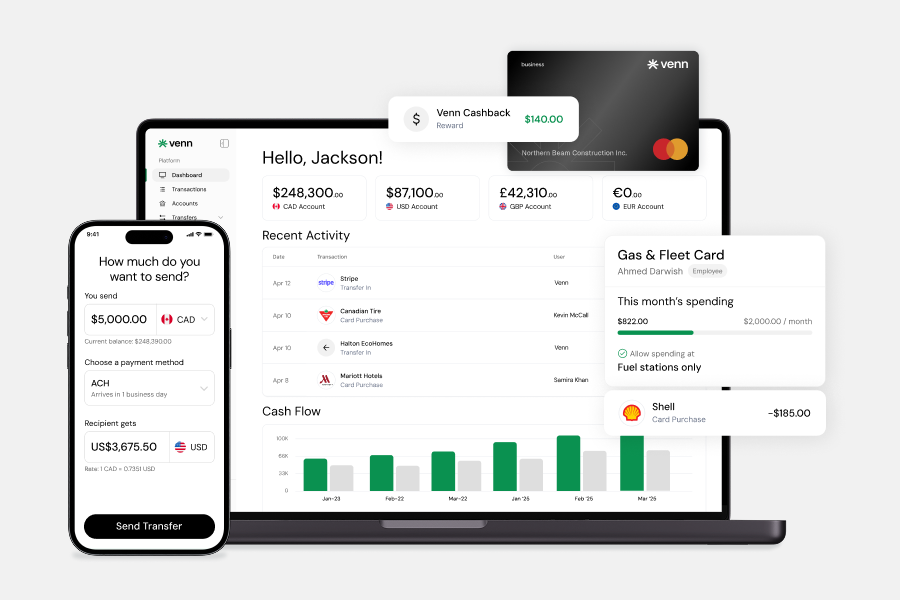
Venn eliminates payment friction that slows construction operations. Free, unlimited Interac e-Transfer® means paying individual subcontractors costs nothing, whether you're settling a small invoice or making regular payments. Real local US accounts with full ACH capability transform how you work with American suppliers—no more $17 fees for receiving US wires or forcing suppliers to use expensive wire transfers.
International payments to 180 countries in 36+ currencies cost just $6-10 depending on your plan, compared to $30-50 at traditional banks. Receive wires completely free, and send domestic EFTs for $0-2. This fee structure alone can save construction companies thousands annually.
Industry-Leading FX Rates
Currency exchange often represents a hidden cost drain for construction businesses. Venn offers 0.25%-0.45% FX markup depending on your plan, compared to up to 3% at traditional banks.* When you're purchasing $100,000 in US equipment, that difference means saving $2,500 or more on a single transaction.
Multi-currency accounts eliminate unnecessary conversions entirely. Hold USD from American clients, pay US suppliers directly, and only convert what you need for Canadian expenses. Seamless integration with Stripe, Shopify, and PayPal means USD receipts flow directly into your USD account without forced conversions.
Cash Flow Optimization
Every dollar counts in construction cash management. Venn pays 2.75% interest on CAD balances and up to 3.5% interest on USD balances (learn more) with no minimum requirements, helping offset the impact of holdbacks and payment delays. Create unlimited sub-accounts for project-based budgeting at no extra cost—traditional banks often charge $5-10 monthly per additional account.
Pricing per account rather than per user makes Venn especially valuable for growing construction companies. Add project managers, bookkeepers, and site supervisors without paying $10+ per user like many competitors charge. Instant or same-day transfers between accounts keep funds flowing where needed.
Integrated Expense Management
Field purchases and employee expenses create administrative headaches without proper tools. Venn's multi-currency card automatically uses the currency you're paying in, eliminating conversion fees on international purchases. Earn 1% unlimited cashback on all card spending with no minimum thresholds or category restrictions.
OCR receipt capture and invoice matching transform expense tracking. Site supervisors can photograph receipts instantly, with automatic extraction of vendor, amount, and tax details. This single platform replaces separate banking, payment, and expense management tools, reducing both costs and complexity.
Built for Canadian Business Compliance
Unlike many fintech solutions, Venn provides real Canadian bank accounts through Peoples Trust infrastructure. Pay taxes, process payroll, and handle all government remittances—capabilities many modern platforms can't offer. Your funds receive protection under CDIC insurance, and Venn operates as a registered Payment Service Provider fully compliant with Canadian regulations.
Accounting Integration
Direct integration with QuickBooks and Xero eliminates manual data entry. Automated payables let you pay vendors directly from your accounting software, with immediate synchronization of payment details. Create recipients without requiring invoices first, providing more flexibility than competitors who force rigid invoice-based workflows. Streamlined reconciliation matches transactions automatically, reducing month-end closing time.
Setting Up Your Construction Business Banking
Step-by-Step Setup Process
1. Business Registration and Documentation
Before approaching any financial institution, ensure your business structure and registration are complete. Sole proprietorships need business name registration and a Business Number from CRA. Partnerships require partnership agreements clearly defining financial responsibilities. Corporations must provide articles of incorporation, corporate resolutions, and shareholder registers.
GST/HST registration should be completed simultaneously, as you'll need the number for proper invoicing. Don't wait until you hit the mandatory threshold, voluntary registration lets you claim ITCs on startup expenses.
2. Choosing Your Account Structure
Smart account structure simplifies financial management from day one. Smaller contractors might start with a single account plus sub-accounts for major projects. Larger operations benefit from multiple account strategies: operating account for daily expenses, payroll account for wage payments, tax account for GST/HST reserves, and separate project accounts for major jobs.
Consider holdback management in your structure. Some contractors maintain a dedicated holdback account, transferring retained amounts immediately upon invoicing. This physical separation prevents accidentally using funds that aren't truly available.
3. Setting Up Payment Methods
Efficient payment setup saves hours weekly. Start by linking your primary accounting software, this connection enables automated transaction import and categorization. Add key subcontractors and suppliers as payees, including their preferred payment methods. Some prefer e-Transfers for speed, while others need EFTs for accounting system compatibility.
Configure approval workflows that match your business structure. Perhaps project managers can approve expenses up to $5,000, while larger payments require owner authorization. Set up payment notifications so recipients know funds are coming, reducing payment inquiry calls.
4. Implementing Expense Management
Issue cards strategically to team members who make regular purchases. Set appropriate limits, perhaps $2,500 for site supervisors and $10,000 for project managers. Configure real-time notifications for all card transactions, allowing immediate detection of any issues.
Train your team on receipt capture from day one. Every purchase needs digital documentation for both tax compliance and job costing. Modern expense management systems make this painless, but only if everyone follows the process consistently.
Integrating Banking with Your Accounting System
Connection between banking and accounting transforms construction financial management. Start by mapping your chart of accounts to match your project structure. Each major project might have subcategories for labour, materials, equipment, and subcontractors.
Bank feed setup requires attention to detail. Ensure transaction descriptions import with enough detail for accurate categorization. Configure rules for recurring transactions like insurance or equipment leases. Set up separate rules for different payment types, e-Transfers might default to subcontractor expense while bill payments go to utilities.
Reconciliation workflows should match your business cycle. Weekly reconciliation during busy seasons prevents month-end surprises. Match bank transactions to invoices and receipts promptly, investigating any discrepancies immediately. Leverage automated matching features, but maintain human oversight for accuracy.
Advanced Financial Strategies for Growing Construction Businesses
Scaling Your Financial Operations
Multi-Project Management
Growth brings complexity that demands sophisticated financial structures. Sub-accounts provide project isolation without the overhead of separate corporations. Track each project's cash position independently while maintaining consolidated oversight. This approach reveals which projects generate cash and which consume it, enabling better bid decisions.
Cash allocation between projects requires careful planning. Maintain minimum operating reserves in each project account while pooling excess funds for maximum interest earnings. Transfer protocols should be documented—who can move funds between projects, approval requirements, and documentation needs.
Planning for growth means building scalable systems today. Choose banking platforms that grow with you without multiplying costs. Per-user pricing models that seem reasonable for five employees become burdensome at fifty.
Financing and Credit Management
Banking relationships lay groundwork for future financing needs. Consistent account management, minimal overdrafts, and steady growth demonstrate creditworthiness. Many contractors discover financing needs during growth spurts but lack the banking history lenders require.
Lines of credit provide flexibility for seasonal variations and growth opportunities. Build these relationships before you need them—applying for credit during cash crunches rarely ends well. Bonding requirements for larger projects often depend on strong banking relationships and demonstrated financial management.
Financial ratios matter more than many contractors realize. Maintain current ratios above 1.2, track gross profit margins by project type, and monitor debt-to-equity relationships. These metrics influence both bonding capacity and credit availability.
Leveraging Financial Data for Better Decision-Making
Key Financial Metrics for Construction
Gross profit margins reveal true project profitability after direct costs. Track these by project type, residential renovation might average 35% while commercial construction yields 20%. Understanding your margins enables better bidding and project selection.
Current ratio and working capital indicate financial health. Construction companies need higher ratios than other industries due to holdback requirements and payment delays. Target a current ratio of 1.5 or higher for financial stability.
Days sales outstanding (DSO) measures collection efficiency. If your DSO exceeds payment terms by more than 15 days, collection processes need attention. Work-in-progress analysis reveals whether projects are ahead or behind schedule financially.
Overhead rates require careful monitoring. As you grow, overhead should decrease as a percentage of revenue through economies of scale. If overhead percentage increases, examine whether growth is actually profitable.
Using Banking Data for Insights
Real-time cash position monitoring prevents surprises. Set up dashboards showing cash by project, upcoming payables, and expected receivables. This visibility enables proactive decisions rather than reactive scrambling.
Spending pattern analysis reveals optimization opportunities. Perhaps material purchases cluster around month-end, creating cash crunches. Spreading purchases more evenly might reduce credit line usage and interest costs.
Vendor payment tracking identifies relationship management needs. Quick payment to key suppliers might earn discounts or priority service during material shortages. Seasonal trend identification helps predict cash needs, allowing better interest rate negotiations or investment timing.
Common Financial Mistakes Construction Businesses Make (And How to Avoid Them)
Mistake 1: Poor Cash Flow Forecasting
Running out of cash between progress payments devastates construction businesses. The solution starts with detailed cash flow projections extending at least 90 days. Build conservative scenarios assuming delayed payments and cost overruns. Maintain operating reserves equal to two months of overhead expenses. Use interest-bearing accounts for reserves—even 2.75% interest on CAD balances and up to 3.5% interest on USD balances (learn more) provides meaningful returns on six-figure balances.
Mistake 2: Inadequate Job Costing
Not knowing true project profitability until completion prevents course correction. Implement real-time job costing with weekly updates. Track costs against estimates line by line. Compare actual labour hours to budgeted amounts. Include overhead allocation in profitability calculations. Modern accounting integration makes this tracking automatic rather than arduous.
Mistake 3: Ignoring Holdback Management
Failing to plan for retained funds creates predictable cash crunches. Track holdback release dates meticulously—set calendar reminders 30 days before each release. Budget projects assuming holdback funds aren't available. Understand provincial requirements thoroughly, especially if working across borders. Consider holdback financing options for large projects where retained amounts strain cash flow.
Mistake 4: High Banking and Payment Fees
Paying excessive fees slowly bleeds profitability. Traditional banks charging $30-50 for wire transfers, 2-3% for currency exchange, and $17 for incoming wires cost thousands annually. Modern fintech solutions offer transparent, low-cost fee structures. Free e-Transfers, $6-10 international wires, and 0.25%-0.45% FX rates transform your cost structure.
Mistake 5: Weak Subcontractor Payment Systems
Manual payment processes create costly delays and errors. Automate payments through banking platform integration with accounting software. Use free Interac e-Transfer® for quick settlements. Maintain clear payment schedules communicated to all parties. Document every payment with proper lien waivers and statutory declarations.
Mistake 6: No Separation Between Personal and Business Finances
Mixing personal and business finances creates tax nightmares, destroys financial visibility, and appears unprofessional to clients and lenders. Establish dedicated business accounts immediately, even as a sole proprietor. Maintain strict separation with clear documentation for any owner draws or contributions. Use business cards for all business expenses without exception.
Frequently Asked Questions About Construction Business Banking in Canada
Q: What type of business account do I need for a construction business in Canada?
A: You need a business account that supports your legal structure (sole proprietorship, partnership, or corporation) and the realities of construction cash flow. Look for multi-currency capability, low transaction fees, accounting integration, and the ability to create sub-accounts for projects. Modern platforms like Venn include these features by default.
Q: How do holdbacks work in Canadian construction?
A: Holdbacks require a percentage of contract value to be retained as financial security. In Ontario, 10% must be held back; in Manitoba, it’s 7.5%. Ontario now requires mandatory annual holdback release, and funds are generally released 60 days after substantial completion or once lien rights expire.
Q: Can I use a US bank account for my Canadian construction business?
A: You can open “USD accounts” at Canadian banks, but most are based in Canada and cannot send or receive ACH transfers. You’ll still pay inbound wire fees even for US-to-US transfers. Real US-domiciled accounts (like Venn offers) support ACH, reduce costs, and make paying US suppliers simpler.
Q: What banking features help with construction cash flow management?
A: Ideal features include interest-bearing accounts, project-based sub-accounts, low-cost transfers, real-time balances, and integrated accounting. These help manage retainage, control spend, improve forecasting, and keep project cash separate for clarity and compliance.
Q: How can I reduce banking fees for my construction business?
A: Choose a banking platform with transparent pricing and modern rails. Look for free or low-cost EFTs and Interac e-Transfers®, affordable international wires, and competitive FX (0.25%–0.45% vs. 2%–3% at major banks). Savings compound quickly for construction companies making frequent supplier and subcontractor payments.
---
**Disclaimer:** This publication is provided for general information purposes and does not constitute legal, tax or other professional advice from Venn Software Inc or its subsidiaries and its affiliates, and it is not intended as a substitute for obtaining advice from a financial advisor or any other professional. We make no representations, warranties or guarantees, whether expressed or implied, that the content in the publication is accurate, complete or up to date.

Venn is all-in-one business banking built for Canada
From free local CAD/USD accounts and team cards to the cheapest FX and global payments—Venn gives Canadian businesses everything they need to move money smarter. Join 15,000+ businesses today.
Frequently asked questions
Everything you need to know about the product and billing.
Join 15,000+ businesses banking with Venn today
Streamline your business banking and save on your spend and transfers today
No personal credit check or guarantee.