USD Business Account in Canada for E-commerce 2026 Guide
USD Business Account in Canada: How E-commerce Sellers Hold, Receive and Spend US Dollars (2026) with ACH, hold USD, pay vendors, and reduce FX drag for teams.


Trusted by 15,000+ Canadian businesses
Business banking for Canada
Local CAD and USD accounts, corporate cards with cashback, the lowest FX rates in Canada, free local transfers, and more.
The Cross-Border Currency Problem For Sellers
Many Canadian e-commerce sellers enter 2026 earning a meaningful share of revenue in US dollars. Shopify orders from US customers, Amazon marketplace payouts, wholesale invoices, and distributor payments can all arrive in USD — and the margin problem starts when that revenue gets converted into CAD before the business actually needs it in CAD.
This article is about business account workflows for Canadian e-commerce sellers, not a generic overview of US currency. A practical USD business account in Canada should help your team answer three operating questions: how do you receive USD payments in Canada, when should you keep USD for future costs, and how do you spend USD from a business account without creating avoidable FX drag?
If your revenue comes in USD and your suppliers, ad platforms, SaaS tools, or contractors also bill in USD, forced conversion creates unnecessary back-and-forth movement. The goal is to match revenue currency to expense currency where possible, then convert USD to CAD only when the business genuinely needs Canadian-dollar cash.
What A USD Business Account Means For A Canadian Business
A USD business account helps a Canadian business accept, maintain, convert, and use US dollars for business activity. For e-commerce sellers, that means receiving marketplace payouts, billing US customers, keeping USD for upcoming costs, and spending USD on suppliers, ads, or software without converting every transaction by default.
The account itself is only part of the setup. Its value depends on how it connects to receiving rails such as ACH and wires, payment tools, business cards, FX conversion, and accounting software. A useful USD business account Canada workflow should help your team receive, hold, and spend USD in a way that matches how money actually moves through the business.
How It Differs From Personal Accounts And Card-Only Tools
A personal USD account may show a US dollar balance, but it usually lacks the controls, documentation, and payment workflows an e-commerce business needs. Even a Canada-based US dollar business account can feel limited if incoming payouts rely on wires or SWIFT rather than the practical cross-border payment rails Canadian sellers use every week.
Card-only tools solve a narrower problem. They help teams spend, but they don't necessarily help you receive USD payments, manage marketplace payouts, or reconcile supplier payments from one operating flow. For sellers, the goal is to hold, receive, and spend USD as part of a working finance system — not simply view a balance.
Why E-commerce Sellers Need USD Workflows
A Canadian e-commerce USD account becomes practical when revenue and expenses both move in US dollars. Shopify payouts, Amazon marketplace payouts, and US customer invoices create recurring USD inflows, while many sellers simultaneously pay suppliers, advertising platforms, logistics partners, contractors, and software subscriptions in USD.
If your setup forces every payout into CAD and then converts funds back to USD for operating costs, margin gets harder to manage. A stronger workflow lets you receive, hold, and spend USD with cleaner reconciliation and fewer avoidable currency steps.
Why The Wrong Setup Can Reduce Margins
Small currency decisions compound quickly when your payout, account, card, and accounting tools don't work together. A setup that triggers forced conversion can turn USD revenue into CAD before you need it, then require another conversion when you pay a US vendor — effectively taxing the same dollars twice.
Beyond business account foreign exchange fees, sellers may face extra charges on inbound wires or cross-border payment workflows. The impact is operational too. Finance teams spend more time matching deposits, conversions, fees, and vendor payments across systems, which makes true margin harder to see.
Common Friction Points In USD Operations
For Canadian e-commerce sellers, USD operations often break down in predictable ways: payouts trigger forced CAD conversion before you can hold USD in a business account; teams convert USD to CAD, then back to USD for vendors; inbound wires add avoidable costs; ACH and wire payments in USD have limited support; supplier payments require manual workarounds; and accounting loses clarity when revenue, FX, fees, and expenses sit across currencies.
The Decision Lens For Evaluating Accounts
Evaluate a USD business account Canada setup by the workflow it supports, not the label on the product. If your business gets paid by marketplaces, invoices US customers, or uses ACH and wire payments, start with receiving rails. Then ask whether you can keep USD until expenses arise, spend USD from the account, convert USD to CAD at transparent pricing, and sync activity into QuickBooks or Xero. For e-commerce teams, the key distinction is whether the provider can function as a true operating setup or only adds a card-based spend layer on top of an existing account.
How Canadian Sellers Receive USD
Canadian sellers usually receive USD through four paths: marketplace payouts from Amazon or other channels, payment processor settlements from Shopify or Stripe, invoice payments from US wholesale customers, and direct customer payments. The best approach depends on the rails your payer supports.
If you're researching how to get paid in USD as a Canadian business, focus on whether your setup can accept ACH and wire payments in USD, provide US banking details for Canadian business use, and avoid automatic conversion into CAD before you decide what to do with the funds. Some multi-currency business platforms, including Venn, support local USD receiving workflows, while traditional USD accounts may rely more heavily on SWIFT-based routing.
Marketplace And Customer Payment Flows
Your receiving setup needs to match how money actually arrives. A marketplace may send a USD payout to your receiving account after settlement. A wholesale buyer in the US may pay a USD invoice directly. A payment processor may release customer funds into your business account on a fixed schedule.
If your receiving details change often or can't support common platform requirements, payouts can fail, delay reconciliation, or trigger unwanted conversion. Predictable account details help you receive USD payments in Canada, keep clean records, and plan supplier payments with fewer manual fixes.
ACH, Wires, And Local Receiving Details
ACH is the everyday rail for many US domestic business payments, including vendor transfers and customer collections. Wires typically fit higher-value payments, time-sensitive transfers, or cross-border transactions where bank-to-bank routing matters more than low transaction cost. If you need US banking details for Canadian business operations, verify the rail behind the account. Some Canadian bank USD accounts still feel less native for US workflows than sellers expect. Venn, for example, is a technology company offering a genuinely US-domiciled account that can send and receive ACH through Venn US banking.
How To Keep USD Without Forced Conversion
If your store earns in USD and pays meaningful expenses in USD, forced conversion creates avoidable workflow friction — converting revenue into CAD, then converting back to USD for suppliers, ad platforms, software, or contractors. A better operating setup lets you hold USD in your business account until the next USD expense arrives, then convert to CAD only when domestic obligations require it.
When Keeping USD Makes Sense
Keeping USD can protect margins when your next major costs are also in USD. If your Shopify or Amazon payouts arrive in US dollars, you may want that balance available for future supplier payments, upcoming ad campaigns, US-denominated SaaS, or contractor invoices. The practical rule: match revenue currency to expense currency where possible. For Canadian e-commerce sellers with recurring USD revenue and recurring USD costs, converting only the net excess to CAD reduces avoidable FX churn.
When Converting To CAD Still Makes Sense
If your team runs mostly on Canadian costs, converting USD to CAD is often the practical choice. CAD payroll, rent, domestic operating expenses, and tax installments all require predictable local cash flow. Some sellers convert immediately after receiving USD payments in Canada, while others schedule conversions around pay runs or filing dates. The right cadence depends on your revenue currency, expense currency, and tolerance for FX movement.
How Sellers Spend USD Efficiently
Once USD is in the business, the next priority is using it cleanly. If your suppliers, ad platforms, SaaS tools, contractors, or fulfillment partners bill in US dollars, look for a setup that lets you spend from your USD balance directly — reducing unnecessary round trips from USD to CAD and back to USD.
For Canadian e-commerce teams, this means direct USD supplier payments, card spend that draws from the right currency balance, and expense records that sync into accounting without extra manual cleanup.
Paying Suppliers And Partners In USD
Paying directly in USD eliminates extra conversion steps and makes costs easier to match against USD revenue. This matters for inventory suppliers, 3PLs, freight forwarders, US agencies, software vendors, and contractors who invoice in US dollars. A practical USD business account Canada setup should let you spend from your USD balance where possible, then convert only when the expense truly requires CAD.
Paying For Growth And Operations In USD
Many e-commerce teams earn in USD and spend it just as quickly on growth. Meta, Google, TikTok, and Amazon ads often bill in US dollars, and SaaS subscriptions, analytics tools, help desk platforms, fulfillment partners, and contractor payments can follow the same pattern. If every charge triggers a conversion from CAD, your margin model gets harder to trust.
Spending USD directly from a business account lets you match revenue currency to expense currency — giving you cleaner contribution-margin planning, especially for Shopify and Amazon sellers managing ad budgets, app stacks, and recurring operational costs across borders.
Cards And Expense Controls For USD Spend
Ad platforms, SaaS apps, and US contractors can turn card spend into a hidden FX leak if purchases settle in the wrong currency or lack approval discipline. For a Canadian e-commerce USD account, card currency should match the operating workflow: receive USD, keep it available for USD costs, then spend with clear controls.
Venn offers a Mastercard charge card with spend controls, plus virtual and physical cards for team use. Approval workflows and policies help finance teams manage who can spend, where, and how much. The card also earns 1% cashback from the first dollar, capped by plan: $5K/month on Essentials, $25K/m0onth on Plus, and unlimited on Pro.
Cashback and card perks can improve unit economics, but they should support your workflow — not replace it.
Your Main Options In Canada
For a USD business account in Canada, e-commerce sellers usually compare three provider categories.
Traditional bank USD business accounts suit teams that value branch access, established banking relationships, and familiar processes. They can help you hold USD, but cross-border workflows may feel more fragmented.
Multi-currency business platforms focus on operating flexibility. If your team needs to receive USD payments in Canada, keep funds in USD, convert when practical, and spend from the right currency, this category often aligns well with e-commerce workflows.
Spend-management tools solve a different problem. They help control card spend and expenses, but they typically sit on top of your account setup rather than replace a Canadian e-commerce USD account.
Traditional Bank USD Business Accounts
Big 5 USD business accounts remain familiar options for Canadian businesses that value branch access, relationship managers, and established banking processes. For some e-commerce sellers, that continuity matters — especially when the business already keeps CAD operating accounts with the same institution.
The tradeoff is workflow fit. A US dollar business account in Canada through a traditional bank may still feel SWIFT-oriented rather than native to day-to-day US payment flows. FX markups can reach up to 3%, inbound wire fees often add friction, and teams may need separate processes for the account, conversion, card spend, and reconciliation.
Multi-Currency Business Platforms
If your e-commerce team runs in CAD and USD, and occasionally pays suppliers or contractors in GBP or EUR, a multi-currency business account in Canada can reduce the friction of separate accounts and manual reconciliation. Venn is one example, with CAD, USD, GBP, and EUR account functionality for businesses that need to receive, hold, convert, and spend across currencies. Its FX markup is 0.45% on Essentials, 0.35% on Plus, and 0.25% on Pro and Custom, with QuickBooks and Xero compatibility for cleaner month-end workflows. Wise may also fit transfer-focused teams that mainly need cross-border conversion rather than a broader operating setup.
Spend-Management Tools
Spend-management tools help finance teams control card usage, route approvals, and capture receipts before expenses reach accounting — valuable for e-commerce teams with frequent ad spend, software subscriptions, or employee purchases.
That said, they solve a different problem than a USD operating account. If your priority is to receive USD payments in Canada, keep funds in USD, and pay US suppliers from that balance, confirm the tool actually supports that workflow. Ramp, for example, fits better as a spend layer on top of an existing account setup than as a replacement for receiving and holding USD.
What Matters In A Provider Comparison
How To Choose Based On Your Seller Profile
If you run a Shopify or DTC brand with recurring USD payouts and steady ad spend in US dollars, prioritize a setup that lets you receive, hold, and spend USD without converting every cycle. That usually points toward a Canadian e-commerce USD account built for day-to-day operating workflows.
For Amazon or marketplace sellers who receive USD but pay mostly CAD costs, conversion control matters more than USD spending depth. Look closely at timing, FX transparency, and how easily you can move funds into your Canadian operating account.
Wholesale brands invoicing US customers should focus on predictable USD receiving details and clean reconciliation. Businesses that value in-person service may still prefer a Big 5 relationship with branch access. And if your finance team needs card controls and accounting sync in one workflow, compare multi-currency business platforms such as Venn against a separate account-plus-spend-tool stack.
What To Check Before Opening An Account
Before you choose a Canadian e-commerce USD account, map the full money flow from payout to reconciliation.
- Receiving: Can you receive USD payments in Canada through the rails your marketplaces, customers, and payment processors use?
- ACH access: If you invoice US customers or work with US platforms, confirm whether the account supports ACH and wire payments in USD.
- Wire costs: Check inbound wire fees, not just monthly account fees.
- FX pricing: Compare business account foreign exchange fees and markups before you convert USD to CAD business funds.
- USD control: Make sure you can hold USD in business account balances without forced conversion.
- Spending: Confirm whether you can spend USD from business account balances directly, including supplier payments and ad platforms.
- Card setup: Check whether the card is debit, charge, prepaid, or credit, since each affects cash flow differently.
- Operations: Look for QuickBooks or Xero integrations that support clean multi-currency reconciliation.
- Eligibility: Confirm province availability before applying.
- Product type: Decide whether you need a real account workflow or only a spend-management layer.
Where Venn Fits For E-commerce Sellers
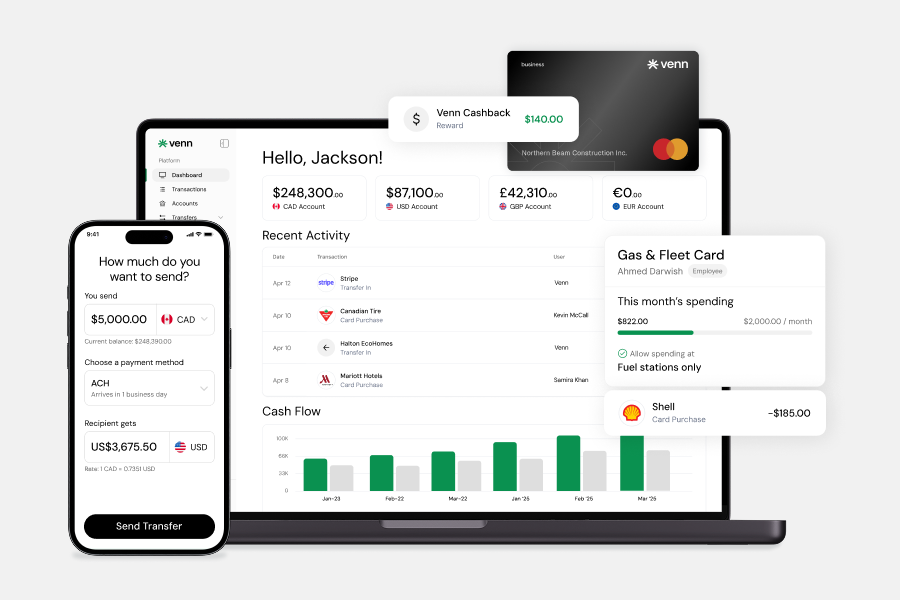
If your store earns in USD but still runs part of the business in CAD, Venn can fit as a multi-currency operating stack rather than a standalone FX tool. Through Venn global accounts, Canadian sellers can manage CAD and USD operating functionality, use local USD receiving, and work with ACH capability as covered above.
For day-to-day finance work, the value is in keeping payments, spend, and reconciliation closer together. Venn includes payables for vendor payments, Venn invoicing for customer billing, and spend management with expense controls — all in the same stack. Free unlimited Interac e-Transfer® also supports domestic vendor payments.
When month-end gets busy, Venn accounting automation supports two-way QuickBooks and Xero sync, receipt matching, and transaction categorization. Account balances are held at Bank of Montreal, and eligible deposits are covered by CDIC insurance protection up to applicable limits.
Venn supports Canadian incorporated businesses and sole proprietors. It is not available in Quebec. Plan details are available on Venn pricing.
Choosing A USD Workflow That Protects Margin
The right setup depends on how money actually moves through your business. A USD business account Canada comparison should start with the workflow: can you receive USD payments in Canada, hold USD when it matches upcoming expenses, convert to CAD only when needed, spend USD from the business account, and reconcile each step clearly?
Headline fees rarely tell the full story. Compare provider type, payment rails such as ACH and wire payments in USD, FX pricing, and accounting visibility across marketplaces, suppliers, ad platforms, and software tools. If your team wants a multi-currency business account Canada workflow that supports day-to-day operations, Venn is worth exploring alongside the other options covered above. Sign up for Venn
Frequently Asked Questions
Q: What is the difference between a USD business account and a regular Canadian business account?
A: A USD business account is designed to receive, hold, convert, and spend US dollars for business use. A regular Canadian business account usually operates in CAD, which can require earlier currency conversion or separate products to manage USD payments.
Q: Can a Canadian business get paid in USD without converting to CAD right away?
A: Yes, depending on the provider and receiving setup. If you want to receive USD payments in Canada without forced conversion, compare the available account rails, payout details, and provider options covered above.
Q: Do all USD business accounts support ACH?
A: No. ACH support varies by provider and account type. Before opening an account, confirm whether it supports receiving ACH transfers, sending ACH payments, or both, and check for any eligibility requirements, transaction limits, and fees.
Q: Should an e-commerce seller hold USD or convert it to CAD immediately?
A: It depends on how your revenue and expenses match. If you pay US suppliers, advertising platforms, or software subscriptions in USD, holding some USD may reduce unnecessary currency conversions. However, CAD payroll, rent, and taxes may favour converting part of the balance to CAD.
Q: Can I pay US suppliers directly from a USD balance?
A: Yes, if your provider supports direct USD payments or USD card spending. For Shopify, Amazon, and direct-to-consumer (DTC) sellers, this can help align USD revenue with USD operating costs and potentially reduce unnecessary currency conversions.
Q: Is a spend-management card the same as a USD business account?
A: No. A spend-management card can help control business expenses, but it may not provide the full functionality to receive, hold, convert, and send USD as part of a business operating setup. Check whether the provider offers a complete USD account or only payment and expense-management features.
---
**Disclaimer:** This publication is provided for general information purposes only and does not constitute legal, tax, financial, or other professional advice from Venn Software Inc., its subsidiaries, or its affiliates, and is not a substitute for advice from a qualified professional. All comparisons and competitor information reflect publicly available information believed accurate as of October 22, 2026; features, pricing, rates, and terms referenced are subject to change and may differ at the time you read this. All product names, logos, and brands referenced are the property of their respective owners; their mention does not imply affiliation with or endorsement by Venn. Any comparative statements reflect Venn's views and are provided to help readers evaluate options. We make no representations, warranties, or guarantees, express or implied, that the content is accurate, complete, or up to date.

Venn is all-in-one business banking built for Canada
From free local CAD/USD accounts and team cards to the cheapest FX and global payments—Venn gives Canadian businesses everything they need to move money smarter. Join 15,000+ businesses today.
Frequently asked questions
Everything you need to know about the product and billing.
Join 15,000+ businesses banking with Venn today
Streamline your business banking and save on your spend and transfers today
No personal credit check or guarantee.