How to open a US Domiciled business account in Canada 2026
How to open a US Domiciled business account in Canada with ACH details. Learn docs, fees, and options like Venn to cut FX costs and delays. Save on SWIFT fees.


Trusted by 15,000+ Canadian businesses
Business banking for Canada
Local CAD and USD accounts, corporate cards with cashback, the lowest FX rates in Canada, free local transfers, and more.
Canadian businesses selling to US customers, paying American contractors, or using US-based platforms face a common challenge: getting paid and paying others without losing money to unnecessary fees and delays. The solution often involves opening a US domiciled business account, but many "USD accounts" marketed to Canadian businesses aren't actually US-domiciled. They're Canadian accounts that hold US dollars, which means your American clients still face international payment friction when paying you.
Understanding this distinction can save your business thousands annually and eliminate the payment headaches that slow down your operations. This guide explains what "US-domiciled" actually means, walks you through your options, and shows you how to set up a cross-border financial stack that works. Platforms like Venn now offer Canadian businesses real local account details for multiple currencies, including USD accounts with ACH capability, so you can operate like a local business when transacting across borders.
What "US Domiciled" Actually Means (And Why It Matters)
US-Domiciled vs USD Account In Canada
These two terms sound similar but function very differently for your business operations.
A USD account at a Canadian institution is a Canadian-based account that holds US dollars. When someone sends you money, it often travels through international payment networks (SWIFT), which means delays and fees even when both parties think they're dealing in USD.
A US-domiciled account is an account based in the United States with US routing and account numbers. It connects directly to domestic US payment networks, primarily ACH (Automated Clearing House). Your American clients can pay you the same way they pay any other US vendor.
This matters because US clients prefer paying via ACH. It's what they use for payroll, vendor payments, and recurring transactions. Many US platforms and marketplaces require US routing and account numbers to send payouts. When your "US account" isn't truly local, you're forcing international transactions where domestic ones would suffice.
Payment Rails Primer: ACH vs Wire vs SWIFT
ACH handles domestic US bank-to-bank transfers. It's the standard for business invoices, payroll, and vendor payments. Transactions typically settle in 1-3 business days at minimal cost.
Wire transfers move faster but cost more. Domestic US wires settle same-day, while international wires can take several days and incur multiple fees.
SWIFT is an international messaging network that connects banks worldwide. Even transactions that appear "US-to-US" can route through SWIFT if one account isn't truly US-domiciled, introducing unexpected fees and delays.
The key differentiator for cross-border operations is having local account capabilities. When you can receive and send payments within the same network as your counterparties, you eliminate the friction that comes with international transfers for routine payments.
Quick Decision Tree: Which Type Of US Account Do You Need?
Before comparing providers, clarify what your business actually requires:
• If you need US clients to pay you easily via ACH → prioritize a real US account with ACH details and routing numbers
• If you mainly hold USD and convert occasionally → prioritize low FX spreads and minimal monthly fees
• If you need multi-currency capability (USD + GBP/EUR) → prioritize platforms with local rails for each currency (ACH, SEPA, Faster Payments)
• If you need employee spend controls and expense management → prioritize platforms with corporate cards and accounting automation
Many Canadian businesses need several of these capabilities simultaneously. Venn addresses this by providing real local US accounts with ACH send/receive capability, multi-currency accounts supporting CAD, USD, GBP, and EUR, a 1% unlimited cashback business card, and direct integrations with QuickBooks and Xero for streamlined accounting workflows.
Comparison Table: US-Domiciled Business Account Options For Canadians
Best Ways To Open A US Domiciled Business Account In Canada
Option 1: Venn (Best For A Modern Cross-Border Financial Stack)
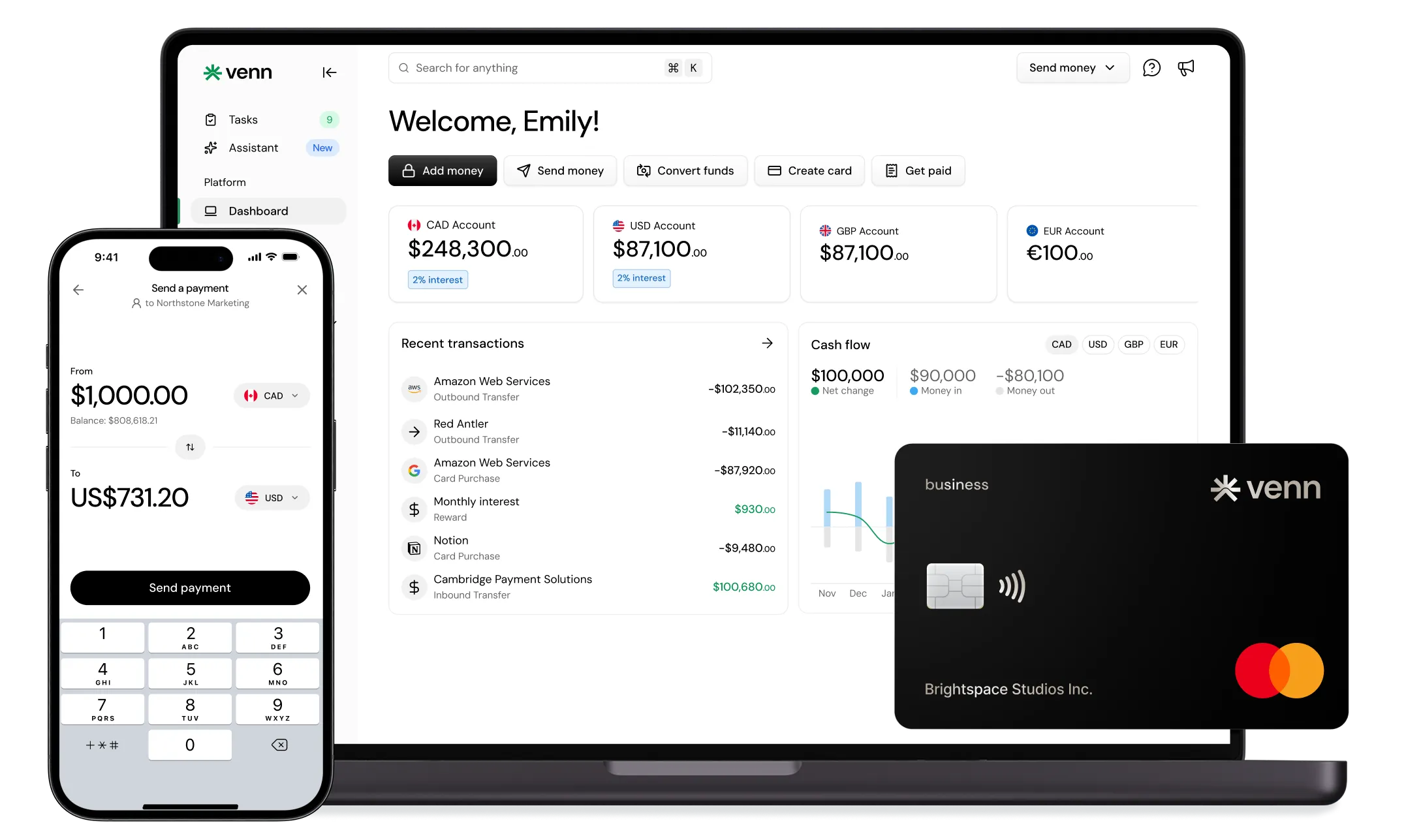
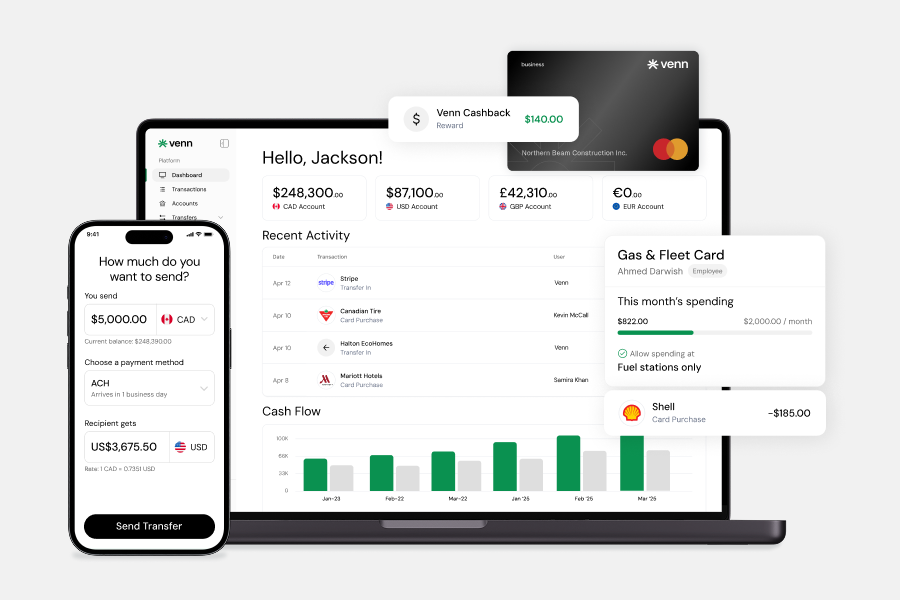
Venn is a Canadian business financial platform that provides what many cross-border businesses need: real local US account capability with ACH send and receive functionality. This is uncommon among Canadian providers.
Key capabilities:
• Multi-currency accounts in CAD, USD, GBP, and EUR with local rails for each (ACH in the US, SEPA for EUR, Faster Payments for GBP)
• 1% unlimited cashback on card spend with multi-currency card behavior that reduces unnecessary FX conversions
• Automated payables and accounting workflows with direct QuickBooks and Xero integrations
• Global transfers at competitive rates
• CDIC insurance protection on eligible deposits held at Bank of Montreal, a CDIC member institution
For Canadian businesses that invoice US clients, pay American contractors, or manage expenses across currencies, Venn consolidates these functions into a single platform rather than requiring multiple banking relationships.
Verdict: Venn is the strongest fit for Canadian businesses that need real US ACH plus multi-currency capability in a single platform.
Option 2: Canadian Bank Cross-Border Solutions (Best For Branch Access)
Major Canadian banks offer USD accounts and some cross-border services. This works for businesses that value in-person support or already have established relationships with a Big 5 bank.
Considerations:
• "US accounts" may still behave like international setups for certain transactions
• Monthly fees, wire fees, and exchange spreads tend to be higher than fintech alternatives
• Branch access and relationship banking can be valuable for complex situations
Verdict: Choose this route only if in-branch relationship banking outweighs higher fees and possibly non-local rails.
Option 3: Multi-Currency Fintech Accounts (Best For Simple Receiving And Holding)
Several fintech platforms offer multi-currency accounts with USD holding capability. These work well for freelancers and smaller businesses with lighter cross-border needs.
Considerations:
• ACH availability varies significantly between providers
• Business eligibility requirements differ
• Some platforms provide receiving details but limited sending capability
Verdict: Fine for light USD holding, but confirm ACH send and receive capability before committing.
Option 4: US Bank Account Via US Entity (Best For True US Operations)
Opening an account directly with a US bank requires forming a US entity (typically an LLC or C-Corp), obtaining an EIN, and often maintaining a US address.
When this makes sense:
• You're running actual US operations
• You need US payroll
• You require US-only services or banking relationships
Considerations:
• Higher setup complexity and ongoing compliance overhead
• Annual state filing requirements
• Potential tax implications requiring professional guidance
Verdict: Worth the setup and compliance overhead only if you run genuine US operations or payroll.
Step-By-Step: How To Open A US Domiciled Business Account In Canada
Step 1: Confirm Your Must-Haves
The most common mistake is choosing an account that doesn't actually meet your needs.
Before applying anywhere, answer these questions:
• Do you need ACH capability, or just USD holding?
• Do you need to pay US vendors through domestic US rails?
• Do you need employee cards and spend controls?
• Do you need GBP or EUR accounts alongside USD?
Step 2: Gather Typical Documents
Most providers require similar documentation:
• Business registration or incorporation documents
• Government-issued ID for directors and owners
• Proof of business address
• Business information including industry, website, and sometimes sample invoices or contracts
Requirements vary by provider and business type. Sole proprietors typically face simpler requirements than corporations with multiple shareholders.
Step 3: Apply And Complete Verification
The application is online and can often be completed the same day, taking only a few minutes. Verification (KYC) timelines range from same-day to several business days depending on the provider and your business profile.
Common friction points include name mismatches between documents, unclear business models, and insufficient documentation. Having clean, consistent documentation ready speeds up approval.
Step 4: Get Paid Like A Local
Once approved, you'll receive US account details including routing and account numbers. Share these with US clients just as any American vendor would.
Practical tips:
• Add payment instructions directly to your invoices
• Store payer templates in your invoicing or accounting software
• Consider setting up recurring payment arrangements for regular clients
Using local account details reduces friction for US clients and eliminates the "international payment" perception that can slow down collections.
Step 5: Manage FX Intentionally
Currency conversion is where many businesses lose money without realizing it. The spread between the rate you receive and the mid-market rate represents a cost that adds up quickly on significant volume.
Strategic approach:
• Receive USD into your USD account
• Hold USD when you have upcoming USD expenses
• Pay USD bills directly from USD balances
• Convert to CAD strategically rather than automatically
Venn's multi-currency approach supports this strategy by letting you hold and transact in multiple currencies, converting only when it makes sense for your business.
Fees And Pitfalls To Watch
Common Fee Buckets
• Monthly account fees: Range from free to $50+ depending on provider
• Incoming/outgoing wires: Can be $15-45 per transaction
• FX conversion: Spreads vary dramatically, from 0.5% to 3%+
• Cross-border card fees: Many cards add 2.5% on foreign transactions
For context, Canada's Big 5 banks typically add a 2.0–3.5% spread on USD/CAD conversion. Additionally, many Canadian credit cards charge around 2.5% on foreign transactions. In contrast, Venn's FX markups start from 0.25%.
Pitfalls That Cost Businesses Money
"My 'US account' still charges wire fees for US-to-US transfers": This happens when your account isn't truly US-domiciled and transactions route internationally.
"I can receive USD but can't receive ACH": Some accounts provide receiving details that only work for wire transfers, not the ACH payments your US clients prefer.
"My card converts even when I already hold the purchase currency": Cards without multi-currency logic force conversions you don't need.
"My banking tool doesn't integrate with accounting, so month-end is painful": Manual reconciliation wastes time and introduces errors.
Venn addresses each of these: ACH-capable US local accounts, multi-currency balances, smart card behavior, and direct QuickBooks/Xero integration for automated reconciliation.
Tax And Reporting Considerations
A truly US-domiciled account can carry different reporting obligations than a Canadian account holding USD. Canadian filers may need to report foreign holdings, such as through form T1135, when the total cost of specified foreign property exceeds certain thresholds. US-sourced income can also involve withholding requirements and a W-8BEN form.
Your specific obligations depend on your business structure, particularly if you've taken the US-entity route. These rules can be complex, and the consequences for non-compliance are significant. Consult a qualified tax professional to confirm your reporting requirements.
Industry Use Cases: Who Benefits Most?
Ecommerce and Importers: Pay US suppliers directly in USD without conversion fees. Hold inventory payments in USD until needed. Venn's 1% unlimited cashback on supplier payments adds up quickly on high-volume purchasing.
SaaS and Tech Companies: Receive USD revenue from American customers via ACH. Pay US contractors without international wire fees. Clean reconciliation in accounting software reduces month-end close time.
Agencies and Consultants: Invoice US clients with local payment details they recognize. Collect via ACH for predictable cash flow. Expense management with Venn's corporate card keeps project costs organized and earns 1% cashback on client-related spending.
Professional Services: Fewer administrative tasks with automated accounting workflows. Clearer audit trails for compliance requirements.
Marketing and Media Buying: Spend control across team members. Real-time expense visibility. Card rewards on ad spend and vendor payments.
What A Modern Cross-Border Financial Stack Looks Like
The most efficient setup combines purpose-built tools at each layer:
Banking and Spend Layer: Venn provides multi-currency accounts with local rails, corporate cards with 1% unlimited cashback, and global transfer capability.
Accounting Layer: QuickBooks or Xero handles your general ledger, reporting, and compliance requirements.
Payments Layer: Your invoicing system or payment processor handles collections, integrated with your banking layer for automatic reconciliation.
This stack delivers faster month-end close, cleaner reconciliation, fewer fees, and better visibility into cash flow across currencies.
Conclusion
Opening a US domiciled business account in Canada comes down to understanding what "US-domiciled" actually means: an account with US routing numbers that connects to domestic US payment rails like ACH. Many "USD accounts" don't meet this standard, leaving you with international payment friction despite holding US dollars.
Choose your account based on your actual needs: ACH capability, FX strategy, multi-currency operations, and accounting workflow integration. For most Canadian businesses with US clients or vendors, a platform like Venn that combines real local US account details with multi-currency capability and modern expense management provides the most complete solution.
Your next step: open the account, add your new payment details to your invoices, and align your banking with your accounting software for automated reconciliation. Sign up for Venn
FAQ
Q: Do I need a US address to open a US-domiciled business account in Canada?
A: It depends on the provider. Traditional US banks typically require a US address and often a US-incorporated entity. Modern platforms like Venn offer US-domiciled account functionality to Canadian businesses without requiring a US address or US entity, making cross-border payments easier to manage.
Q: Can a Canadian corporation open a US bank account without a US entity?
A: Opening an account directly with a US bank usually requires forming a US entity. However, some Canadian platforms now provide US-domiciled account capabilities, including ACH access, to Canadian corporations without requiring US incorporation.
Q: What's the difference between ACH and a wire transfer?
A: ACH is the domestic US bank-to-bank payment network used for routine business payments. It typically settles in 1–3 business days at very low cost. Wire transfers move faster, often the same day, but are significantly more expensive, usually costing $15–45 per transaction. For regular vendor payments and client collections, ACH is usually the better option.
Q: Will my "USD account" let me receive ACH payments?
A: Not necessarily. Many USD accounts at Canadian banks are Canada-based accounts that hold US dollars but rely on international payment rails. To receive ACH payments, you need an account with US routing and account numbers that explicitly supports ACH transfers.
Q: Is my money insured?
A: Insurance depends on the provider and account structure. Some platforms, like Venn, offer CDIC insurance protection on eligible deposits held at Bank of Montreal, a CDIC member institution. US-based accounts may qualify for FDIC insurance. Always confirm coverage details, limits, and eligibility directly with your provider.
Q: How do I reduce FX fees when getting paid in USD?
A: Hold USD in your USD account instead of automatically converting to CAD. Pay US-dollar expenses directly from that balance and only convert to CAD when needed. This strategy avoids repeated conversions and can significantly reduce FX costs, especially when supported by multi-currency platforms like Venn.
Q: Are there tax implications for a Canadian business with a US-domiciled account?
A: It depends on your setup. Canadian filers may face foreign-holdings reporting such as Form T1135 and US withholding rules on US-sourced income. Confirm your specific obligations with a qualified tax professional.
Venn Mastercard Charge Card is issued by Peoples Trust Company under licence from Mastercard International Incorporated. Mastercard is a registered trademark, and the circles design is a trademark of Mastercard International Incorporated.
Disclaimer: This publication is provided for general information purposes and does not constitute legal, tax or other professional advice from Venn Software Inc or its subsidiaries and its affiliates, and it is not intended as a substitute for obtaining advice from a financial advisor or any other professional. We make no representations, warranties or guarantees, whether expressed or implied, that the content in the publication is accurate, complete or up to date.

Venn is all-in-one business banking built for Canada
From free local CAD/USD accounts and team cards to the cheapest FX and global payments—Venn gives Canadian businesses everything they need to move money smarter. Join 15,000+ businesses today.
Frequently asked questions
Everything you need to know about the product and billing.
Join 15,000+ businesses banking with Venn today
Streamline your business banking and save on your spend and transfers today
No personal credit check or guarantee.