Start a Consulting Business in Canada 2026 Metrics
How to start a consulting business in Canada in 2026 metrics to track, from pricing and CRA setup to utilization, DSO and cash runway weekly scorecards.

Ahmed Shafik
Co-founder

Trusted by 15,000+ Canadian businesses
Business banking for Canada
Local CAD and USD accounts, corporate cards with cashback, the lowest FX rates in Canada, free local transfers, and more.
Starting a consulting business in Canada offers remarkable upside: low overhead, flexible structure, and the ability to monetize expertise you already have. But here's what separates consultants who thrive from those who struggle: the ones who succeed track the right metrics from day one.
A consulting business is straightforward to launch. Staying profitable requires discipline. Consultants fail from avoidable issues: inconsistent pipeline, underpricing, low utilization, slow collections, and untracked profitability. The solution combines a simple setup plan with a metrics-driven operating cadence, supported by a modern financial stack that makes tracking effortless.
This guide walks you through the exact steps to launch your consulting business in Canada in 2026, with the specific metrics to track at each stage. You'll learn how to structure your offer, price your services, register with the CRA, set up your financial operations, and build a weekly scorecard that keeps you profitable.
Step 1: Pick a Profitable Niche and Outcome-Based Offer
What to Do
Generic consultants struggle. Specialists command premium rates and close faster. Choose an industry you understand, a buyer who has budget authority, and an urgent problem that costs them money or opportunity.
Package your expertise into one to three clear offers. An audit identifies problems. An implementation solves them. A retainer provides ongoing support. Start with one offer and expand as you validate demand.
Your ideal client profile should be specific enough that you can name five companies that fit it. "Small businesses" is too broad. "Series A SaaS companies in Toronto struggling with customer churn" gives you a target.
Metrics to Track
ICP clarity score: Rate yourself 1-10 on how specifically you can describe your ideal client's industry, size, pain point, and budget. Anything below 7 means you need more focus.
Offer conversion rate: Track what percentage of leads book discovery calls. Below 20% suggests your positioning needs work.
Average sales cycle length: Measure days from first contact to signed contract. Longer cycles tie up your pipeline and make forecasting difficult.
Step 2: Choose Your Pricing Model
Practical Pricing Models for New Consultants
Hourly billing works when starting out. It's simple to explain and easy to scope. The downside: your income caps at available hours, and clients focus on time rather than outcomes.
Project-based pricing rewards efficiency. You quote a fixed fee for defined deliverables. This requires strong scope control and clear change order processes.
Retainer arrangements provide stability. Monthly recurring revenue makes forecasting straightforward and reduces the constant pressure to sell. Build toward retainers as you establish client relationships.
Most successful consultants in Canada charge between $150 and $500 per hour depending on specialization and client size. Project fees typically range from $5,000 for small engagements to $50,000 or more for comprehensive implementations.
Metrics to Track
Effective hourly rate: Project revenue divided by hours delivered. This reveals your true earning rate regardless of pricing model. If your effective rate drops below your target, you're underpricing or over-delivering.
Gross margin percentage: Revenue minus delivery costs, divided by revenue. Include subcontractors, software, and direct expenses. Target 60% or higher for sustainable consulting.
Retainer coverage: Recurring revenue divided by baseline monthly expenses. When this exceeds 1.0, your fixed costs are covered before you sell anything new.
Step 3: Register Your Business and Get Your CRA Accounts Right
Decide Your Structure
Sole proprietorship is the simplest path. You report business income on your personal tax return. Setup takes minutes. The downside: no liability protection and limited tax planning options.
Incorporation creates a separate legal entity. This provides liability protection, potential tax advantages at higher income levels, and a more professional appearance. The tradeoff: additional compliance requirements and accounting costs.
Most consultants start as sole proprietors and incorporate once annual revenue exceeds $75,000 to $100,000. Confirm the right timing with your accountant based on your specific situation.
CRA Setup Basics
Register for a Business Number through the CRA. This nine-digit identifier connects to your program accounts for GST/HST, payroll, and corporate income tax. You can register online through the CRA's Business Registration Online service.
GST/HST: When You Must Register
You must register for GST/HST once your taxable supplies exceed $30,000 over the last four consecutive calendar quarters or in a single quarter. Below this threshold, registration is optional.
Some consultants register voluntarily even below the threshold. This allows you to claim input tax credits on business purchases and appears more professional to larger clients who expect GST/HST on invoices.
Confirm your specific obligations with the CRA or your accountant, as rules vary by province and service type.
Metrics to Track
Rolling 4-quarter taxable supplies: Track your cumulative taxable revenue to anticipate when you'll cross the GST/HST threshold.
Tax set-aside rate: The percentage of each payment you hold for income tax and GST/HST. Most consultants set aside 25% to 35% depending on their tax bracket and province.
Step 4: Set Up Your Consulting Financial Stack
The Minimum Stack
Your financial infrastructure determines how easily you can track the metrics that matter. The minimum viable stack includes:
Banking: Separate accounts for operating cash, tax set-aside, and profit buffer. Mixing these creates confusion and makes tax time painful.
Card: A business card with clean spend tracking and automatic receipt capture. Personal cards mixed with business expenses create accounting nightmares.
Accounting: QuickBooks or Xero for invoicing, expense categorization, and financial reporting. These platforms generate the reports you need for KPI tracking.
Where Venn Fits
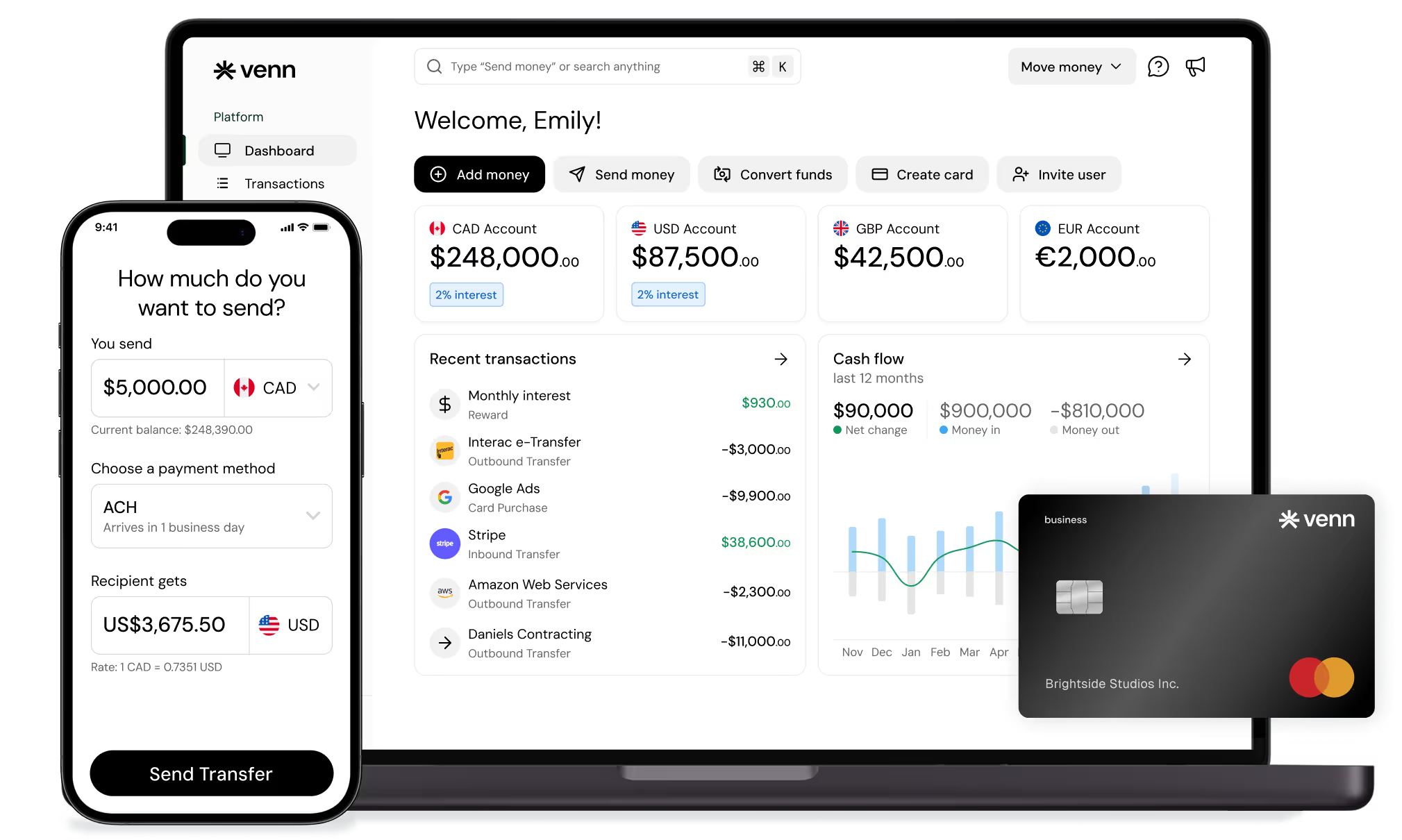
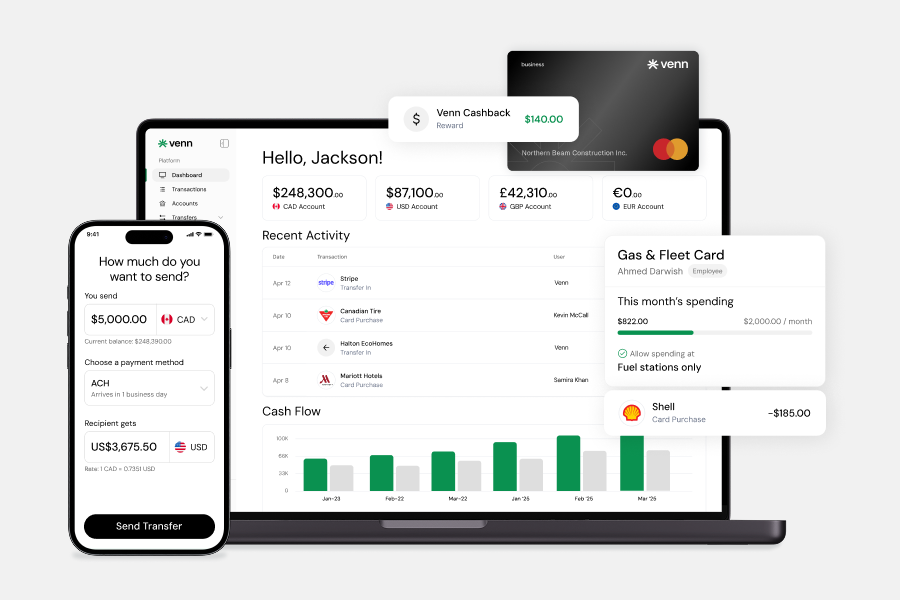
Venn serves as the business banking layer of a modern consulting stack. Use Venn to run day-to-day business finances with clear separation of funds across operating, tax, and payroll accounts.
The Venn corporate card offers 1% unlimited cashback on all spending. For consultants with recurring SaaS subscriptions, travel expenses, and contractor payments, this cashback directly improves margins.
If you work with US clients, Venn provides a real US-domiciled account with ACH support. This eliminates the friction of international wire transfers and lets American clients pay you the same way they pay domestic vendors. Venn also offers EUR and GBP options for consultants serving European clients.
Venn connects directly to QuickBooks and Xero, keeping your books clean and your month-end fast. This integration means your banking data flows automatically into your accounting system, making KPI tracking straightforward.
Funds held with Venn are covered under CDIC insurance protection.
Metrics to Track
Cash runway: Cash on hand divided by average monthly burn. Consultants should maintain three to six months of runway minimum.
Software spend percentage: Total software costs divided by revenue. Keep this below 5% for healthy margins.
FX cost tracking: Track fees and markups as a line item. Multi-currency consulting can bleed margin through poor FX rates.
Step 5: Create Your Core Assets
What to Create
Website or landing page: A single page explaining who you help, what you do, and how to contact you. LinkedIn works as a landing page for many consultants.
Proposal template: A reusable document covering scope, timeline, investment, and terms. Customize for each opportunity but start from a proven structure.
Statement of work template: Detailed deliverables, milestones, acceptance criteria, and payment terms. This protects both you and your client.
Invoice template: Professional invoices with clear payment terms, multiple payment options, and your GST/HST number if registered.
Metrics to Track
Proposal-to-close rate: Proposals sent divided by deals won. Below 30% suggests pricing or positioning problems.
Average deal size: Total revenue divided by number of projects. Track this monthly to spot trends.
Time-to-first-value: Days from kickoff to first deliverable. Shorter timelines build client confidence and accelerate referrals.
Step 6: Get Clients
Three Reliable Acquisition Plays
LinkedIn outbound and content: Share insights from your expertise. Comment on posts from ideal clients. Send personalized connection requests followed by value-first messages.
Partnerships: Build relationships with agencies, accountants, and software vendors who serve your ideal clients. Referral partnerships compound over time.
Network activation: Former colleagues, past clients, and professional connections already trust you. Tell them specifically what you're doing and who you're looking for.
Metrics to Track
Lead-to-call rate: Leads generated divided by discovery calls booked. Below 15% means your outreach needs work.
Call-to-proposal rate: Discovery calls divided by proposals sent. Below 50% suggests qualification issues.
Close rate: Proposals divided by signed contracts. Track by channel to identify your most effective acquisition sources.
CAC proxy: Hours spent on business development divided by clients acquired. For solo consultants, time is your acquisition cost.
Step 7: Deliver Work Without Killing Your Margin
Simple Delivery System
Structure projects around weekly milestones with scoped meetings and documented change orders. When clients request work outside the original scope, document it and price it before delivering.
Build reusable templates, frameworks, and documentation. Every hour you spend creating something reusable pays dividends on future projects.
Metrics to Track
Billable utilization rate: Billable hours divided by total work hours. Target 60% to 70% for solo consultants. Below 50% means too much time on non-revenue activities.
Scope creep rate: Change requests per project. More than two per project suggests scoping problems.
Repeat work rate: Percentage of revenue from returning clients. Above 40% indicates strong delivery and client satisfaction.
Step 8: Manage Cash Flow Like a Pro
Cash Flow Basics for Consultants
Request deposits on new projects. Fifty percent upfront is standard for project work. Retainers should be paid in advance.
Set payment terms at net 15 or net 30. Longer terms hurt your cash flow. Include late payment terms in your contracts.
Set aside taxes immediately when payments arrive. Use separate accounts to make this automatic rather than relying on discipline.
Venn Tie-In
Use Venn's account separation to operationalize your tax set-aside and buffer accounts. When a client payment arrives, transfer the tax portion immediately. This removes the temptation to spend money you'll owe the CRA.
The card and transfer features keep spending clean and measurable, feeding accurate data into your accounting system for reliable KPI tracking.
Metrics to Track
DSO (Days Sales Outstanding): Accounts receivable divided by revenue, multiplied by days in period. Target under 30 days. Above 45 days indicates collection problems.
On-time payment rate: Invoices paid by due date divided by total invoices. Below 80% means your terms or follow-up process needs attention.
Buffer coverage: Cash buffer divided by monthly fixed costs. Maintain at least two months of coverage.
Step 9: Protect the Business
What to Consider
Professional liability insurance (errors and omissions) protects against claims that your advice caused client harm. Most consultants should carry $1 million to $2 million in coverage.
Contracts should include clear scope definitions, acceptance criteria, confidentiality provisions, and limitation of liability clauses. Have a lawyer review your template before you use it.
Metrics to Track
Project risk flags: Count of active projects with scope issues, stakeholder churn, or payment delays. Address flags before they become problems.
Dispute rate: Percentage of projects requiring remediation or refunds. Above 5% indicates systemic delivery or expectation issues.
The KPI Dashboard: A Simple Weekly Scorecard
Review these metrics every Friday in 15 minutes. Track trends, not just snapshots.
Launch Checklist: Start in Seven Days
• Define your niche and one clear offer
• Choose sole proprietorship or incorporation
• Register for a Business Number with the CRA
• Open a Venn account with separate operating and tax set-aside accounts
• Set up QuickBooks or Xero and connect to Venn
• Create your proposal and invoice templates
• Announce your consulting practice to your network
• Book your first discovery calls
Conclusion
Starting a consulting business in Canada in 2026 requires less than you think: a clear offer, basic registration, and a simple financial stack. Staying profitable requires more discipline: tracking the metrics that matter and acting on what they tell you.
Pick your niche. Set up your stack. Sell consistently. Track utilization and cash flow weekly. The consultants who succeed treat their practice like a business, not just a collection of projects.
Sign up for a Venn account and set up a metrics-ready banking and accounting workflow that makes tracking effortless from day one.
FAQs
Q: Do I need to register for GST/HST as a consultant in Canada?
A: You must register once your taxable supplies exceed $30,000 over four consecutive calendar quarters or in a single quarter. Below this threshold, registration is optional but may benefit consultants who want to claim input tax credits. Confirm your specific situation with the CRA or your accountant.
Q: Should I incorporate or stay a sole proprietor as a consultant?
A: Most consultants start as sole proprietors for simplicity and incorporate once annual revenue exceeds $75,000 to $100,000. Incorporation provides liability protection and potential tax advantages but adds compliance costs. Work with an accountant to determine the right timing for your situation.
Q: What are the most important consulting metrics to track weekly?
A: Focus on five core metrics: active opportunities in your pipeline, close rate on proposals, billable utilization rate, DSO on receivables, and cash runway in months. These metrics cover the full cycle from sales through delivery to cash collection.
Q: How should I get paid by US clients as a Canadian consultant?
A: A US-domiciled account with ACH support provides the simplest experience for American clients. Venn offers this capability, allowing US clients to pay you like a domestic vendor. For tax implications of US-source income, consult with a cross-border tax professional.
Venn Mastercard Charge Card is issued by Peoples Trust Company under licence from Mastercard International Incorporated. Mastercard is a registered trademark, and the circles design is a trademark of Mastercard International Incorporated.
---
**Disclaimer:** This publication is provided for general information purposes and does not constitute legal, tax or other professional advice from Venn Software Inc or its subsidiaries and its affiliates, and it is not intended as a substitute for obtaining advice from a financial advisor or any other professional. We make no representations, warranties or guarantees, whether expressed or implied, that the content in the publication is accurate, complete or up to date.
This publication is provided for general information purposes only and does not constitute legal, tax, financial, or other professional advice from Venn Software Inc., its subsidiaries, or its affiliates, and is not a substitute for advice from a qualified professional. All comparisons and competitor information reflect publicly available information believed accurate as of May 7, 2026; features, pricing, rates, and terms referenced are subject to change and may differ at the time you read this. All product names, logos, and brands referenced are the property of their respective owners; their mention does not imply affiliation with or endorsement by Venn. Any comparative statements reflect Venn's views and are provided to help readers evaluate options. We make no representations, warranties, or guarantees, express or implied, that the content is accurate, complete, or up to date.

Venn is all-in-one business banking built for Canada
From free local CAD/USD accounts and team cards to the cheapest FX and global payments—Venn gives Canadian businesses everything they need to move money smarter. Join 15,000+ businesses today.
Frequently asked questions
Everything you need to know about the product and billing.
Join 15,000+ businesses banking with Venn today
Streamline your business banking and save on your spend and transfers today
No personal credit check or guarantee.