Pay US Vendors and Fuel Suppliers as a Canadian Carrier
Best way to pay US vendors and fuel suppliers as a Canadian carrier in 2026. Compare ACH, wires, fleet cards and USD accounts to cut FX leakage for faster AP.

Ahmed Shafik
Co-founder
Trusted by 15,000+ Canadian businesses
Business banking for Canada
Local CAD and USD accounts, corporate cards with cashback, the lowest FX rates in Canada, free local transfers, and more.
Canadian carriers operating cross-border lanes in 2026 face a payment environment that is more complex than it appears. Fuel stops, roadside repairs, parts orders, broker settlements, and recurring supplier invoices all generate USD-denominated obligations, often on tight timelines with little room for payment friction or avoidable cost.
Finding the best way to pay US vendors and fuel suppliers as a Canadian carrier is not a single-answer question. The right method depends on the payment scenario: a weekly fuel supplier settlement calls for a different approach than an urgent same-day repair invoice or a recurring monthly parts order.
This guide compares the main options available to Canadian carriers, including ACH and local USD transfers, wire transfers, fleet and fuel cards, business charge cards, cross-border payment platforms, and multi-currency business account workflows. For each method, the focus is on cost, speed, FX impact, and how well it fits into a practical accounts payable operation.
Why Payment Method Matters For Canadian Carriers
Choosing how to pay US vendors and fuel suppliers is an operational decision with real financial consequences. The payment rail you select affects how quickly suppliers receive funds, how much you lose to FX markup and transfer fees, and how much time your back-office team spends reconciling invoices each week.
Canadian carriers running cross-border lanes often collect revenue in both CAD and USD while paying US fuel suppliers, repair shops, parts vendors, and brokers in USD. That mix creates constant conversion pressure. Pay the wrong way, and you absorb unnecessary exchange-rate markup on every transaction. Pay too slowly, and you risk supplier friction or miss early-payment discounts.
Fuel suppliers add another layer of complexity. Payments are frequent, sometimes urgent, and tied directly to trucks moving on the road. A payment method that works well for a monthly parts invoice may be entirely wrong for a weekly fuel settlement.
No single payment rail solves every scenario. The right choice depends on the use case, the supplier's preferences, how quickly funds need to arrive, and whether your accounting workflow can handle the reconciliation cleanly. Selecting payment methods with those factors in mind keeps cash flow predictable and reduces the administrative burden on your finance team.
The Real Cost Of Paying US Vendors
The wire fee on your bank statement is only the beginning. Most Canadian carriers also absorb an FX markup on every CAD-to-USD conversion, intermediary bank charges that reduce what the vendor actually receives, and delayed settlement that can strain supplier relationships or trigger late fees.
Those costs compound quickly across a typical cross-border AP workflow. A weekly fuel settlement to a US cardlock network, a monthly invoice from a US parts distributor, and an emergency roadside repair charge in Ohio each carry their own conversion cost, transfer fee, and reconciliation burden. Pay all three by wire every time, and the fees stack up before your finance team has even started matching invoices.
Missed early-payment discounts add another layer. Some US parts suppliers offer 1% to 2% net-10 terms. If a slow or expensive transfer method causes you to miss that window, the discount loss can exceed the transfer fee itself.
Admin time is a real cost too. Manual payment entry, chasing confirmation numbers, and reconciling USD transactions against CAD bank statements pulls your back-office team away from higher-value work. For carriers running tight margins on cross-border lanes, that friction is a cost worth measuring.
Why Fuel Suppliers Are a Special Case
Fuel payments don't behave like ordinary vendor invoices. A carrier might settle with a fuel supplier weekly, sometimes more often, and the volume compounds quickly across a fleet. Drivers need fuel now, not after a wire clears. That urgency, combined with high transaction frequency, makes fuel supplier payments a distinct workflow problem.
Fleet or fuel cards handle on-road purchasing well. They give drivers a controlled way to buy fuel at accepted networks, and they generate per-vehicle or per-driver spend data that simplifies reporting by truck or route. For recurring supplier invoice settlement, however, ACH or a local USD transfer often fits better, provided the supplier accepts it and your payment setup supports true US payment rails. The right answer depends on whether you're solving for the driver at the pump or the AP team reconciling weekly settlements.
The Main Ways To Pay US Vendors And Fuel Suppliers
Canadian carriers typically work across several payment methods rather than relying on one approach for every expense. A recurring fuel supplier settlement calls for a different tool than an urgent repair invoice or a small one-off parts order. Choosing the right method for each scenario affects cost, speed, and how cleanly the payment flows into your books.
The five main options most cross-border carriers use are:
• ACH or local USD transfers: Lower-cost transfers suited to recurring vendor payments when suppliers accept US bank rails
• Wire transfers: Widely accepted and useful for urgent or high-value payments, though fees and FX costs add up quickly
• Fleet and fuel cards: Purpose-built for driver fuel spend, with controls and reporting by vehicle or driver
• Business card payments: Practical for one-off or online vendor transactions, hotels, and incidental business expenses
• Cross-border and multi-currency platforms: Useful for carriers with regular USD payables who want to hold USD balances, reduce repeated CAD-to-USD conversions, and streamline reconciliation
Each method carries its own cost profile, acceptance rate, and fit for specific payment scenarios. The sections below evaluate each one so you can build a payment mix that matches how your operation actually runs.
ACH or Local USD Bank Transfer
For recurring US vendor payments, ACH or a local USD bank transfer is often the most cost-effective option available to Canadian carriers. When a supplier accepts ACH, you avoid wire fees entirely, benefit from predictable processing timelines, and can automate payment runs to fit a structured accounts payable workflow. That consistency matters when you're settling weekly fuel supplier invoices or paying a US parts vendor on a fixed schedule.
The main limitation is supplier acceptance. Not every US vendor is set up to receive ACH, and this method rarely suits urgent same-day payments. Timing can also vary, with standard ACH typically settling in one to two business days rather than immediately.
There is also an important capability gap to understand: many Canadian business accounts do not provide true US ACH access. They may route payments through correspondent banking arrangements that add delays or fees. A real USD account with direct access to US payment rails removes that friction and, critically, lets you hold a USD balance rather than converting CAD to USD for each individual payment. That workflow reduces repeated foreign exchange conversions, which is where many carriers quietly lose money on cross-border payables.
Wire Transfers
Wire transfers work well for urgent, high-value, or exception payments, particularly when a US vendor requests wire details or a same-day payment needs to move quickly. Most suppliers accept them, and the payment rails are well established for cross-border transactions.
The drawbacks are real, though. Sending fees typically run $25 to $50 or more per transaction, and intermediary or recipient banks may deduct additional charges before the funds arrive. FX economics on wires are often less favourable than other methods, and each transfer requires manual processing. For Canadian carriers paying weekly fuel settlements, routine parts invoices, or recurring maintenance vendors, those costs and that friction add up fast. Wires are best reserved for exceptions, not everyday cross-border vendor payments.
Fleet And Fuel Cards
Fleet and fuel cards work best for driver fuel purchases at accepted network locations. They give fleet managers meaningful controls, including spend limits by driver or vehicle, fuel-type restrictions, and transaction-level reporting that simplifies reconciliation at month end. That visibility reduces the reimbursement burden on back-office teams and keeps fuel spend organized without requiring drivers to pay out of pocket.
The tradeoffs are real, though. Acceptance depends on the card network, so drivers may encounter stations that don't participate. Program fees vary, and some cards carry per-transaction charges that add up across a large fleet. Fleet and fuel cards also serve a narrow purpose: they handle driver fuel spend well, but they don't address broader vendor AP workflows like paying US parts suppliers, maintenance shops, or freight brokers.
Card Payments For Business Spend
Business cards work well for a range of cross-border incidental expenses: hotel stays during US runs, online tools and software subscriptions, small repair invoices at roadside shops, and parts purchases from US suppliers. For these one-off or low-value transactions, a card offers speed and convenience that ACH or wire transfers cannot match.
For large, recurring supplier invoices, cards are generally less practical. Most fuel suppliers and major parts vendors prefer ACH or wire settlement for high-volume payables.
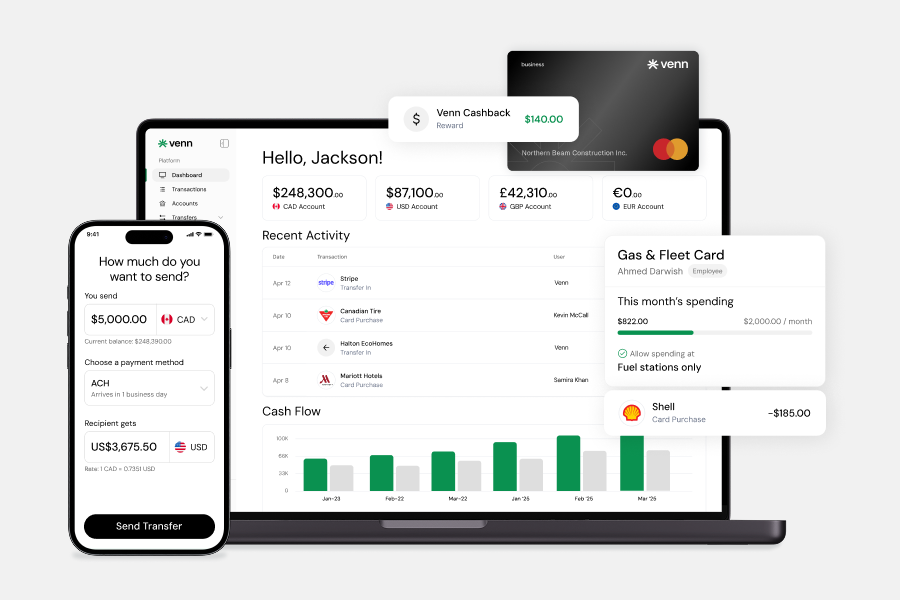
Among the card options available to Canadian carriers, Venn offers a Mastercard charge card with 1% cashback from the first dollar, with unlimited cashback on the Pro plan. The card supports both physical and virtual formats, includes expense controls for managing approved spend, and captures receipts automatically through OCR. These features make it a useful tool for managing approved business expenses across drivers and back-office staff, though it is not a replacement for a dedicated fleet fuel program on high-volume lanes.
Cross-Border Payment Platforms And Multi-Currency Business Accounts
Carriers with steady US payables can reduce FX leakage significantly by holding USD rather than converting CAD for each payment. Cross-border payment platforms and multi-currency business accounts make this practical by giving Canadian businesses a real USD operating balance they can draw from when supplier invoices arrive.
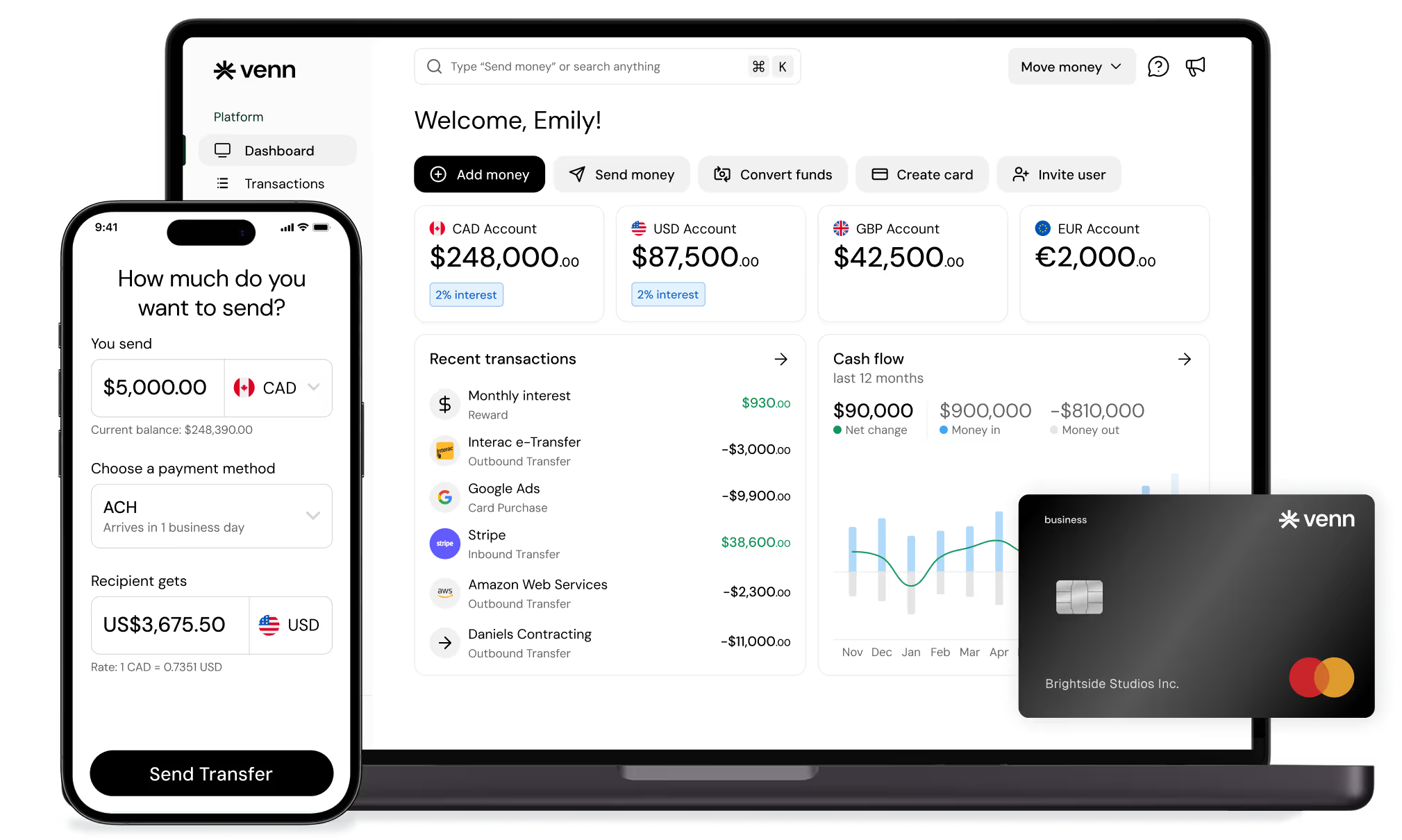
Venn is one option worth evaluating in this category. It offers real USD account capability with ACH, alongside CAD, USD, GBP, and EUR accounts in a single platform. FX markup runs between 0.25% and 0.45% depending on plan, which is meaningful for carriers processing regular US payables. Venn also earns 2.75% interest on CAD balances and up to 3.5% interest on USD balances (learn more) with no minimum balance requirement, and funds are covered under CDIC insurance protection. QuickBooks and Xero integrations make reconciliation cleaner for back-office teams managing vendor payments across currencies. Through Venn's mobile app, users can access funds, send transfers, and create new cards directly from their phone. Note that Venn is a technology company, not a bank, and is not currently available to businesses in Quebec.
Other platforms such as Wise, Float, and Keep offer cross-border payment features worth comparing depending on your existing banking relationships and payment volume. The right fit depends on whether you need ACH capability, accounting sync, or expense controls as your primary priority.
ACH Vs Wire Vs Card Vs Fuel Card: Which Is Best For Each Scenario?
No single payment method covers every cross-border vendor situation. The right choice depends on payment size, urgency, vendor type, and how much FX conversion you want to absorb. Use this table to match your payment scenario to the method that fits best.
For recurring fuel supplier invoices, ACH or a local USD transfer from a held USD balance typically offers the best cost profile. For an urgent repair invoice at a US shop, a wire gets funds there reliably. Driver fuel spend on the road fits fleet card programs best. For small or one-off US vendor charges, a business card with reasonable FX terms works well. Carriers managing steady USD payables across multiple vendor types benefit most from a multi-currency account workflow that reduces repeated CAD-to-USD conversions and connects directly to accounting software.
Scenario-Based Recommendations
The right payment method depends on your specific situation. Use these as starting points, not fixed rules. Supplier acceptance, urgency, cost, and your accounting requirements should drive the final call.
• Recurring fuel supplier invoices: ACH or a local USD transfer usually works best. Lower cost, easier to automate, and cleaner for reconciliation when you run consistent payment cycles.
• Urgent same-day large vendor payment: A wire transfer is typically the most reliable option. Expect higher fees, but the reach and speed justify it for exception payments.
• Driver fuel purchases on the road: A fleet or fuel card gives drivers a controlled, trackable way to pay at accepted networks without out-of-pocket reimbursements or manual expense submissions.
• Small one-off US business expense: A business charge card handles incidental spend well, whether that is a repair invoice, a hotel, or a software subscription. Keep these separate from your core AP workflow.
• Carrier with regular USD income and expenses: A multi-currency account workflow reduces repeated CAD-to-USD conversions and simplifies your payables. Holding a USD balance lets you pay US vendors directly without converting on every transaction.
How To Reduce FX Leakage On US Supplier Payments
Many Canadian carriers lose money not through a single large error, but through small, repeated conversion costs that accumulate across every USD invoice. The most common pattern: converting CAD to USD separately for each payment, then focusing only on the wire fee while ignoring the exchange-rate markup applied to the conversion itself.
Those two costs are not equal. A $15 wire fee is visible. A 2.5% FX markup on a $20,000 fuel settlement is $500, and it appears nowhere on the invoice.
To reduce this leakage, consider the following:
• Hold USD where possible. If your operation generates USD revenue, keep a portion in a USD-denominated account and pay US suppliers directly from that balance. Each conversion you avoid is a markup you do not pay.
• Build a USD-denominated workflow for recurring US expenses. Fuel settlements, parts suppliers, and maintenance vendors that bill monthly are strong candidates. Routing these through a consistent USD payment workflow reduces both conversion frequency and administrative overhead.
• Compare exchange-rate markup alongside transfer fees. A payment tool with no wire fee but a 2% FX markup will cost more than one charging a modest fee with a 0.5% markup on large payments.
• Do not evaluate payment tools based on advertised speed alone. A fast conversion at a poor rate still costs you money.
Illustrative example (rounded figures only, for comparison purposes):
Suppose a carrier processes $50,000 CAD in US supplier payments each month. At a 2.5% FX markup, the conversion cost is approximately $1,250. At a 0.5% markup, that cost drops to roughly $250. Over 12 months, that difference totals approximately $12,000. This example is illustrative only and does not reflect live rates or any specific provider's current pricing.
The markup percentage matters more than most carriers realize, particularly for businesses with high-frequency or high-volume USD payables.
What Canadian Carriers Should Look For In A Payment Setup
A strong payment setup for cross-border carrier operations covers three areas: operational capability, accounting integration, and financial controls. Gaps in any one of these create friction that compounds quickly across a high-volume AP workflow.
Operational capability starts with true USD payment support. Your platform should let you send USD payments directly, ideally with ACH access for recurring supplier invoices, rather than routing every payment through a CAD-to-USD conversion. Recurring-payment support matters for weekly fuel supplier settlements and monthly parts vendor invoices. Vendor management tools that store banking details, payment preferences, and contact records reduce manual entry and speed up payment runs.
Accounting integration is where many carriers lose time. Look for native QuickBooks and Xero compatibility so that payments post automatically without manual exports. Invoice matching, OCR receipt capture, and clean expense categorization reduce month-end reconciliation from hours to minutes. Platforms like Venn support QuickBooks and Xero integrations alongside OCR receipt capture and expense management, which helps finance teams keep USD payables organized alongside domestic spend. For domestic vendor payments, free unlimited Interac e-Transfer® removes friction on CAD-denominated invoices without adding per-transaction fees.
Controls and audit readiness round out the criteria. Role-based permissions let you separate who can approve payments from who can initiate them. Approval workflows prevent unauthorized disbursements. Spend visibility by vendor, driver, vehicle, or cost centre gives operations managers and accountants a clear picture of where money is going, which matters both for internal reporting and for clean audit trails.
Noteworthy Options To Consider
No single provider solves every cross-border payment need for a Canadian carrier, and most operations benefit from combining two or three tools rather than forcing one solution to do everything. The categories below reflect how carriers actually structure their US payables workflows.
Traditional Canadian banks offer familiarity, existing credit relationships, and wire transfer capability. They work well for high-value exception payments and carriers who want their primary credit facility and payment accounts under one roof. The tradeoff is typically higher FX markup and limited ACH access for recurring USD payables.
Fleet and fuel card programs serve a specific and important function: managing driver fuel spend at accepted networks. Programs from providers like WEX or Comdata offer per-vehicle controls, consolidated fuel reporting, and reduced out-of-pocket driver payments. Their value is operational rather than general-purpose, and acceptance at independent or regional fuel stops can vary.
Cross-border payment platforms such as Wise Business give carriers a way to send USD payments at lower FX markup than traditional banks. They suit businesses making frequent international transfers without needing a full business banking setup.
Multi-currency business banking platforms address a broader workflow. Venn, for example, offers real USD accounts with ACH capability, CAD balances earning 2.75% interest and USD balances earning up to 3.5% interest (learn more) with no minimum, a Mastercard charge card with 1% cashback from the first dollar, and QuickBooks and Xero compatibility. Funds are covered under CDIC insurance protection. Venn is a technology company, not a bank, and is not currently available to businesses in Quebec. This category suits carriers who want banking, spend controls, and payment workflows consolidated in one place, though carriers with complex credit needs may still rely on a traditional bank alongside it.
Traditional Canadian Banks
For carriers that value established lending relationships, branch access, and conventional treasury services, traditional Canadian banks remain a practical choice. Most major banks offer USD business accounts, international wire capabilities, and credit facilities that newer platforms do not yet match in scale or depth.
That said, the costs add up quickly for cross-border carrier operations. Wire transfer fees typically range from $15 to $40 per transaction, and FX markups on CAD-to-USD conversions often sit between 1.5% and 2.5% above the mid-market rate. For a carrier processing weekly fuel supplier settlements or recurring US parts invoices, those markups compound into meaningful annual losses.
Reconciliation is another friction point. Most traditional bank portals require manual export and matching workflows, which adds back-office time for finance teams managing high-frequency USD payables. Access to true US ACH rails is also inconsistent, depending on the specific account type and bank relationship, which limits options for carriers who want to pay US vendors through local USD transfers rather than international wires.
Traditional banks suit carriers with complex credit needs or long-standing institutional relationships. For high-volume cross-border payment workflows, the cost and workflow limitations are worth weighing carefully.
Fleet And Fuel Card Programs
Fleet and fuel card programs serve a clear operational purpose: giving drivers a controlled, trackable way to purchase fuel at accepted networks. For that specific use case, they work well. But they do not replace a full accounts payable setup for cross-border vendor payments.
On the operational side, fleet cards offer meaningful controls. You can set spending limits by driver or vehicle, restrict purchase categories, and pull detailed fuel reports for reconciliation. Most programs include fraud monitoring and generate consolidated statements that simplify monthly accounting. For carriers running regular US lanes, that spend visibility matters.
The tradeoffs are real, though. Program fees vary, and network acceptance is not universal across every US truck stop or fuel supplier. More importantly, fleet cards have no practical role in paying repair shops, parts suppliers, freight brokers, or any vendor that requires ACH or wire payment. Trying to route those payments through a card program creates friction and often fails outright. Carriers that rely solely on fleet cards for US vendor spend will still need a separate payment workflow for the rest of their payables.
Cross-Border Payment Platforms
Cross-border payment platforms can help Canadian carriers manage US supplier payments and foreign exchange more efficiently than ad hoc wire transfers, particularly for businesses with steady USD payables or frequent vendor transactions.
These platforms typically offer transparent fee structures, multi-currency account support, and faster digital onboarding compared to traditional bank wire setups. For carriers paying US fuel suppliers or parts vendors on a recurring basis, the ability to hold USD and pay out without converting each time can meaningfully reduce FX leakage over a month of volume.
Fit depends on several practical factors. Not every US supplier accepts the payment rails these platforms use, so confirming vendor acceptance before switching workflows matters. Approval workflows, account structure for multiple users, and depth of accounting integration with QuickBooks or Xero vary across providers and should be evaluated against your back-office needs.
Platforms such as Wise and Loop serve different segments of this category. Venn, a Canadian business banking platform, offers real USD account capability with ACH, multi-currency support across CAD, USD, GBP, and EUR, and QuickBooks and Xero compatibility, making it a relevant option for carriers that want payment and expense workflows in one place. Venn is a technology company, not a bank, and funds are covered under CDIC insurance protection. Note that Venn is not currently available to businesses in Quebec.
Multi-Currency Business Banking Platforms
Carriers that want USD workflows, expense controls, and accounting integrations consolidated in one place may find multi-currency business banking platforms a practical fit. Rather than managing separate tools for payments, cards, and reconciliation, these platforms bring those functions together under a single account structure.
Venn is one notable Canadian option in this category. It offers real USD account capability with ACH, alongside CAD, USD, GBP, and EUR accounts, making it easier to hold and pay in USD without converting on every transaction. FX rates are competitive, though carriers should compare markup percentages against their current provider before switching. The Venn Mastercard Charge Card earns 1% cashback from the first dollar, with unlimited cashback on the Pro plan. Expense controls, OCR receipt capture, and native QuickBooks and Xero compatibility support cleaner accounts payable workflows. Funds are covered under CDIC insurance protection through Venn's banking setup. Venn is a technology company, not a bank, and is not currently available to businesses in Quebec.
That said, carriers with established bank relationships or those whose operations centre on fleet-card acceptance at fuel networks may find those existing programs better suited to their day-to-day needs.
Common Mistakes To Avoid
• Paying every US invoice by wire when ACH would work. Wires cost more and add up fast on recurring supplier payments where ACH delivers the same result at a fraction of the price.
• Comparing transfer fees while ignoring FX markup. A low wire fee means little if the exchange rate carries a 2% to 3% markup on every USD payment.
• Using a business card for supplier payments that belong in AP. Cards work well for incidental spend, but routing large vendor invoices through a card creates reconciliation problems and blurs your accounts payable records.
• Mixing fuel spend, parts invoices, and admin expenses into one workflow. Separate payment streams by category so your finance team can report accurately and catch discrepancies without manual sorting.
• Choosing a payment tool with weak reconciliation support. If your platform does not sync cleanly with QuickBooks or Xero, your team absorbs that cost in manual data entry every month.
• Failing to confirm supplier payment preferences before a payment is urgent. Some US vendors only accept ACH; others require wires. Discovering this at 4 p.m. on a Friday when a truck is waiting on parts is avoidable with basic vendor onboarding.
Conclusion
The best way to pay US vendors and fuel suppliers as a Canadian carrier is rarely a single method. Most carriers benefit from combining approaches: ACH or local USD transfers for recurring supplier invoices, wire transfers for urgent or high-value exceptions, fleet cards for driver fuel purchases on the road, and business cards for incidental spend where they fit. Carriers with consistent USD payables often reduce FX leakage by maintaining a multi-currency workflow rather than converting CAD to USD on every payment.
Take stock of your current payment mix. If you're paying too many recurring invoices by wire, absorbing unnecessary FX markup, or spending hours reconciling fuel and vendor spend manually, that's worth addressing. Venn is one option worth evaluating if you want a Canadian business platform that combines USD account capability with ACH, expense controls, and QuickBooks or Xero integrations. Whether Venn fits depends on your volume, vendor mix, and existing banking relationships. Sign up for Venn
FAQ
Q: Is ACH cheaper than a wire transfer for paying US suppliers?
A: In most cases, yes. ACH transfers typically carry lower flat fees than wire transfers and often come with better FX pricing when sent through a platform that supports true US payment rails. For recurring supplier payments, the cost difference adds up quickly over a full month of payables.
Q: What is the best payment method for recurring fuel supplier invoices?
A: ACH or a local USD transfer is usually the most cost-effective and operationally clean option for recurring fuel supplier invoices. If your business pays the same suppliers regularly, ACH payments can reduce transaction costs, simplify reconciliation, and provide more predictable cash flow management than repeated wire transfers.
Q: Should Canadian carriers hold USD to pay US vendors?
A: Holding USD makes practical sense if your business regularly pays US vendors or collects USD freight revenue. Converting CAD to USD for each individual payment means paying the FX markup repeatedly. A USD operating balance smooths that out and gives your finance team more predictable costs.
Q: Are fleet cards enough for all US fuel and vendor payments?
A: Fleet cards work well for driver fuel purchases at accepted networks, but they do not cover all vendor payment needs. Parts suppliers, repair shops, brokers, and other US vendors often require ACH or wire transfers, so most carriers need both a fleet card program and a separate AP payment workflow.
Q: What should I compare besides transfer fees?
A: Compare the FX markup on each conversion, payment delivery speed, reconciliation support, and whether the provider integrates with your accounting software such as QuickBooks or Xero. A low transfer fee paired with a high FX markup can cost more overall than a slightly higher flat fee with a tighter exchange rate.
---
**Disclaimer:** This publication is provided for general information purposes and does not constitute legal, tax or other professional advice from Venn Software Inc or its subsidiaries and its affiliates, and it is not intended as a substitute for obtaining advice from a financial advisor or any other professional. We make no representations, warranties or guarantees, whether expressed or implied, that the content in the publication is accurate, complete or up to date.
This publication is provided for general information purposes only and does not constitute legal, tax, financial, or other professional advice from Venn Software Inc., its subsidiaries, or its affiliates, and is not a substitute for advice from a qualified professional. All comparisons and competitor information reflect publicly available information believed accurate as of June 2, 2026; features, pricing, rates, and terms referenced are subject to change and may differ at the time you read this. All product names, logos, and brands referenced are the property of their respective owners; their mention does not imply affiliation with or endorsement by Venn. Any comparative statements reflect Venn's views and are provided to help readers evaluate options. We make no representations, warranties, or guarantees, express or implied, that the content is accurate, complete, or up to date.

Venn is all-in-one business banking built for Canada
From free local CAD/USD accounts and team cards to the cheapest FX and global payments—Venn gives Canadian businesses everything they need to move money smarter. Join 15,000+ businesses today.
Frequently asked questions
Everything you need to know about the product and billing.
Join 15,000+ businesses banking with Venn today
Streamline your business banking and save on your spend and transfers today
No personal credit check or guarantee.