Best Corporate Card for Canadian Trucking Companies 2026
Best Corporate Card for Canadian Trucking Companies compare fuel cards and corporate platforms for rebates, CAD USD spend, driver limits, QuickBooks Xero.

Ahmed Shafik
Co-founder

Trusted by 15,000+ Canadian businesses
Business banking for Canada
Local CAD and USD accounts, corporate cards with cashback, the lowest FX rates in Canada, free local transfers, and more.
Canadian trucking companies in 2026 run expense across a wide range of channels: diesel at cardlock stations, roadside repairs, tolls, driver meals, lodging, dispatch software, and U.S.-denominated supplier costs. Many operators manage these through a patchwork of tools, which creates reconciliation headaches and blind spots by driver, vehicle, or route. Finding the best corporate card for Canadian trucking companies is not a matter of picking one universal winner. The right setup depends on what your fleet actually needs.
A fuel-heavy regional fleet with consistent routes may extract the most value from a closed-loop fuel card with network rebates and cardlock access. A cross-border operator managing CAD and USD spend simultaneously needs flexible currency controls and low FX costs. A growing fleet with multiple drivers needs per-card spend limits, merchant restrictions, and accounting sync that feeds directly into QuickBooks or Xero.
This comparison covers five credible options across fleet cards, bank-issued cards, and modern corporate spend platforms. Each serves a different combination of fuel network coverage, driver controls, route profile, and back-office requirements.
Quick Comparison Table
| Card / Platform | Best For | Rewards or Rebates | Controls | Cross-Border Fit | Accounting / Reporting | Main Trade-Off |
|---|---|---|---|---|---|---|
| Venn | Trucking businesses with mixed CAD/USD operating spend | 1% cashback from $1; capped at $5K/mo (Essentials), $25K/mo (Plus), unlimited (Pro) | Virtual and physical cards, spend limits, receipt capture via OCR | Multi-currency card matches USD/CAD/GBP/EUR balances automatically; no FX fee on matched currency | QuickBooks and Xero sync; automated reconciliation | Not a closed-loop fuel network; fleets prioritizing cardlock rebates may prefer a dedicated fleet card |
| Petro-Canada SuperPass | Fleets fueling heavily within the Petro-Pass cardlock network | Volume-based fuel rebates at Petro-Canada locations | Driver and vehicle prompts; fuel-type and odometer controls | Canada-focused; limited cross-border utility | Fleet-level fuel reporting; transaction history by card | Network-dependent; limited value outside Petro-Canada locations |
| BMO Fleet Card | Larger fleets needing driver and vehicle-level transaction data | Fuel savings through program pricing | Driver ID, vehicle ID, odometer prompts, merchant restrictions | Primarily Canada-focused | Detailed per-driver and per-vehicle reporting | More fleet-operations focused than finance-stack oriented; less useful for non-fuel spend |
| 7-Eleven Commercial Fleet Canada Mastercard | Fleets wanting open-loop acceptance across Canada and the U.S. | Litre-based fuel rebates | Card prompts, misuse controls, fleet-level oversight | Mastercard acceptance in Canada and the U.S.; useful for cross-border routes | Fleet reporting tools; transaction-level data | Primarily a fuel management tool; limited broader accounting or banking workflow integration |
| Amex Business Edge | Owner-operators with mixed non-fuel business spend | Membership Rewards points; bonus multipliers on gas, office, and dining categories | Basic spend visibility; no driver or vehicle-level prompts | Standard Amex acceptance; no dedicated FX or multi-currency account | Basic expense reporting; no native QuickBooks or Xero sync | No fleet-specific controls; less suited to multi-driver operations or fuel-heavy fleets |
How We Chose These Options
Selecting the best corporate card for Canadian trucking companies requires a different lens than a standard business credit card review. We evaluated options across several trucking-specific factors: fuel and truck-stop acceptance, cardlock network coverage, driver and vehicle-level spend controls, route fit across Canadian and U.S. corridors, rebate or cashback structure, reporting depth, and compatibility with accounting workflows like QuickBooks and Xero.
We also weighted cross-border usefulness heavily, since many fleets carry CAD and USD expenses simultaneously and need a card setup that handles both without punishing FX costs.
Critically, this comparison spans three card categories on purpose. Fleet cards, general business credit cards, and modern corporate charge platforms each solve different problems. A trucking company often needs one tool for fuel, another for repairs and driver purchases, and a third for back-office reconciliation. Evaluating only one category would leave most operators with an incomplete picture. We sized each option for both owner-operators running a single truck and larger multi-driver fleets with more complex reporting and control requirements.
Best Corporate Card for Canadian Trucking Companies: Corporate and Fleet Card Options
The options below cover four distinct card categories: dedicated closed-loop fleet fuel cards, an open-loop fleet card with broad acceptance, a modern corporate charge and spend platform, and a mainstream business rewards card. Each one solves a different problem, and no single option fits every fleet.
A fuel-heavy long-haul carrier running fixed Canadian routes has different priorities than a cross-border operator managing CAD and USD expenses across drivers, trucks, and suppliers. Route density, spend mix, and back-office complexity all shape which card delivers the most value.
Each option below opens with a concise positioning statement, followed by its core strengths, meaningful limitations, and the operating profile it suits best.
Venn
Best for trucking companies that need multi-currency spend control and accounting automation.
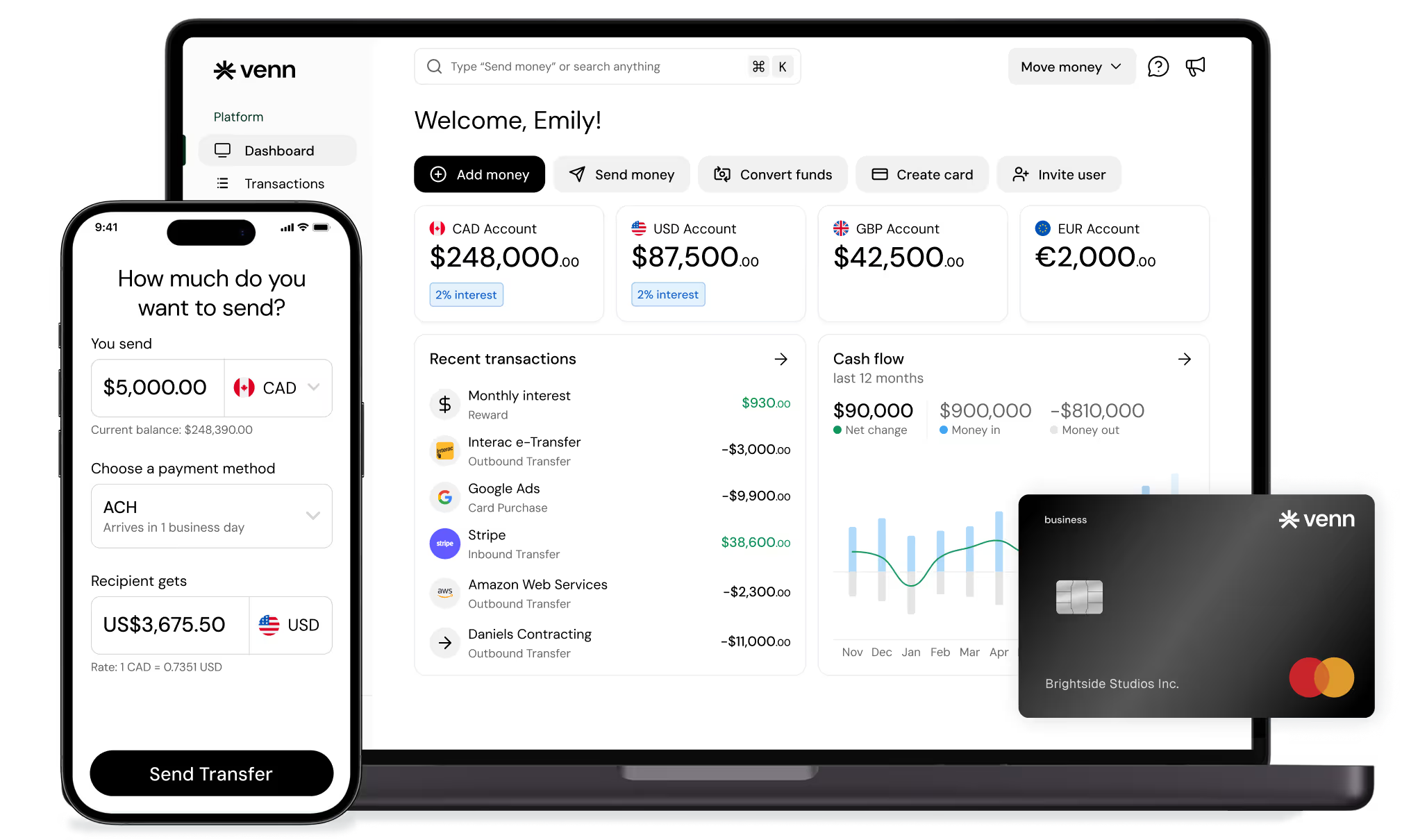
Venn suits cross-border trucking businesses and finance teams managing operating spend well beyond fuel. Its multi-currency accounts cover CAD, USD, GBP, and EUR, and the Venn corporate card is designed to draw from the matching currency balance where one is available. For fleets paying USD fuel bills, U.S. repair shops, or American suppliers, that means fewer forced conversions and lower FX costs on everyday route expenses.
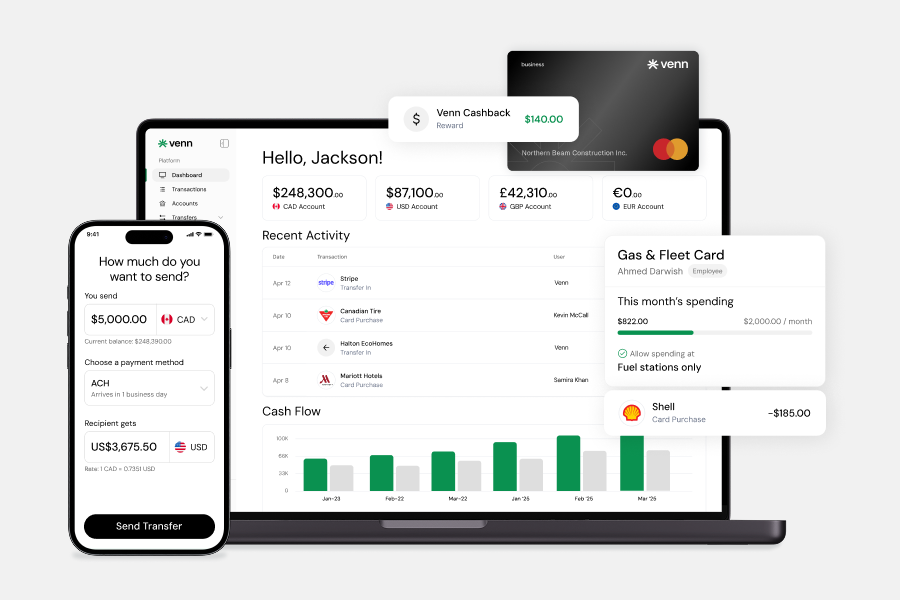
The card earns 1% cashback on eligible spend from the first dollar. On the Essentials plan, that cap sits at $5,000 per month; Plus raises it to $25,000; Pro removes the cap entirely. Virtual and physical cards are both available, with spend controls, per-card limits, and approval workflows that let finance managers set guardrails for individual drivers or cost centres. OCR receipt capture feeds directly into the reconciliation workflow, and direct integrations with QuickBooks and Xero reduce manual bookkeeping for dispatch and accounting teams. The mobile app also lets teams access funds, send transfers, and issue cards directly from a phone.
For vendors paid by bank transfer, free unlimited Interac e-Transfer® is available on all plans, which can be useful for Canadian supplier payments.
Eligible deposits with Venn are covered under CDIC insurance protection.
The trade-off is straightforward: Venn is not a closed-loop fuel network card. Fleets that prioritize cardlock access, station-specific rebates, or detailed odometer prompts at the pump will find a dedicated fleet card better suited to those needs. Venn performs strongest as a complement to a fuel card, handling the broader financial operations that a fuel-only card cannot.
Petro-Canada SuperPass
Best for fleets that fuel heavily within the Petro-Pass ecosystem.
Petro-Canada SuperPass earns its place in any trucking-specific card comparison because of one thing most general business cards cannot offer: a purpose-built fuel network that aligns with Canadian trucking routes. The card provides access to Petro-Pass cardlock locations across the country, giving drivers a reliable fueling option at sites designed for commercial vehicles. Fleet reporting covers fuel purchases by vehicle or driver, which helps operators track consumption, spot irregularities, and manage fuel budgets without manual reconciliation.
For fleets whose lanes run through Petro-Canada locations, the network density is a genuine operational advantage. Route fit matters more here than generic rewards points. If your trucks consistently fuel within the Petro-Pass network, the reporting and cardlock access deliver real value.
The trade-offs are worth noting. Petro-Canada SuperPass is a closed-loop fuel card, so it offers limited utility for non-network purchases, U.S. fuel stops, or cross-border supplier payments. It does not address broader finance workflows such as accounting automation, multi-currency spend management, or reconciliation across operating expenses beyond fuel. Fleets that need those capabilities alongside fuel tracking will likely need a second card or platform to cover the rest of their operating spend.
BMO Fleet Card
Best for larger fleets that want deep driver and vehicle reporting.
BMO's Fleet Card captures transaction-level detail that most general business cards cannot match. Each purchase records the driver ID, vehicle ID, odometer reading, fuel grade, and purchase type, giving dispatch, maintenance, and finance teams a granular view of spend by truck or route. For fleets running multiple units with different drivers on the road simultaneously, that level of data supports both policy enforcement and fuel expense tracking without relying on manual reconciliation.
The card suits structured operations where separate teams review spend categories independently. A maintenance manager can pull vehicle-level fuel consumption data while a finance team monitors overall fleet card expenditure, all from the same reporting layer.
The trade-off is scope. BMO Fleet Card is built for fleet operations, not broader financial workflows. Businesses that also need multi-currency accounts for cross-border trucking costs, automated vendor payments, or direct accounting sync with QuickBooks or Xero will find this card covers only part of the picture. In those cases, pairing it with a corporate spend platform that handles the rest of the finance stack is a practical approach.
7-Eleven Commercial Fleet Canada Mastercard
Best for fleets that want open-loop acceptance plus fleet controls.
Where closed-loop fuel cards restrict drivers to a specific network, the 7-Eleven Commercial Fleet Canada Mastercard runs on the Mastercard network, which means drivers can fuel at virtually any station across Canada and the United States. For trucking companies running cross-border routes or operating in regions where a single fuel brand has thin coverage, that flexibility removes a real operational constraint.
The card supports litre-based rebates, giving fleets a fuel-cost offset tied directly to volume rather than a flat cashback rate on total spend. Fleet managers can set card-level prompts that require drivers to enter odometer readings, vehicle IDs, or driver IDs at the pump, which creates a transaction-level audit trail and reduces misuse. Purchase restrictions let administrators limit card use to fuel and approved merchant categories, keeping driver spend within defined boundaries.
That combination of open-loop acceptance, rebate structure, and driver controls positions this card as a practical middle ground between a closed-loop cardlock card and a general business credit card. It gives fleets more acceptance flexibility than a network-specific fuel card, while retaining the controls that prevent unauthorized purchases.
The trade-off is scope. This card manages fuel spend effectively, but it does not extend into broader financial operations. Trucking businesses that need multi-currency accounts for U.S. supplier payments, accounting sync with QuickBooks or Xero, or consolidated visibility across all operating expenses will need a separate solution to cover those workflows.
Amex Business Edge or a Verified Mainstream Business Rewards Card
Best for owner-operators with mixed non-fuel business spend.
The Amex Business Edge card earns accelerated points on everyday categories including gas, office supplies, and restaurants, making it a practical fit for owner-operators who split their spending across fuel, hotels, meals, and administrative tools rather than concentrating it at a single fuel network. For a sole operator running a small fleet or managing dispatch from a home office, one general rewards card can simplify expense tracking without requiring multiple accounts.
The trade-off is real, though. Mainstream business rewards cards are built for broad commercial spending, not trucking-specific operations. You will not get driver-level card controls, vehicle assignment, odometer prompts, cardlock network access, or fuel-policy enforcement. Reconciling fuel spend by truck or route requires manual work that dedicated fleet cards handle automatically.
For owner-operators whose non-fuel operating costs, think software subscriptions, courier fees, and supplier invoices, rival their fuel spend, a general rewards card earns meaningful value. For fleets where fuel dominates and driver accountability matters, a dedicated fleet card will serve the operation better.
Fleet Card vs Corporate Card: What Trucking Companies Actually Need
The core decision comes down to where your spend actually concentrates. Fleet cards are built around fuel networks, cardlock access, and vehicle-level controls. Corporate spend platforms are built around broader operating expenses, accounting visibility, and finance operations across the whole business.
In 2026, most Canadian trucking companies don't fit neatly into one category. A mid-sized fleet might run fuel through a cardlock network, pay for repairs and roadside services on a separate card, manage cross-border USD supplier costs, and need all of it reconciled in QuickBooks or Xero by month-end. A single fleet card handles the fuel side well. It handles almost nothing else.
That's why a hybrid setup often outperforms a single-card approach. A dedicated fleet card covers fuel rebates and driver prompts at the pump. A corporate spend platform covers everything from maintenance invoices to dispatch software to cross-border supplier payments, with spend controls, receipt capture, and accounting sync built in.
Venn fits the second half of that equation. It's not a closed-loop fuel network card, and fleets that prioritize station-specific rebates or cardlock coverage above all else should evaluate fleet cards on those merits. But for trucking businesses managing mixed operating spend, CAD and USD expenses, and back-office reconciliation, a corporate spend platform adds meaningful value alongside a fuel card rather than instead of one.
When a Fleet Card Makes More Sense
Fleets that concentrate most of their spend at the pump are often better served by a dedicated fleet card. If your trucks run consistent routes through Petro-Canada, cardlock networks, or other major truck-stop chains, a fleet card can unlock network-specific rebates that directly reduce per-litre costs at scale.
Driver misuse prevention is another strong argument for fleet cards. Products like the BMO Fleet Card and 7-Eleven Commercial Fleet Canada Mastercard support odometer prompts, vehicle ID assignment, and merchant-category restrictions that limit cards to fuel and approved purchases only. For multi-driver operations where accountability at the pump matters, those controls are difficult to replicate with a general-purpose card.
Fleet cards also generate vehicle-level and route-based reporting that operations managers can act on directly: fuel consumption by truck, transaction frequency by driver, and variance flags across a fleet. For larger operations managing 10 or more vehicles, that granularity supports both cost control and compliance.
If fuel spend represents the majority of your operating costs and your routes align with a specific network, the rebate structure and purpose-built controls of a fleet card will likely outperform a broader spend platform on those metrics alone.
When a Corporate Card Makes More Sense
A corporate card or spend platform earns its place when fuel is only part of the picture. Trucking businesses routinely spend across repairs, parts, roadside assistance, driver hotels, meals, dispatch software, SaaS subscriptions, insurance premiums, and supplier invoices. A fuel card offers no visibility into any of that.
Venn fits this profile well. Physical and virtual cards with configurable spend controls let finance teams set limits by driver or expense category. OCR receipt capture reduces manual data entry, and direct integrations with QuickBooks and Xero keep reconciliation tight. For fleets with cross-border operations, Venn's multi-currency accounts and competitive FX rates mean USD supplier payments and U.S. repair costs clear without unnecessary conversion fees. Eligible deposits are covered under CDIC insurance protection.
The trade-off is straightforward: Venn is not a closed-loop fuel network card, so fleets that prioritize cardlock access or station-specific rebates above all else will still want a dedicated fleet card for fuel.
When a Hybrid Setup Is Best
Many trucking businesses find that no single card covers every need cleanly. A fleet card handles diesel, cardlock access, and network-specific rebates. A corporate spend platform like Venn covers the rest: repairs, hotels, software subscriptions, cross-border supplier payments, and back-office workflows.
This split keeps fuel rebates separate from general operating spend, which simplifies reconciliation and makes it easier to track costs by category. For fleets with CAD and USD expenses, Venn's multi-currency card automatically charges the matching currency balance, avoiding unnecessary FX conversion on U.S. repairs or vendor payments. QuickBooks and Xero sync reduces manual entry across both spend streams.
Driver-level and team-level spend controls mean finance managers can set limits on corporate cards without disrupting the fuel card setup already in place. The hybrid approach works particularly well for growing fleets that need tighter visibility across all operating costs, not just fuel.
What to Compare Before Applying
No single corporate card fits every trucking operation. Before you apply, map your business against these key variables to avoid choosing a card that works well in theory but creates friction in practice.
Routes and fuel concentration. If your fleet fuels heavily within a specific network, a closed-loop fleet card may deliver stronger per-litre savings. If your drivers fuel across multiple brands or provinces, open-loop acceptance matters more.
Fleet size and driver model. A sole owner-operator has different control needs than a dispatcher managing 20 drivers. Confirm whether the card supports individual driver assignment, vehicle-level tracking, and per-card spend limits.
U.S. exposure. Cross-border trucking companies should verify whether a card handles USD spend natively or converts every transaction. FX markups on fuel, repairs, and supplier payments add up quickly across a full fleet.
Accounting and reporting systems. Check whether the card integrates with your existing software. QuickBooks and Xero compatibility reduces manual reconciliation time significantly.
Key questions to answer before applying:
• Does the card cover your primary truck stops and cardlock locations?
• Can you restrict purchases by merchant category or set daily limits per driver?
• What are the annual or monthly fees, and do rebates or cashback offset them at your spend volume?
• Are there eligibility requirements tied to business structure, revenue, or incorporation status?
• Does the card support both CAD and USD balances, or does it convert automatically?
Product terms, fee structures, rebate rates, and eligibility requirements can change. Verify current details directly with each provider in 2026 before making a final decision.
Fuel Acceptance and Route Coverage
A strong rebate rate means nothing if your drivers regularly pull into stations outside the card's network. Before committing to any fuel card for your trucking company, map your actual lanes against the card's acceptance footprint.
For Canadian routes, assess how densely the network covers your primary corridors. Petro-Canada SuperPass, for example, carries meaningful coverage across major Canadian highways and includes cardlock access, which matters for fleets running overnight or off-peak hours when attended stations are closed. If your trucks run dedicated lanes between a handful of cities, a brand-loyal card with strong coverage on those specific routes may outperform a broader open-loop option on a per-litre basis.
Cross-border fleets face a different calculation. A card that performs well from Vancouver to Calgary may leave drivers scrambling for accepted fuel stops once they cross into the U.S. The 7-Eleven Commercial Fleet Canada Mastercard addresses this with open-loop Mastercard acceptance across both countries, giving drivers more flexibility outside a single brand's network.
Also consider whether your drivers need cardlock access specifically. Cardlock terminals serve commercial vehicles around the clock and typically offer better pricing than retail pumps, but not every fleet card includes cardlock network access. Confirm this before applying.
Driver and Vehicle Controls
Fleet cards and corporate spend platforms both offer controls, but they operate at different levels. Dedicated fleet cards, such as the BMO Fleet Card or Petro-Canada SuperPass, capture vehicle-specific data at the pump: odometer readings, fuel grade, driver ID prompts, and merchant category restrictions that lock cards to fuel-only purchases. These vehicle-level prompts are purpose-built for trucking operations and are difficult to replicate on a general spend platform.
Corporate spend platforms take a broader approach. Venn, for example, lets you issue virtual and physical cards to individual drivers, set transaction limits, restrict spending by merchant category, require receipt capture at the point of purchase, and receive real-time alerts on card activity. These controls work well for non-fuel operating spend, including repairs, supplies, tolls, and cross-border vendor payments, where a closed-loop fuel card offers no coverage.
For fleets managing both fuel and broader driver spend, the practical difference matters: a fleet card enforces fuel-specific policy at the pump, while a spend platform enforces broader expense policy across every category. Many trucking operators run both in parallel rather than choosing one over the other.
Cross-Border CAD and USD Needs
Canadian trucking companies operating U.S. lanes face a distinct set of payment challenges: fuel purchases at American truck stops, roadside repairs billed in USD, driver hotels, and supplier invoices all denominated in a foreign currency. Every unnecessary conversion adds cost, and those costs compound quickly across a busy fleet.
Before choosing a card, evaluate how it handles FX. Many standard business credit cards apply markups of up to 3% on foreign currency transactions. Over thousands of dollars in monthly U.S. spend, that difference is material.
Venn's multi-currency accounts and card design address this directly. When a cardholder carries a USD balance, the card draws from that balance on eligible USD transactions rather than converting from CAD, which can reduce unnecessary conversion costs on cross-border spend. For fleets that regularly pay U.S. fuel, maintenance, or suppliers, this structure is worth examining closely. Venn also offers competitive FX rates for transactions that do require conversion, tiered by plan.
For cross-border trucking operations, the practical questions to ask any card provider are straightforward: Does the card support USD balances? What is the FX markup? Are U.S. merchant categories accepted without restrictions? The answers will vary significantly between fleet cards, bank-issued business cards, and modern corporate spend platforms.
Rewards, Rebates, and Hidden FX Costs
Fuel rebates and cashback serve different purposes, and neither is universally superior. A fuel rebate delivers clear value when your fleet concentrates spend within a specific network. If your routes run heavily through Petro-Canada locations, a litre-based rebate compounds quickly. Cashback tends to be more useful when operating expenses spread across fuel, repairs, software, dispatch tools, and supplier payments.
Venn offers 1% cashback on eligible card spend, starting from the first dollar. The Essentials plan caps cashback at $5,000 in monthly spend, Plus at $25,000, and Pro offers unlimited cashback. For trucking businesses with mixed operating expenses beyond fuel, that structure can return meaningful value across the full cost base.
Before comparing headline rates, account for the full cost picture. FX markups on cross-border purchases, annual or monthly fees, network restrictions that limit where a card works, and rebate qualification thresholds can all reduce the value you actually receive. A card advertising a strong fuel rebate may require minimum monthly volume or restrict redemptions to specific station tiers. Read the qualification rules carefully before assuming the headline rate applies to your operation.
Accounting, Receipt Capture, and Reconciliation
Collecting driver receipts, assigning expenses by truck or route, and reconciling fuel purchases against GST/HST records creates real back-office friction for trucking finance teams. Venn addresses this with OCR receipt capture and direct QuickBooks and Xero integrations, which reduce manual data entry across broader operating spend categories including repairs, tolls, and supplier payments.
Fleet cards typically produce stronger fuel-specific reporting, with transaction data tied to vehicle ID, odometer, and fuel grade. That depth is genuinely useful for fuel audits and driver accountability. Where fleet card reporting falls short is in multi-category workflows: maintenance invoices, dispatch software subscriptions, and cross-border supplier costs often live outside the fuel card system entirely, creating reconciliation gaps that finance teams fill manually.
For trucking companies managing a mix of fuel and non-fuel expenses, pairing a fleet card with a corporate spend platform that syncs directly to your accounting software can close that gap without adding headcount to the bookkeeping process.
Fees, Liability, and Eligibility Requirements
Before applying for any corporate card or fleet card, compare the full cost structure, not just the headline rate. Monthly platform fees, per-transaction fees, and FX markups all affect your real cost of card spend. Some fleet cards charge card replacement fees that add up quickly across a large driver pool.
Check whether the card operates as a charge card with full monthly repayment required, or a revolving credit product with interest charges. Understand personal guarantee requirements: many business credit cards require the owner to accept personal liability, while some corporate spend platforms do not.
Eligibility rules vary significantly. Some cards require a minimum fleet size, a specific business structure such as an incorporated company, or a minimum monthly spend threshold. Verify whether the product is available to sole proprietors or partnerships if that applies to your operation.
For Venn, eligible deposits are covered under CDIC insurance protection. Always verify current 2026 terms directly with each provider before applying, as fee structures, eligibility criteria, and repayment requirements change.
Conclusion
No single card works best for every Canadian trucking company. The right setup depends on your fleet size, route profile, and where your spend actually concentrates.
Owner-operators with mixed expenses often get solid value from a mainstream business rewards card. Small, growing fleets typically need stronger driver controls and per-card spend limits before anything else. Larger multi-driver operations tend to prioritize vehicle-level fuel reporting, odometer prompts, and cardlock network access. Cross-border fleets running CAD and USD expenses benefit most from a card that matches currency balances automatically and connects directly to accounting software.
For many operators, a hybrid setup is the most practical answer: a dedicated fleet fuel card for fuel-heavy routes, paired with a corporate spend platform for repairs, dispatch costs, supplier payments, and broader operating expenses. Venn fits naturally into that second role, particularly for fleets that need multi-currency spend control, QuickBooks or Xero sync, and 1% cashback on eligible operating spend. It is not a closed-loop fuel network card, so fleets that prioritize station-specific rebates above all else should weigh that trade-off carefully.
Match the card to the actual problem your fleet faces, not the longest feature list. Sign up for Venn
FAQ
Q: What is the difference between a fleet card and a corporate card for trucking companies?
A: A fleet card restricts purchases to fuel and approved merchant categories, often within a specific cardlock or station network, and captures vehicle-level data like odometer readings and fuel grade. A corporate card covers broader business spend, including repairs, hotels, software, and supplier payments, and typically connects to accounting platforms for full financial visibility. Many trucking companies use both: a fleet card at the pump and a corporate card for everything else.
Q: Are fuel rebates always better than cashback for trucking fleets?
A: Not necessarily. Fuel rebates deliver strong value when your routes align closely with the card's network and fuel dominates your operating spend. When a significant portion of costs falls outside fuel, such as maintenance, cross-border suppliers, or driver accommodations, a cashback card that earns on all eligible spend may return more overall. The right answer depends on your route density, network coverage, and how concentrated your fuel spend actually is.
Q: Do Canadian trucking companies need CAD and USD card capabilities?
A: Any fleet running cross-border routes or purchasing U.S. fuel, parts, or repairs benefits from a card that handles both currencies without forcing a conversion on every transaction. Paying USD costs from a USD balance eliminates foreign exchange fees and simplifies reconciliation. Even fleets that operate primarily in Canada may deal with U.S.-denominated suppliers or equipment vendors, making multi-currency capability a practical consideration rather than a niche one.
Q: Can owner-operators qualify for the same cards as larger fleets?
A: Eligibility varies by issuer, card type, and business structure. Some fleet cards require a minimum number of vehicles or a commercial account with a specific carrier network. Corporate spend platforms and mainstream business credit cards often accept sole proprietors and single-vehicle operators, though credit limits and spend caps may differ. Review current terms directly with each issuer, as qualification criteria change and some products are restricted to incorporated entities.
Q: What should trucking companies look for in spend controls?
A: Strong spend controls for trucking include driver-assigned cards, vehicle-level transaction assignment, merchant category restrictions, and purchase prompts that require odometer entry or a driver ID at the point of sale. Receipt capture tied to each transaction reduces reconciliation time, and real-time reporting by driver, truck, or route gives fleet managers visibility into where money is going before month-end. The more granular the control, the easier it is to enforce policy and catch misuse early.
---
**Disclaimer:** This publication is provided for general information purposes and does not constitute legal, tax or other professional advice from Venn Software Inc or its subsidiaries and its affiliates, and it is not intended as a substitute for obtaining advice from a financial advisor or any other professional. We make no representations, warranties or guarantees, whether expressed or implied, that the content in the publication is accurate, complete or up to date.
This publication is provided for general information purposes only and does not constitute legal, tax, financial, or other professional advice from Venn Software Inc., its subsidiaries, or its affiliates, and is not a substitute for advice from a qualified professional. All comparisons and competitor information reflect publicly available information believed accurate as of June 9, 2026; features, pricing, rates, and terms referenced are subject to change and may differ at the time you read this. All product names, logos, and brands referenced are the property of their respective owners; their mention does not imply affiliation with or endorsement by Venn. Any comparative statements reflect Venn's views and are provided to help readers evaluate options. We make no representations, warranties, or guarantees, express or implied, that the content is accurate, complete, or up to date.

Venn is all-in-one business banking built for Canada
From free local CAD/USD accounts and team cards to the cheapest FX and global payments—Venn gives Canadian businesses everything they need to move money smarter. Join 15,000+ businesses today.
Frequently asked questions
Everything you need to know about the product and billing.
Join 15,000+ businesses banking with Venn today
Streamline your business banking and save on your spend and transfers today
No personal credit check or guarantee.