Vendor Management Best Practices, Tools, and Strategies 2026
Explore vendor management best practices, tools, and strategies for 2026. Learn how Canadian businesses can optimize costs, efficiency, and risk management.


Trusted by 15,000+ Canadian businesses
Business banking for Canada
Local CAD and USD accounts, corporate cards with cashback, the lowest FX rates in Canada, free local transfers, and more.
Managing vendors effectively can make or break your business operations. Canadian businesses work with an average of 23 vendors, representing nearly 35% of their operating expenses. When you consider that vendor relationships directly impact your cash flow, operational efficiency, and risk exposure, the importance of strategic vendor management becomes crystal clear.
The vendor management landscape in 2026 presents unique challenges and opportunities. Businesses now navigate increasingly complex cross-border relationships, evolving regulatory requirements, and the imperative for digital-first approaches. Modern vendor management extends far beyond simple procurement decisions. It encompasses strategic selection, performance optimization, risk mitigation, and perhaps most critically, efficient payment operations that can significantly impact your bottom line.
This comprehensive guide explores proven vendor management best practices, actionable frameworks for the entire vendor lifecycle, and strategies to leverage modern financial infrastructure for competitive advantage. You'll discover how to reduce vendor-related costs, minimize risks, and transform vendor relationships into strategic partnerships that drive business growth.
If you're interested in learning more about managing vendor contracts specifically, you can check out our comprehensive guide here.
What Is Vendor Management?
Vendor management is the end-to-end process of selecting, onboarding, managing, and optimizing relationships with third-party suppliers and service providers. It's a strategic discipline that touches every aspect of how your business interacts with external partners who provide goods, services, or expertise critical to your operations.
The scope of vendor management encompasses several key areas. Strategic vendor selection and due diligence ensure you partner with providers who align with your business objectives and values. Contract negotiation and service level agreements establish clear expectations and accountability. The onboarding and integration phase sets the foundation for successful collaboration. Ongoing performance monitoring tracks whether vendors meet their commitments and deliver value. Risk and compliance management protects your business from vendor-related threats. Payment processing and financial operations ensure smooth, cost-effective transactions. Finally, relationship optimization and renewal decisions determine whether partnerships continue to serve your strategic interests.
Vendor management extends well beyond the procurement function. It's a cross-functional discipline requiring collaboration between finance, operations, legal, and executive leadership. Each stakeholder brings unique perspectives and requirements that shape how your organization approaches vendor relationship management. Success requires breaking down silos and establishing integrated processes that serve the entire organization's needs.
Why Effective Vendor Management Matters for Canadian Businesses
The benefits of strategic vendor management extend far beyond simple cost savings, though the financial impact alone justifies the investment in robust processes and systems.
Cost Optimization
Strategic vendor management reduces your total cost of ownership through multiple avenues. Better negotiation positions you to secure favorable pricing and terms. Payment term optimization improves cash flow management. Eliminating redundant vendors reduces administrative overhead. For Canadian businesses working with international suppliers, payment infrastructure choices significantly impact costs. Traditional wire fees, unfavorable FX rates, and transfer timing can add thousands to your vendor expenses annually. Smart payment method selection and modern financial infrastructure can reduce these costs by 40-60%.
Risk Mitigation
Vendor-related risks pose serious threats to business continuity. Service disruptions can halt operations. Compliance failures expose you to regulatory penalties. Data breaches through vendor systems compromise customer trust. Financial instability among key suppliers threatens your supply chain. Canadian businesses face additional complexity with cross-border compliance considerations, making robust risk management essential for protecting your operations and reputation.
Operational Efficiency
Streamlined vendor processes free your team to focus on strategic initiatives rather than administrative tasks. Automated workflows reduce manual data entry and errors. Accelerated payment cycles strengthen vendor relationships while improving your cash flow predictability. Integration between vendor management systems and accounting platforms eliminates duplicate work and ensures accurate financial reporting.
Strategic Relationships
Modern vendor management positions suppliers as strategic partners rather than transactional relationships. This shift in perspective opens doors to collaboration, innovation access, and preferential treatment. Vendors who view you as a valued partner are more likely to prioritize your needs, offer early access to new capabilities, and work collaboratively to solve challenges.
Competitive Advantage
Companies with optimized vendor ecosystems gain significant competitive advantages. They scale faster by leveraging vendor capabilities rather than building everything internally. They respond to market changes more quickly through flexible vendor relationships. They maintain better margins through cost-effective vendor management practices. In today's interconnected business environment, your vendor management capabilities directly influence your competitive position.
The Vendor Management Lifecycle: A Framework for Success
The vendor management lifecycle provides a structured approach to managing vendor relationships from initial selection through eventual transition or renewal. Understanding each phase enables you to implement consistent, effective processes across your entire vendor portfolio.
Phase 1: Vendor Selection and Evaluation
Success begins with thoughtful vendor selection. Define clear requirements and selection criteria before evaluating potential partners. Conduct thorough market research and implement structured RFP processes to ensure objective evaluation. Assess vendor capabilities, financial stability, and cultural fit to identify partners who align with your business values and objectives.
Payment considerations deserve special attention during selection. Evaluate payment terms, currency requirements, and banking compatibility. Can the vendor accept your preferred payment methods? Do they have local banking relationships that enable cost-effective transfers? For international vendors, understanding their payment infrastructure helps avoid costly surprises later.
Phase 2: Contract Negotiation and Onboarding
Effective contracts form the foundation of successful vendor relationships. Negotiate pricing structures that provide value while ensuring vendor sustainability. Establish clear SLAs with measurable performance metrics. Define payment terms that balance your working capital needs with vendor requirements.
The onboarding process sets the tone for the entire relationship. Complete thorough due diligence and compliance checks before engagement begins. Set up vendor accounts in your financial and operational systems with accurate banking information. Configure payment methods strategically, choosing between ACH, EFT, wire transfers, or international payment options based on cost and speed requirements. A smooth onboarding experience demonstrates professionalism and builds vendor confidence in your partnership.
Phase 3: Performance Management and Monitoring
Ongoing performance management transforms good vendor relationships into great ones. Track KPIs and SLA compliance systematically rather than waiting for problems to emerge. Monitor payment accuracy and timing to maintain vendor trust. Regular business reviews provide forums for addressing issues proactively and identifying improvement opportunities.
Performance data should drive continuous optimization. Use objective metrics to guide conversations about service improvements. Celebrate successes to reinforce positive behaviors. Address challenges collaboratively, focusing on solutions rather than blame. This approach builds stronger relationships while ensuring vendors deliver expected value.
Phase 4: Risk Management and Compliance
Vendor risks evolve continuously, requiring ongoing vigilance. Conduct regular risk assessments covering financial stability, cybersecurity posture, regulatory compliance, and operational resilience. Monitor external factors that might impact vendor performance, from economic conditions to industry disruptions.
Compliance monitoring protects your business from regulatory penalties and reputational damage. Ensure vendors maintain required certifications and insurance coverage. Track regulatory changes that might impact vendor relationships. For critical vendors, develop and test contingency plans to ensure business continuity if primary relationships fail.
Phase 5: Renewal, Optimization, or Offboarding
Every vendor relationship eventually reaches an inflection point. Regular evaluation determines whether relationships continue delivering value. High-performing vendors merit contract renewals, often with improved terms reflecting their proven track record. Underperforming vendors require improvement plans or replacement.
When transitioning vendors, ensure smooth knowledge transfer and operational continuity. Document lessons learned to improve future vendor selection. Maintain professional relationships even during transitions, as industry connections often prove valuable later. This continuous cycle of evaluation and optimization keeps your vendor portfolio aligned with evolving business needs.
12 Vendor Management Best Practices for 2026
1. Establish Clear Vendor Selection Criteria
Define objective criteria before evaluating any vendor. Your framework should include capability assessment, financial stability verification, cultural alignment evaluation, technology compatibility review, and payment/banking requirement analysis. For Canadian businesses working internationally, evaluate whether vendors can accept payments via ACH, SEPA, or Faster Payments to reduce transfer costs. Document your criteria to ensure consistent evaluation across all vendor categories and decision-makers.
2. Centralize Vendor Information and Documentation
Maintain a single source of truth for all vendor-related information. This repository should include contracts, contact details, payment information, insurance certificates, compliance documentation, and performance history. Use centralized systems that integrate with accounting platforms like QuickBooks or Xero for seamless data flow. This centralization reduces information silos, improves decision-making, and ensures critical documentation remains accessible when needed.
3. Negotiate Favorable Payment Terms
Payment terms directly impact your working capital and cash flow management. Negotiate terms that balance your financial needs with maintaining strong vendor relationships. Consider early payment discounts carefully, evaluating whether optimized payment infrastructure with lower wire fees and better FX rates makes faster payment economically beneficial. Remember that payment flexibility often proves as valuable as extended terms.
4. Implement Robust Contract Management
Clear contracts prevent misunderstandings and protect both parties' interests. Establish specific SLAs with measurable performance metrics. Define pricing structures that account for volume changes and market fluctuations. Include clear termination clauses that protect your interests while treating vendors fairly. Ensure contracts specify acceptable payment currencies and methods to avoid disputes. Track contract milestones, renewal dates, and price escalation clauses systematically.
5. Automate Vendor Onboarding
Create standardized onboarding workflows that ensure consistency while reducing administrative burden. Automated processes should collect necessary documentation, verify banking information, configure appropriate payment methods, and complete all compliance checks. This automation reduces errors, accelerates time-to-value, and creates positive first impressions with new vendors. Well-designed onboarding also ensures you capture all information needed for effective ongoing management.
6. Monitor Vendor Performance with Data-Driven KPIs
Track metrics that matter: on-time delivery rates, quality scores, responsiveness metrics, invoice accuracy, and cost variance from contracts. Establish supplier scorecards that provide objective performance evaluation. Schedule regular business reviews to discuss trends and improvement opportunities. Share performance data with vendors to demonstrate your commitment to mutual success and data-driven decision making.
7. Optimize Payment Processes and Infrastructure
Evaluate your payment capabilities comprehensively. Can you send ACH payments to US vendors? Do you have local EUR and GBP accounts for European suppliers? Are you paying excessive wire fees or FX markups? Modern payment infrastructure can reduce vendor payment costs by 40-60% compared to traditional banking.
Businesses using platforms with multi-currency accounts, low FX rates (0.25%-0.45%), and affordable wire transfers ($6-10) significantly reduce vendor payment costs while improving payment speed and reliability.
8. Implement Vendor Risk Management Protocols
Conduct initial and ongoing risk assessments covering all critical areas. Evaluate financial stability through credit reports and financial statements. Assess cybersecurity posture through questionnaires and certifications. Verify compliance with relevant regulations and industry standards. Test operational resilience through business continuity planning. For critical vendors, establish specific contingency plans and identify backup suppliers to ensure continuity.
9. Maintain Compliance and Audit Readiness
Ensure vendors meet all regulatory requirements relevant to your industry and operations. Maintain comprehensive documentation for audit purposes, organizing records for easy retrieval. For international vendors, understand cross-border compliance obligations and tax implications. Regular compliance reviews prevent surprises during audits and protect your business from regulatory penalties.
10. Foster Strategic Vendor Relationships
Move beyond transactional interactions to build genuine partnerships. Conduct regular strategic reviews that explore mutual growth opportunities. Share business roadmaps where appropriate to help vendors anticipate your future needs. Collaborate on innovation initiatives that benefit both parties. Strong relationships yield tangible benefits: preferential pricing, priority support, early access to new capabilities, and collaborative problem-solving during challenges.
11. Leverage Technology and Automation
Implement vendor management systems that integrate seamlessly with your accounting, procurement, and payment platforms. Automate invoice processing, payment approvals, and reconciliation to eliminate manual work. Use OCR technology for receipt capture and invoice matching to reduce errors and processing time.
Platforms offering automated payables from QuickBooks/Xero, OCR receipt capture, and invoice matching can eliminate hours of manual accounting work while improving accuracy and vendor payment timing.
12. Conduct Regular Vendor Portfolio Reviews
Schedule quarterly or annual reviews of your entire vendor portfolio. Identify redundant vendors providing similar services. Explore consolidation opportunities that might yield better pricing or service. Evaluate underperforming relationships that consume resources without delivering value. Assess whether payment infrastructure changes could reduce costs across multiple vendors. These regular reviews ensure your vendor portfolio remains aligned with business objectives and market conditions.
Common Vendor Management Challenges and How to Solve Them
Even well-managed vendor programs face recurring challenges. Understanding these common issues and their solutions helps you proactively address problems before they impact your business.
Challenge 1: High Payment Processing Costs
Traditional banking forces Canadian businesses into expensive payment methods. You might pay $15-25 per wire transfer, lose 2-3% on FX markups, and incur inbound wire fees even for US-to-US transfers when using Canadian-based "US accounts." These costs quickly compound across multiple vendors and currencies.
The solution lies in modern financial platforms with real local accounts. True US, CAD, EUR, and GBP accounts enable domestic payment methods like ACH, EFT, SEPA, and Faster Payments instead of expensive wires. Evaluate FX rate structures carefully to ensure you're not losing 2-3% on every international payment. This infrastructure change alone can reduce payment costs by 40-60%.
Challenge 2: Manual, Time-Consuming Processes
Manual invoice processing, payment approvals, and reconciliation consume significant finance team time while introducing errors that damage vendor relationships. These inefficiencies compound as your vendor base grows.
Automation transforms vendor payment operations. Implement automated payables that integrate directly with your accounting platform. Use OCR technology for invoice capture and matching. Look for platforms that allow recipient creation without requiring invoices, providing flexibility for various payment scenarios. This automation frees your team for strategic work while improving payment accuracy and timing.
Challenge 3: Vendor Risk and Compliance Blind Spots
Many businesses lack visibility into vendor financial health, compliance status, and operational risks until problems emerge. This reactive approach leaves you vulnerable to disruptions and regulatory penalties.
Establish regular risk assessment cadences that proactively identify potential issues. Use third-party monitoring services for critical vendors. Build compliance checks into vendor onboarding and renewal processes. Document your risk management procedures to demonstrate due diligence to auditors and regulators.
Challenge 4: Poor Vendor Performance Visibility
Without clear KPIs and tracking mechanisms, performance issues go unaddressed until they become critical. This lack of visibility prevents optimization and damages vendor relationships through delayed problem resolution.
Implement supplier scorecards with objective metrics tracked consistently. Conduct regular business reviews that use data to drive improvement conversations. Share performance data with vendors to demonstrate transparency and commitment to mutual success. This proactive approach strengthens relationships while ensuring performance expectations are met.
How Technology Enables Better Vendor Management
Modern technology transforms vendor management from an administrative burden into a strategic advantage. Understanding available tools and their capabilities helps you build an efficient, scalable vendor management program.
Integrated Financial Platforms
Modern business banking platforms integrate vendor payment capabilities directly with accounting systems. This integration enables automated workflows from invoice receipt through payment execution and reconciliation. Instead of managing disconnected systems, you gain unified visibility and control over vendor financial operations.
Multi-Currency Capabilities
International vendor relationships require sophisticated currency management. Having real USD, EUR, and GBP accounts eliminates cross-border fees that traditional banks charge. For example, businesses receiving Stripe payments in foreign currencies avoid the 1.5% cross-border charge by maintaining local currency accounts. This infrastructure dramatically reduces the total cost of international vendor relationships.
Payment Automation and Flexibility
Platforms supporting multiple payment methods provide flexibility to optimize for cost and speed based on specific vendor requirements. ACH for US vendors, EFT for Canadian suppliers, SEPA for European partners, and Interac e-Transfer® for smaller Canadian vendors each serve different needs. The ability to choose the right payment method for each situation reduces costs while meeting vendor preferences.
Accounting Integration
Direct QuickBooks and Xero integration eliminates duplicate data entry and reconciliation work. Approved invoices trigger payments automatically, with transaction details flowing seamlessly back to your accounting system. This integration reduces errors, saves time, and provides real-time visibility into vendor payment status.
Expense Management and Visibility
Corporate card programs with integrated expense management provide granular visibility into vendor-related spending. Automated receipt capture and categorization simplify accounting workflows. Real-time spending data enables better budget management and vendor spend analysis.
Real-Time Reporting and Analytics
Modern platforms provide dashboards showing vendor payment history, spending trends, and optimization opportunities. This visibility enables data-driven decisions about vendor relationships, payment timing, and cost reduction opportunities.
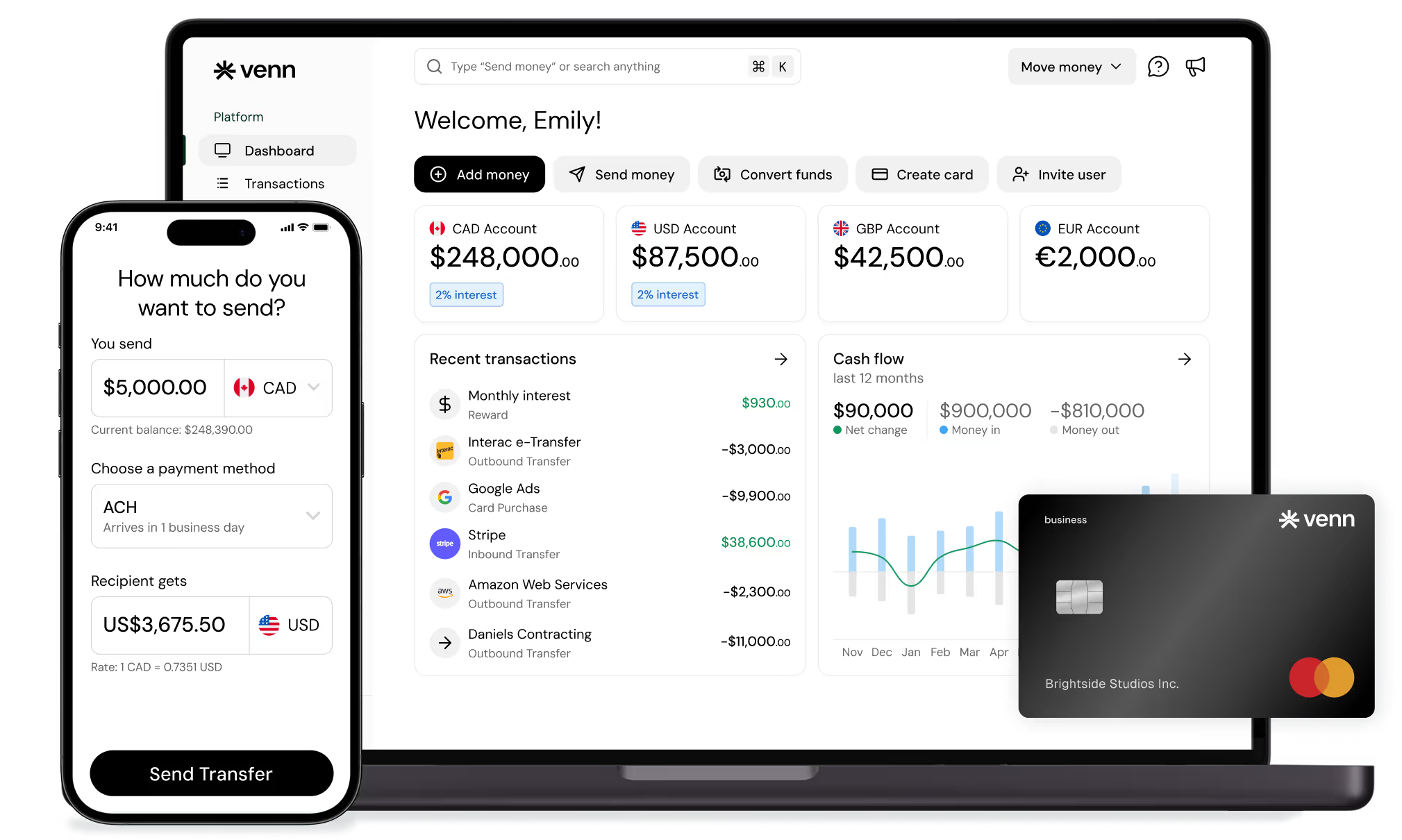
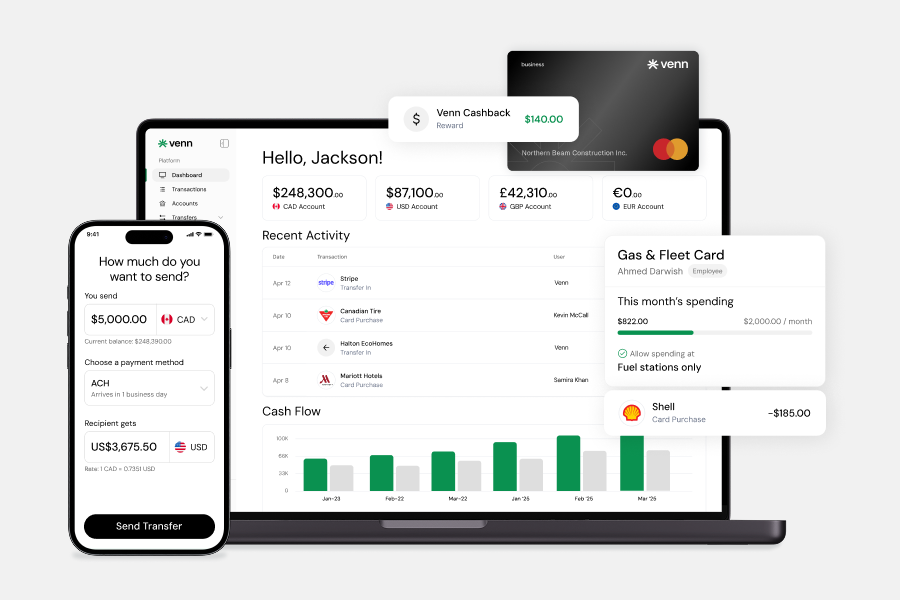
For Canadian businesses looking to optimize vendor payment operations, platforms like Venn provide comprehensive solutions addressing multiple needs. With real local CAD, USD, EUR, and GBP accounts, automated payables integration, and sophisticated expense management capabilities, businesses gain the infrastructure needed for efficient vendor management in a single platform.
Optimizing Vendor Payments: A Critical Success Factor
Payment infrastructure often represents the largest hidden cost in vendor management, yet many businesses accept inefficient payment processes as unavoidable. Understanding and optimizing your payment capabilities can transform vendor relationships while significantly reducing costs.
The Hidden Costs of Traditional Banking
Canadian businesses lose thousands annually to inefficient payment infrastructure that most consider "just the cost of doing business." Traditional banks charge $15-25 per outbound wire transfer, making regular vendor payments expensive. Even worse, many Canadian banks charge $17 inbound wire fees on US-to-US transfers when using their "US dollar accounts" that aren't actually domiciled in the United States.
Foreign exchange markups of 2-3% hide in seemingly competitive rates. The inability to send EFTs to Canadian vendors forces expensive wire transfers for domestic payments. Payment processors like Stripe charge 1.5% cross-border fees when you receive payments in foreign currencies without local accounts. These costs compound quickly across multiple vendors and currencies.
The Multi-Currency Account Advantage
Real local accounts transform vendor payment economics through dramatic cost reductions and improved payment speed. US accounts enable ACH sending and receiving, eliminating wire fees for American vendors while providing faster settlement. EUR accounts enable SEPA transfers throughout Europe, dramatically cheaper and faster than international wires. GBP accounts provide access to Faster Payments for UK vendors, often settling within hours. True Canadian accounts support EFT, Interac e-Transfer®, and pre-authorized debits for comprehensive domestic coverage.
Payment Speed and Vendor Relationships
Payment timing directly affects vendor relationships and your negotiating position. Faster payments strengthen relationships and often unlock better terms or priority service. The difference between same-day ACH and 3-5 day international wires can determine whether a vendor prioritizes your orders during busy periods. Reliable, fast payments build trust that translates into tangible business benefits.
Automation and Integration
Integrated payment platforms that connect seamlessly with QuickBooks and Xero eliminate manual payment workflows. This automation reduces errors that damage vendor relationships while freeing finance team time for strategic work. The compound effect of automation across dozens or hundreds of vendors transforms finance operations.
For Canadian businesses looking to optimize vendor payment operations, platforms like Venn provide comprehensive solutions. Venn offers real local CAD, USD, EUR, and GBP accounts, enabling businesses to pay international vendors using domestic payment methods (ACH, SEPA, Faster Payments) instead of expensive wires. With FX rates of 0.25%-0.45%, wire transfers at $6-10, and free unlimited Interac e-Transfer® capabilities, businesses can reduce payment costs by 40-60% compared to traditional banking.
Venn's integration with QuickBooks and Xero enables automated payables, while OCR receipt capture and invoice matching streamline accounting workflows. The platform also allows recipient creation without invoices, providing flexibility that competitors don't offer. For businesses managing multiple vendors across currencies, Venn's multi-currency corporate card automatically uses the payment currency first, eliminating unnecessary FX fees on vendor purchases.
Frequently Asked Questions About Vendor Management
Q: What is the difference between vendor management and supplier management?
A: The terms are often used interchangeably, but some organizations distinguish them by scope. Vendor management typically refers to managing relationships with service providers and product suppliers, while supplier management may focus specifically on raw materials and manufacturing inputs. In practice, both involve the same core processes: selection, contracting, performance monitoring, and relationship optimization.
Q: What should be included in a vendor contract?
A: Comprehensive vendor contracts should include scope of work or deliverables, pricing and payment terms, service level agreements (SLAs) with performance metrics, liability and indemnification clauses, data security and confidentiality provisions, compliance requirements, termination clauses, and dispute resolution processes. For international vendors, contracts should also specify payment currencies and methods.
Q: How often should we review vendor performance?
A: Informal vendor performance should be monitored continuously through KPIs and service feedback. Formal reviews are typically conducted quarterly for strategic or high-spend vendors and annually for less critical relationships. A full vendor portfolio review should be done at least once per year to identify consolidation or optimization opportunities.
Q: What are the biggest risks in vendor management?
A: Major risks include vendor financial instability, compliance failures, data security breaches, over-reliance on a single vendor (concentration risk), and hidden costs caused by inefficient payment methods or FX fees. Effective vendor management includes regular risk assessments, contingency planning, and diversification for critical services.
Q: How can Canadian businesses reduce international vendor payment costs?
A: The most effective approach is using platforms that provide real local currency accounts (USD, EUR, GBP) instead of relying on traditional bank wires. This enables lower-cost domestic payment methods like ACH, SEPA, and Faster Payments, and avoids bank FX markups of 2–3%. Modern platforms typically charge 0.25%–0.45% FX instead, producing significant savings on recurring international payments.
---
**Disclaimer:** This publication is provided for general information purposes and does not constitute legal, tax or other professional advice from Venn Software Inc or its subsidiaries and its affiliates, and it is not intended as a substitute for obtaining advice from a financial advisor or any other professional. We make no representations, warranties or guarantees, whether expressed or implied, that the content in the publication is accurate, complete or up to date.

Venn is all-in-one business banking built for Canada
From free local CAD/USD accounts and team cards to the cheapest FX and global payments—Venn gives Canadian businesses everything they need to move money smarter. Join 15,000+ businesses today.
Frequently asked questions
Everything you need to know about the product and billing.
Join 15,000+ businesses banking with Venn today
Streamline your business banking and save on your spend and transfers today
No personal credit check or guarantee.