Mercury Alternatives for Canadian Startups 2026 Guide
Compare Mercury Alternatives for Canadian Startups. Review CAD and USD options, cards, FX fees, and QuickBooks or Xero fit for Venn, Airwallex, RBC, TD.

Trusted by 15,000+ Canadian businesses
Business banking for Canada
Local CAD and USD accounts, corporate cards with cashback, the lowest FX rates in Canada, free local transfers, and more.
Mercury Alternatives for Canadian Startups
Updated June 2026
Introduction
Canadian founders searching for Mercury alternatives are usually comparing fit, eligibility, local operating needs, and cross-border workflows, not looking for a generic Mercury review. Many startups need local CAD operations first, while others need USD access, global payments, corporate cards, QuickBooks or Xero workflows, or branch support. This guide compares Mercury Alternatives for Canadian Startups through that practical lens, so you can shortlist platforms based on how your business actually operates.
Why Canadian Startups Search for Mercury Alternatives
Mercury earns attention from founders because it offers a modern user experience, startup-friendly positioning, and U.S.-focused business banking built for digital companies. The friction starts with eligibility. Mercury generally centers access on businesses formed and registered in the United States or a U.S. territory, with existing or planned U.S. operations.
That leaves many Canada-only startups looking for Mercury alternatives for Canadian startups, especially when they need local CAD operations first, including Canadian vendor payments, payroll readiness, and day-to-day operating accounts before adding U.S. banking capabilities.
What This Guide Will Compare
This guide compares four core options in 2026: Venn, Airwallex, RBC Business Banking, and TD Business Banking. We assess each through the lens of Canadian business fit, CAD support, USD and global capabilities, cards, accounting integrations, fees, and day-to-day workflow fit. The goal is to help founders evaluate Mercury alternatives for Canadian startups based on operating needs, not to rank providers from best to worst.
Quick Comparison Table
Use this snapshot to shortlist Mercury Alternatives for Canadian Startups before reviewing each platform in more detail.
Best Mercury Alternatives for Canadian Startups
A practical shortlist starts with four different fits: Venn, Airwallex, RBC Business Banking, and TD Business Banking. Venn suits startups that want Canada-first operations with integrated finance workflows. Airwallex fits teams that prioritize global payments and multi-currency movement. RBC and TD appeal to founders who prefer traditional banking infrastructure, established branch networks, and familiar Canadian business account structures.
The right Mercury alternative for Canadian businesses depends on how your startup actually runs: local CAD operations, cross-border business banking Canada needs, major-bank support, or tighter coordination between cards, payments, and accounting.
Venn
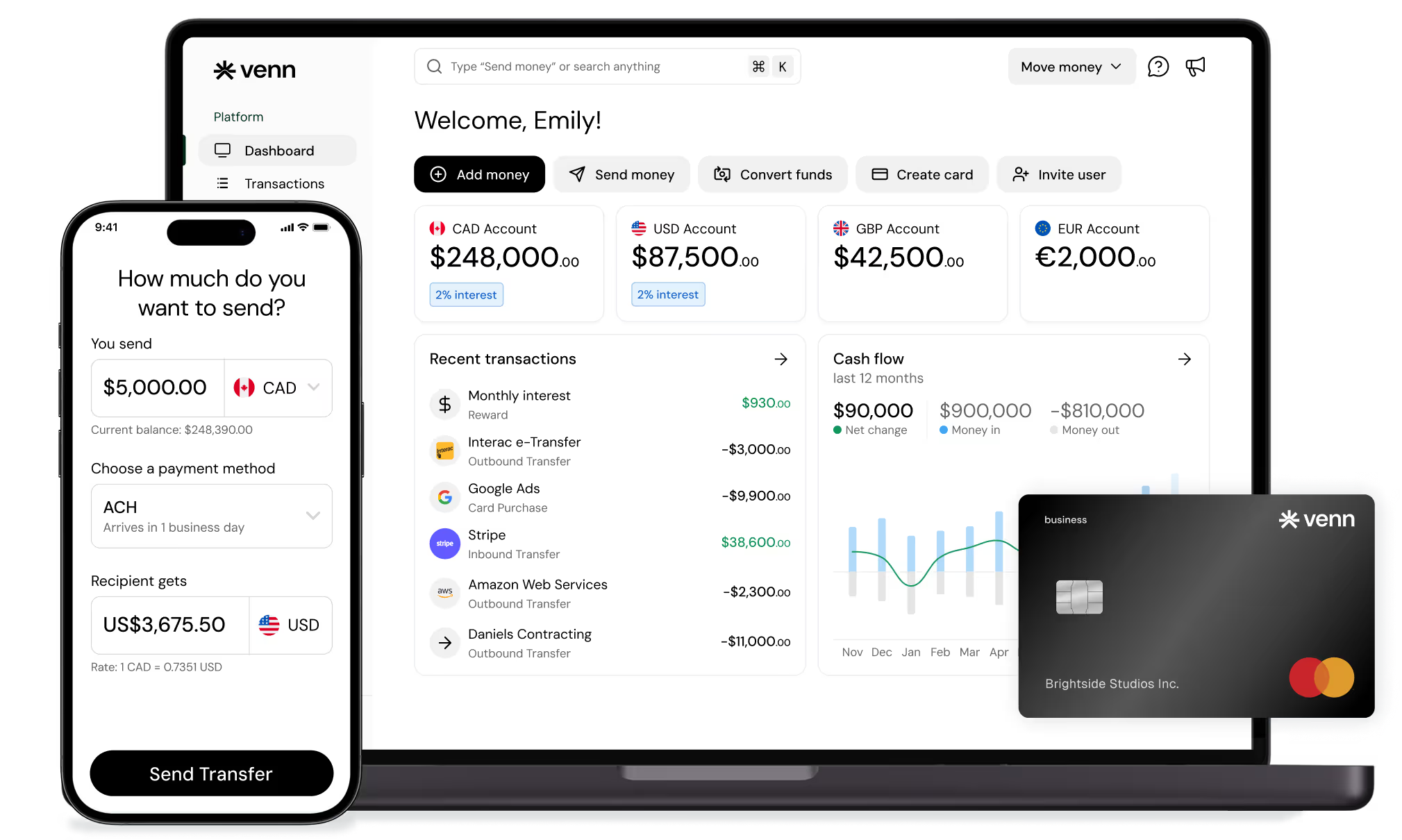
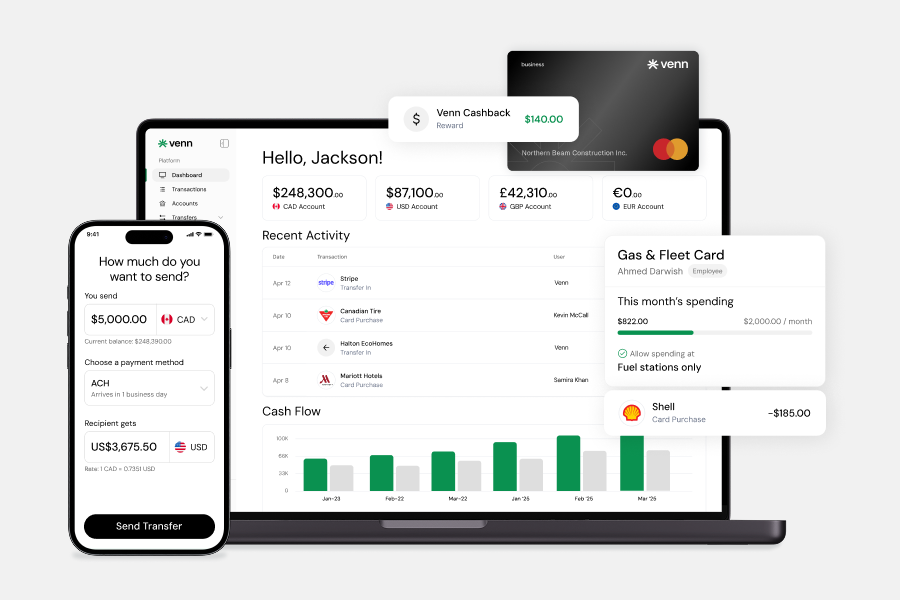
Venn is a Canadian business banking platform for startups that want local operating accounts plus cross-border capability in one workflow. It fits founders comparing Mercury alternatives for Canadian startups who need CAD operations at home and practical multi-currency support as they sell, hire, and pay internationally.
Canada-First Operations
Venn supports CAD, USD, GBP, and EUR accounts, making it a strong fit for a Canadian startup business account that also needs global reach. Teams can run Canadian payroll, pay domestic vendors, and use free unlimited Interac e-Transfer® for vendor payments.
Eligible deposits with Venn are covered by CDIC insurance protection, which matters for finance teams that want modern software without giving up familiar safeguards.
Cross-Border Payments
For startups managing global suppliers or USD revenue, Venn offers competitive FX rates of 0.25% to 0.45%, depending on plan. Qualifying balances can earn 2.75% CAD and 3.00% USD, with up to 3.50% on larger USD balances. The funding deadline is October 15, 2026, and the boosted-rate term runs through July 15, 2027. See the full details on the Venn Interest Boost. After the funding window, the standard 2% rate applies as the fallback.
Cards, Expenses, and Accounting
Venn’s card offers 1% cashback, with unlimited cashback available on eligible higher-tier plans. Finance teams also get expense controls, approval workflows, virtual and physical cards, OCR receipt capture, and AI transaction categorization.
Direct QuickBooks and Xero integrations help connect cards, payments, and accounting, especially for software-heavy spend.
Tradeoffs
Venn is not available to businesses in Quebec, so founders there will need another option.
Airwallex
Airwallex fits global-first startups that manage suppliers, customers, contractors, or entities across multiple countries and need international money movement built into daily operations.
Global Payments
For Canadian startups comparing Mercury alternatives, Airwallex stands out for cross-border payment depth. In Canada, it markets support for 20+ currencies, local and global transfers, and workflows designed for international operations. That can suit SaaS companies billing customers abroad, e-commerce brands paying overseas suppliers, agencies working with international contractors, and marketplaces with recurring payouts across regions.
Multi-Currency Operations
Airwallex is strongest when FX exposure is frequent rather than occasional. A startup paying invoices in USD, collecting revenue in multiple currencies, or managing vendor payments across Asia, Europe, and North America can use Airwallex to reduce friction across currencies and payment routes.
Cards and Pricing
Airwallex also offers corporate cards, which can help teams manage travel, software, supplier, and online advertising spend across markets. Its Canadian pricing page markets FX pricing at 0.5% above interbank for major currencies, making it worth evaluating for companies with meaningful conversion volume.
Tradeoffs
Airwallex may feel more global-payments-oriented than domestic Canada-first. Teams focused mainly on Canadian payroll, local vendors, and day-to-day domestic finance processes may prefer a platform or bank account structure built around Canadian operating needs.
RBC Business Banking
RBC fits startups that want a traditional Canadian banking relationship, especially when branch access and lender familiarity matter as much as digital convenience.
Traditional Bank Relationship
As one of Canada’s major banks, RBC gives founders access to mainstream business banking infrastructure, including in-person service and established account structures. This can help companies that handle cash, need branch support, or prefer a recognizable banking partner for finance operations.
CAD and USD Accounts
RBC offers Canadian business banking and U.S. dollar business accounts in Canada, which makes it relevant for founders comparing Mercury alternatives for Canadian startups with both domestic and cross-border needs. Its broader international business banking options may also suit companies that expect to work with foreign customers, suppliers, or banking counterparties.
Branch and Lending Familiarity
RBC can be practical for startups that expect future financing conversations, since many lenders, accountants, and advisors already understand major-bank statements, credit products, and operating account history.
Tradeoffs
The tradeoff is workflow depth. Monthly fees, transaction pricing, and legacy processes can add friction, particularly for software-heavy teams that want more integrated automation across payments, approvals, cards, and accounting.
TD Business Banking
TD fits startups that want major-bank familiarity, Canadian-dollar operations, and basic U.S.-dollar banking without adopting a software-first finance stack.
CAD and USD Basics
TD promotes business accounts in both Canadian and U.S. dollars, including small-business options built around electronic transaction structures. For a Canadian startup business account, that can cover practical day-to-day needs such as receiving customer payments, paying vendors, and separating CAD and USD activity when cross-border revenue or expenses start to grow.
Established Infrastructure
The main appeal is familiarity. Founders comparing Mercury alternatives for Canadian startups may prefer TD if their finance operations value conventional account setup, recognizable banking processes, and access to a broad Canadian banking network over deeper automation.
Tradeoffs
TD may feel less flexible than software-first platforms for teams that want integrated approvals, accounting workflows, spend controls, or built-in operating finance tools. Monthly fees, transaction limits, and account packaging can also require closer review, especially for startups with high electronic transaction volume or changing cash-flow patterns.
How to Choose the Right Mercury Alternative
Start with how your startup actually operates, then map that reality to the platform profiles above. A Canada-only company with local payroll, Canadian vendors, and CAD revenue needs a different setup than a cross-border SaaS business collecting USD, paying contractors abroad, and reconciling spend across currencies.
For Mercury alternatives for Canadian startups, the key questions are practical: Where is the company incorporated? Where does revenue arrive? Which currencies do you pay and receive? How do employees, suppliers, taxes, subscriptions, and reimbursements move through the business? Just as important, how does your finance team close the books each month?
If most activity happens in Canada, prioritize startup banking Canada workflows and local operating rails. If revenue and costs span countries, focus on cross-border business banking Canada needs and a multi-currency business account Canada. If your team wants fewer manual steps, weigh how payments, cards, approvals, and reconciliation fit together.
Choose a Canada-First Platform If You Need Local Operating Rails
Prioritize local rails when your startup runs mainly in Canada. Payroll, bill pay, Canadian vendor payments, domestic incorporation, and daily CAD cash management all point to a Canada-first setup before global extras. This is especially relevant when comparing Mercury alternatives for Canadian startups that need operating reliability at home, not only cross-border flexibility. Before committing, validate that your provider supports the workflows your finance team uses every day, as outlined in the platform profiles above.
Choose a Global-First Platform If You Manage Multiple Currencies
Prioritize global-first capabilities when money moves across borders every week, not once a quarter. This matters for startups paying international contractors, buying from overseas suppliers, accepting global customer payments, or receiving Stripe and marketplace payouts in foreign currencies. Before choosing among Mercury alternatives for Canadian startups, ask how often you convert funds, which currencies you receive and send, and whether recurring FX exposure affects margins. A strong multi-currency business account in Canada should help your team reduce manual payment work, track cross-border cash flow clearly, and support international transfers for businesses in Canada without forcing every transaction through one domestic operating model.
Choose a Traditional Bank If You Need Familiarity and Branch Support
A traditional bank can be the practical choice when your startup needs in-person service, branch access, or regular cash handling. Some founders also prefer established institutions for conservative finance operations, especially when internal controls, signing authorities, and familiar account structures matter more than software automation. In a comparison of Mercury alternatives for Canadian startups, this path makes sense for businesses that value relationship continuity, physical banking support, and standard operating processes over a fully digital finance workflow.
Choose a More Integrated Stack If You Want Cards, Accounting, and Payments Together
Finance teams are moving toward integrated operating stacks in 2026, especially startups that want fewer handoffs between spend management, bill payments, approvals, and accounting. For Canadian founders comparing Mercury alternatives for Canadian startups, the question is less “which account looks most modern?” and more “which workflow reduces reconciliation work every month?”
Venn fits into this operational finance trend, as outlined in the platform section, alongside global-first and traditional-bank options. Compare each provider against how your team actually works, including who approves spend, how payments get initiated, and how cleanly transactions reach your accounting system.
Common Mistakes to Warn Against
Use this as a final checklist when comparing Mercury alternatives for Canadian startups. Costly mismatches often happen when founders optimize for one headline feature, such as USD access or card rewards, while overlooking daily finance operations.
• Choosing a provider before confirming CAD payment workflows, payroll needs, and vendor payment fit.
• Treating FX fees on cards and wires as minor, especially with frequent cross-border spend.
• Ignoring reconciliation, approvals, receipt capture, and QuickBooks or Xero compatibility.
• Selecting a platform your finance team will outgrow once transaction volume, currencies, or controls become more complex.
Choosing Based on USD Access Alone
USD access can help a Canadian startup receive customer revenue or pay cross-border suppliers, but it does not cover the full operating workflow. When comparing Mercury alternatives for Canadian startups, test each option against how money actually moves through the business:
• Do you also need local CAD rails for day-to-day operations?
• Will your payroll provider connect cleanly?
• Can you pay Canadian vendors without workarounds?
• Do card and approval controls help manage FX exposure before spend happens?
Ignoring FX Costs on Cards and Wires
Monthly account fees tell only part of the story. Mercury’s official support content says non-USD business card transactions carry a 3% conversion fee, and non-USD international wires carry a 1% exchange fee. For Canada-based startups paying suppliers, contractors, ad platforms, or SaaS vendors across borders, those costs can matter more than a low monthly fee. When comparing Mercury alternatives for Canadian startups, model FX across card spend, wires, payouts, and currency conversion volume.
Overlooking Accounting Workflow Fit
A finance setup scales only if accounting workflows stay clean as transaction volume grows. When comparing Mercury alternatives for Canadian startups, look beyond account access and ask how each option supports month-end reconciliation, receipt capture, spend approvals, card controls, and bill payment records. Your team should also confirm whether transaction data can sync reliably with QuickBooks or Xero. Small gaps create manual cleanup, delayed closes, and weaker visibility into cash movement.
Conclusion
The right choice among Mercury alternatives for Canadian startups depends on how your company actually operates. A Canada-only founder may prioritize local operating workflows, while a cross-border SaaS, ecommerce, or services company may need stronger global payments and currency flexibility. Some teams value traditional banking infrastructure and branch familiarity. Others want a more integrated finance stack that connects spending, payments, approvals, and reporting into one operating rhythm.
Start with the work your finance team handles every week. Compare those day-to-day workflows first, then shortlist the provider that fits them best.
FAQ
Q: Can a Canadian startup use Mercury?
A: A Canadian founder may be able to apply in specific cases, but Mercury is generally oriented around businesses formed in the U.S. or a U.S. territory. If you only operate through a Canadian entity, use the eligibility context covered near the top of this guide before shortlisting Mercury or any Mercury alternatives for Canadian startups.
Q: What is the best Mercury alternative if I only have a Canadian company?
A: It depends on what your startup needs most. Prioritize local CAD operations if you run payroll, pay Canadian vendors, or manage domestic cash flow, look at global payments if you invoice or pay internationally, and consider branch banking if in-person support matters. Use the comparison table and platform profiles above to match each option to your operating model.
Q: What should I prioritize, CAD business banking or USD access?
A: Many Canadian startups need both, especially if they sell to U.S. customers or pay global suppliers. In practice, local CAD operating rails often matter first because they support day-to-day finance workflows in Canada. Once that foundation works, compare USD access, cross-border business banking, and multi-currency account needs.
Q: Are traditional banks or fintech platforms better for startups?
A: Traditional banks offer familiar infrastructure, established processes, and branch access, which can help teams that value conventional banking relationships. Fintech platforms tend to focus on software-driven efficiency, faster workflows, cards, payments, and finance operations in one place. The better fit depends on whether your startup values familiarity or operational speed more.
---
**Disclaimer:** This publication is provided for general information purposes only and does not constitute legal, tax, financial, or other professional advice from Venn Software Inc., its subsidiaries, or its affiliates, and is not a substitute for advice from a qualified professional. All comparisons and competitor information reflect publicly available information believed accurate as of June 1, 2026; features, pricing, rates, and terms referenced are subject to change and may differ at the time you read this. All product names, logos, and brands referenced are the property of their respective owners; their mention does not imply affiliation with or endorsement by Venn. Any comparative statements reflect Venn's views and are provided to help readers evaluate options. We make no representations, warranties, or guarantees, express or implied, that the content is accurate, complete, or up to date.

Venn is all-in-one business banking built for Canada
From free local CAD/USD accounts and team cards to the cheapest FX and global payments—Venn gives Canadian businesses everything they need to move money smarter. Join 15,000+ businesses today.
Frequently asked questions
Everything you need to know about the product and billing.
Join 15,000+ businesses banking with Venn today
Streamline your business banking and save on your spend and transfers today
No personal credit check or guarantee.