How to Automate Your Businesses Invoices in Canada
Learn how to automate invoices for your business in Canada. Streamline AP and AR, cut costs, boost cash flow, and simplify multi-currency payments with Venn.

.png)
Trusted by 15,000+ Canadian businesses
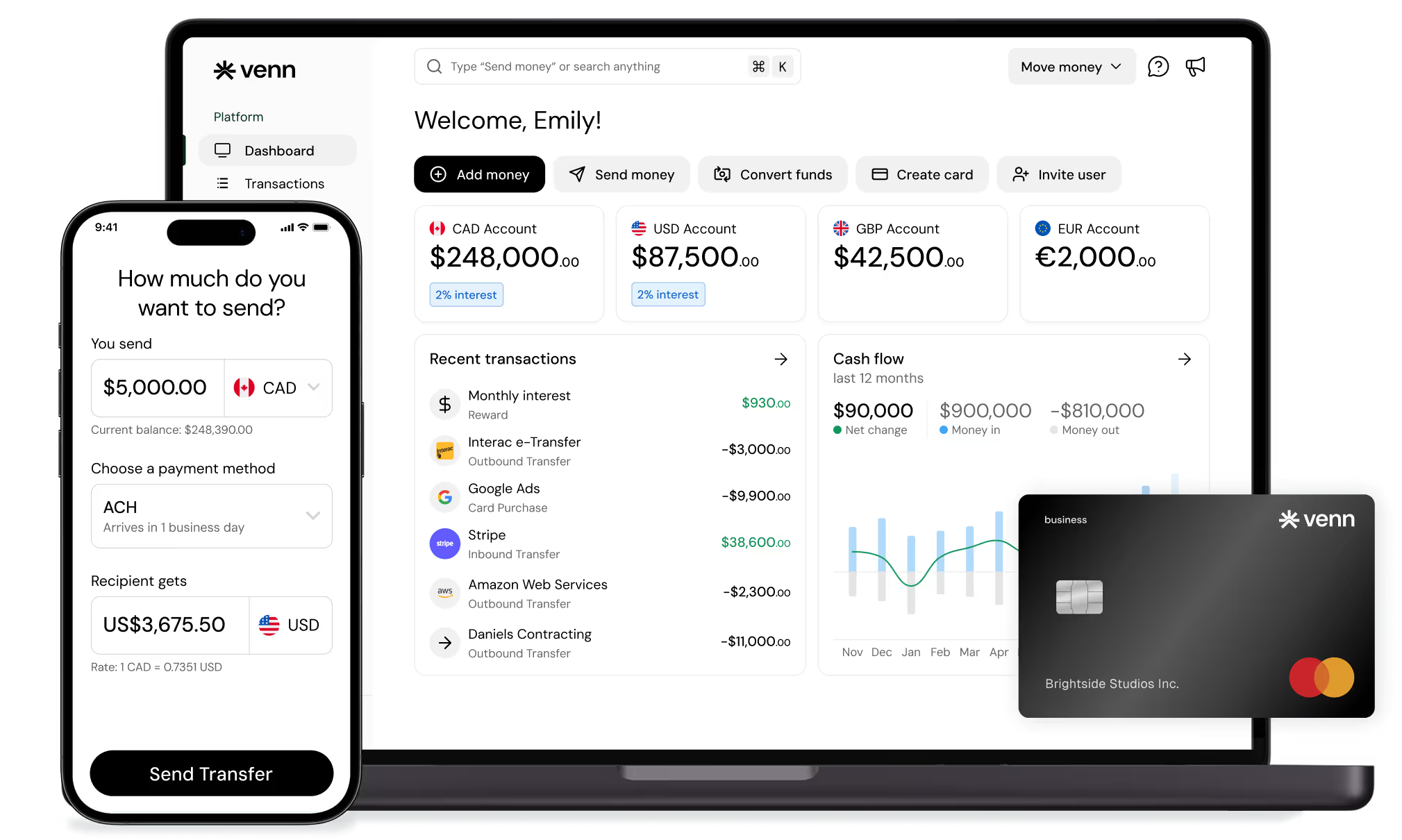
Business banking for Canada
Local CAD and USD accounts, corporate cards with cashback, the lowest FX rates in Canada, free local transfers, and more.
Manual invoice processing drains Canadian businesses of precious time and money. Whether you're creating invoices for customers or processing vendor bills, the hours spent on data entry, approval routing, and payment tracking compound quickly. For businesses handling multiple currencies or cross-border transactions, these challenges multiply exponentially.
This comprehensive guide walks you through practical steps to automate both outgoing and incoming invoices. You'll discover essential features to prioritize in automation tools, integration strategies that work with Canadian accounting systems, and how modern banking platforms can consolidate invoice automation with payment processing. By implementing these strategies, you can reduce processing time by up to 80%, minimize errors, accelerate cash flow, and slash payment processing costs.
From understanding the basics of invoice automation to implementing sophisticated workflows, this guide provides the roadmap Canadian businesses need to transform their financial operations.
Why Canadian Businesses Need Invoice Automation
Canadian businesses face unique invoicing challenges that make automation essential for competitive operations.
Manual invoice creation consumes hours of productive time while introducing errors that damage professional relationships. Tracking payment status across dozens or hundreds of customers creates an administrative nightmare. Late payments strain cash flow, forcing businesses to delay their own vendor payments or growth investments. Multi-currency invoicing adds layers of complexity when serving US or international clients. Cross-border payment fees can consume 3-5% of invoice value through traditional banking channels.
Paper invoices and email attachments create data entry bottlenecks that delay payment processing. Manual approval routing means invoices sit in email inboxes for days or weeks. Without centralized visibility, finance teams struggle to forecast cash needs or capture early-payment discounts. Reconciliation becomes a monthly ordeal of matching payments to invoices across multiple systems. The risk of duplicate payments or missed invoices grows with volume.
Traditional Canadian banks offer limited access to true US ACH accounts, forcing expensive wire transfers for USD invoices. Converting USD payments through Big 5 banks incurs 2-3% FX markups that erode margins. These same banks charge $15-17 for inbound wire transfers, even for US-to-US transfers through their "US dollar accounts." Many Canadian banks restrict business EFT capabilities or impose low Interac e-Transfer® limits that don't meet B2B payment needs.
Modern invoice automation addresses all these challenges while integrating seamlessly with your existing financial infrastructure.
What Is Invoice Automation? Understanding the Basics
Invoice automation uses software and technology to automatically create, send, receive, process, and pay invoices with minimal manual intervention.
Break down the two types:
• Accounts Receivable (AR) Automation: Automatically generating invoices from your business data, sending them to customers through their preferred channels, tracking payment status in real-time, sending payment reminders at optimal intervals, and reconciling payments to your accounting system.
• Accounts Payable (AP) Automation: Automatically capturing invoice data from emails or uploads, routing invoices for approval based on predefined rules, matching invoices to purchase orders and receipts, scheduling payments for optimal cash flow, and syncing all transactions with your accounting software.
The core technologies powering invoice automation include OCR (Optical Character Recognition) for extracting data from invoice images, workflow automation engines for routing approvals, API integrations connecting to accounting software and banks, payment processing automation for executing transfers, and AI/ML algorithms for invoice matching and exception detection.
Modern solutions increasingly integrate invoice automation directly with business banking platforms, eliminating the need to juggle multiple systems while providing unified visibility into cash flow and payment processing.
Key Benefits of Automating Your Invoice Processes
• Automated invoicing with embedded payment links accelerates customer payments by 2–3×, improving cash flow and reducing days outstanding.
• Streamlined AP approval workflows prevent vendor invoices from getting stuck in email inboxes, ensuring timely reviews and payments.
• Real-time dashboards provide instant visibility into outstanding receivables and upcoming payables, enabling better cash management at a glance.
• Improved forecasting supports smarter decisions around investments, inventory planning, and growth initiatives.
• Reduce or eliminate manual processing costs that average $15–30 per invoice, while saving on payment fees by routing transactions through optimal methods like EFT instead of wire transfers.
• Timely payments strengthen vendor relationships and can unlock early-payment discounts of 1–2%, as vendors prefer working with businesses that pay predictably.
• Automated systems create complete digital records of invoice activity, approvals, and payments—simplifying audits and protecting against disputes.
• Scale invoice processing without adding headcount. Many businesses handle 5–10× more invoices with the same team after automation.
• Companies that automate invoice processing report up to an 80% reduction in processing time and up to 50% lower processing costs compared to manual methods.
How to Automate Invoices: Step-by-Step Implementation Guide
This practical roadmap guides businesses through invoice automation implementation regardless of their starting point. While complexity varies based on business size and current systems, these fundamental steps create a solid foundation for any organization.
Step 1: Assess Your Current Invoice Workflow
Before automating, map your existing processes to identify opportunities and measure future improvements.
Document how you currently create invoices, whether through manual entry, spreadsheet templates, or basic software. List all information you include such as line items, payment terms, and tax calculations. Note your delivery methods including email, mail, or customer portals. Track how you monitor payment status and handle late payment follow-ups. Identify whether you invoice in multiple currencies and how you manage exchange rates.
Map how you receive vendor invoices through paper mail, email, or vendor portals. Document your approval chain and identify who approves different invoice types and amounts. Review how you match invoices to purchase orders or receipts. List your payment methods including checks, wires, EFT, or Interac e-Transfer®. Note your process for handling exceptions and discrepancies.
Document specific pain points, bottlenecks, and time spent on each activity. This baseline helps you measure automation ROI and identify which areas to prioritize for immediate impact.
Step 2: Choose the Right Invoice Automation Solution
Selecting the right platform determines your automation success. Consider these essential features when evaluating options.
Must-Have Capabilities:
Look for customizable invoice templates that reflect your brand, automated invoice generation from time tracking or project management data, multiple delivery methods to meet customer preferences, integrated payment links for instant online payment, automated payment reminders with customizable schedules, real-time payment tracking dashboards, multi-currency invoicing support with competitive FX rates, and customer payment portals for self-service access.
Prioritize OCR technology with high accuracy rates, multi-channel invoice capture from email, upload, or mobile apps, automated approval routing with role-based workflows, three-way matching between POs, receipts, and invoices, intelligent exception handling and flagging, deep integration with QuickBooks or Xero, scheduled payment processing with multiple methods, and vendor portals for streamlined invoice submission.
Ensure seamless sync with your accounting system through native APIs, bank account integration for automated payment processing, API access for custom workflow development, and receipt capture integration for complete expense visibility.
Support for CAD, USD, GBP, and EUR transactions is non-negotiable. Look for platforms offering local payment methods including EFT, Interac e-Transfer®, and wire transfers.
Modern business banking platforms increasingly offer integrated invoice automation alongside payment processing, expense management, and multi-currency accounts. This consolidation eliminates data silos, reduces subscription costs, and simplifies financial operations through unified workflows.
Step 3: Integrate With Your Accounting System
Seamless accounting integration transforms invoice automation from a standalone tool into a comprehensive financial management system.
Key Integration Points:
Enable automatic invoice sync in both directions to maintain data consistency. Synchronize customer and vendor data to prevent duplicate entries. Map your chart of accounts and tax codes for accurate categorization. Configure payment reconciliation rules to match bank transactions automatically. Ensure real-time balance updates for accurate financial reporting.
Connect your accounting software through native API integration for reliability. Map your chart of accounts and tax codes to the automation platform. Configure sync settings choosing between real-time or scheduled updates based on volume. Set up automatic reconciliation rules to match payments to invoices. Test thoroughly with sample invoices before processing live transactions.
Eliminate duplicate data entry that wastes time and introduces errors. Ensure accounting records stay current without manual updates. Simplify month-end closing with pre-reconciled transactions. Maintain a single source of truth for all financial data. Enable better reporting and forecasting with complete, accurate information.
Look for platforms offering native integrations rather than third-party connectors, as these typically provide more reliable sync, better error handling, and responsive support when issues arise.
Step 4: Set Up Automated Invoice Creation and Delivery (AR)
Streamline how you bill customers by automating the entire invoice lifecycle from creation to payment
Set up recurring invoices for subscription services or retainer clients, eliminating monthly manual creation. Configure automatic invoice creation triggered by time tracking entries or project milestones. Create rules for milestone-based invoicing that generate invoices upon task completion. Set up automatic line item population pulling data from project management or inventory systems.
Configure automatic email delivery immediately upon invoice creation.
For US or international clients, configure invoicing in their preferred currency to eliminate conversion friction. Maintain local currency accounts (USD, GBP, EUR) to receive payments without conversion fees. Apply automatic FX rates with transparent markup when conversion is necessary. Include payment instructions for local methods like US ACH, SEPA, or Faster Payments.
Businesses accepting online payments through embedded links or customer portals get paid 2-3x faster than those relying on traditional bank transfers or checks.
Step 5: Implement Automated Payment Reminders and Follow-Up
Systematic follow-up reduces days sales outstanding (DSO) without damaging customer relationships.
Send automatic reminders 3-5 days before due date as friendly payment notifications. Configure escalating reminders for overdue invoices at strategic intervals like 3, 7, and 14 days past due. Customize reminder tone progressing from helpful to urgent based on payment history. Include payment links in every reminder to minimize friction.
Monitor which invoices are paid, pending, or overdue through real-time dashboards. Set up alerts for large overdue amounts requiring personal attention. Generate aging reports automatically for credit management decisions.
Keep initial reminders friendly and helpful, positioning them as customer service. Gradually increase urgency for overdue accounts while maintaining professionalism. Make payment as frictionless as possible with multiple payment options and embedded links. Consider offering flexible payment terms or plans for valuable customers experiencing temporary difficulties.
Automated reminders recover payments faster than manual follow-up while freeing staff for relationship-building activities.
Step 6: Automate Invoice Receipt and Data Capture (AP)
Eliminate manual data entry for incoming invoices through intelligent capture and processing. Set up dedicated email addresses like ap@yourcompany.com for vendor invoice submission.
Train the system to recognize common vendor invoice formats for optimal accuracy. Set up automatic field extraction for vendor name, invoice number, date, amount, and line items. Configure validation rules catching errors like duplicate invoice numbers or unusual amounts. Enable automatic coding based on vendor history or expense categories.
Some systems require an invoice to create a vendor record, creating workflow problems. Look for platforms that let you set up vendor profiles independently, then match invoices as they arrive. This flexibility supports proactive vendor management.
Flag invoices that don't match expected formats for manual review. Alert on duplicate invoices before payment to prevent costly errors. Identify invoices exceeding budget thresholds for additional scrutiny. Queue unusual items for manual review while processing standard invoices automatically.
Modern OCR technology achieves 95%+ accuracy on standard invoice formats, with machine learning continuously improving performance based on your specific vendors.
Step 7: Configure Approval Workflows and Routing
Design approval hierarchies matching your organizational structure while maintaining efficiency.
Set Up Approval Rules:
Configure automatic approval for invoices under $500 to minimize bottlenecks. Route $500-$5,000 invoices to department managers for standard approval. Require director or VP approval for $5,000-$25,000 invoices. Reserve CFO or executive approval for invoices exceeding $25,000.
Route invoices to appropriate department heads based on expense categories or cost centers. Enable cross-functional approvals for shared expenses like software subscriptions. Configure backup approvers preventing delays when primary approvers are unavailable. Set up out-of-office delegation for seamless coverage.
Auto-approve recurring vendors under certain thresholds based on payment history. Require additional scrutiny for new vendors to prevent fraud. Fast-track critical vendors maintaining essential business operations. Flag unusual invoice amounts from regular vendors for investigation.
For businesses using purchase orders, automatically match invoices to POs and receipts. Flag discrepancies in quantity, price, or terms for review. Set tolerance thresholds allowing automatic approval within acceptable variances. Escalate significant mismatches to appropriate personnel for resolution.
Allow approvers to review and approve invoices from smartphones or tablets. Prevent bottlenecks when team members travel or work remotely. Include invoice images and relevant documentation in mobile views. Maintain security through device authentication and encrypted connections.
Track approval status in real-time to identify bottlenecks and ensure timely vendor payments that maintain strong relationships.
Step 8: Automate Payment Processing
Execute payments efficiently while optimizing costs and maintaining control.
Configure Payment Methods:
Different payment scenarios require different approaches for optimal efficiency and cost.
Use EFT (Electronic Funds Transfer) for standard business payments at minimal cost. Leverage Interac e-Transfer® for smaller amounts or vendors without EFT details. Reserve wire transfers for urgent large payments where speed justifies higher fees.
Access US ACH payments through platforms with real US banking infrastructure. Use wire transfers as fallback for vendors not accepting ACH. Consider integrated USD payment platforms avoiding traditional bank limitations.
Send local currency payments to GBP/EUR accounts via SEPA or Faster Payments. Use international wire transfers for countries without local payment rails. Leverage multi-currency platforms that optimize routing and minimize fees.
Set up automatic payment execution on due dates or early-payment discount dates. Batch payments for efficient processing and reduced transaction fees. Configure payment approval workflows separate from invoice approval for proper controls. Enable scheduled payments for recurring vendors like rent or subscriptions.
Optimize Payment Costs:
Canadian businesses can achieve significant savings by escaping traditional bank fee structures.
Wire transfers cost $15-50 per transaction regardless of amount. FX markup adds 2-3% to every currency conversion. Inbound wire fees of $15-17 apply even to USD-to-USD transfers through Canadian bank "US accounts."
Use local currency accounts to send and receive payments without conversion. Leverage EFT/ACH for domestic payments at $0-2 per transaction. Access competitive FX rates of 0.25-0.45% versus 2-3% bank markups. Eliminate inbound wire fees with proper multi-currency account infrastructure.
Automatically mark invoices as paid when payments process successfully. Sync payment data to accounting systems for real-time updates. Generate payment confirmations for vendor records. Maintain complete audit trails for compliance and dispute resolution.
Step 9: Monitor, Measure, and Optimize
Invoice automation requires ongoing refinement to maximize ROI and adapt to changing business needs.
Track Key Metrics:
Monitor average days to payment (DSO) to measure collection efficiency. Track invoice-to-payment time by customer segment. Analyze payment method adoption rates to optimize offerings. Calculate overdue invoice percentage for credit management. Measure time spent on invoice-related tasks to quantify efficiency gains.
Track invoice processing time from receipt to payment. Calculate processing cost per invoice including labor and fees. Monitor early-payment discounts captured versus missed opportunities. Measure exception rates requiring manual intervention. Identify approval bottlenecks slowing payment cycles.
Work with vendors causing frequent matching issues to standardize invoice formats. Adjust approval thresholds based on actual risk patterns and payment history. Refine OCR training for better accuracy on problematic invoice types. Update payment terms or methods based on cost-benefit analysis. Streamline workflows wherever bottlenecks appear
Schedule monthly or quarterly reviews with finance team stakeholders to assess automation performance, identify improvement opportunities, and ensure the system evolves with business needs.
Common Challenges in Invoice Automation (and How to Solve Them)
Understanding potential obstacles helps ensure smooth implementation and adoption.
Challenge 1: Vendor Adoption for AP Automation
Many vendors send invoices via email or mail in various formats, creating standardization challenges.
Provide clear submission guidelines with preferred formats and required fields. Offer vendor portals for standardized submission that benefit both parties. Deploy robust OCR technology that handles format variation gracefully. Maintain dedicated email addresses that vendors can easily remember and use. Work directly with key vendors' AP teams to optimize formatting for mutual benefit.
Challenge 2: Complex Approval Hierarchies
Organizations with matrix structures or multiple approval requirements can create workflow bottlenecks.
Map approval workflows carefully during setup, involving all stakeholders. Build in parallel approvals where multiple sign-offs can happen simultaneously. Set up backup approvers preventing single points of failure. Enable mobile approvals providing flexibility for traveling executives. Use amount-based thresholds to streamline low-value invoice approvals.
Challenge 3: Exception Handling
Not every invoice fits automated workflows perfectly, requiring manual intervention strategies.
Design clear exception workflows with designated reviewers for different scenarios. Set appropriate tolerance thresholds balancing automation with control. Train teams thoroughly on handling common exceptions. Continuously refine rules based on exception patterns reducing future manual work. Maintain human oversight for unusual transactions while automating routine ones.
Challenge 4: Multi-Currency Complexity for Canadian Businesses
Canadian businesses often invoice in CAD, USD, GBP, and EUR, creating operational and cost complexity.
Maintain separate local currency accounts (CAD, USD, GBP, EUR) for each major currency. Receive payments in original currency avoiding forced conversions and fees. Access competitive FX rates of 0.25-0.45% when conversion is necessary. Configure automatic currency selection based on customer location and preferences.
Challenge 5: Data Migration and Historical Records
Moving from legacy systems requires careful data migration planning.
Start with clean data exports from existing systems, correcting errors first. Migrate customer and vendor master records before transactional data. Consider a fresh start date for automation while maintaining historical records in legacy systems. Run parallel systems briefly during transition to ensure accuracy. Archive historical data appropriately for audit and reference purposes.
How Modern Business Banking Platforms Simplify Invoice Automation for Canadian Companies
Traditional invoice automation requires juggling multiple tools: separate invoice software, banking platforms, payment processors, expense management systems, and accounting software. Each integration point creates complexity, cost, and potential failure points that compound over time.
Modern business banking platforms like Venn are consolidating these functions into unified solutions, particularly valuable for Canadian businesses managing multi-currency operations.
The All-in-One Approach:
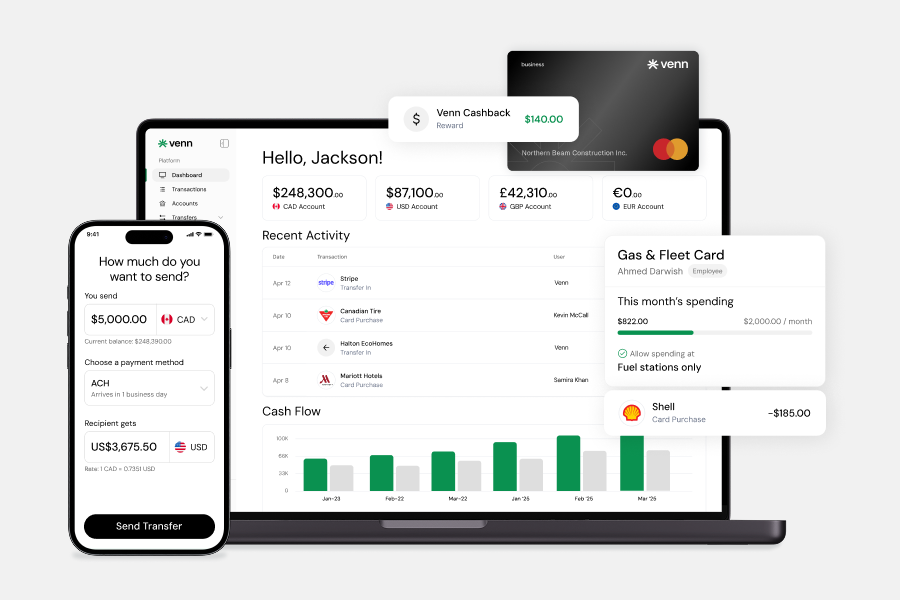
Instead of using separate invoice software and then logging into your bank to process payments, integrated platforms let you create invoices, track status, and execute payments from a single interface. This eliminates context switching and ensures real-time visibility into cash position alongside invoice status.
Canadian businesses face unique challenges with USD and international transactions that traditional banks poorly address. Modern platforms provide real Canadian bank accounts with CDIC protection, genuine US accounts with ACH send and receive capability (rare for Canadian businesses), local GBP and EUR accounts with SEPA and Faster Payments access, and the ability to invoice and receive payments in customer's currency without forced conversion.
A Canadian software company invoices a US client in USD. With a traditional Canadian bank, they'd either invoice in CAD (creating friction for the client) or receive USD into a "US account" that's actually Canadian-based, incurring $17 inbound wire fees and 2-3% FX conversion. With a platform offering real US accounts, they receive USD via ACH directly, then convert at competitive rates (0.25-0.45%) only when needed, or hold USD for US expenses.
Platforms with banking infrastructure offer free unlimited Interac e-Transfer® for smaller payments, low-cost EFT/ACH transfers ($0-2 versus traditional bank fees of $15-30), reduced wire transfer costs ($6-10 versus $15-50 at banks), and intelligent routing to the most cost-effective payment method based on amount, currency, and urgency.
Native QuickBooks and Xero integration means invoices, payments, expenses, and bank transactions all sync automatically, eliminating reconciliation work and ensuring accurate financial reporting.
By consolidating tools, businesses save on multiple subscriptions ($50-500/month per tool), reduce integration complexity and maintenance overhead, decrease processing time by eliminating platform switching, and significantly lower payment processing costs, particularly for multi-currency operations where traditional banks impose excessive fees.
Frequently Asked Questions About Invoice Automation
Q: How much does invoice automation software typically cost?
A: Pricing varies widely based on features and business size. Basic invoice automation tools start around $20–50/month for small businesses, while comprehensive AP/AR automation platforms range from $100–500+/month. Watch for per-user fees, transaction costs, and payment processing fees. Some modern business banking platforms include invoice automation as part of their overall service, potentially eliminating separate software costs. Calculate total cost of ownership including software, payment fees, FX costs, and staff time.
Q: Will invoice automation work with my existing accounting software?
A: Most invoice automation platforms integrate with popular accounting software like QuickBooks and Xero. Check for native integrations rather than third-party connectors, as these typically provide more reliable synchronization. During evaluation, verify that the integration supports bidirectional sync, automatic reconciliation, and all the data fields you need.
Q: How long does it take to implement invoice automation?
A: Implementation timelines vary based on business complexity. Small businesses with straightforward workflows can be operational in 1–2 weeks. Mid-sized businesses with complex approval hierarchies and multiple integrations typically need 4–6 weeks. The key factors are data migration, workflow configuration, team training, and testing. Most businesses can start seeing benefits within the first month.
Q: Can I automate invoices if I have international clients or vendors?
A: Yes, and automation is particularly valuable for international invoicing. Look for platforms with multi-currency support, competitive FX rates, and access to local currency accounts. For Canadian businesses, having real USD, GBP, and EUR accounts allows you to invoice international clients in their currency and receive payments without expensive cross-border fees. This is a significant advantage over traditional Canadian banks that force currency conversion with 2–3% markups.
Q: What's the difference between invoice automation and accounts payable automation?
A: Invoice automation is the broader term covering both outgoing invoices (accounts receivable) and incoming invoices (accounts payable). AP automation specifically refers to automating the processing of vendor invoices you receive and need to pay. AR automation refers to automating the invoices you send to customers. Comprehensive platforms handle both sides of invoice management.
---
**Disclaimer:** This publication is provided for general information purposes and does not constitute legal, tax or other professional advice from Venn Software Inc or its subsidiaries and its affiliates, and it is not intended as a substitute for obtaining advice from a financial advisor or any other professional. We make no representations, warranties or guarantees, whether expressed or implied, that the content in the publication is accurate, complete or up to date.

Venn is all-in-one business banking built for Canada
From free local CAD/USD accounts and team cards to the cheapest FX and global payments—Venn gives Canadian businesses everything they need to move money smarter. Join 15,000+ businesses today.
Frequently asked questions
Everything you need to know about the product and billing.
Join 15,000+ businesses banking with Venn today
Streamline your business banking and save on your spend and transfers today
No personal credit check or guarantee.