How to start a construction business in Canada 2026 Guide
How to start a construction business in Canada with a step-by-step 2026 checklist for registration, licences, insurance, CRA accounts, and a financial stack.

Ahmed Shafik
Co-founder
.png)
Trusted by 15,000+ Canadian businesses
Business banking for Canada
Local CAD and USD accounts, corporate cards with cashback, the lowest FX rates in Canada, free local transfers, and more.
Starting a construction business in Canada means navigating a complex web of registration requirements, licensing rules, insurance obligations, and financial decisions. The industry rewards those who build solid operational foundations from day one.
This guide provides a clear, step-by-step launch plan covering everything from choosing your business structure to setting up a financial stack that keeps cash flowing and books clean. Requirements vary by province, municipality, and trade specialization, so we focus on giving you a repeatable method for finding the right information rather than attempting to list every micro-rule across the country.
Whether you plan to operate as a general contractor or specialize in a regulated trade, the sequence matters. Get your registration and compliance pieces in place first, then build your financial infrastructure to support growth.
Requirements At A Glance: The Fast Checklist
Before diving into details, here is what you need to launch a construction business in Canada:
• Define your services and business model (general contractor vs specialty trade, residential vs commercial)
• Choose your business structure (sole proprietorship, partnership, or corporation)
• Register your business name and complete provincial registration
• Set up CRA accounts (Business Number, GST/HST, payroll if hiring employees)
• Obtain required licences and permits (trade certification, municipal business licence)
• Register with your provincial workers' compensation board
• Secure insurance coverage (general liability, tools/equipment, commercial auto)
• Establish business banking, corporate cards, accounting software, and invoicing systems
• Create contract templates and job documentation processes
• Implement safety protocols and training records
Step 1: Define Your Construction Niche And Business Model
Your licensing requirements, insurance costs, and financial setup all depend on what type of construction work you plan to perform.
General Contractor Vs Specialty Trade
General contractors coordinate projects and manage subcontractors, while specialty trades perform specific work like electrical, plumbing, HVAC, or gas fitting. This distinction matters significantly for licensing.
Specialty trades often require provincial certification or licensing. Electricians, plumbers, gas fitters, and HVAC technicians typically need trade certification and must work under licensed contractors in most provinces. General contractors face fewer mandatory licensing requirements in many jurisdictions, though some provinces and municipalities require registration or licensing for residential renovation work.
Check with your provincial labour ministry and trade regulator before committing to a business model. The requirements differ substantially between Ontario, British Columbia, Alberta, and other provinces.
Pricing And Estimating Basics
Construction businesses typically operate using fixed bid, time and materials, cost-plus, or maintenance contract models. Regardless of which approach you choose, accurate job costing requires tracking these categories from day one:
• Labour costs (wages, benefits, burden)
• Materials and supplies
• Equipment rental or ownership costs
• Subcontractor expenses
• Permits and fees
• Overhead allocation
• Contingency reserve
Set up these categories in your accounting system before your first job. Retrofitting proper job costing later creates significant headaches.
Step 2: Choose Your Business Structure
The choice between sole proprietorship and incorporation affects your liability exposure, tax situation, and administrative burden.
When Sole Proprietorship Can Make Sense
Starting as a sole proprietor offers simplicity. Registration costs are minimal, bookkeeping is straightforward, and you can test your business concept without significant administrative overhead. Many contractors start this way while building their client base.
When Incorporation Is Worth Considering
Incorporation creates a separate legal entity that provides liability protection. Commercial clients often prefer working with incorporated contractors, and incorporation opens tax planning opportunities that sole proprietors cannot access.
Consider incorporation if you plan to take on larger projects, work with commercial clients, or want to separate personal assets from business liability.
Decision Guide
| Factor | Sole Proprietorship | Corporation |
|---|---|---|
| Setup complexity | Low | Moderate |
| Liability protection | None | Yes |
| Tax flexibility | Limited | More options |
| Adding partners/owners | Difficult | Straightforward |
| Ongoing compliance | Minimal | Annual filings required |
Consult an accountant before deciding. The right structure depends on your specific situation, revenue expectations, and risk tolerance.
Step 3: Register Your Construction Business
Name Search And Registration
Your trade name (what customers see) may differ from your legal name (what appears on official documents). Before committing to a name, search provincial business registries and consider trademark availability.
Each province maintains its own business registry. In Ontario, use the Ontario Business Registry. In British Columbia, use BC Registry Services. Alberta uses the Alberta Corporate Registry. Complete your provincial registration before ordering business cards or marketing materials.
Federal Vs Provincial Incorporation
Most contractors incorporate provincially, which costs less and works fine if you operate in a single province. Federal incorporation makes sense if you plan to operate across multiple provinces or want stronger name protection nationally.
Recordkeeping Basics From Day One
Create a system for storing critical documents: registration certificates, insurance policies, workers' compensation account information, licences, contracts, and change orders. Cloud storage with proper backup works well for most contractors.
Step 4: Set Up CRA Accounts
Business Number And Tax Accounts
Your Business Number (BN) serves as your identifier with the Canada Revenue Agency. You can register for a BN online through the CRA Business Registration Online service. This number connects to your various tax accounts: GST/HST, payroll deductions, and corporate income tax (if incorporated).
GST/HST Registration
You must register for GST/HST once your revenue exceeds $30,000 in a single calendar quarter or over four consecutive calendar quarters. Many contractors register voluntarily before reaching this threshold to claim input tax credits on business purchases.
Verify current thresholds and rules with CRA, as requirements may change. Proper GST/HST compliance prevents costly penalties and interest charges.
Payroll Account
If you hire employees rather than subcontractors, you need a payroll account to remit source deductions (income tax, CPP, EI). Remittance frequency depends on your payroll size. Keep detailed records of all payments and deductions.
Step 5: Licences, Permits, And Trade Certification
What Is Typically Required
Construction businesses commonly need:
• Municipal business licence (requirements vary by city)
• Building permits (obtained per project, not in advance)
• Trade certification for regulated trades (electrician, plumber, gas fitter, HVAC)
• Home builder/renovator registration (required in some provinces)
How To Find The Right Requirements Fast
Use this three-step approach to identify your specific requirements:
• Check your provincial labour or consumer protection ministry website for trade licensing and contractor registration requirements
• Contact your trade regulator or provincial safety authority if you perform regulated work
• Call your municipal business licensing office to confirm local requirements
This method works regardless of which province or trade you operate in.
Bonding And Prequalification
Larger commercial projects and government contracts often require performance bonds or bid bonds. Bonding companies evaluate your financial strength, experience, and track record before issuing bonds. Build relationships with surety providers before you need bonding for a specific project.
Step 6: Insurance And Workers' Compensation
Common Policies For Contractors
Most construction businesses need:
• Commercial general liability (CGL): Protects against third-party injury and property damage claims
• Tools and equipment coverage: Covers theft, damage, or loss of your tools
• Commercial auto: Required for business vehicles
• Builder's risk: Project-specific coverage for work in progress
• Professional liability: Relevant for design-build contractors or those providing consulting services
Insurance requirements vary by client and project. Commercial clients typically require $2 million or $5 million in CGL coverage and want to be named as additional insureds.
Workers' Compensation Registration
Each province operates its own workers' compensation system. In Ontario, register with the Workplace Safety and Insurance Board (WSIB). Other provinces have Workers' Compensation Boards (WCB) with different names and requirements.
Registration is mandatory for most construction businesses. Coverage rules vary for business owners, employees, and subcontractors. Some provinces require clearance certificates proving your account is in good standing before you can work on certain projects.
Proof-Of-Insurance Pack
Prepare these documents for client requests:
• Certificate of insurance showing coverage types and limits
• Additional insured endorsements
• Workers' compensation clearance certificate
• Professional liability certificate (if applicable)
Step 7: Build Your Construction Financial Stack
The Goal: Clean Books, Controlled Spend, And Faster Payments
Construction businesses live and die by cash flow. You need visibility into job costs, control over spending, and efficient payment processing for both receivables and payables.
A modern construction financial stack includes:
• Business banking with separate accounts for operations and tax reserves
• Corporate cards with spending controls and receipt capture
• Accounting software configured for job costing
• Invoicing and payment collection tools
• Payroll processing (if you have employees)
Business Banking And Spending With Venn
Setting up dedicated business accounts separates your personal and business finances, simplifies tax preparation, and presents a professional image to clients and suppliers.
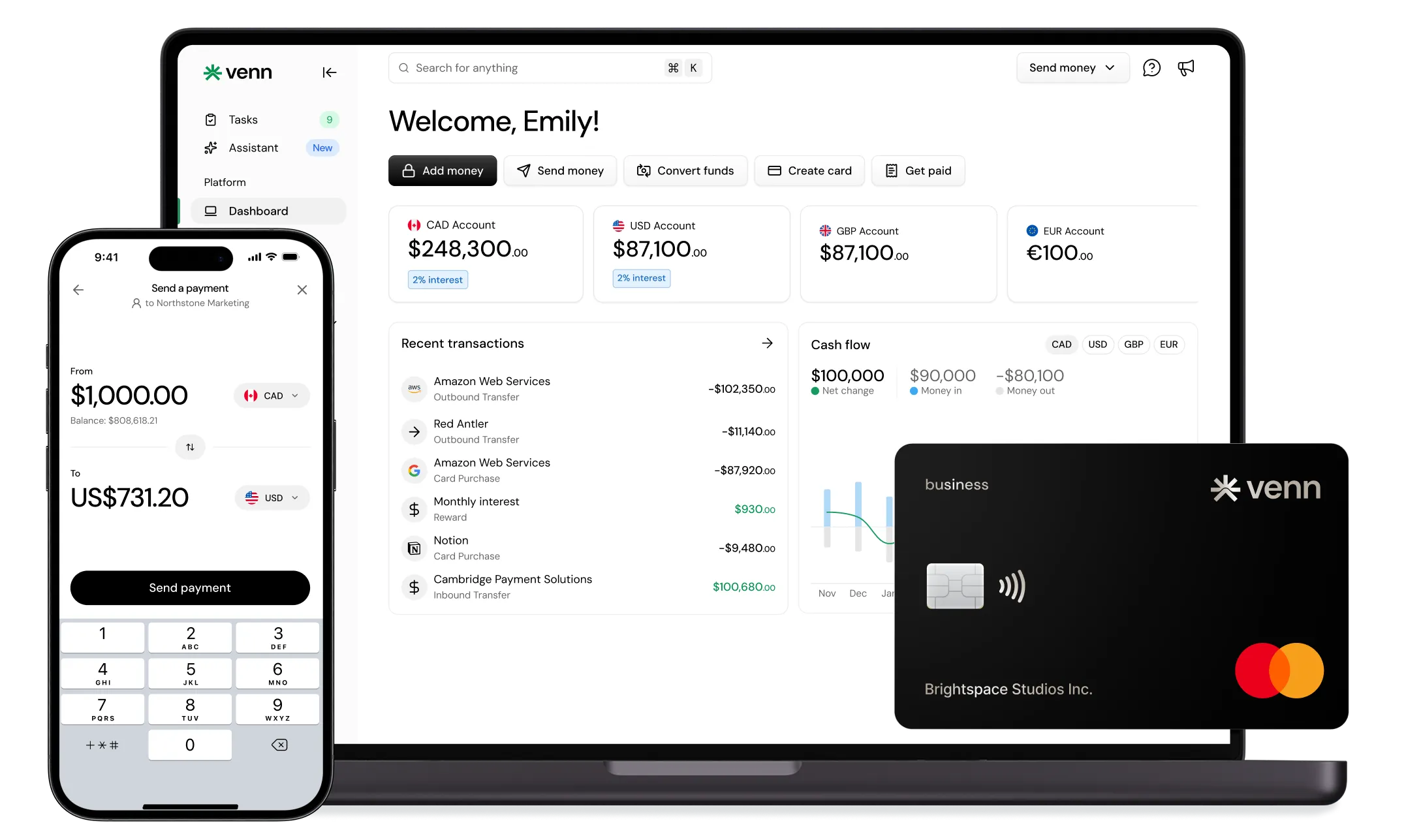
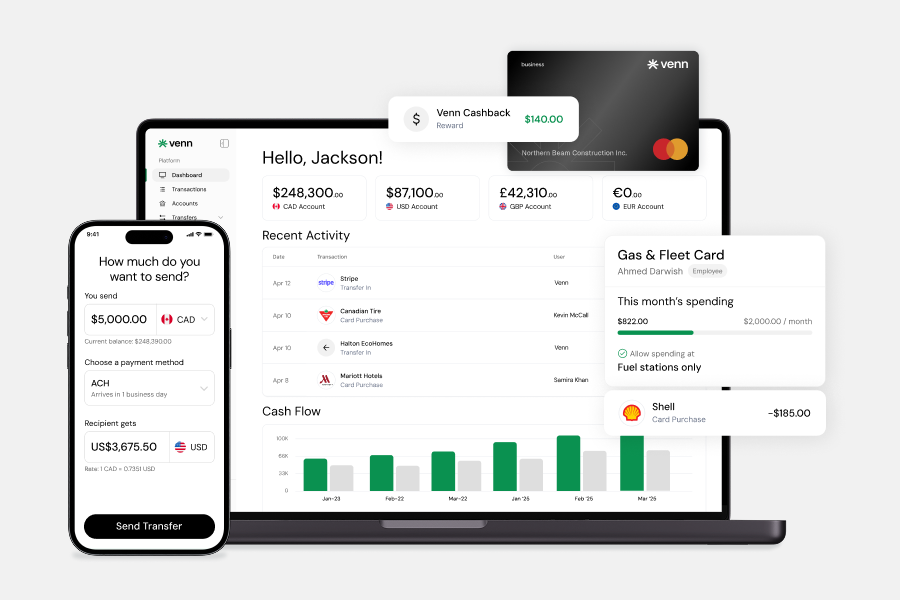
Venn business account page provides CAD and USD accounts that work well for contractors who purchase materials or tools from US suppliers. Keeping separate accounts for different purposes, such as operations and HST reserves, helps prevent cash flow surprises.
The Venn corporate card offers 1% cashback on purchases, which adds up quickly when you are buying fuel, materials, tools, and software subscriptions. Spending controls help prevent unauthorized purchases, while built-in expense management reduces the time spent chasing receipts at month-end.
For contractors working with bookkeepers or accountants, QuickBooks and Xero keep transactions flowing into your accounting system automatically. This compatibility supports cleaner job costing and faster reconciliation.
Funds held through Venn are covered under CDIC insurance protection, providing security for your business deposits.
| Capability | Venn | Traditional Banks | Expense Tools Only |
|---|---|---|---|
| Business banking + spend controls | Yes | Yes | No |
| CAD and USD accounts | Yes | Varies | Sometimes |
| Cashback on card spend | 1% | Often limited | Varies |
| QuickBooks/Xero compatibility | Yes | Limited | Varies |
| Interac e-Transfer® | Available | Available | Often not primary focus |
Multi-Currency And Cross-Border Purchasing
Many Canadian contractors buy tools, equipment parts, or software from US suppliers. Converting CAD to USD for every purchase adds friction and cost.
Venn FX and multi-currency accounts let you hold and pay from USD directly, reducing conversion frequency. This approach works well for regular US purchases or SaaS subscriptions billed in American dollars.
How To Get Paid And Pay Suppliers
Standardize your payment methods to reduce administrative overhead:
• Use EFT for regular supplier payments
• Use Interac e-Transfer® for fast local transfers to subcontractors or suppliers
• Accept EFT or Interac e-Transfer® from clients for faster collection
Create a simple payables policy covering approval requirements, purchase documentation, and receipt capture rules. Consistent processes prevent disputes and support cleaner books.
Step 8: Contracts, Invoicing, And Change Orders
Must-Have Documents
Written contracts protect your cash flow and reduce disputes. Every project should include:
• Clear scope of work with specifications
• Payment schedule and deposit requirements
• Change order process and pricing
• Warranty terms and deficiency resolution process
• Dispute resolution mechanism
Invoicing Basics That Reduce Disputes
Effective invoices include line-item detail, proper tax handling, clear due dates, and late payment terms where permitted. For larger projects, address holdback/retainage requirements in your contract and invoice accordingly.
Send invoices promptly after completing work or reaching milestones. Delayed invoicing leads to delayed payment.
Step 9: Hiring Employees Vs Subcontractors
Classification Basics
The distinction between employees and subcontractors affects tax obligations, workers' compensation, and legal liability. CRA examines factors like control, ownership of tools, chance of profit/risk of loss, and integration into your business.
Misclassification creates significant liability. Consult an accountant or employment lawyer before establishing your workforce model.
Payment Workflow Recommendations
For subcontractors, tie payments to milestones and require proof of work completion. Understand provincial construction lien legislation, as holdback requirements vary by province.
For employees, establish a regular payroll schedule and maintain proper records of hours, wages, and deductions.
Step 10: Safety And Compliance Basics
Minimum Safety Habits For New Construction Businesses
Build these practices into your operations from day one:
• Conduct regular toolbox talks before starting work
• Maintain an incident log for all workplace injuries or near-misses
• Provide and require appropriate personal protective equipment
• Keep training records for all workers
• Document site-specific hazards and controls
Some projects require formal safety programs, certifications like COR (Certificate of Recognition), or specific training credentials. Check requirements before bidding on larger commercial or industrial work.
Cost And Timeline: What It Usually Takes To Launch
Typical Cost Categories
Expect to budget for:
• Registration fees: $60 to $500 depending on structure and province
• Insurance: $2,000 to $10,000+ annually depending on coverage and trade
• Workers' compensation: Varies by province and classification
• Tools and equipment: Highly variable based on trade
• Vehicle: $20,000 to $60,000 for a work truck
• Software and subscriptions: $100 to $500 monthly
• Professional fees (accountant, lawyer): $1,000 to $5,000 for initial setup
Realistic Timeline
The fastest possible launch, assuming you have all documentation ready, takes two to four weeks. A more realistic timeline, accounting for insurance quotes, workers' compensation registration, and municipal licensing, runs six to twelve weeks.
Do not rush the compliance pieces. Operating without proper insurance or workers' compensation coverage creates serious liability exposure.
Conclusion
Starting a construction business in Canada requires careful attention to registration, licensing, insurance, and financial infrastructure. The sequence matters: get your legal and compliance foundation in place before taking on projects.
Build repeatable systems for documentation, safety, and financial management. These systems scale with your business and prevent the chaos that derails many growing contractors.
Ready to set up your construction business financial stack? Sign up for a Venn account to establish dedicated business banking, simplify expense management, and streamline payments as you grow your contracting business.
FAQ
Q: Do I need a licence to start a construction business in Canada?
A: Requirements vary by province and trade. General contractors face fewer mandatory licensing requirements in most provinces, though some jurisdictions require home builder or renovator registration. Regulated trades like electrical, plumbing, and gas fitting typically require provincial certification. Check with your provincial labour ministry and municipal business licensing office for specific requirements.
Q: Should I incorporate my contracting business in Canada?
A: Incorporation provides liability protection and tax planning opportunities but adds administrative complexity and cost. Sole proprietorship works for testing your business concept with minimal overhead. Consult an accountant to evaluate your specific situation, revenue expectations, and risk tolerance before deciding.
Q: What insurance do I need as a contractor?
A: Most contractors need commercial general liability, tools/equipment coverage, and commercial auto insurance at minimum. Builder's risk coverage applies to specific projects. Coverage requirements vary by client and project type. Commercial clients typically require $2 million or more in general liability coverage.
Q: Do I need to register for GST/HST right away?
A: Registration becomes mandatory when your revenue exceeds $30,000 in a single quarter or over four consecutive quarters. Many contractors register voluntarily before reaching this threshold to claim input tax credits. Verify current thresholds with the CRA, as requirements may change.
Q: How do I pay subcontractors efficiently?
A: Tie payments to clear milestones with documented proof of work completion. Use consistent payment methods like EFT or Interac e-Transfer® for predictable processing. Understand your provincial construction lien legislation and holdback requirements. Maintain written subcontractor agreements covering scope, payment terms, and insurance requirements.
Q: What is the easiest way to keep construction business finances organized?
A: Separate business and personal finances completely using dedicated business accounts. Set up job costing categories in your accounting software from day one. Use a corporate card with expense capture to reduce receipt chasing. Integrate your banking with QuickBooks or Xero for automatic transaction flow. Venn provides this integrated approach with business banking, corporate cards, and accounting software compatibility in one platform.
---
**Disclaimer:** This publication is provided for general information purposes and does not constitute legal, tax or other professional advice from Venn Software Inc or its subsidiaries and its affiliates, and it is not intended as a substitute for obtaining advice from a financial advisor or any other professional. We make no representations, warranties or guarantees, whether expressed or implied, that the content in the publication is accurate, complete or up to date.
This publication is provided for general information purposes only and does not constitute legal, tax, financial, or other professional advice from Venn Software Inc., its subsidiaries, or its affiliates, and is not a substitute for advice from a qualified professional. All comparisons and competitor information reflect publicly available information believed accurate as of May 26, 2026; features, pricing, rates, and terms referenced are subject to change and may differ at the time you read this. All product names, logos, and brands referenced are the property of their respective owners; their mention does not imply affiliation with or endorsement by Venn. Any comparative statements reflect Venn's views and are provided to help readers evaluate options. We make no representations, warranties, or guarantees, express or implied, that the content is accurate, complete, or up to date.

Venn is all-in-one business banking built for Canada
From free local CAD/USD accounts and team cards to the cheapest FX and global payments—Venn gives Canadian businesses everything they need to move money smarter. Join 15,000+ businesses today.
Frequently asked questions
Everything you need to know about the product and billing.
Join 15,000+ businesses banking with Venn today
Streamline your business banking and save on your spend and transfers today
No personal credit check or guarantee.