Best Finance and Accounting Software for Canadian Construction Companies
Discover the best finance and accounting software for construction businesses in Canada. Compare features, compliance, and tools contractors actually use.

.png)
Trusted by 15,000+ Canadian businesses
Business banking for Canada
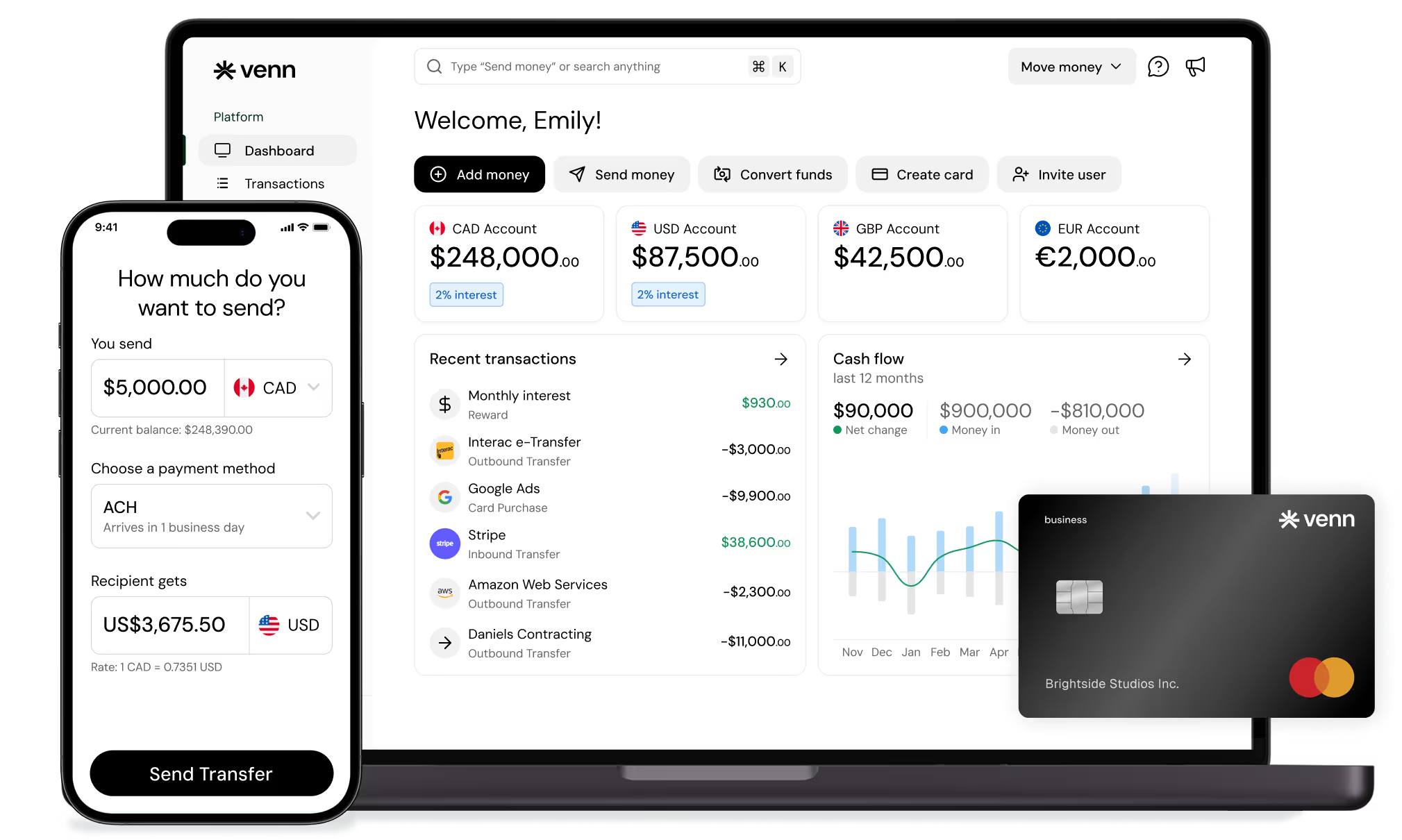
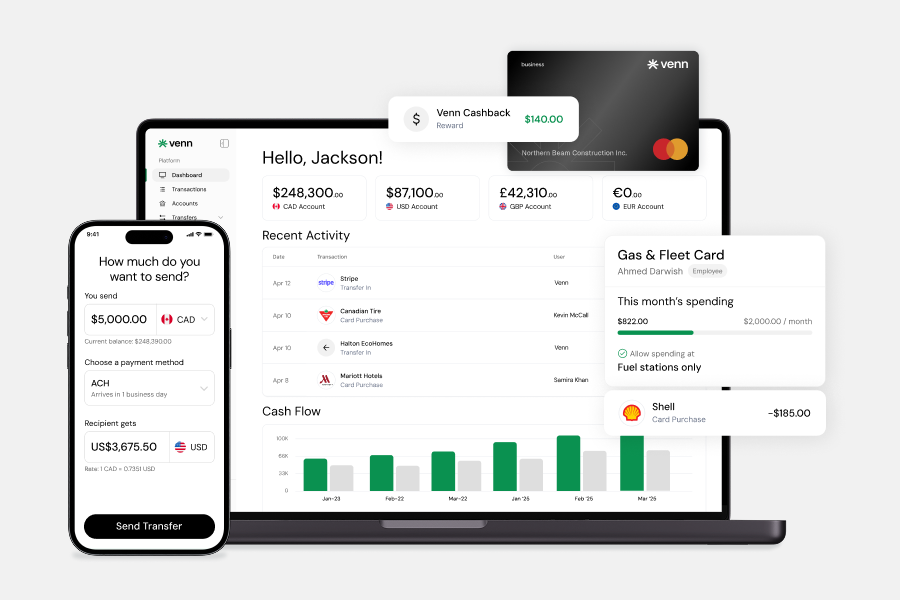
Local CAD and USD accounts, corporate cards with cashback, the lowest FX rates in Canada, free local transfers, and more.
Best Finance & Accounting Software for Construction Businesses in Canada (Tools Contractors Actually Use)
Managing finances for a construction business isn't like running a retail store or consulting firm. You're juggling multiple projects, tracking costs across labor, materials, and subcontractors, managing holdbacks, dealing with progress billing, and navigating Canadian tax requirements like GST/HST on partial invoices and T5018 reporting.
Generic accounting software like basic QuickBooks or FreshBooks falls short because it can't handle job costing, retainage, or construction-specific workflows. But even specialized construction accounting software leaves gaps in banking, payments, and cash flow management.
This guide delivers:
• Comprehensive reviews of the top construction accounting platforms Canadian contractors actually use
• Clear guidance on essential features for Canadian compliance
• Honest assessment of pricing (in CAD where available)
• How modern banking infrastructure complements your accounting software
• Decision framework based on business size and complexity
Why Construction Accounting Is Different
Construction businesses face unique financial challenges that generic accounting software simply can't handle. Here's why you need specialized tools.
Job-Based Financial Tracking
Unlike businesses that track overall profitability, contractors need to know whether each individual project is making or losing money. This requires tracking every dollar of labor, materials, equipment, and overhead against specific jobs or phases.
Progress Billing & Retainage (Holdbacks)
Construction projects use unique invoicing methods. You might bill based on percentage of completion, completed milestones, or AIA-style applications for payment. Plus, in Canada, holdback requirements (typically 10% withheld until project completion) add another layer of complexity.
Complex Cost Structures
A single project involves direct costs (labor, materials, equipment), indirect costs (overhead allocation), subcontractor management, and change orders. You need software that tracks all these categories and allocates them correctly.
Canadian Compliance Requirements
• GST/HST on Progress Billings: Tax must be calculated correctly on partial invoices
• T5018 Reporting: Statement of Contract Payments for construction services
• Provincial Variations: Different PST rules in BC, Saskatchewan, Manitoba; QST in Quebec
• Holdback Tracking: Compliance with provincial Construction Lien Acts
Cash Flow Challenges
Long payment cycles (30-90 days), holdbacks that can take months to release, and upfront material costs create constant cash flow pressure. You need visibility into receivables, payables, and WIP (work in progress).
Multi-Project Management
Most contractors run several projects simultaneously. You need to track profitability, resource allocation, and cash flow across all jobs while maintaining project-level detail.
Change Order Management
Scope changes are inevitable in construction. Your software needs to document, approve, and bill these changes while maintaining budget integrity.
These unique requirements demand purpose-built software solutions. But accounting software is only part of the equation. Let's look at what features matter most.
What to Look for in Construction Accounting Software
Not all construction accounting software is created equal, especially for Canadian contractors. Here are the essential features and nice-to-haves that separate basic tools from comprehensive solutions.
Essential Features:
1. Job Costing
Real-time tracking of labor, materials, equipment, and overhead by project and phase. The ability to compare actual costs against estimates and budgets. This is non-negotiable for profitable contracting.
2. Progress Billing
Support for multiple billing methods: AIA-style applications, percentage-of-completion, milestone billing, time and materials. Must handle retainage/holdback calculations automatically.
3. Retainage/Holdback Management
Automated tracking of withheld amounts, aging reports for holdbacks, and easy release processing when projects are completed and lien periods expire.
4. Subcontractor Management
Track subcontractor contracts, progress payments, lien waivers, and compliance documents. Integration with accounts payable for seamless payment processing.
5. Purchase Order Management
Create and track POs to control costs before they're incurred. Compare PO amounts against budgets and actual invoices.
6. Change Order Tracking
Document scope changes, route for approval, update budgets, and bill clients accordingly. Maintain audit trail for disputes.
7. Equipment Cost Tracking
Allocate owned or rented equipment expenses to specific jobs. Track utilization and calculate true project costs.
8. Canadian Tax Compliance
• GST/HST calculation on progress billings
• T5018 reporting for contract payments
• Provincial tax handling (PST, QST)
• Holdback compliance tracking
9. Reporting & Analytics
• Job profitability reports
• Work-in-progress (WIP) reports
• Cash flow forecasting
• Budget vs. actual comparisons
• Over/under billing analysis
10. Integration Capabilities
Connect with banking, payroll, project management tools, and modern payment platforms. Data should flow seamlessly between systems.
Top Finance & Accounting Software for Construction Businesses in Canada
We've analyzed the most popular construction accounting platforms based on features, Canadian compliance, pricing, and real contractor feedback. Each solution serves different business sizes and needs. Here's what you need to know. We also cover this in our 2026 Construction Business Banking Guide, you can read that and learn more here.
1. Sage 300 Construction and Real Estate (CRE)
Overview: Industry-standard ERP solution designed specifically for mid-to-large construction and real estate contractors. Offers comprehensive project and financial management with deep construction-specific functionality.
Best For: Mid-sized to large contractors ($5M+ annual revenue) managing complex commercial projects who need enterprise-grade features and can invest in implementation and training.
Key Features:
• Advanced job costing with unlimited cost codes and phases
• Comprehensive progress billing (AIA, unit price, time & materials)
• Robust retainage and holdback management
• Subcontractor compliance and lien waiver tracking
• Equipment cost allocation and maintenance scheduling
• Multi-company and multi-currency support
• Strong Canadian payroll with tax updates for 2025
• Detailed WIP and over/under billing reports
Canadian-Specific Considerations:
Sage provides regular Canadian payroll tax updates, with the 2025 update now available. The system handles GST/HST on progress billings and supports T5018 reporting requirements. Strong support network across Canada.
Pricing:
Cloud deployment typically costs around CAD $1,000/month for a 5-user system, scaling to CAD $3,500/month for 20 users. Pricing varies widely based on users, modules, and customization, typically ranging from $200 to $1,500+ per month. Implementation costs are additional.
Pros:
• Purpose-built for construction with 40+ years of industry expertise
• Comprehensive feature set covers entire project lifecycle
• Strong reporting and analytics capabilities
• Excellent Canadian compliance features
• Integrates with major project management tools (Procore, Autodesk)
Cons:
• Steep learning curve and complex for smaller businesses
• Speed issues reported, with some reports taking several minutes to run; UI feels dated
• Higher total cost of ownership including implementation and training
• May be over-featured for simple residential or small commercial work
Integration Capabilities:
Integrates with Procore, Autodesk Construction Cloud, Bluebeam, Microsoft Office, and various payroll systems.
2. QuickBooks Online Plus/Advanced (with Project Tracking)
Overview: The most popular accounting software for small businesses, with construction-specific features available in Plus and Advanced plans. Cloud-based with extensive third-party integrations.
Best For: Small contractors (under $2M revenue) and residential builders who need solid accounting with basic job costing. Ideal for businesses already familiar with QuickBooks or looking for affordability and ease of use.
Key Features:
• Project tracking and job costing by customer/project
• Basic progress invoicing capabilities
• Expense tracking by project
• Time tracking integration (QuickBooks Time)
• Inventory management (Plus and above)
• Multi-currency support
• Canadian GST/HST compliance
• Integration with 300+ apps
Canadian-Specific Considerations:
QuickBooks Online Plus starts at $80 CAD per month or $860 CAD per year. Fully supports Canadian tax requirements including GST/HST. QuickBooks Payroll available as add-on for Canadian payroll compliance.
Pricing:
• Plus: $80 CAD/month (monthly) or $860 CAD/year (annual)
• Advanced: Starts at US$235/month (~$320 CAD/month)
• Frequent promotional discounts (50-75% off first 3-6 months)
• Payroll is additional ($40-100 CAD/month depending on plan)
Pros:
• Most affordable option for small contractors
• Intuitive interface with minimal learning curve
• Extensive app marketplace for specialized construction tools
• Strong Canadian support and resources
• Accountant-friendly (most bookkeepers know QuickBooks)
Cons:
• Limited construction-specific features compared to specialized software
• Job costing less robust than dedicated construction platforms
• No native retainage/holdback management
• Reporting capabilities limited without third-party tools
• Project tracking works best for straightforward jobs
Integration Capabilities:
Connects with Buildertrend, Method:CRM, TSheets, Stripe, PayPal, and hundreds of other apps. Can integrate with Venn for enhanced banking and payment capabilities.
3. Foundation Software
Overview: Purpose-built construction accounting software with 40+ years serving the industry. Offers modular approach allowing contractors to pay only for features they need.
Best For: Small to mid-sized contractors ($1M-$50M revenue) who want construction-specific features without enterprise complexity. Particularly strong for contractors focused on detailed job costing and financial control.
Key Features:
• Advanced job costing that tracks every dollar, hour, and quantity in real time with customizable reports on cash flows and work-in-progress
• Automated alerts to prevent cost overruns; formatted billing for AIA, unit price, and time & material billing
• Payroll module handles complex construction scenarios like prevailing wages and union requirements
• Purchase order and subcontract management
• Equipment and inventory tracking
• Document management integration
• Mobile field apps for time and expense capture
Canadian-Specific Considerations:
While Foundation is US-based, it serves Canadian contractors and handles multi-currency. Verify Canadian payroll and tax compliance with your implementation partner.
Pricing:
Pricing starts at $500 monthly. Foundation uses customizable pricing based on modules selected rather than standard pricing. Users report pricing "right in the middle of the market" compared to alternatives.
Pros:
• 83% of users find the interface simple and easy to use; 74% praise accounting functionalities
• 93% of users report timely customer support responses
• Modular approach means you only pay for what you need
• Strong job costing and financial reporting
• Can scale with your business by adding modules
Cons:
• 72% of users report difficulty fixing software glitches; 58% mention formatting issues when exporting reports to Excel
• 90% of users note mobile functionality issues with payroll, time tracking, and reporting
• Implementation required (not self-serve)
• Pricing not transparent (requires quote)
Integration Capabilities:
Integrates with Payroll4Construction, various time tracking systems, and document management tools. API available for custom integrations.
4. Procore (Financial Management Module)
Overview: Cloud-based construction project management platform with robust financial management capabilities. Best when you need both project management and financial tools in one ecosystem.
Best For: Mid-to-large contractors ($10M+ revenue) already using Procore for project management, or those wanting seamless integration between field operations and financial management.
Key Features:
• Budget tracking with real-time cost updates from the field
• Change event and change order management
• Commitment management (subcontracts and purchase orders)
• Real-time forecasting, division insights, and budget tracking
• Invoice management and payment applications
• Integration with major ERP systems (Sage 300, CMiC, Foundation)
• Unlimited users included in pricing
Canadian-Specific Considerations:
Procore serves Canadian contractors and supports multi-currency. However, verify integration with Canadian payroll systems and tax compliance features.
Pricing:
Procore charges an upfront annual fee based on Annual Construction Volume (ACV) with unlimited users, customer support, and data storage included. Plans start around $375 per month, but costs can reach tens of thousands annually for large contractors. A contractor with $4M annual revenue was quoted $500 monthly for project management plus $300-$500 monthly for financial module, totaling $6,000-$12,000 annually.
Pros:
• Seamless integration between project management and financials
• Real-time visibility from field to office
• Unlimited users (cost scales with project volume, not users)
• Strong mobile capabilities for field teams
• Excellent for large, complex projects
Cons:
• Premium pricing puts it out of reach for smaller contractors
• Breadth of features creates learning curve; training usually required
• Best value realized when using full Procore ecosystem
• Users report hidden fees for implementation, data storage, and premium support
• Overkill for simple residential or small commercial work
Integration Capabilities:
Integrates with Sage 300, CMiC, and other ERP systems. Connects with scheduling tools, document management, and various construction apps.
5. Jonas Construction Software
Overview: Canadian-developed comprehensive ERP solution for construction and service contractors. Particularly strong for mechanical, electrical, plumbing, and HVAC contractors.
Best For: Mid-sized Canadian contractors (20-200 employees) in specialty trades who need integrated construction, service, and accounting capabilities. Excellent for companies with both project and service work.
Key Features:
• Modules include dispatch and job scheduling, accounting, job costing, invoicing, payroll, and reporting
• Service dispatch and work order management
• Equipment tracking and maintenance
• Granular reporting that tracks job levels and financials; drill into details for consolidated multi-company reports
• Canadian payroll fully integrated
• Mobile field solutions
• Project management with document control
Canadian-Specific Considerations:
Jonas Construction is based in Ontario, Canada, and built specifically for Canadian contractors. Full Canadian payroll, GST/HST compliance, and T5018 reporting built-in. Strong Canadian support network.
Pricing:
Pricing starts at $249 CAD per user, monthly. Implementation starts around $20,000 with subscription costs averaging $200+ per user annually. Total cost depends on modules selected and number of users.
Pros:
• 85% of users mention its usability and functionality as intuitive and accessible
• 64% of users praise fast support response times
• Built by Canadians for Canadian contractors
• Excellent for companies with both construction and service work
• Strong integration between all modules
Cons:
• Some users find it less user-friendly than Sage 50 for accounting; what takes 1 click in Sage takes 3 in Jonas
• Significant upfront investment for implementation
• Better suited for specialty trades than general contractors
• Requires internet connection for field functionality
Integration Capabilities:
Integrates with various time tracking, document management, and mobile field solutions. Over 34 technology partners including Microsoft and IBM.
6. Buildertrend
Overview: Cloud-based construction project management software with integrated financial tools. Designed specifically for residential contractors and remodelers.
Best For: Residential builders, remodelers, and custom home contractors who need client communication tools alongside project and financial management.
Key Features:
• Project scheduling and task management
• Client portal for communication and selections
• Integrated financial management and job costing
• Change order management
• Photo and document storage
• Daily logs and time tracking
• Bid management
• Purchase order tracking
Canadian-Specific Considerations:
Buildertrend serves Canadian contractors but verify Canadian payroll integration and tax compliance features. Multi-currency support available.
Pricing:
Pricing varies based on annual construction volume and features needed. Typically ranges from $299-$799 USD/month. Contact for Canadian pricing.
Pros:
• Excellent client communication and portal features
• User-friendly interface with minimal learning curve
• Strong mobile app for field and client use
• All-in-one solution for residential contractors
• Good integration with QuickBooks
Cons:
• Less robust for commercial or large-scale projects
• Financial features not as deep as dedicated construction accounting software
• Limited customization for complex workflows
• Best suited for residential work
Integration Capabilities:
Integrates with QuickBooks, various accounting platforms, and numerous construction-specific apps.
7. FreshBooks (with Construction Features)
Overview: Simple, cloud-based accounting software with basic project tracking. Originally designed for freelancers and service businesses, now offers construction-specific features.
Best For: Very small contractors (1-5 employees), sole proprietors, and trades working on straightforward projects who need affordable, easy-to-use accounting.
Key Features:
• Professional invoicing with online payments
• Expense tracking and receipt capture
• Basic time tracking by project
• Simple project budgeting
• Canadian GST/HST compliance
• Mobile app for on-the-go management
• Client portal
Canadian-Specific Considerations:
FreshBooks is a Canadian company based in Toronto. Fully supports Canadian tax requirements and offers Canadian dollar pricing.
Pricing:
Plans range from $19-$60 CAD/month depending on features and number of billable clients. 30-day free trial available.
Pros:
• Most affordable option on this list
• Extremely easy to use with minimal training
• Great for simple invoicing and expense tracking
• Canadian company with excellent local support
• Fast setup and implementation
Cons:
• Very limited job costing capabilities
• No retainage/holdback management
• Not suitable for multiple simultaneous projects
• Lacks construction-specific features like AIA billing
• No equipment or subcontractor management
Integration Capabilities:
Integrates with various payment processors, time tracking tools, and basic business apps. Limited construction-specific integrations.
Comparison Table
| Software | Best For | Starting Price (CAD) | Job Costing | Canadian Compliance | Learning Curve |
|---|---|---|---|---|---|
| Sage 300 CRE | Mid-large contractors, complex projects | $1,000–3,500/month | Advanced | Excellent | Steep |
| QuickBooks Online Plus | Small contractors, residential | $80/month | Basic | Good | Easy |
| Foundation Software | Small-mid contractors, job costing focus | $500/month | Advanced | Good (verify) | Moderate |
| Procore Financial | Large contractors, complex projects | $6,000–12,000/year | Advanced | Good (verify) | Steep |
| Jonas Construction | Mid-sized Canadian specialty trades | $249/user/month | Advanced | Excellent | Moderate |
| Buildertrend | Residential builders, remodelers | $400–1,000/month | Moderate | Good (verify) | Easy |
| FreshBooks | Very small contractors, sole proprietors | $19–60/month | Basic | Excellent | Very Easy |
The Missing Piece: Modern Banking Infrastructure for Construction Businesses
Here's what most construction accounting software comparisons won't tell you: even the best construction accounting platform can't solve all your financial challenges. Why? Because accounting software and banking infrastructure serve different but equally critical functions.
The Banking Gap:
Your construction accounting software excels at job costing, progress billing, and project profitability. But what happens when you need to:
• Pay US suppliers or subcontractors without losing 2-3% to bank FX fees?
• Receive payments from clients faster than the standard 3-5 business days?
• Send free Interac e-Transfers® to subcontractors without hitting your bank's limits?
• Access your cash to pay urgent invoices while waiting for client payments?
This is where traditional bank accounts and even most construction software fall short.
What Construction Businesses Actually Need:
1. Real Multi-Currency Accounts
If you're working with US clients or suppliers, you need actual USD accounts, not just currency conversion. With Venn, Canadian construction businesses get real local US accounts that can send and receive ACH payments. This means when a US client pays you, there's no $17 wire fee and no 2-3% FX markup eating into your margins. You can hold USD, pay US suppliers directly, and only convert to CAD when rates are favorable.
2. Unlimited Free Transfers
Construction businesses make dozens of payments weekly: subcontractors, suppliers, equipment rentals. Venn offers unlimited free Interac e-Transfers® on all plans (the only fintech in Canada to do so), plus low-cost EFT and wire transfers. Compare this to traditional banks that charge $1-3 per e-Transfer after your monthly limit, plus $10-30 for wire transfers.
3. Lowest FX Rates in Canada
When you do need to convert currency, Venn's FX rates (0.25%-0.45% depending on plan) are significantly lower than traditional banks (1.5%-3%). On a $100,000 USD payment, that's the difference between paying $250-450 in FX fees versus $1,500-3,000 at your bank. That's $1,250-2,750 back in your pocket per transaction.
4. Fast Payment Processing
Cash flow is critical in construction. Venn processes outbound wires in 1-2 days (compared to Plooto's 3-5 days), and recipients receive payments same or next business day. You receive wires for free, compared to $15-25 at traditional banks.
5. Seamless Accounting Integration
Venn integrates directly with QuickBooks and Xero, automatically syncing transactions to your accounting software. This eliminates duplicate data entry and ensures your job costing stays accurate. You can also automate payables directly from your accounting system.
6. Better Cash Flow Management
Venn offers 2.75% interest on CAD balances and up to 3.5% interest on USD balances (no minimums required) (learn more), turning your operating cash into an income source while you wait for client payments. Plus, earn 1% unlimited cash back on business spending with the Venn card.
How It Works Together:
Think of it this way: Your construction accounting software (Sage 300, QuickBooks, Foundation, etc.) is your financial command center, tracking job costs, profitability, and project performance. Venn is your financial infrastructure, handling the actual movement of money in and out of your business efficiently and cost-effectively.
For example:
• You invoice a US client for $50,000 USD using your construction accounting software
• Client pays into your Venn USD account (no conversion, no wire fees)
• You pay US suppliers $30,000 USD directly via ACH (no FX fees)
• You convert the remaining $20,000 USD to CAD at 0.35% FX rate when favorable
• All transactions automatically sync to QuickBooks for job costing
• You earn 2.75% interest on CAD balances and up to 3.5% interest on USD balances while waiting for next payment (learn more)
The Result: You've saved approximately $1,000-1,500 in FX and banking fees on a single project, while maintaining accurate job costing in your construction accounting software.
Now that you understand both the accounting software landscape and the importance of modern banking infrastructure, let's help you choose the right combination for your business.
How to Choose the Right Construction Accounting Software for Your Business
The "best" construction accounting software depends entirely on your business size, project complexity, and growth plans. Here's a practical decision framework.
By Business Size & Revenue:
Very Small Contractors (Under $500K revenue)
• Start with FreshBooks or QuickBooks Online Plus
• Focus on basic invoicing, expense tracking, and simple project tracking
• Upgrade when you need detailed job costing
Small Contractors ($500K-$2M revenue)
• QuickBooks Online Plus/Advanced with construction add-ons
• Consider Buildertrend for residential work
• Foundation Software if job costing is critical
Mid-Sized Contractors ($2M-$10M revenue)
• Foundation Software or Jonas Construction for specialty trades
• Sage 300 CRE if managing complex commercial projects
• Procore if you need integrated project management
Large Contractors ($10M+ revenue)
• Sage 300 CRE for comprehensive ERP functionality
• Procore for integrated project and financial management
• Custom solutions may be worth considering
Making Construction Accounting Work Better
Choosing the right construction accounting software is just the first step. Success depends on proper implementation, training, and ongoing optimization. Here's how to maximize your investment:
Best Practices for Implementation:
Start with Clean Data
Before migrating to new software, clean up your existing data. Reconcile all accounts, close completed projects, and standardize your cost codes. This prevents carrying forward problems into your new system.
Standardize Your Processes
Create consistent workflows for common tasks like invoice approval, change order processing, and subcontractor payments. Document these processes before implementation to ensure everyone follows the same procedures.
Train Your Team Properly
Budget time and money for comprehensive training. Your software is only as good as the people using it. Consider appointing power users who can train others and troubleshoot issues.
Phase Your Rollout
Don't try to implement every feature at once. Start with core functionality like job costing and invoicing, then add advanced features like equipment tracking or inventory management once basics are mastered.
Common Pitfalls to Avoid:
Underestimating Setup Time
Construction accounting software requires significant setup: cost codes, job templates, tax rules, user permissions. Plan for this taking weeks, not days.
Ignoring Integration Needs
Your accounting software needs to connect with banking, payroll, and project management tools. Plan integrations from the start rather than retrofitting later.
Skipping Regular Reviews
Schedule monthly reviews of your setup and processes. Are cost codes still relevant? Do approval workflows still make sense? Regular optimization keeps your system efficient.
Neglecting Reporting
The best construction accounting software provides powerful reporting, but only if you use it. Set up dashboards for key metrics and review them weekly.
Maximizing ROI:
To get the most from your construction accounting software:
• Automate Repetitive Tasks: Use recurring invoices, automated payment reminders, and scheduled reports
• Enforce Data Entry Standards: Consistent, timely data entry ensures accurate job costing
• Use Mobile Features: Capture field data in real-time to improve accuracy and reduce admin work
• Monitor Key Metrics: Track job profitability, cash flow, and WIP weekly, not monthly
• Integrate Banking Operations: Connect with modern banking platforms to streamline payments and reduce fees
The Future of Construction Finance Management
The construction industry is rapidly evolving, and so are the tools contractors use to manage their finances. Here's what's coming:
AI and Automation
Artificial intelligence will increasingly handle routine tasks like invoice coding, anomaly detection, and cash flow forecasting. This frees your team to focus on strategic decisions rather than data entry.
Real-Time Everything
The days of waiting for month-end reports are ending. Modern systems provide real-time visibility into job costs, cash positions, and project profitability. This enables faster decision-making and problem-solving.
Seamless Integration
The future isn't about one all-encompassing system, but rather best-in-class tools that work together seamlessly. Your accounting software, banking platform, project management system, and field apps will function as one integrated ecosystem.
Mobile-First Design
As more work happens in the field, software designed for desktop use becomes a limitation. Future platforms will be built mobile-first, with full functionality available on phones and tablets. From the Venn app, contractors can check available funds, send transfers, and issue new cards right from their phone.
Embedded Financial Services
Banking, payments, and financing will be embedded directly into construction software. Instead of switching between systems, you'll access all financial services from one platform.
This evolution makes choosing flexible, modern solutions more important than ever. Look for software that embraces open APIs, regular updates, and integration with innovative financial platforms.
Frequently Asked Questions:
Q: What’s the best accounting software for construction companies in Canada?
A: QuickBooks Online and Xero are the most widely used accounting platforms among Canadian construction companies because they support job costing, progress billing, subcontractor management, payroll integration, and CRA tax compliance. For larger firms, Sage 300 Construction & Real Estate offers more advanced capability but requires heavier setup and higher costs.
Q: Do I need construction-specific accounting software, or is regular accounting software enough?
A: If you manage multiple projects, subcontractors, retainage, and progress billing, you’ll benefit significantly from construction-focused features. Platforms like QuickBooks Online with construction job costing, Xero Projects, and Sage construction software provide better project profitability insight and reduce manual spreadsheet work.
Q: Which finance platforms integrate best with Canadian construction workflows?
A: Platforms that integrate banking, payments, and accounting provide the best experience. Venn integrates directly with QuickBooks and Xero, supports project-based cash flow management, provides multi-currency support for US suppliers, offers unlimited e-Transfers®, and allows contractors to create multiple sub-accounts for retainage and project budgeting.
Q: What features should I look for in construction accounting software?
A: Key features include: job costing and profitability tracking, progress billing, retainage/holdback handling, subcontractor payment management, GST/HST compliance, payroll integration, CRA reporting, and reliable integration with banking platforms.
Q: How do construction companies handle GST/HST in accounting systems?
A: Your accounting software should automatically track GST/HST collected and input tax credits on expenses. Progress invoices should properly apply tax on each billing stage. QuickBooks and Xero automate tax reporting and integrate directly with CRA filing workflows.
Q: Can I automate payments to subcontractors and vendors?
A: Yes. Modern finance platforms like Venn automate vendor payments via EFT, ACH, wires, and Interac e-Transfer®, integrate directly with QuickBooks and Xero, and create full audit trails. This eliminates cheque processing and reduces late payment risk.
Q: What’s the best accounting solution for small construction businesses or solo trades?
A: Sole proprietors and small contractors typically do best with QuickBooks EasyStart, QuickBooks Online Essentials, or Xero. These platforms provide invoicing, expense tracking, job tracking, and GST/HST support at low cost with simple setup.
Q: What’s the best option for larger or enterprise-level construction firms?
A: Larger contractors often use Sage 300 Construction, Jonas Construction Software, or Procore Financials due to advanced project controls, enterprise reporting, and integration with field operations. However, they require higher implementation effort and cost.
Q: Can accounting software help with construction cash flow management?
A: Yes. When combined with modern business banking platforms like Venn, you can track incoming progress payments, separate retainage holdbacks into dedicated sub-accounts, pay subcontractors quickly, and maintain real-time cash visibility across projects.
---
**Disclaimer:** This publication is provided for general information purposes and does not constitute legal, tax or other professional advice from Venn Software Inc or its subsidiaries and its affiliates, and it is not intended as a substitute for obtaining advice from a financial advisor or any other professional. We make no representations, warranties or guarantees, whether expressed or implied, that the content in the publication is accurate, complete or up to date.

Venn is all-in-one business banking built for Canada
From free local CAD/USD accounts and team cards to the cheapest FX and global payments—Venn gives Canadian businesses everything they need to move money smarter. Join 15,000+ businesses today.
Frequently asked questions
Everything you need to know about the product and billing.
Join 15,000+ businesses banking with Venn today
Streamline your business banking and save on your spend and transfers today
No personal credit check or guarantee.