How FX Pricing Works: Volume vs Transparent Rates Explained
How FX Pricing Works: Volume-Based vs. Transparent Rates Explained. Learn all-in FX cost math, hidden fee checks, and provider questions for Canadian businesses.

Ahmed Shafik
Co-founder
.png)
Trusted by 15,000+ Canadian businesses
Business banking for Canada
Local CAD and USD accounts, corporate cards with cashback, the lowest FX rates in Canada, free local transfers, and more.
Every Canadian business that pays an overseas supplier, bills a US client, or subscribes to software priced in USD faces the same question: what am I actually paying for foreign exchange?
The answer should be simple. It rarely is.
Between spreads quoted in basis points, tiered pricing that shifts monthly, and wire fees that appear out of nowhere, comparing FX costs across providers feels like solving a puzzle with missing pieces. For finance teams trying to forecast landed costs or reconcile multi-currency transactions in QuickBooks, this opacity creates real operational friction.
This guide breaks down the two dominant FX pricing models, volume-based (tiered) and transparent, and gives you a practical framework for calculating your true "all-in cost" on any conversion. You'll find worked examples, a provider evaluation checklist, and operational guidance for reducing FX friction without adding finance busywork.
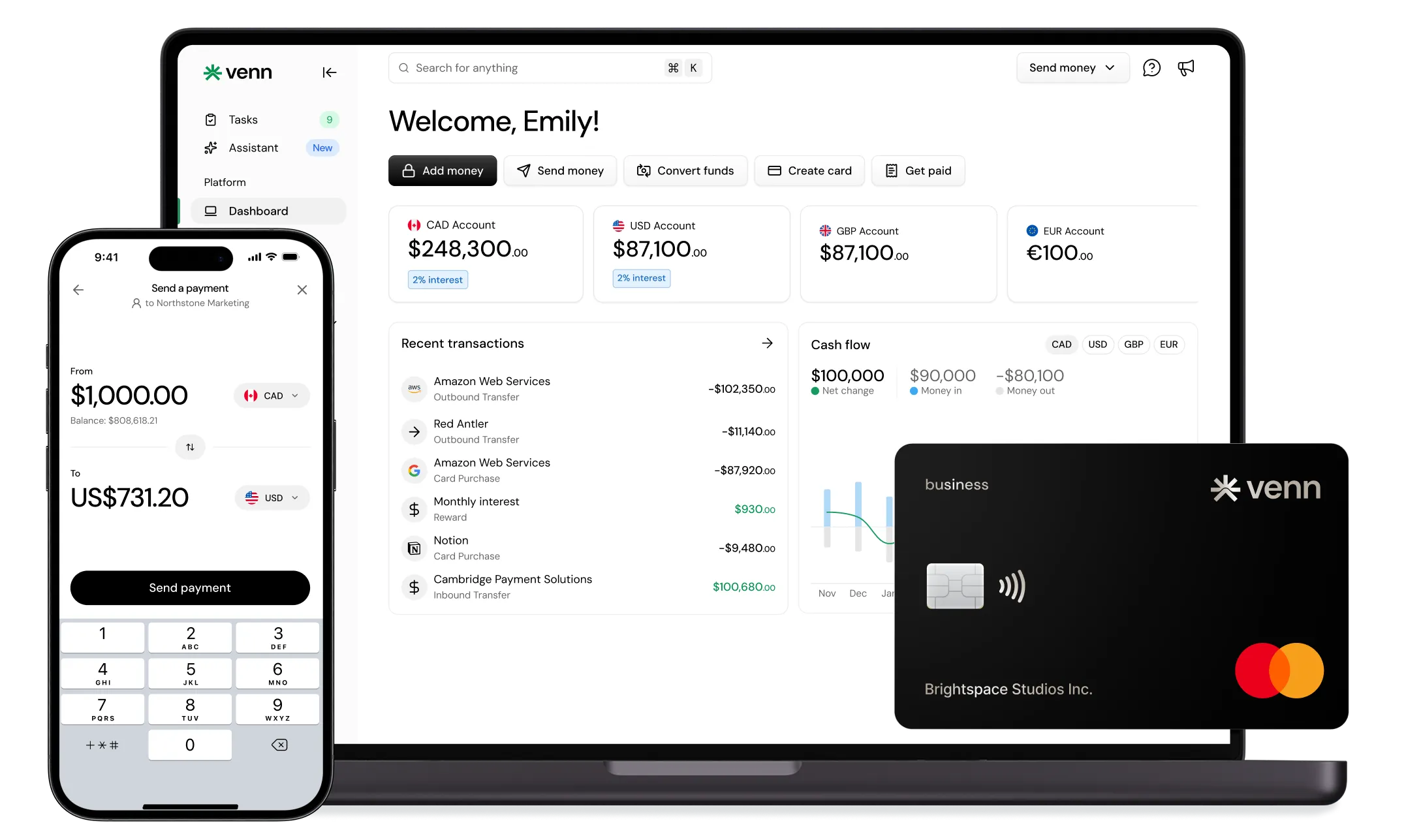
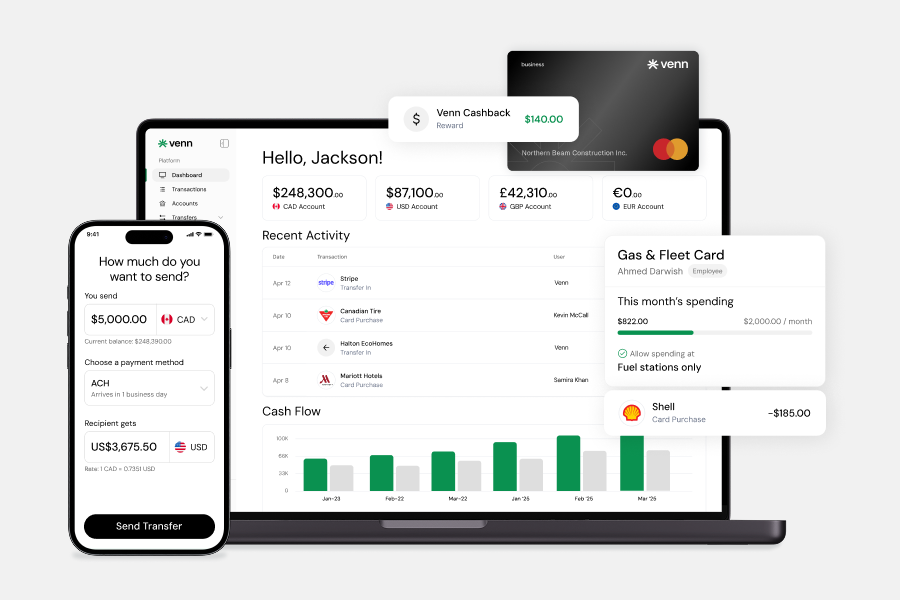
Venn, a business banking platform built for multi-currency operations, serves as a reference point throughout. With CAD, USD, EUR, and GBP accounts, local payment rails like ACH and SEPA, and direct accounting integrations, Venn represents what transparent, operationally friendly FX looks like for Canadian businesses in 2026.
What "FX Pricing" Actually Includes (And What It Doesn't)
The 3 Building Blocks of an FX Quote
Every foreign exchange quote you receive contains three components, whether your provider discloses them clearly or not.
Mid-market/interbank rate: This is the "true" exchange rate at any given moment, the midpoint between what buyers are willing to pay and what sellers are willing to accept on global currency markets. Think of it as the wholesale rate. You can check it on Google, XE, or Reuters.
Spread/markup: The difference between the mid-market rate and the rate you actually receive. Providers quote this in basis points (bps) or as a percentage. A 50 bps markup means you pay 0.50% more than mid-market.
Fees: Fixed or variable charges layered on top. These include transfer fees, wire fees, intermediary bank deductions, and sometimes "processing" or "handling" charges that appear only on your statement.
The challenge? Many providers bundle the spread and fees together, making it impossible to know where your money goes.
Key Terms (Plain-English Mini-Glossary)
Basis points (bps): One basis point equals 0.01%. So 100 bps = 1.00%. When a provider quotes "40 bps," they mean a 0.40% markup.
Spread vs markup vs margin: These terms are often used interchangeably. All describe the difference between the mid-market rate and your quoted rate.
"All-in rate" vs "mid-market": Your all-in rate is what you actually pay after spread and fees. The mid-market rate is the reference point. The gap between them is your true cost.
Quote timestamp / rate validity window: Exchange rates move constantly. A quote is only valid for a specific window, sometimes 30 seconds, sometimes 24 hours. Always confirm when your rate expires.
Model 1: Volume-Based (Tiered) FX Pricing
How Tiered FX Pricing Works
Traditional banks and some fintechs offer volume-based pricing that improves as your monthly or quarterly conversion volume increases. The structure typically looks like this:
| Monthly Volume | Spread (bps) |
|---|---|
| Under $50,000 | 150 bps |
| $50,000–$250,000 | 100 bps |
| $250,000–$1M | 60 bps |
| Over $1M | Negotiated |
Pros: At high volumes, tiered pricing can deliver competitive rates. Relationship managers may negotiate custom terms for valuable clients.
Cons: Opacity makes auditing difficult. Forecasting costs becomes guesswork when you're near a tier boundary. Smaller months mean worse rates. Some providers require bundled banking relationships or minimum balances to access better tiers.
When Volume-Based Pricing Can Be a Fit
Tiered pricing works best for businesses with large, predictable monthly conversions, dedicated treasury or finance operations bandwidth, and willingness to actively manage provider relationships. If you convert $500,000+ monthly in predictable patterns and have someone to negotiate and verify rates, tiered pricing may deliver savings.
For most Canadian SMBs, the administrative overhead and forecasting complexity outweigh potential savings.
Model 2: Transparent FX Pricing
What "Transparent" Should Mean (And What to Watch For)
Transparent pricing means you can verify exactly what you're paying on every conversion. A truly transparent provider discloses:
• The mid-market rate at the time of conversion
• The exact markup (in bps or %) applied
• Any fixed fees per transaction
• The rate validity window
Watch for providers who claim "transparent pricing" but bury the spread in an "all-in rate" without showing the mid-market reference. If you can't independently verify the markup, it's not transparent.
Pros and Cons of Transparent Pricing
Pros: Easier budgeting since costs are predictable. Simpler reconciliation because each transaction's FX cost is clear. Better cost attribution per vendor, client, or invoice. No surprises when volume fluctuates.
Cons: May not beat bespoke tiered rates at very high volumes. However, the operational simplicity often compensates for marginal rate differences.
Venn's approach exemplifies transparent pricing: a consistent, disclosed markup structure across CAD, USD, EUR, and GBP conversions, with no hidden fees or volume thresholds that shift your costs unpredictably.
The "All-In FX Cost" Framework (Make Comparisons Apples-to-Apples)
Step-by-Step: Convert Any Quote Into an Effective Percentage
To compare providers fairly, calculate your effective FX cost as a percentage of the amount converted:
Effective FX Cost (%) = (Spread Cost + Transfer Fees) / Amount Converted × 100
Example: You convert $10,000 CAD to USD. The mid-market rate is 1.3600. Your provider quotes 1.3532, and charges a $25 wire fee.
• Spread cost: ($10,000 / 1.3532) - ($10,000 / 1.3600) = $7,391.01 - $7,352.94 = $38.07
• Total cost: $38.07 + $25 = $63.07
• Effective cost: $63.07 / $10,000 = 0.63%
Now you can compare any quote using the same metric.
Hidden Costs Checklist
Before accepting any FX quote, verify these potential hidden costs:
• Wire fees: Both outbound and inbound, including intermediary bank deductions
• Weekend/after-hours markup: Many providers widen spreads outside market hours
• Minimum fees: Some charge a floor fee regardless of transaction size
• Forced conversions: If you lack a local currency account, you may convert twice (USD → CAD → USD)
• Processor cross-border fees: Receiving card payments in another currency often triggers 1-3% additional fees
Multi-currency accounts eliminate forced conversions. With Venn's USD, EUR, and GBP accounts, you can receive funds in the currency earned, pay expenses in that same currency, and convert only when strategically beneficial, improving your all-in outcome significantly.
Worked Examples
Scenario A: $5,000 CAD → USD for a One-Off Supplier Payment
| FactorBank (Tiered) | Transparent Provider | |
|---|---|---|
| Mid-market rate | 1.3600 | 1.3600 |
| Quoted rate | 1.3400 (147 bps) | 1.3532 (50 bps) |
| USD received | $3,731.34 | $3,694.58 |
| Wire fee | $45 | $0 (ACH) |
| Net USD delivered | $3,686.34 | $3,694.58 |
| Effective cost | 1.72% | 0.50% |
The bank's wider spread plus wire fee costs $54.24 more on a $5,000 conversion. Over a year of monthly supplier payments, that's $650+ in avoidable costs.
Scenario B: $250,000/month Multi-Currency (USD + EUR) for Inventory + Contractors
A growing ecommerce brand converts $150,000 CAD to USD and $100,000 CAD to EUR monthly.
| Factor | Tiered Bank | Transparent Provider |
|---|---|---|
| USD spread (at volume) | 75 bps | 50 bps |
| EUR spread (at volume) | 85 bps | 50 bps |
| Monthly spread cost | $1,975 | $1,250 |
| Wire fees (8 payments) | $280 | $0 (local rails) |
| Total monthly cost | $2,255 | $1,250 |
| Annual savings | — | $12,060 |
Beyond cost savings, the transparent provider eliminates forecasting complexity. The finance team knows exactly what each conversion costs without tracking tier thresholds or negotiating quarterly.
Scenario C: Getting Paid in USD and Paying USD Expenses
A SaaS company collects $80,000 USD monthly through Stripe and pays $50,000 USD to contractors and cloud providers.
Without local USD account: Stripe converts to CAD (1.5% fee). Company converts CAD back to USD for payments (0.75% spread + wire fees). Total friction: 2.5%+ on $50,000 = $1,250/month.
With Venn USD account: Receive USD via ACH directly into USD account. Pay USD contractors via ACH from the same account. Convert only the $30,000 surplus to CAD when needed.
Annual savings: $15,000+ in avoided conversions and fees, plus cleaner reconciliation since USD transactions stay in USD.
How to Evaluate FX Providers (What to Ask Before You Switch)
The Due-Diligence Questions
Before committing to any FX provider, get clear answers to these questions:
• What rate source do you use as your mid-market reference?
• Is your markup disclosed (bps or %) and consistent across all conversions?
• Are there minimum fees per transaction?
• What fees apply per payment rail (ACH/EFT/wire/SEPA)?
• How does pricing change after-hours or on weekends?
• Can I hold and operate in multiple currencies without forced conversion?
• What reporting and audit trail do you provide for finance reconciliation?
• Do you integrate with QuickBooks or Xero for automated transaction sync?
Red Flags
Walk away from providers who exhibit these warning signs:
• "Fee-free" claims without clarity on spread (the fee is hidden in the rate)
• Quotes without timestamps (impossible to verify against mid-market)
• Bundled packages that obscure FX economics within broader service fees
• Reconciliation friction (no clean export, unclear transaction metadata, manual data entry required)
Operational Playbook: Reducing FX Cost Without Adding Finance Busywork
Build a Simple Treasury Workflow
Even small finance teams can implement smart FX practices:
Set "keep vs convert" rules: USD revenue stays in USD for USD expenses. Convert to CAD only for Canadian payroll, rent, and taxes. This reduces conversion frequency and improves timing flexibility.
Establish approval thresholds: Conversions over $25,000 require rate verification against mid-market. This prevents expensive conversions during unfavorable windows.
Choose payment rails intentionally: ACH for US payments, EFT for Canadian, SEPA for European. Wires only when speed is essential. Rail selection alone can save hundreds per month.
Accounting and Controls (QuickBooks/Xero)
Clean reconciliation requires consistent practices:
• Use standardized memo fields for FX transactions
• Maintain consistent vendor naming across currencies
• Attach invoices and receipts to transactions at time of payment
• Review FX gain/loss accounts monthly
Venn's direct QuickBooks and Xero integrations automate transaction sync, eliminating manual data entry and reducing reconciliation errors. When your banking, card spend, and accounting connect seamlessly, month-end closes faster and FX costs become auditable.
Where Venn Fits in an Optimal Canadian Business Financial Stack
What to Look for in a Core Banking Platform for Global Business
Modern Canadian businesses need more than competitive FX rates. They need an integrated financial stack that includes:
• Multi-currency accounts (CAD/USD/EUR/GBP) to hold funds where earned
• Local payment rails (ACH, EFT, SEPA, Faster Payments) for cost-effective transfers
• Transparent, predictable FX pricing without volume thresholds or hidden fees
• Corporate cards with controls for expense management and cash flow optimization
• Accounting integrations for automated reconciliation
Venn delivers all five. The platform combines business banking with a multi-currency card offering 1% unlimited cashback, expense management with OCR receipt capture, and free unlimited Interac e-Transfer® for vendor payments. Funds held through Venn receive CDIC insurance protection.
Venn Practical Use Cases by Industry
Ecommerce/Retail: Pay overseas suppliers from USD or EUR accounts. Collect USD marketplace revenue without forced conversion. Reduce conversion frequency by matching currency of revenue to currency of expense.
Professional Services/Agencies: Invoice US clients in USD, receive via ACH, pay USD contractors from the same account. Simpler reconciliation with automatic QuickBooks sync.
Software/SaaS: Manage USD revenue from customers alongside USD expenses for cloud infrastructure and tools. Reduce processor cross-border friction. Track multi-currency spend with integrated expense management.
Ready to assess your all-in FX cost and consolidate your multi-currency banking, spend management, and accounting workflows? Sign up for a Venn account at venn.ca
FAQ
Q: What's the difference between the mid-market rate and the rate I actually get?
A: The mid-market rate is the wholesale exchange rate at any moment—the midpoint between buy and sell prices on global markets. The rate you actually receive includes your provider’s markup (spread) and any additional fees. The difference between these two rates represents your true FX cost.
Q: Is a "transparent" FX provider always cheaper than a bank?
A: Not always, but often for small and mid-sized businesses. Banks may offer competitive rates at very high volumes (typically $1M+ per month), but their tiered pricing, wire fees, and forced conversions often make transparent providers more cost-effective for businesses converting under $500,000 monthly.
Q: How do I convert basis points (bps) into dollars?
A: Multiply your conversion amount by the basis points expressed as a decimal. For example, 50 bps on a $10,000 conversion: $10,000 × 0.0050 = $50 in spread cost.
Q: Why do wires sometimes arrive short?
A: Intermediary banks along the wire path may deduct handling fees, typically $15–$30 each. A transfer passing through two intermediaries could arrive $30–$60 short. Using local payment rails (such as ACH or SEPA) when available can help avoid these intermediary deductions.
Q: Should I convert everything to CAD right away?
A: Generally, no. If you have USD expenses, consider keeping USD revenue in a USD account and paying those expenses directly. Convert to CAD only what you need for Canadian obligations. This reduces conversion frequency and gives you flexibility to convert when exchange rates are more favorable.
---
**Disclaimer:** This publication is provided for general information purposes and does not constitute legal, tax or other professional advice from Venn Software Inc or its subsidiaries and its affiliates, and it is not intended as a substitute for obtaining advice from a financial advisor or any other professional. We make no representations, warranties or guarantees, whether expressed or implied, that the content in the publication is accurate, complete or up to date.
This publication is provided for general information purposes only and does not constitute legal, tax, financial, or other professional advice from Venn Software Inc., its subsidiaries, or its affiliates, and is not a substitute for advice from a qualified professional. All comparisons and competitor information reflect publicly available information believed accurate as of April 21, 2026; features, pricing, rates, and terms referenced are subject to change and may differ at the time you read this. All product names, logos, and brands referenced are the property of their respective owners; their mention does not imply affiliation with or endorsement by Venn. Any comparative statements reflect Venn's views and are provided to help readers evaluate options. We make no representations, warranties, or guarantees, express or implied, that the content is accurate, complete, or up to date.

Venn is all-in-one business banking built for Canada
From free local CAD/USD accounts and team cards to the cheapest FX and global payments—Venn gives Canadian businesses everything they need to move money smarter. Join 15,000+ businesses today.
Frequently asked questions
Everything you need to know about the product and billing.
Join 15,000+ businesses banking with Venn today
Streamline your business banking and save on your spend and transfers today
No personal credit check or guarantee.