Cheapest Way to Convert CAD to USD for Canadian Businesses
Cheapest Way to Convert CAD to USD: compare spreads, fees and ACH vs wires. Learn how Canadian businesses cut FX costs with USD accounts and cards, saving time.

Ahmed Shafik
Co-founder

Trusted by 15,000+ Canadian businesses
Business banking for Canada
Local CAD and USD accounts, corporate cards with cashback, the lowest FX rates in Canada, free local transfers, and more.
Finding the cheapest way to convert CAD to USD isn't as straightforward as comparing exchange rates. Canadian businesses lose thousands annually to hidden FX spreads, wire fees, receiving charges, and the operational friction of managing cross-border payments. The advertised rate you see rarely reflects what you actually pay.
This guide breaks down the true total cost of currency conversion and matches you with the right method for your specific business needs. Whether you're paying US vendors monthly, collecting USD revenue from American clients, or managing software subscriptions billed in US dollars, the cheapest option depends entirely on how your business operates.
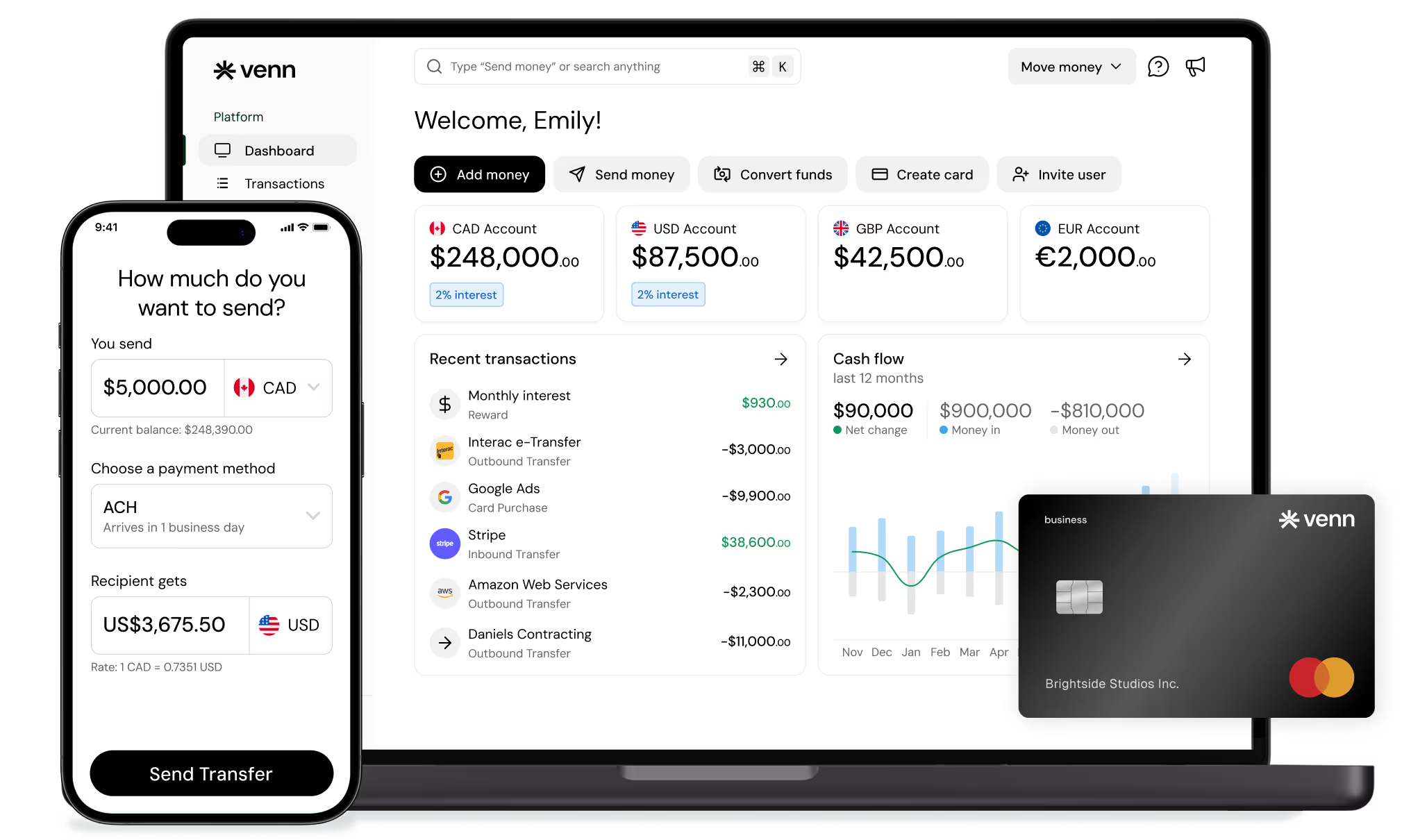
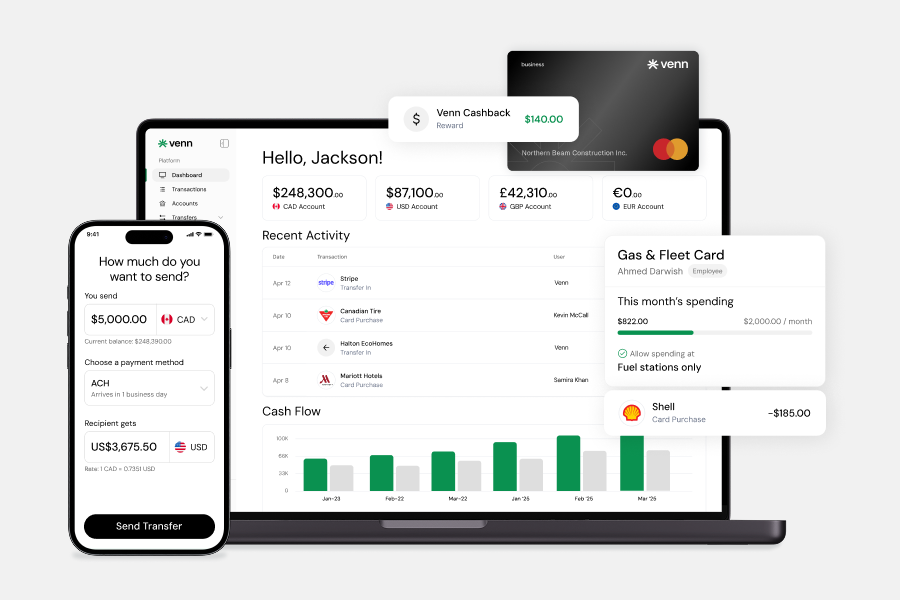
Venn, a Canadian business banking platform, offers businesses a streamlined approach to CAD and USD operations. With a real local US account capable of sending and receiving ACH payments, multi-currency accounts, and accounting-ready workflows, Venn addresses the full cost equation that most currency conversion comparisons ignore.
What "Cheapest" Really Means When Converting CAD to USD
Before comparing options, you need to understand the four cost buckets that determine your true conversion expense.
FX spread is the difference between the mid-market rate and the rate you receive. The mid-market rate represents the true exchange rate between currencies, the midpoint between buy and sell prices on global markets. Banks and conversion services mark up this rate, sometimes by 2-3%, and call it their "exchange rate." On a $50,000 conversion, a 2% spread costs you $1,000 before any fees.
Fixed fees include transfer fees, wire fees, and conversion charges. These can range from $0 to $50+ depending on the method and provider.
Receiving fees are often overlooked. When you send a wire, the receiving institution may charge $15-25 to accept it. Some businesses face these charges on both ends of a transaction.
Operational costs represent the hidden expenses: staff time spent initiating transfers, reconciling payments across multiple platforms, correcting errors, and managing delayed settlements. For businesses making frequent cross-border payments, these costs compound quickly.
The mid-market rate serves as your benchmark. When a provider advertises "no fees," check their spread against the mid-market rate. When they advertise "great rates," calculate the total cost including all fees. Businesses with high AP/AR frequency benefit from different solutions than those making occasional large conversions.
Quick Answer: The Cheapest Option Depends on Your Use Case
Recurring supplier payments in USD: Prioritize local payment rails like ACH over international wires. A platform with a real US account eliminates wire fees entirely. Venn's local US account lets businesses send ACH payments directly, cutting both cost and processing time.
Receiving USD revenue from Stripe, Shopify, or PayPal: Avoid forced conversion at unfavorable rates by receiving funds into a USD account you control. Venn's multi-currency accounts let you hold USD and convert when rates favor you.
One-time large conversions ($100,000+): Dedicated FX services or brokerage strategies may offer the lowest spread, though operational complexity increases.
Everyday USD spend on software and subscriptions: A multi-currency card that draws from your USD balance first eliminates conversion entirely. Venn's card automatically uses the transaction currency when available, paired with 1% unlimited cashback.
Comparison Table: Common Ways Canadian Businesses Convert CAD to USD
| Method | Typical Costs | Speed | Best For | Key Drawbacks | Business-Grade? |
|---|---|---|---|---|---|
| Big 5 Banks | 1.5–3% spread + $25–50 wire fees | 1–3 days | Existing relationships, treasury needs | High total cost, manual processes | Partial |
| Online Transfer Apps | 0.5–1.5% spread + $0–15 fees | Minutes to 2 days | Personal transfers, occasional business use | Transfer limits, limited business features | Limited |
| FX Brokers | 0.3–1% spread + $0–25 fees | 1–2 days | Large conversions ($50K+) | Onboarding time, funding steps | Yes |
| Norbert's Gambit | ~0.1% (trading fees only) | 3–5 days | Large sums for investing | Complex, market risk, not for payables | No |
| Cash/Travel Money | 3–5%+ spread | Immediate | Small travel amounts | Worst rates, impractical for business | No |
| Venn | Competitive spread + plan-based fees | Same/next day ACH | Ongoing business operations | Requires account setup | Yes |
Method-by-Method Breakdown With Business Use Cases
Banks (Big 5): Convenient, Often Costly for FX
Canadian banks offer currency conversion through branches, online banking, and business accounts. The convenience comes at a price. Spreads typically range from 1.5% to 3% above mid-market, and international wire fees add $25-50 per transaction. Receiving banks often charge additional fees.
For businesses with existing credit relationships or specific treasury requirements, banks may offer negotiated rates. Most SMEs, however, pay retail pricing. The operational friction compounds costs: initiating wires requires manual input, tracking payments across systems, and reconciling statements that weren't designed for multi-currency operations.
Banks work best when you need the full suite of business banking services and can negotiate based on your overall relationship. For pure currency conversion, cheaper options exist.
Online Money Transfer Apps: Good UX, Watch the Fee Stack
Consumer-focused transfer apps have expanded into business services, offering clean interfaces and competitive rates. Pricing typically combines a small fee with a spread, or advertises "no fee" while building margin into the exchange rate.
Business considerations matter here. Transfer limits may cap your monthly volume. Compliance requirements vary. Invoice support and reconciliation workflows often lack the depth businesses need. These platforms work well for straightforward transfers but may not integrate cleanly with your accounting stack.
Calculate the true total cost on your typical transfer amount before committing. A $5 fee plus 0.7% spread costs more than a $0 fee plus 1% spread on transfers under $1,700, but less on larger amounts.
FX Brokers and Dedicated FX Services: Competitive for Larger Transfers
Specialized FX services like KnightsbridgeFX or MTFX-style providers offer tighter spreads for larger conversions, often 0.3-1% above mid-market. They're built for businesses and high-net-worth individuals moving significant sums.
The tradeoffs involve onboarding time, funding steps, and settlement windows. You'll typically need to wire funds to the broker, wait for settlement, then wire the converted amount to your destination. For businesses making large quarterly or annual conversions, the savings justify the process. For frequent smaller payments, the operational overhead erodes the rate advantage.
Brokerage Conversion (Norbert's Gambit): Lowest Cost, Highest Complexity
Norbert's Gambit involves buying a Canadian-listed security that trades in both CAD and USD, then journaling shares to the USD side and selling. Trading fees represent your only cost, potentially reducing conversion expense to 0.1% or less.
This strategy suits sophisticated operators converting large sums for investment purposes. The risks are significant: settlement takes 3-5 business days, market movement during that window can erase savings, and the journaling process requires precision. Brokerage support staff may not understand the process.
For urgent payables or operational currency needs, Norbert's Gambit creates more problems than it solves. Reserve this approach for patient, large-scale conversions where time flexibility exists.
Cash, ATMs, and Travel Money: Usually the Worst "Cheapest" Myth
Airport kiosks and retail currency exchanges advertise convenience while charging 3-5%+ spreads. ATM withdrawals abroad incur fees from both your bank and the ATM operator, plus unfavorable conversion rates.
Dynamic currency conversion (DCC) represents a particular trap. When a foreign terminal offers to charge you in CAD "for your convenience," it's applying a markup of 3-7% over what you'd pay by declining and accepting the charge in the local currency.
Cash conversion serves only small travel needs. No business should rely on retail currency exchange for operational spending.
Venn: The Business-Grade Approach to Ongoing CAD↔USD Operations
Venn addresses currency conversion as part of a complete business banking workflow rather than an isolated transaction. The platform provides multi-currency accounts in CAD, USD, GBP, and EUR, letting businesses hold funds in the currencies they need and convert strategically.
The real local US account capability changes the cost equation fundamentally. Instead of sending international wires to pay US vendors, businesses can send ACH payments directly from their Venn USD account. ACH costs a fraction of wire fees and settles faster. Receiving USD payments works the same way: American clients pay via ACH into your local US account, avoiding the wire fees and delays of international transfers.
For businesses collecting USD revenue through Stripe, Shopify, or PayPal, Venn eliminates forced conversion at unfavorable rates. Receive funds in USD, hold them until you need to convert, and control the timing.
The Venn card extends this logic to spend. The multi-currency card automatically uses the transaction currency when your balance supports it. Pay for US software subscriptions from your USD balance without conversion. When you do convert, 1% unlimited cashback on card spend offsets costs across your entire spending profile.
Accounting integration closes the operational cost loop. Venn connects directly with QuickBooks and Xero, automating reconciliation and reducing the manual work that makes multi-currency operations expensive. Free, unlimited Interac e-Transfer® handles Canadian payments without additional fees.
Funds held with Venn are safeguarded and covered under CDIC insurance protection, providing the security businesses require.
Cheapest Option by Business Scenario
You pay US contractors or vendors monthly. Use a platform with local US account ACH capabilities. Venn lets you fund your USD account and pay via ACH, eliminating wire fees entirely. Convert CAD to USD when rates favor you, then pay from your balance.
You invoice US clients and receive USD payments. Provide your local US account details for ACH payment. Venn's USD account accepts incoming ACH, letting you collect without wire fees or forced conversion.
You collect USD via Stripe, Shopify, or PayPal. Route payouts to a USD account you control. Venn's multi-currency accounts let you hold USD revenue and convert on your schedule rather than the platform's.
You run USD software spend. A multi-currency card eliminates conversion on recurring subscriptions. Venn's card uses your USD balance first, and the 1% unlimited cashback applies regardless of currency.
You need to move large sums a few times per year. Compare dedicated FX services for the conversion itself, but consider where the funds will land. If they're funding ongoing US operations, a Venn USD account provides the receiving infrastructure.
You're converting for investment purposes. Norbert's Gambit offers the lowest cost for patient, sophisticated operators. This approach doesn't suit operational business needs.
Practical Tips to Reduce CAD→USD Conversion Costs
• Benchmark against mid-market rates. Check XE or Google Finance for the current mid-market rate before any conversion. Calculate the actual spread you're paying.
• Avoid weekend conversions. Many providers widen spreads on weekends when markets are closed. Convert during business hours when possible.
• Decline dynamic currency conversion. When paying abroad, always choose to pay in the local currency. DCC "convenience" costs 3-7% in hidden markup.
• Use local payment rails. ACH costs less than wires and often settles faster. A real US account makes this possible.
• Consolidate your financial tools. Managing currency across multiple platforms creates reconciliation overhead. A unified platform like Venn reduces admin time and error risk.
• Set internal policies. Define who can authorize conversions, at what thresholds, and document your decision criteria. Consistency prevents costly ad-hoc decisions.
Conclusion
The cheapest way to convert CAD to USD depends on your business's specific operations. Total cost includes spread, fees, receiving charges, and the operational overhead of managing cross-border payments. One-time large conversions favor different solutions than ongoing multi-currency operations.
For Canadian businesses with regular USD needs, whether paying vendors, collecting revenue, or managing card spend, a business banking platform with local US account capabilities, multi-currency accounts, and accounting integration addresses the full cost equation. Venn provides this infrastructure with competitive FX, ACH send and receive, 1% unlimited cashback, and direct QuickBooks and Xero compatibility.
FAQs
Q: What is the mid-market rate and why doesn't my bank give it?
A: The mid-market rate is the midpoint between buy and sell prices on global currency markets, representing the “true” exchange rate. Banks and conversion services add a spread (markup) to this rate as their profit margin. Retail customers typically receive rates that are 1.5–3% worse than the mid-market rate.
Q: What's the difference between FX fees and FX spread?
A: FX fees are explicit charges for the conversion service, shown as a separate line item. FX spread is the hidden markup built into the exchange rate itself. A provider advertising “no fees” may still charge 1–2% through the spread. Always calculate the total cost against the mid-market rate.
Q: Is Norbert's Gambit safe for businesses?
A: Norbert's Gambit can work for converting large sums for investment purposes when you have time flexibility. It is not suitable for urgent payables or operational needs due to 3–5 day settlement times and the risk of market movement during that window.
Q: What's the cheapest way to pay US vendors: ACH or wire?
A: ACH is typically cheaper and often faster than international wires. ACH fees generally range from $0–5, while international wires can cost $25–50 or more and may also incur receiving fees. Using ACH requires a US-based account, which some platforms provide through local US account capabilities.
Q: How do I avoid double conversion when getting paid in USD?
A: Receive USD payments into a USD account you control rather than allowing payment platforms to automatically convert funds to CAD. Multi-currency accounts let you hold USD and convert only when needed, on your terms.
Q: What is dynamic currency conversion (DCC) and how do I avoid it?
A: Dynamic currency conversion (DCC) occurs when a foreign merchant or ATM offers to charge you in your home currency instead of the local currency. This added “convenience” typically includes a 3–7% markup. To avoid it, always decline DCC and choose to pay in the local currency.
Q: Do I need a US-based account to receive ACH payments?
A: Yes. ACH payments require a US routing number and account number. Some Canadian business banking platforms provide real local US account capabilities that can send and receive ACH payments, eliminating the need for a separate US bank relationship.
Interac e-Transfer® is a registered trademark. Based on internal analysis of total markups and FX fees charged by major Canadian financial institutions in January 2025.
---
**Disclaimer:** This publication is provided for general information purposes and does not constitute legal, tax or other professional advice from Venn Software Inc or its subsidiaries and its affiliates, and it is not intended as a substitute for obtaining advice from a financial advisor or any other professional. We make no representations, warranties or guarantees, whether expressed or implied, that the content in the publication is accurate, complete or up to date.
This publication is provided for general information purposes only and does not constitute legal, tax, financial, or other professional advice from Venn Software Inc., its subsidiaries, or its affiliates, and is not a substitute for advice from a qualified professional. All comparisons and competitor information reflect publicly available information believed accurate as of March 3, 2026; features, pricing, rates, and terms referenced are subject to change and may differ at the time you read this. All product names, logos, and brands referenced are the property of their respective owners; their mention does not imply affiliation with or endorsement by Venn. Any comparative statements reflect Venn's views and are provided to help readers evaluate options. We make no representations, warranties, or guarantees, express or implied, that the content is accurate, complete, or up to date.

Venn is all-in-one business banking built for Canada
From free local CAD/USD accounts and team cards to the cheapest FX and global payments—Venn gives Canadian businesses everything they need to move money smarter. Join 15,000+ businesses today.
Frequently asked questions
Everything you need to know about the product and billing.
Join 15,000+ businesses banking with Venn today
Streamline your business banking and save on your spend and transfers today
No personal credit check or guarantee.