Financial Operations for Canadian Law Firms Guide 2026
Financial Operations for Canadian Law Firms Cards, Spend and Disbursements. Set compliant trust vs operating workflows, track GST HST, and reconcile faster.

Ahmed Shafik
Co-founder
.png)

Trusted by 15,000+ Canadian businesses
Business banking for Canada
Local CAD and USD accounts, corporate cards with cashback, the lowest FX rates in Canada, free local transfers, and more.
Canadian law firms face a financial operations problem that standard small-business tools were never designed to solve. Managing partners and firm administrators need faster spend controls, cleaner reconciliation, and modern finance tools, yet the regulatory environment demands far more discipline than a typical SMB setup requires.
The core challenge is structural. Trust funds, operating expenses, client disbursements, staff reimbursements, and GST/HST treatment each follow different rules and require separate workflows. Mixing them, even accidentally, creates compliance exposure that no card rewards program or slick dashboard can fix after the fact.
This guide addresses that complexity directly. It clarifies the trust versus operating account distinction, explains what firm expenses can go on corporate cards and under what conditions, walks through how client disbursements work and how CRA's agency test affects GST/HST treatment, and outlines how firms can build a compliant, modern operating-side finance stack. Whether you are a managing partner reviewing firm-wide controls, a bookkeeper supporting a solo practitioner, or a COO modernizing legal expense management across multiple practice groups, the framework here applies.
Trust Account Vs Operating Account: The First Principle
Before any discussion of corporate cards, spend controls, or financial platforms, one principle must be clear: client money and firm money are not interchangeable. Treating them as such is not a bookkeeping error. It is a professional conduct violation.
Ontario's By-Law 9 requires that money received in trust for a client, including advances for unrendered fees or costs not yet disbursed, must be deposited into a designated trust account. The Law Society of British Columbia's trust rules carry the same core obligation: trust funds must be deposited promptly and kept strictly separate from firm funds. Both provinces require monthly trust reconciliations, with Ontario setting a 25-day deadline after month-end and BC allowing 30 days, plus an annual trust report.
What belongs in trust: unearned retainers, client advances for fees not yet billed, and funds held for disbursements not yet made. What belongs in the operating account: billed fees once properly transferred, payroll, software subscriptions, rent, and bank charges. Ontario's guidance is explicit that card-processing fees must come from the general account, never from trust.
The practical implication is straightforward. A firm cannot deposit a client retainer into its operating account for convenience and move it later. The separation must happen at the point of receipt.
Every section that follows on corporate cards, law firm expense management, and disbursement tracking assumes this foundation is already in place. These tools support operating-side workflows. They do not substitute for trust compliance.
What Belongs In Trust
Trust accounts exist for one purpose: holding client money. That means unearned retainers, advances for fees not yet billed, and advances for disbursements not yet made all belong in trust, not in your operating account.
Ontario's By-Law 9 is explicit on this point. Money received in trust for a client, including advances for unrendered fees or undisbursed costs, must be deposited into a designated trust account. There is no flexibility on timing or routing. British Columbia's rules carry the same core requirement: trust funds must be handled promptly and used only for funds directly related to legal services.
For firms handling their own bookkeeping, the practical rule is straightforward. If a client gave you money before you earned it or spent it on their behalf, it belongs in trust until the billing conditions are met. No operating account, corporate card, or fintech platform changes that obligation or substitutes for a compliant trust account.
What Belongs In The General Or Operating Account
Your firm's general or operating account is where earned revenue and day-to-day firm expenses live. Once you bill a client and transfer funds out of trust according to your law society's rules, those billed fees belong here. Payroll, rent, office overhead, bank charges, and card-processing fees all flow through the operating account. Ontario's Law Society guidance is explicit on one point: card-processing fees must be deducted from the general account, never from trust.
Beyond the basics, law firms carry a range of recurring operating expenses that belong on this side of the ledger. Legal research tools such as Westlaw or Lexis+ subscriptions, practice management software, courier services, filing-related costs the firm absorbs, and staff travel all qualify as firm expenses. Firm-paid disbursements also belong here after you apply the correct accounting treatment and record them properly at the matter level.
Operating-side financial tools, including corporate cards, spend management platforms, and accounting integrations, can make tracking these expenses more efficient. They can enforce approval workflows, capture receipts at the point of purchase, and sync transactions directly to QuickBooks or Xero. None of that changes your trust-account obligations. The operating account handles firm expenses; trust handles client money. That separation is non-negotiable regardless of which tools you use to manage either side.
Provincial Caveat
Core trust-account principles apply consistently across Canada, but the mechanics, timelines, reporting requirements, and permitted workflows vary by province and territory. Ontario requires monthly trust reconciliations completed within 25 days of month-end. British Columbia requires monthly trust reconciliations within 30 days and also mandates annual trust reports. These differences matter in practice, and similar variations exist across other provinces. Confirm the specific rules that apply to your firm with your law society, accountant, or legal bookkeeper before finalizing any financial operations workflow.
Can Canadian Law Firms Use Corporate Cards?
Yes. Canadian law firms can use corporate cards for operating expenses and certain firm-paid disbursements. The critical boundary is this: cards belong on the operating side of your financial setup, not as a workaround for trust accounting obligations.
Where Cards Work Well
Corporate cards are well-suited for predictable, firm-side costs. Common appropriate uses include:
• SaaS and legal tech subscriptions
• Travel and conference expenses
• Office overhead and supplies
• Legal research tools and database access
• Filing fees, courier charges, and expert costs the firm pays upfront and later bills correctly
These are legitimate operating expenses. When a firm pays a disbursement on a client's behalf and plans to recover it through billing, a card can be a practical payment method, provided the firm codes the expense to the correct matter and follows proper billing procedures.
What Cards Cannot Replace
Cards do not substitute for trust compliance. Firms must still maintain proper trust deposits, matter-level client ledgers, required trust records, and all authorization and reconciliation procedures their law society mandates. Ontario's guidance makes clear that retainers must flow directly into a designated trust account, and that card-processing fees must be deducted from the general account, not from trust. No card setup changes those obligations.
Operating-Side Controls That Cards Support
When used within a compliant firm policy, corporate cards can meaningfully improve operating-side financial management. Spend controls, approval workflows, receipt capture, and monthly reconciliation all become more manageable when card use is structured and policy-governed. Law firm expense management improves when every transaction carries a clear purpose, a matter code where applicable, and supporting documentation from the point of purchase.
The key is treating cards as a tool for controlled operating spend, not as a shortcut past the trust-versus-operating distinction that sits at the foundation of law firm bookkeeping.
If You Accept Client Card Payments
Client card payments require more care than a standard business transaction because trust retainers and billed invoices must follow different routing paths. Under Ontario Law Society guidance, retainers collected before work is performed must go directly into a trust-compliant account. Billed fees and disbursements, once earned and invoiced, go to the general operating account. Firms cannot deposit trust money into general and move it later to correct the error. That sequence violates trust accounting rules regardless of intent.
Card-processing fees and service charges must come from the general account, not from trust. Deducting processor fees from a trust deposit contaminates the trust balance and creates a reconciliation problem that compounds over time.
One card-processing setup often cannot serve both purposes. A processor configured to deposit into a single destination account forces a choice: trust or general. Firms accepting both retainers and billed payments by card may need separate processing arrangements or a payment tool built with legal-specific routing in mind. Tools such as LawPay are designed with this separation in mind, though any solution requires the firm to verify that funds land in the correct account type and that the provider does not act as an intermediary holding funds before deposit.
The core principle here is separation, not convenience. Routing discipline at the point of payment prevents compliance problems that are far harder to unwind after the fact.
How To Handle Client Disbursements And GST/HST
Not every cost a law firm recovers from a client receives the same GST/HST treatment. The Canada Revenue Agency draws a clear line between disbursements incurred as agent and costs incurred otherwise than as agent, and that distinction directly affects how firms should bill and report these amounts.
When a lawyer acts as agent for the client, the reimbursement is generally not subject to GST/HST. The lawyer is simply recovering a cost that belongs to the client, not providing an additional taxable supply. Court filing fees and land registration fees are commonly cited examples where agency treatment may apply, though firms should confirm the analysis for each cost type with their accountant or tax advisor.
When a lawyer incurs a cost otherwise than as agent, that reimbursement can form part of the consideration for the firm's taxable legal services. Travel and accommodation, expert invoices, courier charges, and certain service costs may fall into this category depending on how the firm structured and controlled the expenditure.
CRA's agency guidance identifies several relevant factors: whether the firm had authority to act on the client's behalf, which party bore liability for the cost, how the firm recorded the amount, and whether funds were kept separate. Documenting that analysis at the time of the transaction is far easier than reconstructing it later.
Operationally, firms should code every disbursement to the relevant matter, retain the original source invoice or receipt, record a brief agency analysis in the file, and keep reimbursable client costs separate from firm overhead in the chart of accounts. Mixing these categories creates reconciliation problems and increases audit risk.
A Practical Financial Operations Workflow For A Law Firm
Most law firms have the compliance knowledge. The gap is usually in execution: how trust rules, operating spend, matter-based expense tracking, and monthly close discipline connect into a single repeatable workflow. The steps below reflect what a well-run firm should be doing in 2026.
Step 1: Receive Retainers Into Trust
Deposit all unearned retainers and client advances directly into your designated trust account. Do not route them through your operating account first. Ontario's By-Law 9 is explicit on this point, and BC's rules require prompt deposit of trust funds with no intermediary handling.
Step 2: Pay Operating Expenses From The General Account
Payroll, rent, software subscriptions, and firm overhead all belong in your general or operating account. Card-processing fees also come from here, not from trust. Mixing these into trust, even temporarily, creates a compliance problem that is difficult to unwind.
Step 3: Use Cards Only For Approved Operating Or Firm-Paid Client Costs
Corporate cards work well for SaaS tools, travel, research subscriptions, courier charges, and filing fees the firm pays upfront. Restrict card use to these categories through an approval workflow. Cards should never substitute for proper trust deposits or matter-level client ledgers.
Step 4: Tag Reimbursable Expenses By Matter
Every disbursement that a client will eventually reimburse needs a matter code at the point of purchase. Capture the receipt, note the matter reference, and document whether the firm incurred the cost as agent for the client. This distinction affects GST/HST treatment under CRA's disbursement guidance and matters at billing time.
Step 5: Capture Receipts And Source Documents
Retain source documentation for every operating expense and every firm-paid client cost. Ontario's guidance specifically highlights maintaining payment confirmations and source documents as part of sound bookkeeping practice. Receipt capture tools that sync with QuickBooks or Xero reduce the manual effort here considerably.
Step 6: Issue Bills And Move Trust To General Only After Billing Rules Are Met
Once you issue a bill, you can transfer the corresponding amount from trust to your general account, but only after the billing conditions your law society requires are satisfied. Do not transfer trust funds in anticipation of a bill you have not yet issued.
Step 7: Reconcile Trust Monthly
Ontario requires trust reconciliations within 25 days of month-end. BC requires reconciliations within 30 days and also mandates annual trust reports. Build these deadlines into your finance calendar as fixed close dates, not optional tasks.
Step 8: Review Operating Spend And Vendor Coding Monthly
At month-end, review all card transactions against your chart of accounts. Confirm that reimbursable client costs are coded to the correct matter, that firm overhead is coded to the correct expense category, and that no operating charges have been miscoded as client disbursements. Catching coding errors monthly keeps your books clean and your billing accurate.
This workflow is not complex, but it requires consistent execution. Matter-based expense tracking and monthly close discipline are where most firms lose ground, and where clean financial operations create a measurable advantage at audit time and billing time alike.
Noteworthy Options For The Operating Side Of The Stack
No single platform suits every firm. The right operating setup depends on how your firm handles vendor payments, multi-currency transactions, expense approvals, and accounting reconciliation. The table below covers four commonly considered options across those dimensions.
Other fintech options, including platforms focused on FX transfers or prepaid spend management, exist for firms with specific needs not covered above.
The operating-side choice matters most when your firm is scaling headcount, managing vendor payments across currencies, or trying to close the books faster each month. Whichever platform you evaluate, confirm it connects cleanly to your accounting software and produces an audit trail your bookkeeper can work with.
What To Look For In Any Law-Firm Financial Setup
Before comparing platforms or card programs, evaluate any financial setup against the criteria that actually matter for a law firm's compliance obligations and day-to-day operations.
Trust compatibility. Confirm that any account or payment tool you select supports a clean separation between trust and operating funds. No platform should blur that line, regardless of how convenient a unified setup might appear.
Matter-level expense tracking. Reimbursable client costs need to be coded by matter from the moment they are incurred. Look for tools that allow tagging at the transaction level, not just in a spreadsheet after the fact.
Approval controls. Firms with multiple fee earners or staff cardholders need pre-set spending limits and approval workflows. This reduces unauthorized spend and simplifies the monthly close.
Reimbursement workflows. The process for moving approved disbursements from firm-paid to client-billed should be documented and repeatable. Platforms that support structured reimbursement flows reduce the risk of costs falling through the cracks.
Receipt capture. CRA and law society recordkeeping requirements both demand source documentation. Choose tools that attach receipts to transactions automatically or with minimal friction.
Accounting integrations. QuickBooks and Xero are common in Canadian law firms. A platform that connects directly to either reduces manual entry and supports cleaner trust and operating reconciliations.
Multi-currency support. Firms with international clients, foreign vendors, or cross-border disbursements should confirm whether a platform supports accounts in CAD, USD, or other currencies, and understand the FX terms before committing.
CRA payment needs. Payroll remittances, HST/GST filings, and corporate tax payments should flow easily from your operating account. Confirm that your chosen platform supports direct CRA payments.
Entity eligibility. Some platforms restrict access to incorporated businesses only. Sole practitioners and partnerships should verify eligibility before building a workflow around a tool they cannot actually use.
Audit trail quality. Every transaction touching client funds or reimbursable costs needs a clear, timestamped record. Evaluate whether a platform's audit trail would hold up under a law society review or CRA inquiry.
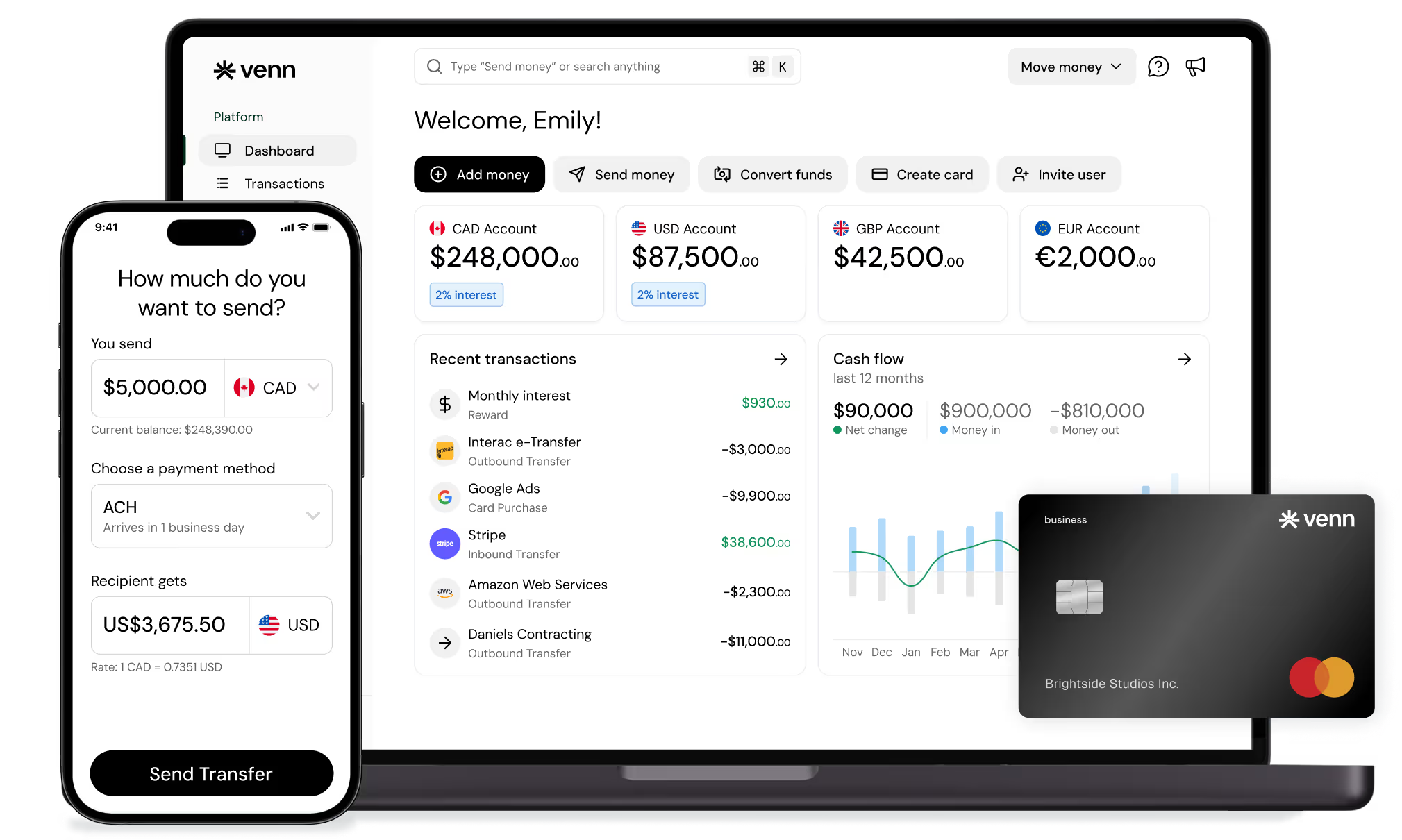
Venn, for example, addresses several of these criteria on the operating side: it offers multi-currency accounts in CAD, USD, GBP, and EUR, QuickBooks and Xero integrations, and a corporate charge card with spend controls. Account balances are held at Bank of Montreal and are eligible for CDIC insurance protection up to applicable limits. Venn is a technology company, not a bank, and is not currently available to businesses in Quebec. Whether those features match your firm's specific needs depends on your practice structure, volume, and existing accounting setup.
No single platform covers every requirement. Most firms end up combining a trust-compliant bank account, a purpose-built operating account or card program, and practice management or accounting software. The goal is a stack where each layer does its job cleanly and the connections between them are auditable.
Conclusion
The strongest financial operations setup for a Canadian law firm is not the one with the most rewards or the lowest monthly fee. It is the one that keeps trust compliance intact while making operating spend, client disbursements, and monthly reconciliation easier to manage.
Start by auditing your current trust-versus-operating workflow. Confirm that retainers flow into trust, that firm expenses run through your general account, and that reimbursable client costs are coded by matter with source documentation attached. Use the checklist in this guide to compare tools against those criteria, and involve your law society guidance, accountant, or legal bookkeeper before making changes to any trust-adjacent process.
For firms reviewing the operating side of their stack, including spend controls, multi-currency vendor payments, and QuickBooks or Xero integrations, Venn is worth evaluating alongside other options. Venn is a technology company; account balances are held at Bank of Montreal and are eligible for CDIC protection up to applicable limits. If tighter operating controls and cleaner reconciliation are on your list, sign up for a Venn account and see whether it fits your firm's workflow.
FAQ
Q: Can a Canadian law firm put retainers on a credit or charge card?
A: Yes, but only if the payment routes directly into a trust-compliant account and the firm follows its law society's rules for trust handling and recordkeeping. Ontario's guidance, for example, requires that retainers paid by card go straight to the designated trust account, not to a general account first. Firms should confirm the specific requirements with their provincial law society before accepting card retainers.
Q: Can a law firm use one card processor for both trust retainers and billed invoices?
A: Not always. Some processor setups only permit one destination account, which creates a compliance problem when trust retainers and billed fees need to land in separate accounts. Ontario's Law Society has specifically flagged this risk, noting that firms must verify their processor can route funds to the correct account type before accepting card payments.
Q: Are all client disbursements exempt from GST/HST?
A: No. CRA treatment depends on whether the firm incurred the cost as agent for the client or otherwise than as agent. Costs incurred as agent are generally not subject to GST/HST on reimbursement, while costs incurred otherwise than as agent can form part of the consideration for a taxable legal service. Firms should confirm the treatment of specific disbursement categories with their accountant or tax advisor.
Q: Do all Canadian provinces use identical trust-account rules?
A: No. The core principles are consistent across Canada, but deadlines, reporting requirements, and procedural mechanics vary by province. Ontario requires monthly trust reconciliations completed within 25 days of month-end, while BC requires reconciliations within 30 days and also mandates annual trust reports. Always verify the current requirements with your own law society.
Q: What should a law firm compare when choosing an operating account or card platform?
A: Prioritize spend controls, accounting integration with tools like QuickBooks or Xero, matter-level expense tracking, reimbursement workflows, compliance support, and audit trail quality. Card rewards are a secondary consideration. A platform that simplifies monthly reconciliation and supports clean matter coding will deliver more operational value than one chosen primarily for cashback rates.
If this article is published with a card image or Mastercard logo in any graphic, the publisher must add the following statement in the legal disclaimer area, outside this FAQ: "Venn Mastercard Charge Card is issued by Peoples Trust Company under licence from Mastercard International Incorporated. Mastercard is a registered trademark, and the circles design is a trademark of Mastercard International Incorporated."
---
**Disclaimer:** This publication is provided for general information purposes and does not constitute legal, tax or other professional advice from Venn Software Inc or its subsidiaries and its affiliates, and it is not intended as a substitute for obtaining advice from a financial advisor or any other professional. We make no representations, warranties or guarantees, whether expressed or implied, that the content in the publication is accurate, complete or up to date.
This publication is provided for general information purposes only and does not constitute legal, tax, financial, or other professional advice from Venn Software Inc., its subsidiaries, or its affiliates, and is not a substitute for advice from a qualified professional. All comparisons and competitor information reflect publicly available information believed accurate as of June 2, 2026; features, pricing, rates, and terms referenced are subject to change and may differ at the time you read this. All product names, logos, and brands referenced are the property of their respective owners; their mention does not imply affiliation with or endorsement by Venn. Any comparative statements reflect Venn's views and are provided to help readers evaluate options. We make no representations, warranties, or guarantees, express or implied, that the content is accurate, complete, or up to date.

Venn is all-in-one business banking built for Canada
From free local CAD/USD accounts and team cards to the cheapest FX and global payments—Venn gives Canadian businesses everything they need to move money smarter. Join 15,000+ businesses today.
Frequently asked questions
Everything you need to know about the product and billing.
Join 15,000+ businesses banking with Venn today
Streamline your business banking and save on your spend and transfers today
No personal credit check or guarantee.