Best Business Bank Account in Canada for Shopify Sellers
Best Business Bank Account in Canada for E-commerce and Shopify Sellers guide. Compare Venn, RBC, TD and more for CAD USD, FX, cards and accounting sync.


Trusted by 15,000+ Canadian businesses
Business banking for Canada
Local CAD and USD accounts, corporate cards with cashback, the lowest FX rates in Canada, free local transfers, and more.
Why Shopify Sellers Outgrow Basic Chequing
For Canadian merchants comparing the best business bank account in Canada for e-commerce and Shopify sellers, the first sign of trouble often appears when Shopify payouts stop feeling simple. A basic business chequing account works when orders are low, expenses are domestic, and one founder manages everything. As volume grows, that same account becomes a bottleneck.
Shopify helps you sell online and accept payments, but it doesn't replace an operating account for day-to-day finance workflows. Your store may receive CAD payouts while your inventory supplier invoices in USD. Ad platforms may bill on a different cycle than Shopify pays out. Contractors, agencies, fulfilment partners, and software apps can all pull cash from the business at different times.
That creates real cleanup work. FX conversion can blur margins on inventory purchases, USD supplier exposure makes cash planning harder when all funds land in CAD, and multiple app charges crowd bank feeds — slowing reconciliation and increasing bookkeeping cleanup at month end.
Once your store has repeat inventory buys, paid acquisition, and external operators to pay, your business account needs to support the way e-commerce cash actually moves.
How We Evaluated the Options
We assessed each option through the lens of a Canadian online store, not a generic small business. A strong Shopify business bank account should fit Canadian incorporation needs and support the way money actually moves across e-commerce operations.
If your store works in CAD and USD, currency handling matters. We looked at whether each provider supports practical multi-currency workflows, how clearly it presents FX costs, and how flexible it is for supplier payments. We also considered whether cards help teams control spend, whether expense tools reduce manual review, and whether accounting sync is part of the workflow rather than an afterthought.
Branch access still matters for some merchants, so traditional banks remain relevant. Digital-first business banking platforms may suit online-first teams better, and international transfer-first tools can help in specific cross-border scenarios. This guide compares fit, fees, and operational complexity rather than naming one universal winner.
Quick Comparison of the Main Options
Venn
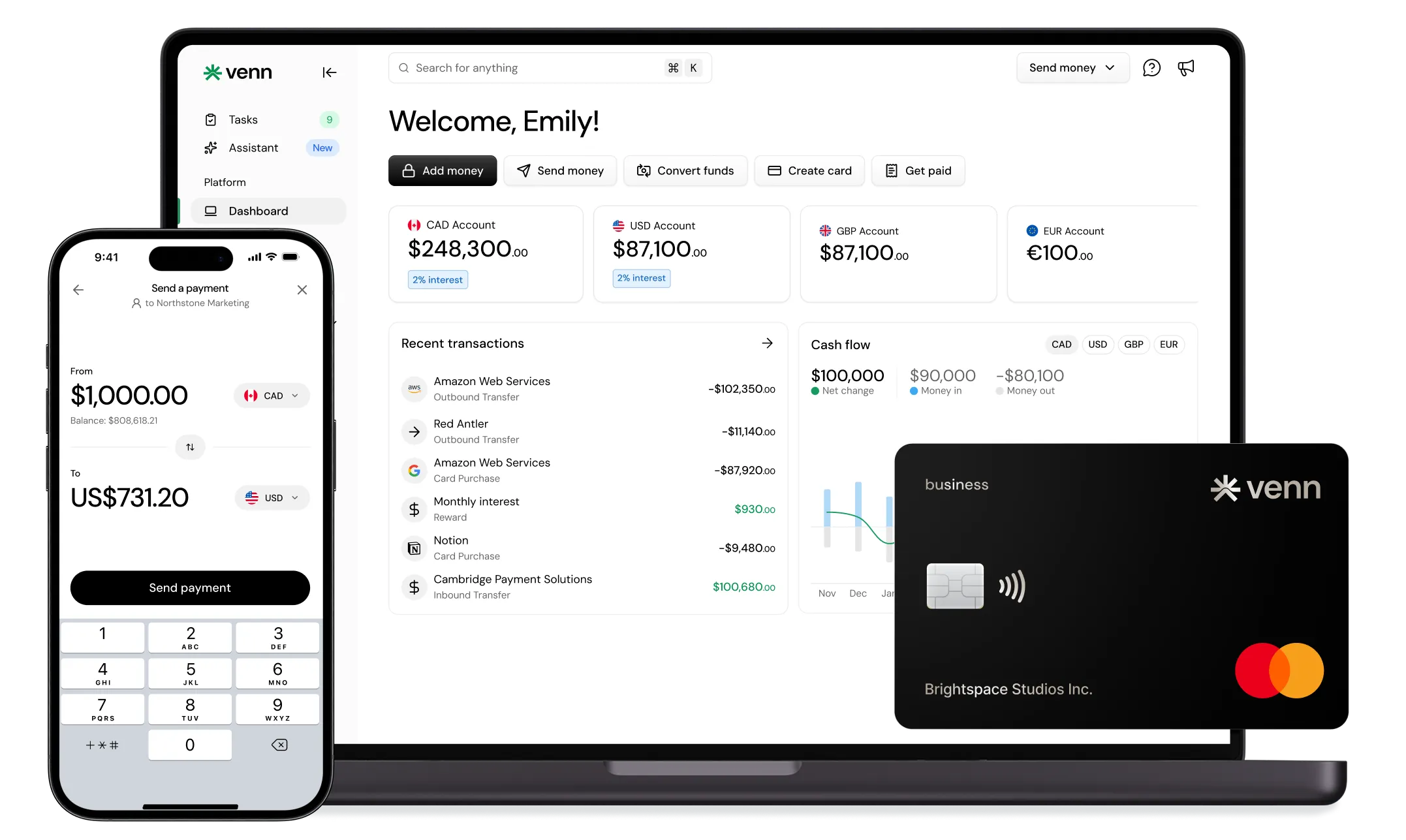
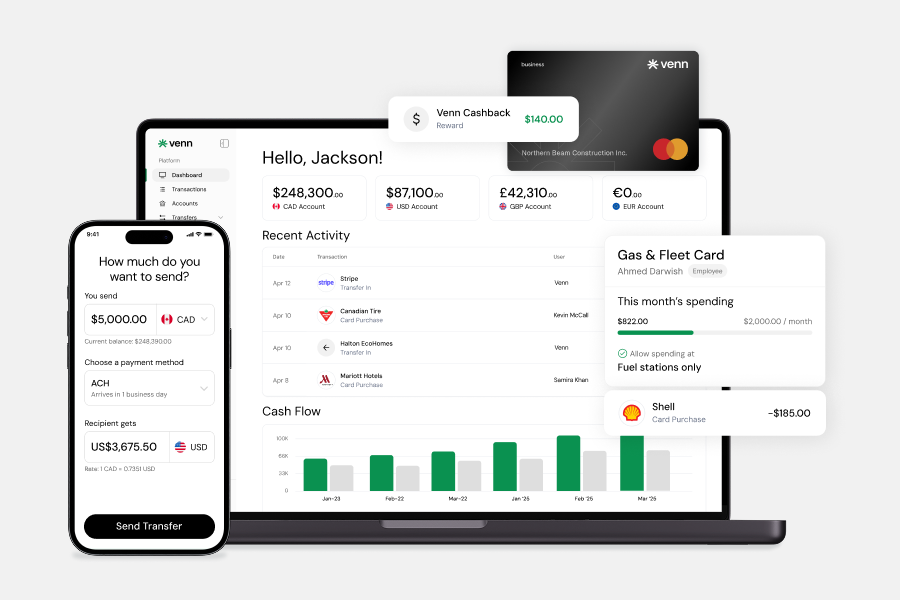
Venn fits Canadian Shopify sellers that want one platform for business accounts and team spend, with cross-border payments and bookkeeping sync built into the same workflow. Venn is a technology company and business banking platform, not a bank.
Multi-Currency Payout Workflows
If your store receives payouts or pays suppliers in more than one currency, Venn supports CAD, USD, GBP, and EUR accounts. You get a real Canadian business account plus a US-domiciled account with ACH for local USD workflows — which matters when Shopify, Stripe, or PayPal payouts need to land in the right currency without unnecessary conversion steps.
FX markups vary by plan: 0.45% on Essentials, 0.35% on Plus, and 0.25% on Pro or Custom.
Cards, Spend Controls, and Cashback
For team purchasing, Venn offers a Mastercard charge card — not credit, not prepaid. Cashback starts at 1% from the first dollar, capped at $5K per month on Essentials and $25K per month on Plus, with unlimited cashback on Pro. Built-in approval workflows and OCR receipt capture help manage ad spend, contractor purchases, and employee expenses with less manual review.
Operations and Fit
Venn includes QuickBooks and Xero two-way sync, payables, invoicing, and free unlimited Interac e-Transfer®. Eligible balances benefit from CDIC insurance protection through Bank of Montreal, a CDIC member, up to applicable limits.
The main limitations: Venn is not available in Quebec, and some advanced integrations are Custom-plan only. It's strongest for merchants that need cross-border and operational tooling, not just a simple domestic account.
RBC
RBC fits sellers who want a familiar traditional bank with branch access, established business banking relationships, and a conventional account structure.
For Canadian Shopify merchants, that familiarity can matter. If you already work with RBC for lending, merchant services, or day-to-day business banking, keeping your Shopify payouts in the same ecosystem may simplify relationship management. Branch support also helps if your team prefers in-person service for account setup, documentation, or broader financial planning.
Pricing depends on the selected business account package, transaction volume, and add-on services, so review current RBC fees before choosing. As with other Big 5 banks, foreign exchange costs can be materially higher than specialist multi-currency options, with FX markups that can reach up to 3%.
The main limitation for cross-border e-commerce is operational friction. Shopify sellers paying USD suppliers or building larger USD workflows may find that traditional US account setups route over SWIFT rather than behaving like a local ACH-first setup. RBC is strongest for sellers who value branch access and relationship banking more than low-friction international payments.
BMO
BMO fits Canadian e-commerce businesses that want a mainstream bank relationship for straightforward domestic operations.
For a Shopify seller with mostly Canadian sales, CAD payouts, and simple supplier payments, BMO can be a practical choice. The appeal is familiarity: established banking infrastructure, a conventional account setup, and a provider many owners already know. If your payment flow starts and ends in CAD, that simplicity may matter more than advanced global tooling.
Specific fees, transaction allowances, and account packaging should be checked against current BMO terms before you decide, since traditional banks often structure business account costs around usage.
The tradeoff appears as your store adds USD suppliers, international contractors, or broader cross-border needs. FX conversion becomes a larger cost variable, inbound wires can add friction, and USD payout workflows may require extra products or more manual oversight.
TD
TD may suit smaller Shopify and e-commerce sellers that want a familiar, conventional business account and expect most money movement to stay within Canada.
For an earlier-stage online store, that simplicity is useful. If your Shopify payouts arrive in CAD, your suppliers invoice domestically, and your team doesn't need complex approval workflows, a traditional account structure can cover the basics without adding operational overhead.
Costs and account packaging vary by plan, so confirm current TD fees, transaction limits, card options, and international payment terms before choosing. The tradeoff becomes clearer as order volume grows — particularly when you receive revenue in one currency and pay inventory, apps, or contractors in another. As your store adds USD suppliers or more frequent supplier payments, compare TD's domestic banking fit with the multi-currency and automation-focused options covered elsewhere in this guide.
Scotiabank
Scotiabank fits businesses that want full-service traditional banking, branch-based support, and a familiar relationship-banking model.
For established merchants, that structure can be valuable. If your finance team prefers in-person conversations for account setup, lending discussions, or cash management, Scotiabank can feel more aligned than an online-only option. It may also suit operators who already work with advisors and want their e-commerce business bank account connected to a broader financial relationship.
Review current monthly fees, transaction charges, and service bundles directly with Scotiabank before choosing, since pricing can change and account fit often depends on transaction volume.
The tradeoff becomes clearer as a Shopify store scales. Online-first sellers often need faster global workflows, tighter card controls for ad spend, and cleaner software connections for reconciliation — and cost sensitivity rises when inventory purchases and cross-border payments become routine. This option best fits merchants that value in-person service more than digital-first operating speed.
Wise Business
Wise Business is best for sellers that mainly need a business account for international payments, currency conversion, and cross-border e-commerce banking.
If your Shopify store pays overseas suppliers or receives funds from customers outside Canada, Wise Business often enters the shortlist because of its transparent FX and global payment workflows. It can be a practical fit when your finance problem is focused: move money between currencies, hold balances where supported, and reduce the guesswork around conversion costs.
Pricing and availability should be checked directly on Wise's Canadian site before you decide, since fees, supported currencies, card access, and local account details can change.
The main tradeoff is scope. Wise Business functions more like a cross-border money movement tool than a complete operating stack. If you also need spend management, payables, invoicing, or bookkeeping workflows, compare it with platforms built to handle more of your daily finance operations.
How to Choose the Right Account for Your Store
Start with your money flow, not the logo on the account. The best bank account for Shopify depends on where your revenue lands, where your costs leave, and how much finance work your team handles each month.
If most Shopify payouts arrive in CAD and your expenses stay in CAD, a traditional bank may be enough. This works well for a founder selling mainly to Canadian customers, paying local contractors, and buying inventory domestically — where branch access, familiar online banking, and simple bookkeeping matter more than advanced cross-border tools.
If you get paid in one currency and pay suppliers in another, look harder at a CAD/USD or broader multi-currency business account. A store receiving CAD Shopify payouts but paying a US distributor, a UK manufacturer, or overseas freight partners can lose time and margin to repeated conversions. Use the comparison table above to check which options support the currencies and payment routes you actually use.
Team spend changes the decision again. Once one founder no longer owns every Meta, Google, shipping, and app subscription charge, you need cleaner control. If employees, freelancers, or media buyers need cards, choose a provider that supports spend ownership and approvals — not just a single debit card tied to the operating account.
Bookkeeping should carry real weight in your decision. If month-end means matching Shopify payouts, ad platform charges, supplier payments, refunds, and contractor invoices line by line, prioritize platforms with strong QuickBooks or Xero reconciliation. Easier accounting sync can save hours and reduce cleanup before tax time.
Branch access still matters for some merchants. If you regularly need in-person service or broader relationship banking, a traditional bank may justify less FX efficiency — and that tradeoff can be reasonable for a domestic retailer with stable processes.
For side-hustle sellers becoming operating businesses, reassess early. Inventory deposits, contractors, ad budgets, USD suppliers, and separate approval steps often appear before revenue feels "big." At that point, compare a traditional bank, a multi-currency business banking platform, and an international transfer-first tool based on your next 12 months of workflow, not last year's simplicity.
Conclusion
The best business bank account in Canada for e-commerce and Shopify sellers depends on how money moves through your store. Start with your payout currencies, then look at where your suppliers are based, how your team spends, whether you need branch access, and how cleanly transactions flow into your bookkeeping system.
For some merchants, a traditional bank remains a strong fit — familiar service, established relationships, and in-person support can matter more than multi-currency flexibility, especially for stores with mostly domestic sales and expenses. For others, a modern business banking platform becomes more useful as cross-border operations, team cards, approval workflows, and bookkeeping integrations move from "nice to have" to daily operating needs.
Venn fits into that second category for Canadian businesses that want a digital-first operating account experience alongside software-driven controls, as outlined above. Before opening or switching accounts, compare each option by workflow, not brand familiarity alone. Sign up for Venn
Frequently Asked Questions
Q: Do Shopify sellers need a separate business account?
A: Yes, a separate Shopify business bank account helps keep store revenue distinct from supplier payments, taxes, refunds, ad spend, and day-to-day operating expenses. If your business is incorporated, keeping business and personal finances separate supports cleaner records and reduces confusion during bookkeeping or tax preparation.
Q: What is the difference between Shopify Payments and a business account?
A: Shopify Payments processes customer transactions and sends payouts to your connected account. A business account is where you receive those payouts, pay suppliers, manage operating cash, issue team cards where available, and reconcile your books. For most sellers, Shopify handles the checkout flow while the business account supports the finance workflow behind the store.
Q: Is a multi-currency business account worth it for a Canadian store?
A: It depends on how your store receives, holds, converts, or spends money. If you sell mainly in CAD and pay expenses in CAD, a simple e-commerce business bank account may be enough. If you receive USD payouts, pay international suppliers, or manage cross-border e-commerce banking needs, review the provider sections above for platform-specific multi-currency details.
Q: What should I look for if I pay USD suppliers from Canada?
A: Start with how the account receives and sends USD, since local payment options can reduce friction compared with more manual international transfer workflows. Look at FX transparency, available transfer methods, supplier payment timing, and how clearly each transaction appears in your bookkeeping. The comparison table and provider sections above can help you narrow the fit without relying on brand familiarity alone.
Q: Do I need a card with spend controls for my e-commerce team?
A: Spend controls become useful when more than one person manages paid ads, software subscriptions, inventory purchases, or contractor expenses. As your team grows, approvals and receipts become harder to track manually, especially across multiple employees, suppliers, and payment platforms. Cards with spending limits, transaction notifications, and receipt-capture features can improve expense visibility and simplify reconciliation.
Legal Disclaimer
This publication is provided for general information purposes only and does not constitute legal, tax, financial, or other professional advice from Venn Software Inc., its subsidiaries, or its affiliates, and is not a substitute for advice from a qualified professional. All comparisons and competitor information reflect publicly available information believed accurate as of October 22, 2026; features, pricing, rates, and terms referenced are subject to change and may differ at the time you read this. All product names, logos, and brands referenced are the property of their respective owners; their mention does not imply affiliation with or endorsement by Venn. Any comparative statements reflect Venn's views and are provided to help readers evaluate options. We make no representations, warranties, or guarantees, express or implied, that the content is accurate, complete, or up to date.
---
**Disclaimer:** This publication is provided for general information purposes only and does not constitute legal, tax, financial, or other professional advice from Venn Software Inc., its subsidiaries, or its affiliates, and is not a substitute for advice from a qualified professional. All comparisons and competitor information reflect publicly available information believed accurate as of October 22, 2026; features, pricing, rates, and terms referenced are subject to change and may differ at the time you read this. All product names, logos, and brands referenced are the property of their respective owners; their mention does not imply affiliation with or endorsement by Venn. Any comparative statements reflect Venn's views and are provided to help readers evaluate options. We make no representations, warranties, or guarantees, express or implied, that the content is accurate, complete, or up to date.

Venn is all-in-one business banking built for Canada
From free local CAD/USD accounts and team cards to the cheapest FX and global payments—Venn gives Canadian businesses everything they need to move money smarter. Join 15,000+ businesses today.
Frequently asked questions
Everything you need to know about the product and billing.
Join 15,000+ businesses banking with Venn today
Streamline your business banking and save on your spend and transfers today
No personal credit check or guarantee.