Best Business Bank Account for Ecommerce in Canada (2026)
Compare multi-currency business accounts, FX rates, Shopify integration, and cashback for Canadian ecommerce businesses. See which account saves the most on USD payouts.

Ahmed Shafik
Co-founder
.png)
Trusted by 15,000+ Canadian businesses
Business banking for Canada
Local CAD and USD accounts, corporate cards with cashback, the lowest FX rates in Canada, free local transfers, and more.
Running a Canadian ecommerce business means watching profits disappear to unnecessary banking fees. Between FX markups on US sales, payment platform conversion charges, and outdated banking infrastructure, online retailers lose thousands annually to financial friction that shouldn't exist. With Canada's ecommerce market reaching US$89.4 billion in 2024, the scale of these preventable losses is significant.
Ecommerce banking requires specific capabilities that traditional accounts weren't designed to handle. You need multi-currency accounts to receive Shopify and Stripe payouts without conversion penalties. You need seamless integration with payment platforms processing hundreds of monthly transactions. You need competitive FX rates when 60-70% of your revenue comes from US customers.
This guide compares Canada's top business banking options through an ecommerce lens. We'll examine traditional banks, fintech alternatives, and specialized platforms built for online retail. You'll see exactly which accounts support multi-currency operations, offer payment gateway integration, provide competitive FX rates, and reward the high monthly spend typical of growing ecommerce businesses.
Why Ecommerce Businesses Need Specialized Banking Solutions
Most Canadian online retailers generate significant revenue from US customers, use USD-based payment platforms, and pay for inventory, software, and advertising in multiple currencies. Traditional business banking ignores these realities, forcing expensive workarounds that erode already-thin margins.
The hidden costs compound quickly. When Shopify or Stripe sends USD payouts to your CAD-only account, you lose 2.5-3% to bank FX markups. Add Stripe's 1.5% cross-border fee for international card payments, and you're sacrificing 4%+ of gross revenue before accounting for any operational costs. For businesses processing $50,000 monthly, that's $2,000 disappearing to preventable fees.
Ecommerce-optimized banking eliminates these friction points. Real USD, EUR, and GBP accounts let you receive international payouts without conversion. Native integration with Shopify, Stripe, and PayPal automates reconciliation for high transaction volumes. Cashback on corporate cards returns money on the $10,000-$100,000+ you spend monthly on Facebook Ads, inventory, and software subscriptions.
What To Look For in an Ecommerce Business Bank Account
Not all business accounts are created equal, and generic banking features rarely align with ecommerce operational needs. The right account should reduce your costs, automate your workflows, and scale with your sales volume.
Focus on features that directly impact your bottom line. Multi-currency accounts eliminate conversion fees on international sales. Native payment platform integration automates reconciliation. Low FX rates save thousands on cross-border transactions. Cashback returns money on your largest expense categories.
Consider your current and projected sales channels. If you're selling to US customers (or planning to), USD account capability is non-negotiable. If you're running paid advertising, cashback on high monthly card spend matters significantly. If you're processing 100+ transactions monthly, accounting automation saves hours of manual work.
Key Features to Prioritize:
• Multi-currency accounts: Real local CAD, USD, and ideally EUR/GBP accounts to receive payouts without conversion fees
• Payment platform integration: Native Shopify, Stripe, and PayPal connectivity to automate payout deposits and reconciliation
• FX rates: Look for 0.25%-0.6% markup, not the 2.5%-3% charged by traditional banks
• Cashback or rewards: 1% unlimited cashback can return $500-$5,000+ monthly on typical ecommerce spend
• Accounting automation: Two-way sync with QuickBooks or Xero to eliminate manual transaction categorization
• Transaction limits: Unlimited or high-volume transaction allowances for daily payouts and supplier payments
• Card features: Multi-currency cards that auto-select payment currency to avoid unnecessary FX fees on international subscriptions
Comparison Table: Ecommerce Banking Options at a Glance
1. Venn (Best Overall for Cross-Border Ecommerce and Multi-Currency Operations)
Purpose-built financial platform for modern Canadian ecommerce businesses
Best For: Ecommerce businesses selling internationally, Shopify/Stripe users, and online retailers with significant US customer base
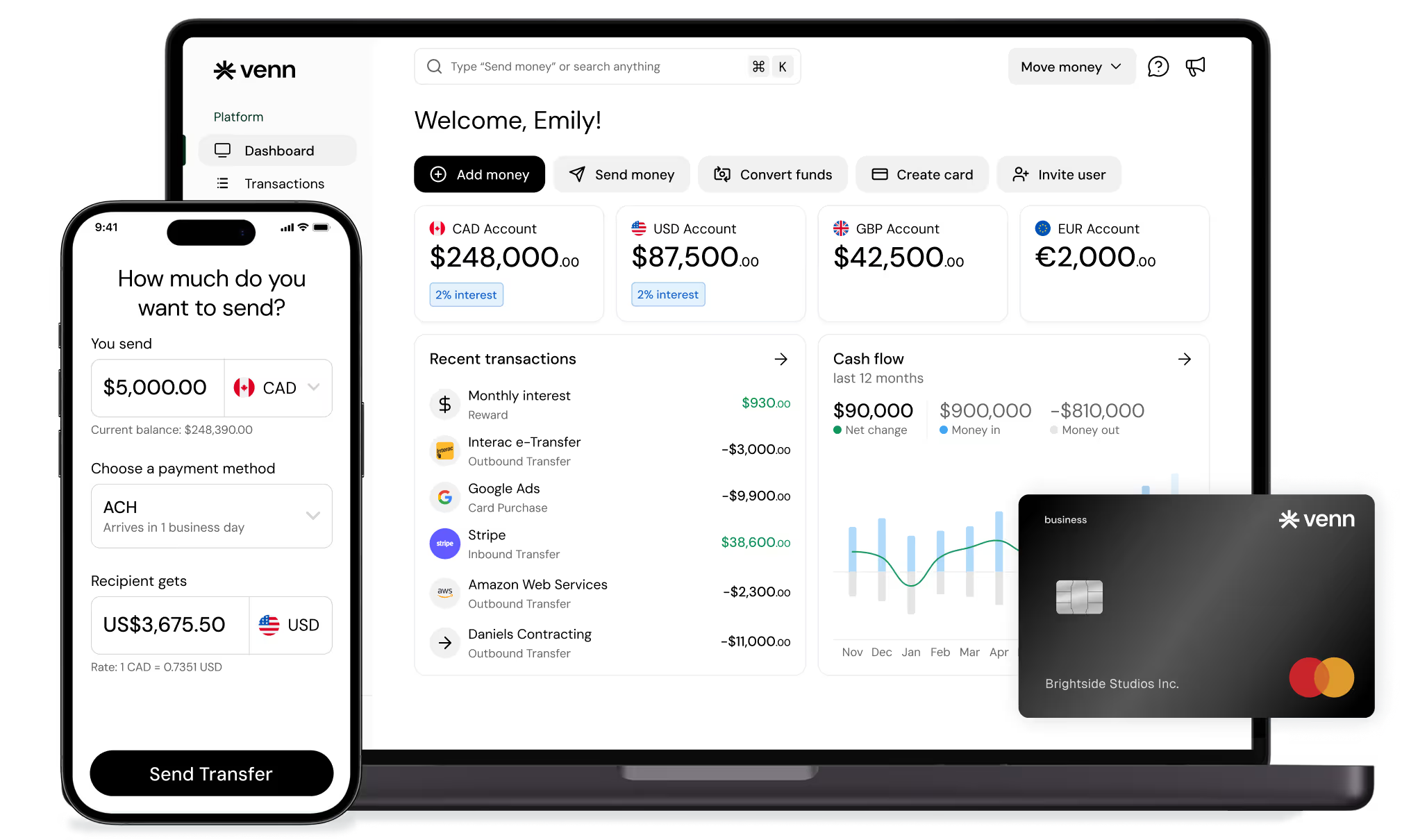
Venn stands alone as the only platform built specifically to solve ecommerce banking challenges. The platform provides real local USD accounts that can send and receive ACH transfers, not virtual accounts that still trigger cross-border fees. This capability lets you receive Shopify and Stripe payouts as true domestic US transfers, eliminating the 1.5% Stripe cross-border fee and 2.5-3% bank FX markup that costs Canadian ecommerce businesses thousands monthly.
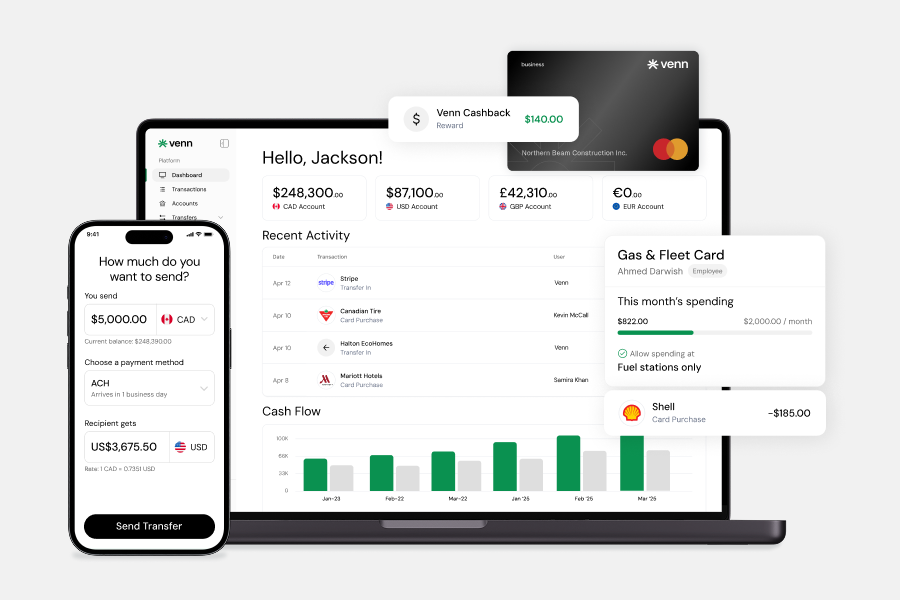
Beyond multi-currency accounts, Venn integrates your entire financial workflow. Native Shopify, Stripe, and PayPal integration means payouts deposit automatically and reconcile in your accounting software. Multi-currency corporate cards automatically pay in the currency you're being charged, saving FX fees on Facebook Ads, Google Ads, and international software subscriptions. You earn 1% unlimited cashback on all spend, returning significant value on the $5,000-$50,000+ monthly expenses typical for growing ecommerce businesses. You also earn up to 2.75% on CAD and 3.5% on USD balances (learn more), putting idle cash to work between payouts.
Features:
• Real local CAD, USD, GBP, and EUR accounts
• Mobile app for on-the-go finance control
• Receive Shopify/Stripe/PayPal payouts without FX conversion
• 0.25%-0.45% FX rates (lowest in Canada)*
• 1% unlimited cashback on all card spend
• Free unlimited Interac e-Transfers®
• Native integration with QuickBooks and Xero
• Multi-currency cards that auto-select payment currency
• up to 2.75% on CAD and 3.5% on USD balances (learn more)
• $0 monthly fee option available
2. Wise Business (Best for International Transfers)
Multi-currency platform for international payments
Best For: Ecommerce businesses focused primarily on international supplier payments with minimal domestic Canadian operations
Wise excels at holding and converting between 40+ currencies with transparent, mid-market FX rates. For ecommerce businesses paying international suppliers or manufacturers, Wise offers a cost-effective way to manage multi-currency inventory purchases.
However, Wise has significant limitations for Canadian ecommerce operations. No Interac e-Transfer® support means you can't easily move money to Canadian suppliers or pay yourself. No native Shopify or Stripe integration requires manual transfers. No cashback means you're missing rewards on substantial monthly software and advertising spend. It works as a supplementary tool but not as your primary business account.
Features:
• Hold 40+ currencies in one account
• Mid-market FX rates (~0.4%-0.6% fee)
• Local account details for USD, EUR, GBP
• Accounting software integration available
• No monthly account fees
• No Interac e-Transfer® support
• No cashback or card rewards
• Manual Shopify/Stripe payout transfers required
3. RBC Digital Choice Business Account
Traditional bank option for domestic-focused sellers
Best For: Ecommerce businesses selling exclusively in Canada with low international transaction needs
RBC's digital account offers unlimited electronic transactions for $6 monthly, which works for high-volume domestic operations. If you're running a Canada-only Shopify store and receiving CAD payouts, this provides basic functionality.
The limitations become costly for any international operations. No included USD account means opening a separate product with additional fees. FX markups of 2.5-3% make receiving USD payouts expensive. No Shopify or accounting integrations mean manual reconciliation for potentially hundreds of monthly transactions. No cashback means missing significant returns on the $5,000-$50,000+ monthly spend typical for growing ecommerce businesses.
Features:
• $6 monthly fee
• Unlimited electronic transactions
• 10 free Interac e-Transfers® monthly
• CAD account only (separate USD account required)
• 2.5%-3% FX markup on conversions
• No payment platform integrations
• No accounting automation
• No cashback or rewards
4. TD Basic Business Plan
Minimal option for very low-volume sellers
Best For: Side-hustle ecommerce or very early-stage sellers processing fewer than 5 transactions monthly
The TD Basic Business account only makes sense for the smallest operations. At $5 monthly with just 5 included transactions, costs escalate quickly for any meaningful ecommerce activity. When you're processing daily Shopify payouts, paying suppliers, running payroll, and managing software subscriptions, you'll exceed the transaction limit immediately. Add 2.5-3.5% FX fees, no USD account, no integrations, and no cashback, and this becomes one of the most expensive options for active ecommerce businesses.
Features:
• $5 monthly fee
• Only 5 included transactions ($1.25 each additional)
• No free Interac e-Transfers®
• CAD only (no USD account option)
• 2.5%-3.5% FX markup
• No platform integrations
• No rewards program
5. BMO eBusiness Plan
No-fee option with limited ecommerce functionality
Best For: Domestic ecommerce businesses with all-electronic operations and no international sales
BMO's $0 monthly fee and unlimited electronic transactions initially appear attractive for ecommerce operations. If you're running a domestic-only online store with CAD-only transactions, this covers basic account functionality without monthly costs.
The value proposition breaks down for any international ecommerce activity. Each Interac e-Transfer® costs $1.50, which adds up when paying Canadian suppliers or contractors. The ~2.9% FX markup makes USD Shopify payouts expensive. No multi-currency accounts, no Shopify integration, and no cashback mean you're paying more and earning less compared to ecommerce-optimized alternatives.
Features:
• $0 monthly fee
• Unlimited electronic transactions
• $1.50 per Interac e-Transfer®
• CAD only (separate USD account required)
• ~2.9% FX markup
• No payment platform integration
• No accounting automation
• No cashback rewards
6. Scotiabank Select Account for Business (Unlimited Plan)
Premium pricing without modern ecommerce features
Best For: Large traditional businesses willing to maintain $75K+ daily balance
At $120 monthly (waivable with $75K average balance), this account targets established businesses with substantial capital. While unlimited transactions work for high-volume operations, the lack of ecommerce-specific features makes this a poor fit for online retailers. No multi-currency accounts, no Shopify or Stripe integration, no accounting automation, 2.5-3% FX fees, and no cashback mean you're paying premium prices for outdated infrastructure. Most growing ecommerce businesses can't maintain $75K in a non-interest-bearing account, making the effective cost prohibitive.
Features:
• $120 monthly fee (waivable with $75K balance)
• Unlimited transactions and Interac e-Transfers®
• CAD account (separate USD account available)
• 2.5%-3% FX markup
• No payment platform integrations
• No accounting automation
• No cashback program
• In-branch support available
How Venn Solves the Biggest Ecommerce Banking Challenges
Scaling an ecommerce business creates operational complexity that most banking platforms weren't designed to handle. Venn consolidates these workflows into a single platform.
Pay Canadian suppliers via free unlimited Interac e-Transfers®, and send international wire transfers for $6-$10 (vs. $30-$50 at traditional banks). Run payroll, pay taxes, and manage team expenses with virtual and physical cards that provide spending controls and real-time visibility. On mobile, you can access funds, send transfers, and issue cards from your phone for day-to-day spending and payout management.
Everything syncs automatically with QuickBooks or Xero, eliminating hours of monthly reconciliation work. You get complete financial operations in one platform, not fragmented services across multiple providers.
Learn more about Venn's pricing, Global Accounts, and Corporate Cards.
Frequently Asked Questions
Q: What is the best bank account for a Shopify business in Canada?
A: Venn offers the most complete solution for Shopify merchants, including real USD accounts that receive payouts without conversion fees, native Shopify integration for automated reconciliation, and 1% unlimited cashback on business spending. Many Shopify stores save $10,000-$20,000 per year compared to traditional banking.
Q: Can I receive Shopify payouts directly in USD?
A: Yes. With Venn's real local USD account, Shopify payouts arrive as domestic US ACH transfers. This eliminates Stripe's 1.5% cross-border fee and your bank's 2.5-3% FX markup, saving more than 4% on all USD revenue.
Q: How much do FX fees cost Canadian ecommerce businesses?
A: Traditional banks charge 2.5-3% FX markup. A Shopify store processing $30,000/month in USD sales pays $750-$900 in FX fees alone. Combined with Stripe's 1.5% cross-border fee, total monthly costs exceed $1,350, or more than $16,000 annually.
Q: Does Venn integrate with Shopify and Stripe?
A: Yes. Venn provides native integration with Shopify, Stripe, and PayPal. Payouts automatically sync to your multi-currency accounts and accounting software, removing manual reconciliation for high-volume ecommerce operations.
Q: What's the difference between a real USD account and a virtual USD account?
A: A real USD account, like the one Venn provides, can send and receive ACH transfers as domestic US transactions. Virtual USD accounts from most Canadian banks still rely on SWIFT, triggering cross-border fees and requiring expensive wire transfers for US payments.
Q: Should I use a fintech or a traditional bank for my ecommerce business?
A: Fintechs typically offer multi-currency accounts, lower FX rates, and native platform integrations that traditional banks lack. Many ecommerce businesses use a fintech as their primary operating account and keep a traditional bank for branch access or credit products.
Q: Can I use two bank accounts together for my ecommerce business?
A: Yes. A common setup pairs a multi-currency fintech account for international payouts and FX savings with a traditional bank for credit lines or branch services. Venn works well as the primary account in this arrangement, handling day-to-day operations while a traditional bank covers lending needs.
Funds held with Venn are covered under CDIC insurance protection.
Venn Mastercard Charge Card is issued by Peoples Trust Company under licence from Mastercard International Incorporated. Mastercard is a registered trademark, and the circles design is a trademark of Mastercard International Incorporated.
---
**Disclaimer:** This publication is provided for general information purposes and does not constitute legal, tax or other professional advice from Venn Software Inc or its subsidiaries and its affiliates, and it is not intended as a substitute for obtaining advice from a financial advisor or any other professional. We make no representations, warranties or guarantees, whether expressed or implied, that the content in the publication is accurate, complete or up to date.
This publication is provided for general information purposes only and does not constitute legal, tax, financial, or other professional advice from Venn Software Inc., its subsidiaries, or its affiliates, and is not a substitute for advice from a qualified professional. All comparisons and competitor information reflect publicly available information believed accurate as of March 5, 2026; features, pricing, rates, and terms referenced are subject to change and may differ at the time you read this. All product names, logos, and brands referenced are the property of their respective owners; their mention does not imply affiliation with or endorsement by Venn. Any comparative statements reflect Venn's views and are provided to help readers evaluate options. We make no representations, warranties, or guarantees, express or implied, that the content is accurate, complete, or up to date.

Venn is all-in-one business banking built for Canada
From free local CAD/USD accounts and team cards to the cheapest FX and global payments—Venn gives Canadian businesses everything they need to move money smarter. Join 15,000+ businesses today.
Frequently asked questions
Everything you need to know about the product and billing.
Join 15,000+ businesses banking with Venn today
Streamline your business banking and save on your spend and transfers today
No personal credit check or guarantee.