Best Bank Account for Canadian Amazon Sellers 2026
Best Bank Account for Canadian Amazon Sellers comparison for 2026. See USD ACH receiving, low FX spreads, supplier payments, and QuickBooks Xero integration.

Ahmed Shafik
Co-founder
Trusted by 15,000+ Canadian businesses
Business banking for Canada
Local CAD and USD accounts, corporate cards with cashback, the lowest FX rates in Canada, free local transfers, and more.
Best Bank Account for Canadian Amazon Sellers (2026 Comparison Guide)
Running a profitable Amazon business from Canada means fighting battles on multiple fronts. You're competing for the Buy Box, optimizing listings, managing inventory, and handling customer service. The last thing you need is your banking setup quietly draining your margins through FX spreads, wire fees, and reconciliation headaches.
Yet that's exactly what happens to most Canadian Amazon sellers. Every USD payout that converts at a 2.5% spread instead of 0.4% chips away at profitability. Every $25 wire fee to pay a supplier adds up. Every hour spent manually reconciling payouts, fees, and refunds is time not spent growing your business.
This guide breaks down the best bank accounts for Canadian Amazon sellers in 2026, focusing on what actually matters: USD receiving capabilities, FX costs, supplier payment options, and bookkeeping integration. You'll find a comparison table, "best for" recommendations, a real cost example, and a practical decision framework to choose the right setup for your operation.
Quick Picks: The Best Options at a Glance
• Best overall financial stack for Canadian Amazon sellers: Venn. Multi-currency accounts, local USD with ACH capability, 1% unlimited cashback, and QuickBooks/Xero integration in one platform.
• Best for simple low-volume FX conversions: Wise Business. Transparent pricing for occasional currency conversions and international transfers.
• Best for complex global treasury operations: Airwallex. Multi-entity support and global collection accounts for sellers operating across many marketplaces.
• Best if you want traditional branch banking: RBC, TD, or Scotiabank. In-person service and lending relationships, though cross-border friction remains.
• Best for teams focused on corporate card controls: Float. Spend management features for larger teams with multiple cardholders.
Comparison Table: Features That Matter for Canadian Amazon Sellers
Note: Verify current pricing and features directly with each provider, as terms change frequently.
What Canadian Amazon Sellers Actually Need From a "Bank Account"
Clean Separation: Payouts, Taxes, Operating Cash, Inventory
Smart Amazon sellers don't run everything through one account. A clean structure makes tax time easier, cash flow clearer, and audits painless.
Consider organizing your finances into distinct buckets: a payout account for receiving Amazon disbursements (ideally in USD), an operating CAD account for payroll and overhead, a tax set-aside account where you park HST/GST and income tax obligations, and a supplier payments account for inventory purchases and 3PL fees.
This separation isn't about complexity for its own sake. When your accountant asks "how much did you actually spend on inventory last quarter?" you should be able to answer in seconds, not hours.
USD Receiving That Behaves Like "Local" USD
Here's where most Canadian sellers get confused. Amazon offers different payout options depending on your marketplace and settings. For Amazon.com sales, you can often receive payouts in USD, but the details matter enormously.
A "local USD account" means you have account details that look like a regular American bank account: a routing number and account number that can receive ACH transfers. This is different from a Canadian USD account that receives funds via SWIFT wire, which costs more and takes longer.
Amazon typically asks for your bank's name, account number, and routing number (for US) or SWIFT/BIC code (for international wires). The specific requirements appear in Seller Central under your deposit method settings.
The key distinction: ACH transfers between US accounts typically cost nothing or just a few dollars. SWIFT wires into a Canadian USD account often incur $15-25 in receiving fees, even for a "US to US" transfer, because the Canadian bank is using international wire infrastructure.
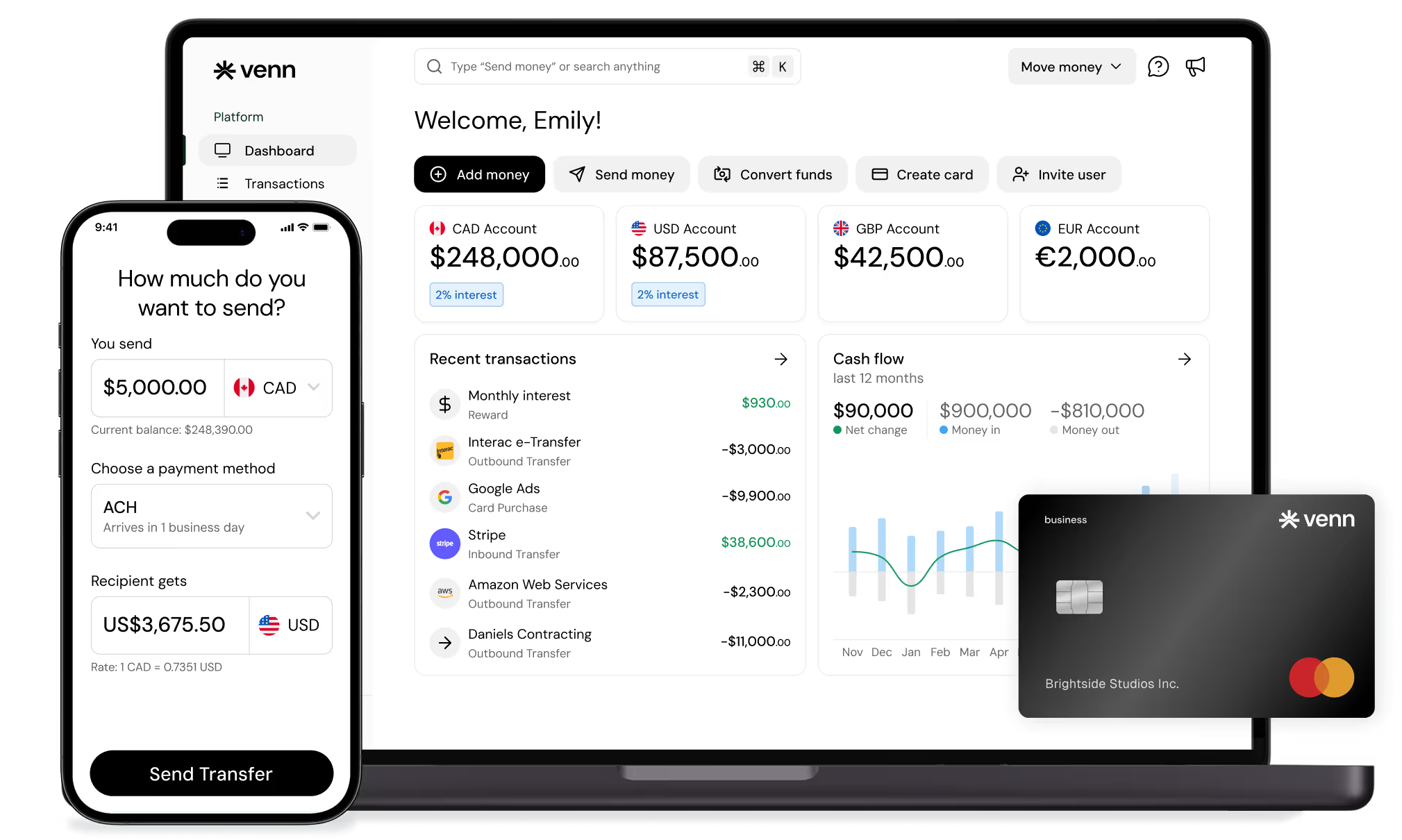
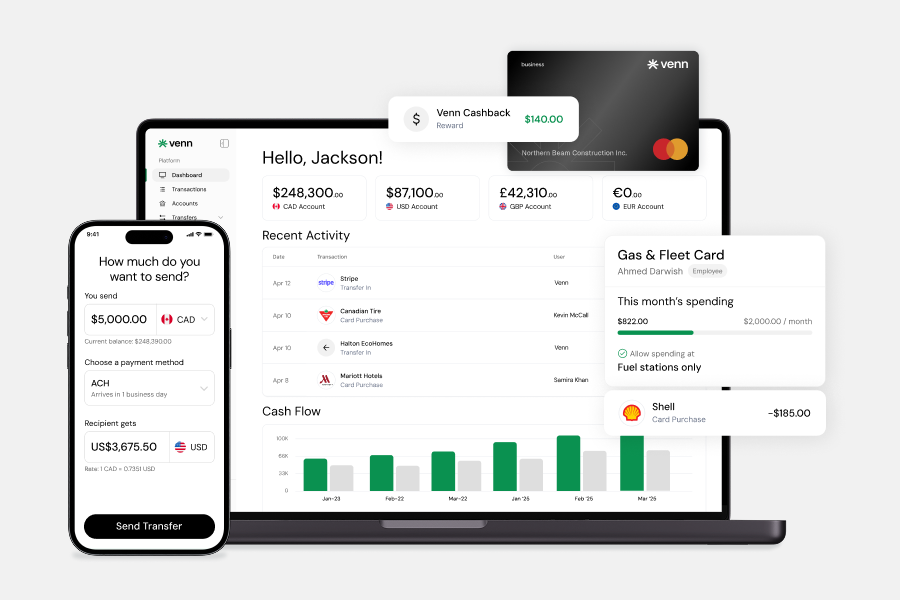
Venn provides Canadian sellers with a real local US account capable of sending and receiving ACH. This capability is rare among Canadian financial providers and eliminates the wire fee friction that eats into margins.
FX Math: Why Spreads Quietly Crush Margins
Foreign exchange costs hide in plain sight. Your bank might advertise "no FX fees" while adding a 2.5% spread to the mid-market rate. On $50,000 in monthly USD revenue, that's $1,250 gone, every single month.
The math is simple but the impact compounds. A seller converting $600,000 USD annually at a 2.5% spread loses $15,000 to FX. The same seller using a 0.4% spread loses $2,400. That $12,600 difference could fund a new product launch, additional inventory, or simply flow to the bottom line.
Total Cost Example: A Typical Canadian Amazon Seller Month
Let's examine a realistic scenario. A Canadian seller does $50,000 USD in Amazon.com payouts monthly, pays $20,000 USD to suppliers and 3PLs, and converts the remaining $30,000 to CAD for payroll, rent, and taxes.
Traditional Big 5 Bank Setup:
• Receiving fee (SWIFT wire): $17
• FX conversion on $30,000 at 2.5% spread: $750
• Outbound wire to US supplier: $45
• Monthly total: ~$812
Venn Setup:
• Receiving fee (ACH): $0
• FX conversion on $30,000 at 0.35% spread: $105
• Outbound ACH to US supplier: $0-2
• Monthly total: ~$107
The difference: approximately $700 per month, or $8,400 annually. This doesn't account for time savings from automated reconciliation or the 1% cashback on card spend for advertising, software, and shipping supplies.
Note: Verify current pricing with each provider. FX spreads and fees change based on account type, volume, and market conditions.
The Best Bank Accounts for Canadian Amazon Sellers
1) Venn (Best Overall Stack for Canadian Amazon Sellers)
Venn stands out because it addresses the complete financial workflow Canadian Amazon sellers face, not just one piece of the puzzle.
Multi-Currency Operations
The platform provides local CAD and USD account functionality, with the USD account capable of sending and receiving ACH. This means Amazon payouts arrive without wire fees, and paying US-based suppliers or 3PLs costs $0-2 instead of $25-45 per wire.
For sellers expanding into European marketplaces, Venn also offers local GBP and EUR accounts with SEPA and Faster Payments capability. These local rails are cheaper and faster than international wires.
Card and Spend Management
The Venn card delivers 1% unlimited cashback on all spend, with no minimum thresholds to hit. For Amazon sellers spending heavily on PPC advertising, shipping supplies, software subscriptions, and inventory tools, this adds up quickly.
The card is multi-currency and automatically uses the currency you're paying in first. Buying from a US supplier? The card pulls from your USD balance without forcing a conversion. This automatic currency matching prevents unnecessary FX fees that other cards trigger.
Bookkeeping Integration
QuickBooks and Xero compatibility means transactions flow automatically into your accounting system. Receipt capture and invoice matching through OCR reduce manual data entry. For sellers who dread monthly reconciliation, this automation is transformative.
Practical Considerations
Venn serves Canadian businesses in all provinces except Quebec. Match your plan level to your payment volume, as wire and ACH costs vary by tier. The platform works best for sellers who want one unified system rather than stitching together multiple point solutions. For day-to-day cash management, the mobile app lets you send transfers, check available funds, and issue new cards from your phone.
Free, unlimited Interac e-Transfer® on all plans handles Canadian vendor payments without per-transaction fees.
2) Wise Business (Best for Simple Conversions and Lightweight Multi-Currency)
Wise Business offers transparent FX pricing and multi-currency holding capabilities that work well for sellers with straightforward needs.
Strengths
The platform clearly displays fees before each transaction, making cost comparison easy. Holding balances in multiple currencies and converting when rates are favorable gives sellers some control over timing.
International transfers to suppliers in various countries work smoothly through Wise's established network.
Limitations
Wise doesn't fully replace a Canada-based business banking workflow. Paying Canadian taxes, handling complex approval chains, and managing full operational banking often requires additional accounts. Verify that Wise's USD account details meet Amazon's specific payout requirements for your situation.
3) Airwallex (Best for Global/Complex Multi-Currency Operations)
Sellers operating across Amazon.com, Amazon.ca, Amazon.co.uk, Amazon.de, and other marketplaces simultaneously may find Airwallex's global infrastructure valuable.
Strengths
Multi-currency collection accounts across many regions simplify receiving payouts from various Amazon marketplaces. The platform handles complex treasury operations for businesses with multiple entities or high transaction volumes.
Considerations
The platform's capabilities come with corresponding complexity. Smaller sellers may find the feature set overwhelming and the pricing structure harder to optimize. This is a better fit for established operations doing seven figures or more across multiple marketplaces.
4) Big 5 Canadian Banks (Best If You Want Branch Access)
RBC, TD, Scotiabank, BMO, and CIBC remain relevant for sellers who value in-person relationships, need business lending, or prefer established institutions.
When They Make Sense
Some sellers genuinely need branch access for specific transactions. Others have existing lending relationships they don't want to disrupt. The Big 5 also offer merchant services, business credit cards, and other products that can simplify vendor relationships.
Common Friction Points
Cross-border USD handling typically requires SWIFT wires, even for US-to-US transfers, because the "USD account" is domiciled in Canada. This means $15-25 inbound wire fees on Amazon payouts.
Large international wire transfers often require branch visits. FX spreads typically range from 1.5% to 3%, significantly higher than fintech alternatives. These costs compound quickly for active Amazon sellers.
Strengths
Granular spend controls let you set limits by employee, category, or vendor. The platform integrates with QuickBooks and Xero for expense tracking.
Considerations
Pricing is per-user, which adds up as your team grows. Cashback rewards require meeting volume thresholds. The platform doesn't address the USD receiving and FX optimization needs that are central to Amazon seller profitability.
6) Loop (Best for Cross-Border Card Use)
Some ecommerce sellers use Loop for USD card spending, particularly for US-based advertising and supplier payments.
Considerations
Evaluate whether Loop's currency handling and FX approach actually saves money compared to alternatives. The platform serves a narrower use case than comprehensive business banking solutions.
How to Choose the Right Account (Decision Framework)
Step 1: Where Do You Sell?
If you sell primarily on Amazon.ca, CAD operations matter most. If Amazon.com is your main marketplace, USD receiving and FX optimization become critical. Multi-marketplace sellers need accounts that handle multiple currencies efficiently.
Step 2: Do You Need USD Receiving That Supports ACH?
For Amazon.com sellers, the answer is almost always yes. ACH-capable USD accounts eliminate wire fees on payouts and supplier payments. This single capability can save thousands annually.
Step 3: How Often Do You Convert USD to CAD?
High-frequency conversion means FX markup matters enormously. A 2% difference on $500,000 in annual conversions is $10,000. Optimize this before worrying about smaller line items.
Step 4: How Do You Pay Suppliers?
US suppliers prefer ACH. Overseas manufacturers may need wires or local payment rails like SEPA. Match your account capabilities to your actual supplier payment patterns.
Step 5: How Important Is Bookkeeping Automation?
If you're spending hours monthly on reconciliation, QuickBooks and Xero integration pays for itself in time savings. Automated transaction categorization and receipt matching reduce errors and accountant fees.
Implementation: A Clean Banking Setup for Canadian Amazon Sellers
Recommended stack:
• Venn as the core operating account, card layer, and multi-currency hub
• QuickBooks or Xero for accounting and financial reporting
• Inventory management tool (A2X, Sellerboard, or similar) for Amazon-specific reconciliation
Monthly workflow:
• Amazon payouts arrive in your USD account (no wire fees with ACH)
• Categorize and allocate: taxes to set-aside, operating expenses to CAD account
• Pay suppliers via ACH (US) or EFT/wire (international)
• Convert USD to CAD as needed at low spreads
• Reconcile weekly using automated transaction feeds
• Review cashback earned and apply to offset operating costs
FAQ
Q: Do Canadian Amazon sellers need a US bank account to get paid in USD?
Not necessarily a traditional US bank account, but you do need USD account details that Amazon accepts. Some Canadian fintech platforms like Venn provide local USD accounts with US routing numbers that work for Amazon payouts. Always confirm accepted deposit methods in Seller Central, as requirements can vary by marketplace.
Q: What bank details does Amazon typically require for payouts?
For USD payouts, Amazon generally requires your bank name, account number, and ABA routing number. Other marketplaces or currencies may require SWIFT/BIC codes or IBANs. These requirements can change, so it’s important to verify current details directly in Seller Central.
Q: How can I reduce FX fees on Amazon payouts?
The most effective strategy is holding USD in a USD account instead of auto-converting to CAD at payout. Convert only when needed and choose providers with low FX markups (around 0.25%–0.5% instead of 2%–3%). Using ACH-capable USD accounts also helps avoid unnecessary wire fees.
Q: Should I use one account for everything or multiple accounts?
Using multiple accounts organized by purpose—such as payouts, taxes, operating expenses, and inventory—keeps bookkeeping cleaner and cash flow easier to track. This separation improves financial visibility and simplifies tax preparation.
Q: Can I pay Canadian taxes and bills from a fintech platform?
It depends on the platform. Some fintechs lack full Canadian payment rails. Platforms like Venn offer Canadian bank account functionality that supports tax remittances, bill payments, and payroll. Always confirm that the platform supports Payments Canada rails before relying on it for core obligations.
Venn Mastercard Charge Card is issued by Peoples Trust Company under licence from Mastercard International Incorporated. Mastercard is a registered trademark, and the circles design is a trademark of Mastercard International Incorporated.
FX rate comparisons based on internal analysis of total markups and fees charged by major Canadian financial institutions in Q1 2026. Verify current pricing directly with providers.
---
**Disclaimer:** This publication is provided for general information purposes and does not constitute legal, tax or other professional advice from Venn Software Inc or its subsidiaries and its affiliates, and it is not intended as a substitute for obtaining advice from a financial advisor or any other professional. We make no representations, warranties or guarantees, whether expressed or implied, that the content in the publication is accurate, complete or up to date.

Venn is all-in-one business banking built for Canada
From free local CAD/USD accounts and team cards to the cheapest FX and global payments—Venn gives Canadian businesses everything they need to move money smarter. Join 15,000+ businesses today.
Frequently asked questions
Everything you need to know about the product and billing.
Join 15,000+ businesses banking with Venn today
Streamline your business banking and save on your spend and transfers today
No personal credit check or guarantee.