What Are Itemized Receipts for Canadian Businesses
Learn what are itemized receipts, what details they include, and when Canadian businesses need them for reimbursements, client billing, and audit ready books.

Ahmed Shafik
Co-founder

Trusted by 15,000+ Canadian businesses
Business banking for Canada
Local CAD and USD accounts, corporate cards with cashback, the lowest FX rates in Canada, free local transfers, and more.
Every finance team knows the frustration: an employee submits an expense report with a crumpled receipt showing only a total amount and the last four digits of a card number. No line items. No way to verify what was purchased. No clear path to proper categorization.
An itemized receipt solves this problem by listing each purchased item or service as a separate line, along with quantities, unit prices, taxes, and the total. Unlike a simple payment slip that proves money changed hands, an itemized receipt proves what the money was spent on.
For Canadian businesses managing expense reimbursements, client billing, or preparing for audits, itemized receipts are essential documentation. They support cleaner books, faster reconciliation, and fewer awkward conversations between employees and finance teams.
This guide covers what makes a receipt "itemized," when your business needs them, and how to build a workflow that captures proper documentation without creating administrative headaches.
What Is an Itemized Receipt?
Simple Definition
An itemized receipt breaks down a transaction into individual line items rather than showing only the total amount paid. Think of it as the difference between knowing you spent $87.50 at a restaurant versus knowing you ordered two entrees, an appetizer, two drinks, and left a 15% tip.
What "Itemized" Means in Practice
The distinction matters because businesses need two types of proof for expenses: proof of payment and proof of purchase details.
A credit card terminal slip proves payment occurred. An itemized receipt proves what was purchased, in what quantities, and at what prices. Finance teams need both, but itemized receipts carry the documentation weight for categorization, policy compliance, and audit trails.
Formats vary significantly by merchant type and country. A restaurant in Toronto will produce a different receipt format than a hotel in Vancouver or an online supplier in the United States. The key is ensuring the receipt contains enough detail to answer the question: "What exactly did this money pay for?"
What Information Should an Itemized Receipt Include?
Common Fields to Look For
A complete itemized receipt typically includes:
• Merchant name and location
• Date and time of purchase
• Individual line items with descriptions
• Quantity and unit price for each item
• Subtotal before taxes
• Applicable taxes and fees (GST, HST, PST)
• Tip or gratuity when applicable
• Total amount paid
• Currency (CAD, USD, or other)
• Payment method indicator
Not every receipt will include all fields, but the core requirement is line-item detail that shows what was purchased, not just how much was spent.
Receipt Types That Are Often Itemized
Restaurant receipts list each dish, beverage, and any additional charges, plus a line for tips. The itemized version differs from the card payment slip you sign at the table.
Hotel folios break down room rates per night, taxes, parking fees, room service, minibar charges, and other incidentals. These multi-page documents serve as the itemized record for business travel.
Retail receipts show individual products, SKUs, quantities, and often include return policy information. For business purchases, these details help separate legitimate expenses from personal items.
Online receipts include ordered items, shipping costs, applicable discounts, taxes, and order confirmation numbers. Email receipts from e-commerce platforms typically qualify as itemized documentation.
Itemized Receipt vs Regular Receipt
Why Totals-Only Receipts Cause Problems
A receipt showing only "$127.43 at ABC Restaurant" creates immediate challenges. Finance teams cannot determine whether the expense was a reasonable business meal or an extravagant personal dinner charged to the company. They cannot verify tip amounts against policy limits. They cannot split the expense if personal items were included.
These documentation gaps trigger follow-up emails, delayed reimbursements, and frustrated employees. At scale, they slow down month-end close and create audit vulnerabilities.
Common "Not Quite Itemized" Formats
Several receipt types look official but lack the detail businesses need:
• Card terminal slips showing only the total and last four digits
• Merchant receipts without individual line items
• Screenshots of payment confirmations without order details
• Summary receipts from point-of-sale systems
When employees submit these formats, finance teams face a choice: accept incomplete documentation or request the proper itemized version.
When Do Businesses Typically Require Itemized Receipts?
Expense Reimbursements and Company Policies
Most Canadian businesses require itemized receipts for specific expense categories, particularly meals and entertainment, travel, and client-related spending. The threshold varies by company policy. Some organizations require itemization for any expense over $25, while others focus only on categories with higher fraud risk.
Meals and entertainment expenses almost always require itemization because they carry the highest scrutiny. Who attended? What was ordered? Was alcohol included? These questions can only be answered with line-item detail.
Client Billing and Billable Expenses
When passing costs through to clients, itemized receipts reduce disputes and demonstrate transparency. A client receiving a bill for "travel expenses: $2,400" will have questions. A client receiving itemized documentation showing flights, hotels, meals, and ground transportation can verify each charge against the scope of work.
Professional services firms, consultants, and agencies billing expenses back to clients benefit significantly from consistent itemized receipt capture.
Bookkeeping, Tax Prep, and Audit Readiness
Itemized receipts support accurate expense categorization, which flows through to financial statements and tax filings. When each transaction includes line-item detail, bookkeepers can allocate costs to the correct accounts without guessing.
For audit readiness, itemized receipts provide the documentation trail that supports expense legitimacy. Businesses should follow CRA guidance and consult qualified professionals for specific tax advice, but the general principle holds: better documentation supports better outcomes.
Why Itemized Receipts Matter Beyond Compliance
Cleaner Books and Faster Month-End Close
Every uncategorized or poorly documented transaction creates work at month-end. Someone must track down the employee, request clarification, and manually categorize the expense. Multiply this by dozens of transactions, and month-end close stretches from days into weeks.
Consistent itemized receipt capture eliminates most of this detective work. When receipts include line-item detail, categorization becomes straightforward.
Fraud Prevention and Policy Compliance
Itemized receipts help detect duplicate submissions, inflated tips, personal items mixed into business expenses, and other policy violations. Without line-item detail, these issues remain invisible until they become significant problems.
Better Spend Analytics
Line-item data supports vendor management and budgeting decisions. Instead of knowing your team spent $15,000 on travel last quarter, you can see the breakdown by airline, hotel chain, and meal category. This visibility enables better negotiations and smarter spending policies.
Examples of Itemized Receipts
Restaurant Example
A proper restaurant itemized receipt shows each menu item ordered, individual prices, any modifiers or additions, subtotal, applicable taxes, tip amount, and final total. The tip line is particularly important for policy compliance, as many companies cap gratuities at 15-20% of the pre-tax subtotal.
The card payment slip you sign at the table is not the itemized receipt. Always request the full itemized version before leaving.
Hotel Example
Hotel folios can span multiple pages and include room rate per night, room taxes, parking charges, internet fees, room service, minibar purchases, and incidentals. Review the folio carefully before checkout to catch errors and ensure all charges are legitimate business expenses.
One common reconciliation issue: deposit holds appear on card statements before the final folio is generated. Match the final folio amount to the settled transaction, not the initial authorization.
Retail or Online Purchase Example
E-commerce receipts typically include ordered items with descriptions, quantities, unit prices, shipping costs, applicable discounts or promotions, taxes, and order confirmation numbers. Save these email receipts immediately. They serve as your itemized documentation for online purchases.
For partial refunds or exchanges, keep both the original receipt and the refund documentation to maintain a complete transaction history.
What to Do If You Do Not Have an Itemized Receipt
Step 1: Ask for a Duplicate
Most merchants can reprint or email itemized receipts within a reasonable timeframe. Contact the restaurant, hotel, or retailer directly. Use language like "I need a duplicate itemized receipt" or "Can you send an invoice copy?" Merchants recognize these requests and typically accommodate them.
For hotels, call the front desk or email the property directly. For restaurants, call during off-peak hours when staff have time to search transaction records.
Step 2: Use a Missing Receipt Process
When a duplicate is unavailable, many companies accept a missing receipt form or attestation. This document should include the date, merchant name, amount, business purpose, attendees (for meals), and explanation of why the receipt is missing.
Acceptability depends entirely on company policy. Some organizations allow missing receipt forms for amounts under a threshold. Others require manager approval. Establish clear guidelines before employees need them.
Step 3: Understand Statement Limitations
Bank and card statements show merchant names, dates, and amounts, but rarely include line-item detail. A statement can prove a transaction occurred but cannot prove what was purchased.
Use statements as backup documentation when itemized receipts are unavailable, but recognize their limitations for categorization and policy compliance.
How to Set Up a Simple Itemized Receipt Workflow
A Practical Policy Template
Define clear expectations by spend category:
• Which expense types require itemization (meals, travel, client entertainment)
• Submission deadlines (within 7 days, before month-end)
• Acceptable formats (photos, PDFs, email forwards)
• Missing receipt procedures and approval requirements
Avoid rigid universal thresholds. A $50 office supply purchase may not need itemization, while a $50 client dinner absolutely does. Set rules based on category and risk, not just dollar amounts.
Storage and Retention Basics
Centralize digital receipt storage with consistent naming conventions and categorization. Cloud-based systems beat shoeboxes of paper receipts for searchability, backup protection, and audit access.
Follow your accountant's guidance on retention periods. CRA generally requires businesses to keep records for six years, but specific requirements vary by business type and situation.
Where Venn Fits: A Modern Stack for Itemized Receipts and Reconciliation
Make Itemized Receipts Easier with Venn Corporate Cards
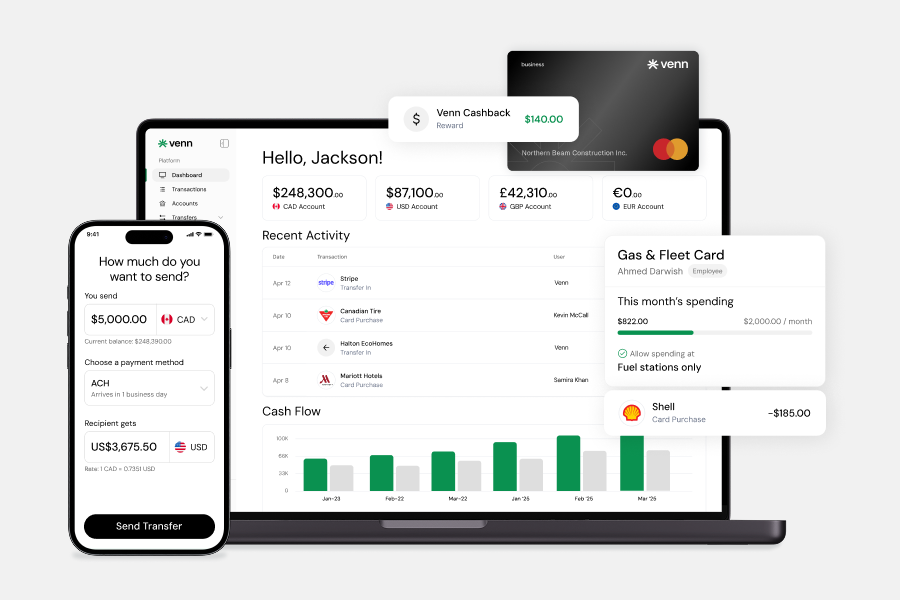
When your team uses Venn corporate cards for business spending, every transaction is captured automatically in your account activity. This creates the foundation for clean reconciliation before anyone submits an expense report.
Venn's expense management features support receipt capture and categorization, reducing the gap between when purchases happen and when documentation is recorded. The 1% unlimited cashback on the Venn Mastercard Charge Card adds tangible value while maintaining operational control.
Multi-Currency Receipt Reality
Canadian businesses with international travel, cross-border suppliers, or remote team members face additional receipt complexity. A receipt from a New York hotel shows USD amounts. A supplier invoice from London shows GBP. Matching these receipts to the correct transactions requires clear currency visibility.
Venn's multi-currency accounts in CAD, USD, EUR, and GBP simplify this matching process. Transactions settle in the appropriate currency, and receipts can be matched without currency conversion confusion. Competitive FX rates reduce the cost of international spending while maintaining clear documentation trails.
Close the Loop with Accounting Workflows
Venn integrates directly with QuickBooks and Xero, creating a clean handoff from banking activity to accounting records. This integration reduces manual data entry, speeds up reconciliation, and minimizes the back-and-forth that happens when receipts are missing or transactions are unclear.
The combination of corporate cards, expense management features, and accounting integration creates a modern financial stack where itemized receipt compliance becomes easier by default.
| Feature | Venn | Traditional Bank + Separate Tools | Manual Processes |
|---|---|---|---|
| Transaction capture | Automatic | Varies by tool | Manual entry |
| Receipt management | Built-in | Separate software | Paper or scattered files |
| Multi-currency support | CAD, USD, EUR, GBP accounts | Limited or high fees | Complex reconciliation |
| Accounting integration | QuickBooks, Xero direct | Varies | Manual export/import |
| Cashback | 1% unlimited | Varies | None |
Sign up for a Venn account to simplify your expense documentation workflow.
FAQ
Q: What is the difference between an itemized receipt and a card payment slip?
A: An itemized receipt lists each purchased item with descriptions, quantities, and prices. A card payment slip shows only the total amount charged and payment method. Businesses need itemized receipts for proper expense categorization.
Q: Do I need an itemized receipt for meals?
A: Most company policies require itemized receipts for meal expenses, especially client meals and entertainment. The itemization helps verify business purpose, attendees, and policy compliance for tips and alcohol.
Q: Is an email receipt itemized?
A: Email receipts can be itemized if they include individual line items, quantities, prices, taxes, and totals. Most e-commerce confirmation emails qualify as itemized documentation.
Q: Can I use a credit card statement instead of an itemized receipt?
A: Credit card statements show merchant names and amounts but lack line-item detail. They may be acceptable as backup documentation in limited situations, but most policies require actual itemized receipts.
Q: What if the receipt is in another currency?
A: Keep the original receipt showing the foreign currency amount. Note the currency clearly and ensure the transaction can be matched to the correct account activity. Multi-currency accounts simplify this matching process.
Q: What should I do if the merchant cannot provide itemized details?
A: Use your company's missing receipt process if one exists. Document the date, merchant, amount, business purpose, and reason the receipt is unavailable. Improve future capture by requesting itemized receipts at the time of purchase.
This article is for informational purposes only and does not constitute legal, tax, or accounting advice. Consult a qualified professional for advice specific to your business.
Venn Mastercard Charge Card is issued by Peoples Trust Company under licence from Mastercard International Incorporated. Mastercard is a registered trademark, and the circles design is a trademark of Mastercard International Incorporated.
---
**Disclaimer:** This publication is provided for general information purposes and does not constitute legal, tax or other professional advice from Venn Software Inc or its subsidiaries and its affiliates, and it is not intended as a substitute for obtaining advice from a financial advisor or any other professional. We make no representations, warranties or guarantees, whether expressed or implied, that the content in the publication is accurate, complete or up to date.
This publication is provided for general information purposes only and does not constitute legal, tax, financial, or other professional advice from Venn Software Inc., its subsidiaries, or its affiliates, and is not a substitute for advice from a qualified professional. All comparisons and competitor information reflect publicly available information believed accurate as of May 21, 2026; features, pricing, rates, and terms referenced are subject to change and may differ at the time you read this. All product names, logos, and brands referenced are the property of their respective owners; their mention does not imply affiliation with or endorsement by Venn. Any comparative statements reflect Venn's views and are provided to help readers evaluate options. We make no representations, warranties, or guarantees, express or implied, that the content is accurate, complete, or up to date.

Venn is all-in-one business banking built for Canada
From free local CAD/USD accounts and team cards to the cheapest FX and global payments—Venn gives Canadian businesses everything they need to move money smarter. Join 15,000+ businesses today.
Frequently asked questions
Everything you need to know about the product and billing.
Join 15,000+ businesses banking with Venn today
Streamline your business banking and save on your spend and transfers today
No personal credit check or guarantee.