What Are EFT Payments? A Guide for Canadian Businesses
What are EFT payments in Canada Learn processing times fees direct deposit vs PAD security tips and how to set up EFT for payroll vendors and billing.

Ahmed Shafik
Co-founder
.png)
Trusted by 15,000+ Canadian businesses
Business banking for Canada
Local CAD and USD accounts, corporate cards with cashback, the lowest FX rates in Canada, free local transfers, and more.
Getting paid and paying others efficiently remains one of the most fundamental challenges for Canadian businesses. Cheques are slow and expensive to process. Wire transfers carry high fees. Card payments eat into margins. For most day-to-day business transactions, electronic funds transfer (EFT) payments offer the most practical balance of cost, speed, and reliability.
This guide covers everything Canadian business owners need to know about EFT payments: what they are, how they work, processing times and fees, setup steps, security considerations, and how to choose the right payment method for different situations. You'll also learn how EFT fits into a modern business finance stack that includes banking, cards, foreign exchange, and accounting automation. Many businesses use a platform like Venn to centralize these workflows in one place.
What Is An EFT Payment? (Plain-English Definition)
An electronic funds transfer (EFT) is any transfer of money between bank accounts that happens electronically rather than through physical cheques or cash. For Canadian businesses, EFT payments typically fall into two categories: credits (money you send) and debits (money you pull from someone else's account with their authorization).
Where EFTs show up in real business operations:
• Payroll deposits to employee bank accounts
• Supplier and vendor payments
• Customer billing through pre-authorized debits
• Government remittances and bill payments
• Contractor and freelancer payouts
Important: "EFT" is an umbrella term, not a single product. When your bank or payment provider talks about EFT, they might mean direct deposits, pre-authorized debits, or other electronic payment types. The specific mechanics and timelines vary depending on which type you're using.
How EFT Payments Work In Canada (Step-By-Step)
Understanding the basic flow helps you set realistic expectations for timing and troubleshoot problems when they occur.
The typical EFT process:
• Initiation: The payer (or the payee, in the case of a debit) submits payment instructions through their bank or payment platform
• Submission: The financial institution batches the instructions and submits them to the clearing system
• Clearing and settlement: Payments Canada's Automated Clearing Settlement System (ACSS) processes most retail EFT transactions in Canada, matching and settling transactions between financial institutions
• Posting: Funds appear in the recipient's account
• Returns (if applicable): Failed transactions (wrong account number, insufficient funds, closed accounts) get returned through the same system
Pre-authorized debits commonly run through the ACSS rail. The Bank of Canada oversees this system as part of Canada's core payment infrastructure.
Practical note: Banks batch EFT submissions at specific cut-off times throughout the day. Missing a cut-off means your payment doesn't get processed until the next batch, which can add a full business day to your timeline.
Common Types Of EFT Payments Canadian Businesses Use
EFT Direct Deposit (Credit/Push)
You send money from your account to someone else's. The recipient doesn't need to take any action beyond providing their banking details.
Best for: Payroll, contractor payments, supplier invoices, refunds
Choose this when: You control the timing and amount, and you're paying a known recipient with verified banking details.
Pre-Authorized Debit (PAD) / Direct Debit (Pull)
You pull money from a customer's or client's account based on their prior authorization. The customer must agree to the arrangement and provide written or electronic authorization.
Best for: Recurring billing (subscriptions, memberships, rent), installment payments, invoice autopay
Choose this when: You need predictable cash flow from recurring charges and your customers prefer automatic payments.
The Financial Consumer Agency of Canada provides guidance on PAD authorization requirements. Businesses collecting PADs must maintain proper authorization records and follow rules around timing, notification, and dispute handling.
Government and Bill Payments
Many Canadian businesses use EFT for tax remittances, utility payments, and other recurring obligations. These often work through specific payment codes or payee setups within your banking platform.
EFT Payments: Processing Times, Fees, And Limits
Processing Times
EFT timing varies based on several factors:
• Batch windows: Most banks process EFTs in batches 2-4 times daily
• Cut-off times: Submit after the cut-off and your payment waits until the next batch
• Weekends and holidays: Settlement only happens on business days
• Verification holds: New payees or large amounts may trigger additional review
Typical timelines: 1-3 business days for standard EFT transactions, though some same-day options exist for premium pricing.
Fees
EFT fees vary significantly by financial institution and account type:
• Some business accounts include unlimited EFTs
• Others charge per-transaction fees ranging from $0.50 to $3.00
• PAD processing may carry different pricing than direct deposits
• Premium same-day processing costs more than standard timing
Total cost includes more than transaction fees. Factor in staff time for setup and reconciliation, costs of handling returns and failed payments, and any FX conversion fees for cross-border transactions.
EFT Vs Other Payment Methods (Canada-Focused Comparison)
Choosing the right payment method depends on your specific situation. This comparison helps you match the method to the use case.
| Payment Method | Typical Best For | Speed (Typical) | Cost (Typical) | Reversibility / Risk Notes | Key Tradeoff |
|---|---|---|---|---|---|
| EFT (Direct Deposit / PAD) | Payroll, vendors, recurring billing | 1–3 business days | Usually low | PADs can be returned; needs strong authorization and verification | Setup and bank-detail accuracy matter |
| Interac e-Transfer® | Fast, ad-hoc payments | Minutes to hours | Low to moderate | Social engineering risk; sender/recipient mistakes | Not ideal for high-volume AP workflows |
| Wire Transfer | Large, urgent, international | Same/next day to a few days | Higher | Harder to reverse; info must be exact | Often expensive, especially cross-border |
| Card Payments | Customer checkout | Instant authorization | Highest (processing fees) | Chargebacks | Convenience vs cost |
| Cheques | Legacy/vendor preference | Slow | Operationally costly | Fraud/stop payments | Manual work and delays |
EFT vs ACH: Cross-Border Context
ACH (Automated Clearing House) is the U.S. equivalent of Canada's EFT system. If your business pays U.S. suppliers or receives payments from U.S. customers, you'll encounter ACH transactions.
The challenge: Canadian banks typically convert ACH transactions through correspondent banking relationships, adding fees and delays. Businesses with significant U.S. payment volume benefit from holding actual U.S. dollar accounts with local ACH routing capabilities.
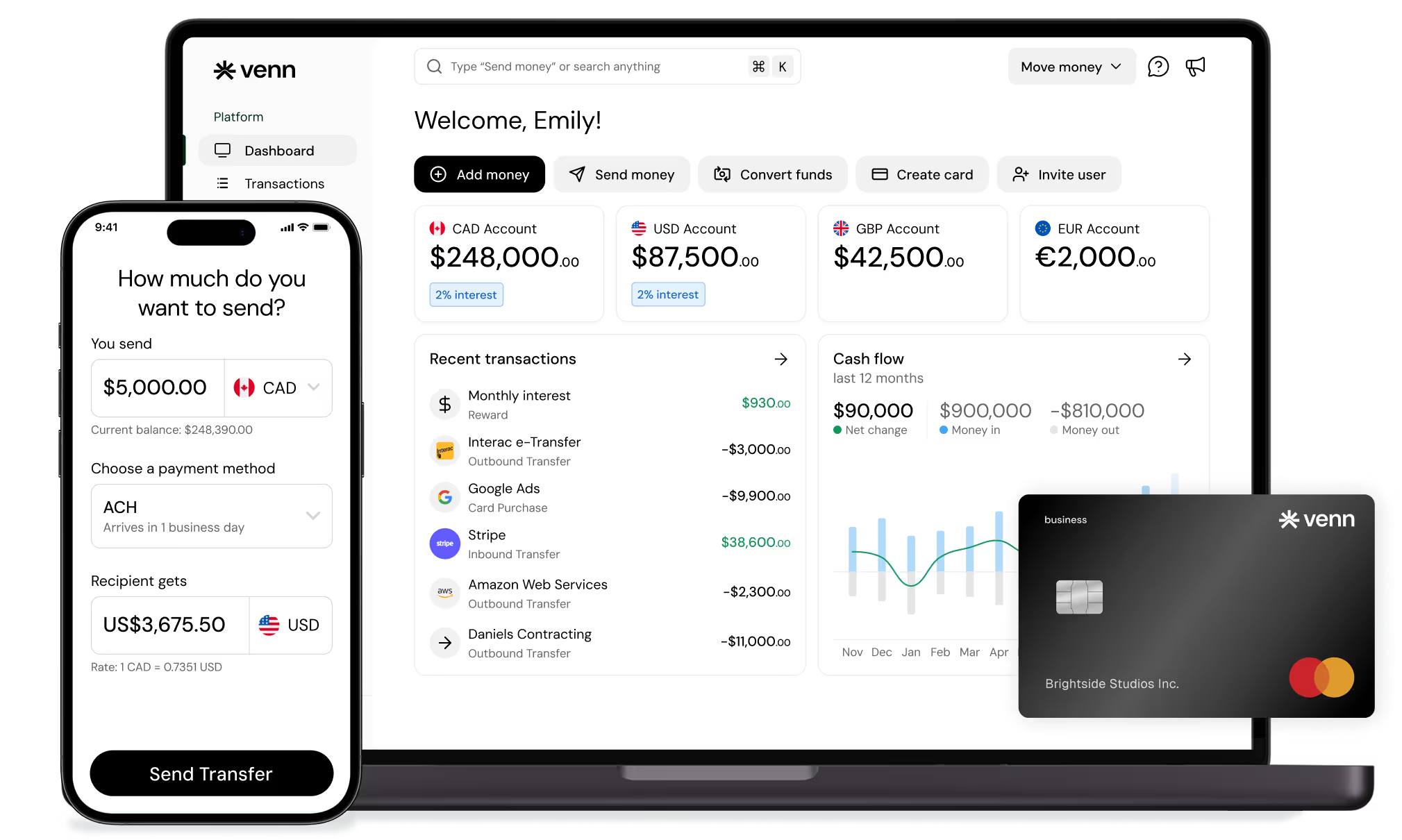
Venn provides multi-currency accounts including USD accounts with actual U.S. account numbers and ACH routing details. This lets Canadian businesses send and receive U.S. payments without unnecessary conversion fees or delays.
How To Send EFT Payments (Accounts Payable Workflow)
Setup Checklist
• [ ] Collect vendor banking details: institution number (3 digits), transit number (5 digits), and account number
• [ ] Accept a void cheque or completed direct deposit form as verification
• [ ] Validate details through a secondary channel (phone call to known number, not email)
• [ ] Consider a small test payment before sending large amounts
• [ ] Set internal approval thresholds and dual-authorization requirements
• [ ] Document cut-off times and establish payment scheduling policies
• [ ] Standardize payment references for easier reconciliation
Common Mistakes That Cause Returns
Typos in account numbers: Even one wrong digit sends the payment to the wrong account or triggers a return.
Closed or inactive accounts: Vendors change banks; always confirm details for the first payment after a gap.
Name mismatches: Some systems flag payments where the account holder name doesn't match the payee name.
Wrong account type: Sending to a savings account when the vendor provided a chequing account number (or vice versa) can cause issues.
Insufficient authorization for PADs: Missing or incomplete authorization records create liability and potential disputes.
How To Accept EFT / PAD Payments From Customers
When To Offer PAD vs Other Methods
PAD works best for: Recurring charges with predictable amounts, customers who prefer set-it-and-forget-it billing, reducing late payments and collection effort.
Card payments work best for: Variable amounts, one-time purchases, customers who want rewards points, situations where you need instant authorization.
Interac e-Transfer® works best for: Ad-hoc payments, smaller businesses without PAD infrastructure, situations where speed matters more than automation.
Authorization Best Practices
Proper PAD authorization protects both you and your customers. While this isn't legal advice, good authorization typically includes:
• Clear description of the payment arrangement (amount, frequency, start date)
• Customer's explicit consent (signed form or electronic agreement)
• Instructions for cancellation or changes
• Your contact information for questions or disputes
• Retention of authorization records for the required period
Customer Experience Tips
• Include clear payment terms on invoices
• Send reminders before scheduled debits
• Have a process for handling failed payments (declined, insufficient funds)
• Make it easy for customers to update banking details or pause payments
Security And Fraud Considerations
EFT fraud often targets the human element rather than the technical infrastructure. Business email compromise (BEC) attacks, where criminals impersonate vendors or executives to redirect payments, cause significant losses for Canadian businesses.
Practical safeguards:
• Verify any request to change banking details through a phone call to a known number
• Implement dual approval for payments above a threshold
• Train staff to recognize phishing attempts and suspicious requests
• Use dedicated devices for banking and payment activities
• Review payment batches before final submission
• Monitor accounts daily for unauthorized transactions
• Maintain updated contact information for all vendors
Reconciliation And Record-Keeping
EFT operations create reconciliation challenges when payment references don't match invoice numbers, when multiple payments batch together, or when returns and adjustments complicate the picture.
Best practices for clean books:
• Use consistent naming conventions for all payments
• Include invoice numbers or references in payment descriptions
• Attach remittance data to accounting entries
• Schedule weekly bank-to-book matching
• Set up bank feed rules to auto-categorize recurring transactions
• Document exceptions and adjustments promptly
This is where an integrated banking layer plus accounting automation makes a significant difference. Venn connects directly to QuickBooks and Xero, reducing manual data entry and speeding up month-end close. When your banking activity flows automatically into your accounting system with proper categorization, reconciliation becomes verification rather than detective work.
Compliance Considerations
Compliance obligations around electronic funds transfers depend on your business type and transaction context. Reporting entities under FINTRAC (Financial Transactions and Reports Analysis Centre of Canada) have specific obligations for reporting certain electronic funds transfers based on thresholds and other criteria.
FINTRAC provides detailed guidance on electronic funds transfer reporting requirements for applicable entities. If your business falls under FINTRAC reporting requirements, consult with your compliance advisor to ensure you're meeting all obligations.
For most small and medium businesses, the key compliance considerations involve proper PAD authorization, record retention, and following your financial institution's terms of service.
How Venn Fits Into An Optimal EFT-First Business Finance Stack
EFT payments are one piece of a modern business finance operation. The real efficiency gains come from connecting payment rails with banking, cards, expense management, and accounting in a unified system.
Operate In Multiple Currencies Without Fragmentation
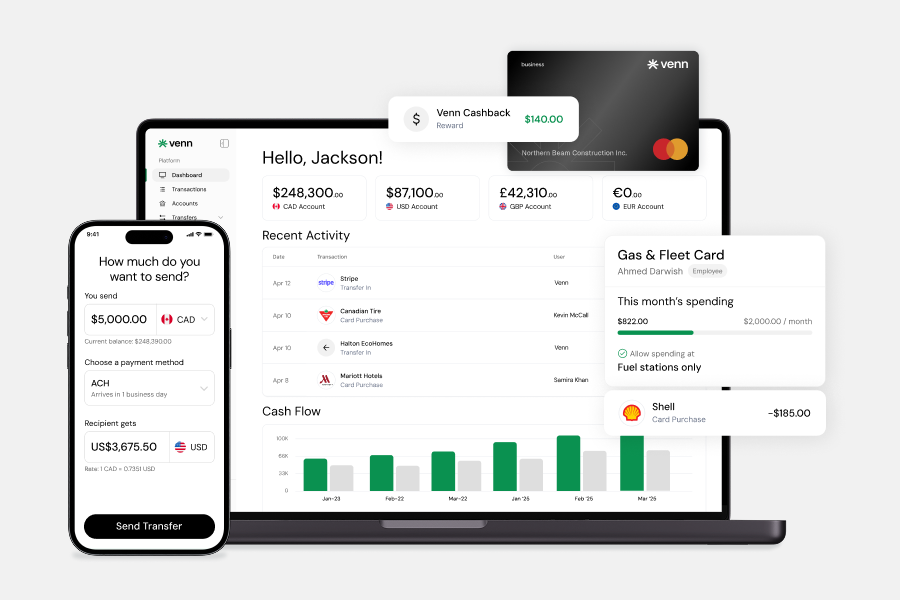
Businesses paying U.S. suppliers, collecting from international customers, or operating across borders face currency conversion costs and complexity. Venn provides multi-currency operating accounts in CAD, USD, EUR, and GBP. For U.S. transactions specifically, you get actual U.S. account numbers and ACH routing details, eliminating the correspondent banking fees that eat into cross-border payments.
Spend Management And Rewards That Scale With Your Team
Day-to-day business spending on software subscriptions, advertising, travel, and inventory adds up. Venn's corporate card offers 1% unlimited cashback on all purchases, with no caps or category restrictions. Issue cards to team members with spending controls and real-time visibility into expenses across your organization.
Clean Books: Connect Banking Activity To Accounting
Manual data entry between banking and accounting systems creates errors and delays. Venn integrates with QuickBooks and Xero, syncing transactions automatically with proper categorization. This reduces month-end close time and gives you accurate financial visibility throughout the month.
Cash Optimization
Idle cash in operating accounts can earn interest. Venn offers 2.75% interest on CAD balances and up to 3.5% interest on USD balances (learn more), turning your operating cash into a working asset rather than a dormant one.
Trust And Protection
Venn is a technology company that partners with regulated financial institutions. Funds held in Venn accounts are eligible for CDIC insurance protection, providing the security Canadian businesses expect from their banking relationships.
Conclusion
EFT payments remain the cost-effective backbone of business payments in Canada. Success depends on choosing the right payment rail for each situation, maintaining strong verification and approval processes, and keeping reconciliation clean and current.
The businesses that operate most efficiently treat EFT as one component of an integrated financial stack, connecting banking, payment rails, cards, expense controls, and accounting automation into a unified workflow.
Ready to simplify your business banking and payments? Sign up for a Venn account.
FAQs
Q: What does EFT mean in Canada?
A: EFT stands for electronic funds transfer. It’s an umbrella term for electronic payments between bank accounts, including direct deposits (sending money) and pre-authorized debits (pulling money with authorization).
Q: How long do EFT payments take in Canada?
A: Most EFT payments take 1–3 business days, depending on when you submit the payment relative to your bank’s cut-off times and whether weekends or holidays fall within the processing window.
Q: Are EFT and PAD the same thing?
A: PAD (pre-authorized debit) is a type of EFT. While EFT covers all electronic transfers, PAD specifically refers to pulling money from someone else’s account based on their prior authorization.
Q: Can an EFT be reversed?
A: Direct deposits are difficult to reverse once processed. PADs can be returned by the account holder’s bank under certain conditions—typically within 90 days for unauthorized transactions or 10 days for authorized transactions with errors.
Q: What banking details do I need for an EFT?
A: You typically need the recipient’s institution number (3 digits), transit number (5 digits), and account number. A void cheque contains all this information, which is why businesses often request one for payment setup.
Q: EFT vs Interac e-Transfer®: which should my business use?
A: Use EFT for high-volume, recurring payments like payroll and vendor invoices. Use Interac e-Transfer® for ad-hoc, smaller payments where speed matters and batch processing isn’t required.
Q: EFT vs ACH: what’s the difference for Canada-U.S. payments?
A: EFT runs through Canada’s ACSS system, while ACH uses the U.S. clearing network. Cross-border payments often require conversion between systems, which can add fees and processing time. Holding a U.S. dollar account with ACH routing can simplify U.S. transactions.
Q: Are EFT payments secure?
A: EFT transactions are secure at the infrastructure level. The main risks come from human error (such as incorrect account details) and social engineering (fraudulent requests to change payment information). Strong verification processes and dual-approval controls help mitigate these risks.
Venn Mastercard Charge Card is issued by Peoples Trust Company under licence from Mastercard International Incorporated. Mastercard is a registered trademark, and the circles design is a trademark of Mastercard International Incorporated.
---
**Disclaimer:** This publication is provided for general information purposes and does not constitute legal, tax or other professional advice from Venn Software Inc or its subsidiaries and its affiliates, and it is not intended as a substitute for obtaining advice from a financial advisor or any other professional. We make no representations, warranties or guarantees, whether expressed or implied, that the content in the publication is accurate, complete or up to date.
This publication is provided for general information purposes only and does not constitute legal, tax, financial, or other professional advice from Venn Software Inc., its subsidiaries, or its affiliates, and is not a substitute for advice from a qualified professional. All comparisons and competitor information reflect publicly available information believed accurate as of April 25, 2026; features, pricing, rates, and terms referenced are subject to change and may differ at the time you read this. All product names, logos, and brands referenced are the property of their respective owners; their mention does not imply affiliation with or endorsement by Venn. Any comparative statements reflect Venn's views and are provided to help readers evaluate options. We make no representations, warranties, or guarantees, express or implied, that the content is accurate, complete, or up to date.

Venn is all-in-one business banking built for Canada
From free local CAD/USD accounts and team cards to the cheapest FX and global payments—Venn gives Canadian businesses everything they need to move money smarter. Join 15,000+ businesses today.
Frequently asked questions
Everything you need to know about the product and billing.
Join 15,000+ businesses banking with Venn today
Streamline your business banking and save on your spend and transfers today
No personal credit check or guarantee.