What are ACH Payments? And How to Send/Receive As A Canadian
What are ACH Payments? And How to Send/Receive As A Canadian. Learn ACH credits vs debits, timelines, and how to get US account details to pay or get paid.

Ahmed Shafik
Co-founder
.png)
Trusted by 15,000+ Canadian businesses
Business banking for Canada
Local CAD and USD accounts, corporate cards with cashback, the lowest FX rates in Canada, free local transfers, and more.
If you run a Canadian business that works with US clients, vendors, or contractors, you've likely encountered ACH payments. Maybe a US customer asked for your "ACH details" to pay an invoice. Perhaps a supplier requested payment via ACH instead of wire. Either way, you discovered that ACH isn't quite as straightforward for Canadian businesses as it sounds.
Here's the reality: ACH is a US-only payment network. Canadian banks don't connect to it directly. But that doesn't mean you can't send or receive ACH payments from Canada. You just need the right setup.
This guide breaks down exactly what ACH payments are, how they work, and the practical steps Canadian businesses can take to send and receive ACH. We'll also show you how platforms like Venn give you local US account details that support ACH, so you can operate like a US business without actually being one.
Key Takeaways
• ACH is a US domestic payment network that Canadian banks cannot access directly
• To send or receive ACH from Canada, you need US routing and account numbers
• ACH is significantly cheaper than wire transfers for routine US payments
• Venn provides Canadian businesses with local USD account details that support ACH
• Understanding ACH credits vs debits helps you choose the right payment method for each situation
What Are ACH Payments? (Definition For Canadians)
ACH stands for Automated Clearing House. It's the electronic network that moves money between US bank accounts for direct deposits, bill payments, and business-to-business transfers. When a US company pays employees via direct deposit or a customer sets up automatic bill pay, that's ACH at work.
The ACH network is governed by Nacha (the National Automated Clearing House Association) and processes trillions of dollars annually. It's the backbone of routine US payments because it's reliable, inexpensive, and widely accepted.
Quick Summary: ACH In One Paragraph
ACH is a US bank-to-bank payment system used for payroll, vendor payments, recurring billing, and general money transfers between US accounts. Canadian businesses encounter ACH when dealing with US customers who want to pay invoices, US vendors who prefer ACH over wires, or US contractors expecting direct deposit. Since ACH only works within the US banking system, Canadians need US account details to participate.
How ACH Payments Work
ACH payments move money electronically between bank accounts, but they don't happen instantly. Understanding the mechanics helps you plan cash flow and set realistic expectations with customers and vendors.
ACH Credit vs ACH Debit
ACH credit is a "push" payment. The sender initiates the transfer and pushes money to the recipient. Examples include payroll deposits, vendor payments, and tax refunds. You control when the money leaves your account.
ACH debit is a "pull" payment. The recipient initiates the transfer and pulls money from your account. Examples include utility bills, subscription payments, and loan payments. This requires authorization from the account holder, since someone else is withdrawing from your account.
For Canadian businesses, ACH credits are more common when paying US vendors or receiving payments from US customers. ACH debits come into play when you're collecting recurring payments from US clients.
Why ACH Feels "Slow": Batching And Business-Day Processing
Unlike card payments that authorize in seconds, ACH payments are processed in batches. Banks collect ACH requests throughout the day, then submit them to the ACH network at specific cutoff times. The network processes these batches and settles them according to a schedule.
This batching system keeps costs low but means payments don't clear immediately. Business days matter too. A payment initiated Friday afternoon might not process until Monday or Tuesday.
How Long Do ACH Payments Take?
ACH timing depends on the type of transfer, the banks involved, and when the payment was initiated.
Standard ACH vs Same Day ACH
Standard ACH typically settles in one to three business days. The exact timing depends on when the payment was submitted relative to bank cutoff times and whether weekends or holidays intervene.
Same Day ACH settles within the same business day if submitted before the cutoff (usually early afternoon Eastern time). Nacha has progressively increased the per-transaction limit for Same Day ACH, making it viable for larger business payments. However, not all banks and payment providers support Same Day ACH, and some charge premium fees for the faster service.
If speed is critical for a specific payment, compare your options. Wires settle faster than standard ACH but cost more. For routine payments where next-day or two-day timing works, standard ACH offers the best value.
ACH Fees, Limits, And Common Gotchas
ACH is known for low costs, but fees and limits vary by provider.
Typical fee patterns: Many banks offer free or very low-cost ACH for business accounts. Payment platforms may charge per-transaction fees ranging from a few cents to a few dollars. Compare your options, especially if you process high volumes.
Returns and failed payments: ACH payments can fail for several reasons: insufficient funds, incorrect account details, closed accounts, or authorization issues. Failed payments trigger return codes that explain what went wrong. Returns can take several days to process, creating cash flow uncertainty.
Reconciliation tips: Use consistent payment descriptors so recipients can identify your payments easily. Include reference numbers or invoice details where possible. This reduces confusion and support requests on both ends.
ACH vs Wire vs EFT/PAD vs Interac e-Transfer® (Canada-First Comparison)
Canadian businesses have multiple options for moving money. Here's how they compare:
| Payment Type | Where It Works | Typical Speed | Typical Cost | Best For | Key Drawback |
|---|---|---|---|---|---|
| ACH | US domestic | Same day to 3 business days | Low | US payroll, vendor payments | Requires US account details |
| Wire | Global | Same day to 2 business days | Higher ($15–50+) | Large, urgent payments | Higher fees, more friction |
| EFT/AFT (Canada) | Canada domestic | 1–2 business days | Low | Canadian payroll, vendor payouts | Not compatible with US ACH |
| PAD (Canada) | Canada domestic | Varies | Low | Recurring billing in Canada | Requires proper authorization |
| Interac e-Transfer® | Canada domestic | Often within minutes | Low | Small to medium payments | Not designed for all B2B flows |
The key insight: these systems don't interconnect seamlessly. ACH is US-only. EFT is Canada-only. Wires bridge the gap but cost more. This mismatch creates friction for Canadian businesses operating cross-border.
Can Canadians Use ACH?
Yes, but not through your regular Canadian bank account. ACH requires US routing numbers and account numbers, which Canadian accounts don't have.
The Key Point: ACH Is US-Only, So Canadians Need The Right Setup
To send or receive ACH payments, you need access to US account details. This typically means one of three approaches:
• Traditional bank cross-border services: Some Canadian banks offer US dollar accounts with US account details, but these often come with higher fees, minimum balances, and limited functionality.
• Payment providers and multi-currency platforms: Various fintech platforms offer US account capabilities for Canadian businesses, with varying levels of ACH support.
• A business banking platform with local US account details: Platforms like Venn provide Canadian businesses with US routing and account numbers that support both sending and receiving ACH. This approach gives you the functionality of a US bank account while keeping your operations based in Canada.
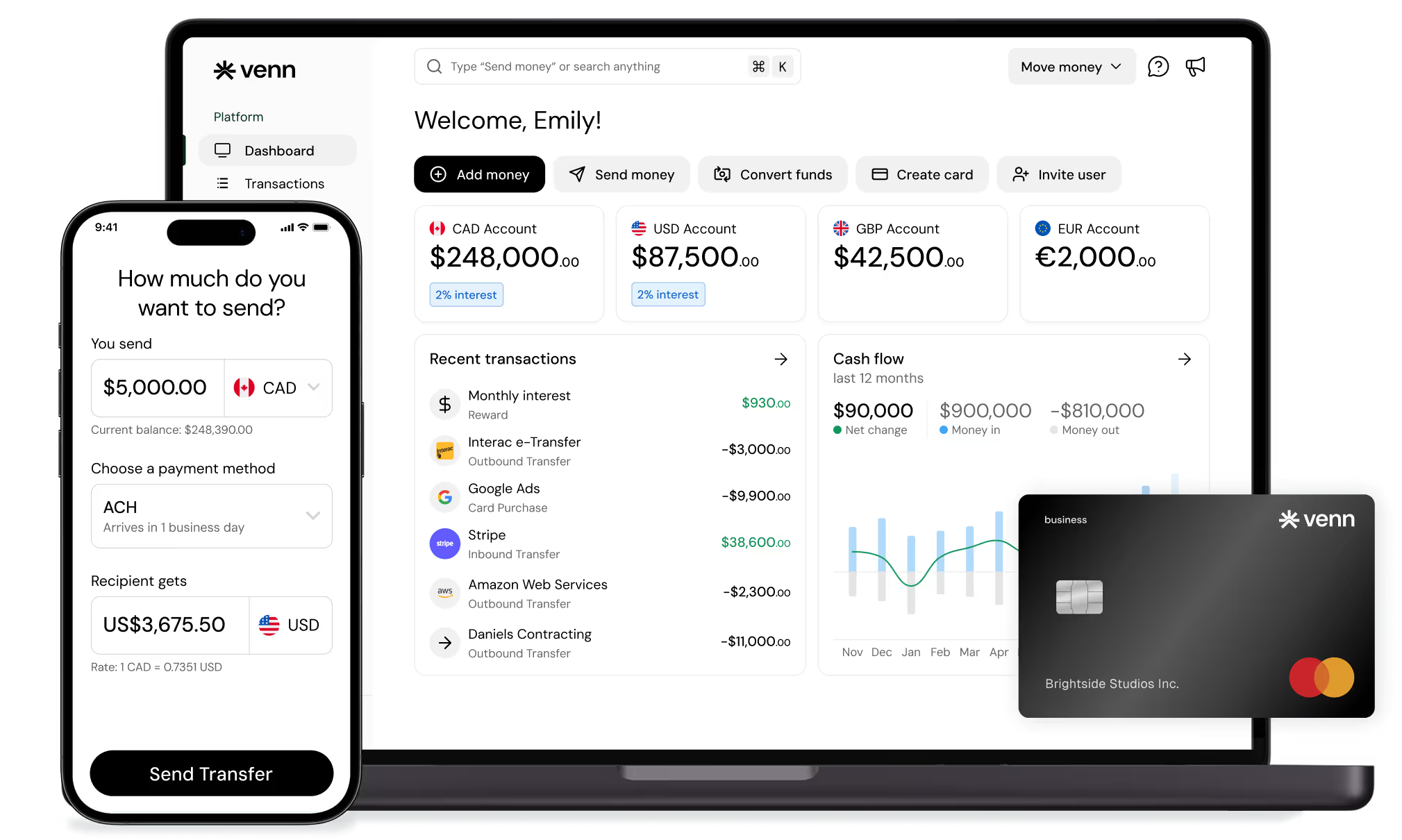
Venn's approach is particularly valuable because it integrates ACH capability with broader business banking features: multi-currency accounts (CAD, USD, EUR, GBP), expense management, a corporate card with 1% unlimited cashback, and accounting integrations with QuickBooks and Xero.
How To Receive ACH Payments As A Canadian Business (Step-By-Step)
Getting paid by US customers via ACH eliminates wire fees and simplifies collections. Here's how to set it up.
Path A (Recommended): Receive ACH Using Venn Local USD Account Details
• Create your Venn USD account: Once your Venn account is set up, you'll have access to US account details including a routing number and account number.
• Share your details with US payers: Provide your US customers with your Venn USD account details. They can then pay you via ACH just like they would pay any US vendor.
• Receive and reconcile payments: ACH payments arrive in your Venn USD account. You can hold funds in USD, convert to CAD when rates are favorable, or pay USD expenses directly.
Why this matters: Receiving ACH instead of wires saves your customers money (they avoid wire fees) and simplifies your collections process. Payments arrive faster and more predictably than international wires, which can get delayed by intermediary banks.
Path B: What To Do If A US Payer Insists On A Wire Instead
Some US companies have policies requiring wires for new vendors or payments above certain thresholds. If wire is the only option:
• Provide your complete wire details including the receiving bank's SWIFT code
• Confirm whether the payer will cover wire fees or if they'll be deducted from your payment
• Allow extra time for the payment to arrive and clear
What Information You Must Provide To A US Payer
When a US customer asks for your ACH details, provide:
• Business legal name (exactly as it appears on your account)
• Routing number (9-digit ABA number)
• Account number
• Account type (typically checking)
• Address (if requested by their payment system)
How To Send ACH From Canada To The US (Step-By-Step)
Paying US vendors, contractors, and suppliers via ACH is straightforward once you have the right account setup.
Pay US Vendors And Contractors Via ACH (With Venn)
• Collect payee bank details: Request the vendor's routing number, account number, account type, and the name on their account.
• Add the recipient in Venn: Enter the payee's details and save them for future payments.
• Schedule the payment: Specify the amount and timing. ACH payments typically arrive within one to three business days.
• Reconcile: Match the payment to your invoice or expense record. Venn's QuickBooks and Xero integrations help automate this process.
When To Use ACH vs Wire For US Payables
Choose ACH when:
• The payment isn't urgent (can wait one to three business days)
• You're making routine vendor payments
• Cost matters more than speed
• You're paying contractors or recurring expenses
Choose wire when:
• The payment is time-sensitive (same-day settlement needed)
• You're making a large, one-time payment where timing is critical
• The recipient requires wire for compliance reasons
Real-World Use Cases By Industry
eCommerce And Retail
Canadian eCommerce businesses working with US suppliers, 3PLs, and fulfillment centers benefit from ACH's low costs. Paying US vendors via ACH instead of wire can save hundreds of dollars monthly. Receiving payouts from US marketplaces via ACH simplifies cash flow management.
SaaS And Agencies
Software companies and agencies with US clients can invoice in USD and receive ACH payments directly. Paying US contractors via ACH is cleaner than international wire transfers. Many US software tools bill in USD, making a US-capable account essential for managing subscriptions.
Professional Services
Consultants, accountants, and lawyers serving US clients can offer ACH as a payment option, reducing friction and fees. Milestone billing and retainer payments work well with ACH credits.
Across all industries, Venn's multi-currency accounts (CAD, USD, EUR, GBP) let you hold and manage funds in the currencies you actually use. The 1% unlimited cashback card helps optimize operating expenses like software subscriptions, advertising, and travel. QuickBooks and Xero integrations keep your books clean without manual reconciliation.
Best Practices: Reduce Failed Payments And Improve Reconciliation
Use consistent naming: When sending payments, use the same business name format every time. This helps recipients match payments to invoices.
Store payment authorizations: If you're collecting ACH debits from US customers, document their authorization properly. This protects you if a payment is disputed.
Verify account details before large payments: A small test payment can confirm account details are correct before you send a significant amount.
Track payment status: Monitor pending ACH payments and follow up promptly on any returns or failures.
Conclusion
ACH payments are essential for Canadian businesses operating cross-border. While the US-only nature of ACH creates friction, the right setup eliminates most barriers. Understanding the difference between ACH credits and debits, knowing typical timelines, and having proper US account details positions your business to send and receive ACH efficiently.
Venn provides Canadian businesses with the infrastructure needed for seamless US payments: local USD account details that support ACH, multi-currency capabilities, competitive FX rates, and integration with your accounting software. Combined with a corporate card offering 1% unlimited cashback and robust expense management, Venn serves as the business banking layer that connects your money movement, spend controls, and financial operations.
FAQ
Q: Is ACH the same as EFT in Canada?
A: No. ACH is the US electronic funds transfer network. Canada has its own system called EFT (Electronic Funds Transfer), sometimes referred to as AFT (Automated Funds Transfer). They serve similar purposes but operate on separate networks that do not interconnect directly.
Q: Can I accept ACH payments from US customers as a Canadian business?
A: Yes. By providing US customers with ACH-capable account details (available through Venn), they can pay you via ACH instead of wire. This reduces wire fees for both parties and often speeds up settlement.
Q: What information is needed to receive an ACH payment?
A: You typically need your business legal name, routing number (9-digit ABA number), account number, and account type (usually checking). Some payment platforms may also request your business address for verification.
Q: Why don’t Canadian bank accounts have routing numbers for ACH?
A: Canadian bank accounts do not have US routing numbers because they operate on different banking systems. To receive ACH payments, you need US banking details provided through a platform like Venn that issues US routing and account numbers for Canadian businesses.
Q: Can I use ACH for payroll if I’m a Canadian business paying US workers?
A: Yes. If you're paying US-based employees or contractors, you can use ACH through US account details from Venn to send payments directly to US bank accounts, making payroll more efficient and avoiding wire transfer fees.
This content is for educational purposes only and does not constitute legal or financial advice. Funds held with Venn are covered under CDIC insurance protection. Interac e-Transfer® is a registered trademark of Interac Corp.
---
**Disclaimer:** This publication is provided for general information purposes and does not constitute legal, tax or other professional advice from Venn Software Inc or its subsidiaries and its affiliates, and it is not intended as a substitute for obtaining advice from a financial advisor or any other professional. We make no representations, warranties or guarantees, whether expressed or implied, that the content in the publication is accurate, complete or up to date.
This publication is provided for general information purposes only and does not constitute legal, tax, financial, or other professional advice from Venn Software Inc., its subsidiaries, or its affiliates, and is not a substitute for advice from a qualified professional. All comparisons and competitor information reflect publicly available information believed accurate as of April 23, 2026; features, pricing, rates, and terms referenced are subject to change and may differ at the time you read this. All product names, logos, and brands referenced are the property of their respective owners; their mention does not imply affiliation with or endorsement by Venn. Any comparative statements reflect Venn's views and are provided to help readers evaluate options. We make no representations, warranties, or guarantees, express or implied, that the content is accurate, complete, or up to date.

Venn is all-in-one business banking built for Canada
From free local CAD/USD accounts and team cards to the cheapest FX and global payments—Venn gives Canadian businesses everything they need to move money smarter. Join 15,000+ businesses today.
Frequently asked questions
Everything you need to know about the product and billing.
Join 15,000+ businesses banking with Venn today
Streamline your business banking and save on your spend and transfers today
No personal credit check or guarantee.