Stripe Fees in Canada for Cross-Border and FX Sales
Stripe Fees in Canada explained: see how international card surcharges and 2% FX conversion stack on USD sales, and when CAD settlement changes cost. for export.


Trusted by 15,000+ Canadian businesses
Business banking for Canada
Local CAD and USD accounts, corporate cards with cashback, the lowest FX rates in Canada, free local transfers, and more.
Why The Headline Processing Rate Is Only The Starting Point
Many Canadian merchants start with the domestic online card rate and assume it explains every Stripe transaction. That shortcut works for a simple local CAD sale, but it understates the cost of cross-border sales.
If your customer uses a foreign card, charges in USD, or receives payouts in a different currency than the charge, the math changes. Stripe fees in Canada can involve three separate cost drivers: base processing, an international card surcharge, and currency conversion.
This guide focuses on the calculations that affect margin. We'll use round-number examples, show where each fee enters the transaction, and give you a decision framework for when your payment and settlement setup deserves a closer look.
How Stripe Fees Work For Canadian Merchants
Stripe Canada pricing starts with the type of payment you accept, then adjusts based on where the customer's card was issued and whether Stripe needs to convert currency before payout. That means the fees you see on a payout can vary even when the order value looks identical at checkout.
For cross-border sales, separate fee triggers can apply. A foreign card may create one merchant-side cost, while currency conversion may create another—and these don't always stack the same way. That's why the payment processing fees Canadian businesses pay through Stripe depend on the full transaction path, not just the headline card rate.
Stripe's Standard Online Card Pricing
For Canadian merchants, Stripe Canada pricing currently starts with a domestic online card rate of 2.9% + CA$0.30. Cross-border sales can add separate charges on top of that, which is why it's worth separating the base card fee from the Stripe international card fee and the Stripe currency conversion fee when you run the numbers.
Stripe support materials also indicate that, for many users, currency conversion generally uses the mid-market rate, with the conversion fee shown separately in relevant reporting. Check Stripe's Canada pricing page on the day you rely on these figures, since fees and settlement details can change.
The Three Currencies That Matter
Before you estimate Stripe USD to CAD fees, it helps to separate three currencies that often get grouped together.
The customer payment method currency is the currency of the card or payment method your buyer uses. A US customer may use a USD card even if your checkout displays CAD.
The presentment currency is the currency you charge at checkout—USD if your product page shows US$100, CAD if it shows CA$100.
The settlement currency is the currency Stripe pays out to your business. For Canadian merchants, this is the layer that determines whether Stripe needs to convert funds before payout.
That distinction matters because a US customer doesn't automatically trigger a Stripe currency conversion fee. The key question is whether the charge currency and settlement currency differ. Know all three before modelling your cross-border sales costs.
What Counts As A Cross-Border Sale
A sale can become cross-border before money ever reaches your Canadian account. The customer may use a card issued outside Canada, pay in a currency shown at checkout, or generate a payout that lands in a different merchant settlement currency—and each of those details shapes how Stripe reads the transaction.
For Canadian merchants, cross-border sales don't automatically mean Stripe performs foreign exchange. A US customer buying from your site may trigger one fee condition, while the checkout currency and payout currency may trigger another. Foreign customer revenue and merchant-side currency conversion are related, but they're not the same thing.
International Card Fees Versus Currency Conversion Fees
The Stripe international card fee and the Stripe currency conversion fee apply for different reasons. Card origin drives the international fee: if a customer pays with a card issued outside Canada, Stripe may treat that payment as international even when you charge the customer in CAD.
Currency conversion works differently. The Stripe currency conversion fee applies when the charge currency and your Stripe settlement currency don't match, which means Stripe must convert funds before payout. You may also see this described as a Stripe FX fee.
A sale can therefore be cross-border without Stripe converting funds. A foreign-issued card charged in your settlement currency, for example, can trigger the international card fee without triggering merchant-side currency conversion.
Customer-Side FX Is A Separate Cost
A customer's card issuer may apply its own foreign exchange cost when the cardholder buys in another currency. That charge belongs to the customer, not the merchant, and it's separate from the Stripe currency conversion fee.
If a US cardholder buys from your Canadian store in CAD, their issuer may convert the purchase for their card statement. The Stripe fees you see in your dashboard reflect merchant-side processing rules—including whether Stripe converts funds for payout—not what the cardholder's bank does on their end.
Real Cost Examples For Canadian Merchants
The scenarios below show how Stripe fees in Canada can shift once cross-border sales and currency conversion enter the picture. Assumptions: each example uses a CA$100 or CA$100-equivalent order, standard online card pricing, and excludes refunds, disputes, taxes, and exchange-rate movement. Exact payout outcomes vary by exchange rate, settlement setup, and order currency.
Canadian Customer With A CAD Sale
A Canadian customer places a CA$100 order, you charge the card in CAD, and Stripe settles the payout in CAD. This is the cleanest scenario.
The calculation uses the standard domestic online card rate: 2.9% of CA$100 equals CA$2.90, plus the fixed CA$0.30 fee. Total Stripe fee: CA$3.20.
Because the card is domestic and the charge currency matches the settlement currency, this example triggers neither an international card surcharge nor a Stripe currency conversion fee.
US Customer Charged In CAD
For a CA$100 order charged in CAD to a US customer using an international card, the estimated Stripe fee is about CA$4.00. The math: 2.9% base processing plus the 0.8% Stripe international card fee, plus the CA$0.30 fixed fee—CA$3.70 + CA$0.30.
No Stripe currency conversion fee applies here if your settlement currency setup lets you receive CAD without Stripe converting the funds. The international card surcharge can still apply because Stripe assesses it based on the card's country of issue, not the currency the merchant receives.
US Customer Charged In USD With CAD Settlement
For a CA$100-equivalent order charged to a US customer in USD, the fee stack can reach about CA$6.00 when Stripe converts the sale into CAD for settlement. Start with the standard online card fee of 2.9% + CA$0.30, or CA$3.20. Add the Stripe international card fee of 0.8% (about CA$0.80) and the Stripe currency conversion fee of 2% (about CA$2.00).
That CA$6.00 estimate arrives before refunds, disputes, taxes, or exchange-rate movement between authorization and payout. This is where many Canadian merchants underestimate margin leakage—particularly when they price in USD but reconcile payouts in CAD.
When Currency Conversion Applies
The examples above point to the rule that matters most: Stripe currency conversion generally applies when the charge currency and your settlement currency differ. In Stripe's currency documentation, those are treated as separate layers of the transaction, alongside the customer's payment method currency.
If you charge a US customer in USD but receive your payout in CAD, Stripe may need to convert the balance before settlement—and that's where Stripe USD to CAD fees enter the merchant-side cost, separate from any international card fee.
Cases Where Conversion Usually Applies
Watch for these common setups where the Stripe currency conversion fee is likely to appear:
- You charge a customer in USD, but your Stripe payout settles in CAD.
- You price an order in EUR, then settle the balance into a CAD account.
- You accept GBP sales, but Stripe must convert the balance before payout.
- You issue refunds or adjustments where Stripe needs to convert between the original charge currency and your settlement currency.
- You maintain balances in multiple currencies, but Stripe converts one balance to meet the payout currency.
Cases Where Merchants May Reduce Forced Conversion
Your account setup can affect whether Stripe forces a currency conversion before payout. Stripe support materials note a Canada-related exception involving USD-denominated bank accounts, which may matter for businesses with meaningful US revenue. That doesn't mean every Canadian merchant can settle USD sales without conversion, or that the same setup applies across all account types.
If your team is reviewing Stripe USD to CAD fees, confirm your own Stripe settlement currency, bank account setup, and payout capabilities directly inside Stripe before changing how you charge customers.
How Canadian Businesses Reduce Cross-Border Payment Friction
Reducing payment friction doesn't mean renegotiating Stripe Canada's published processing rates. The operational goal is to control what happens around settlement.
If your business earns meaningful USD revenue, avoidable costs often appear after the card fee: forced conversions, mismatched settlement currency, supplier payments funded from the wrong currency, and month-end reconciliation across disconnected accounts. A cleaner setup can reduce downstream Stripe FX fee exposure, limit currency fragmentation, and make cross-border sales fees easier to trace from checkout to payout to accounting.
Option 1: Keep Everything In CAD
If most of your buyers are in Canada, a CAD-only checkout with CAD settlement keeps reconciliation straightforward. Your team prices, reports, and receives payouts in one currency, which reduces operational complexity and avoids extra internal tracking.
This setup prioritizes simplicity over fee optimization. Foreign cards may still trigger Stripe's international card fee, and customers outside Canada may face their own FX considerations from their card issuer when paying in CAD. For domestic-heavy merchants, that tradeoff is often reasonable.
Option 2: Add A USD Operating Or Settlement Setup
If US revenue has become material, a USD operating or settlement setup can reduce avoidable friction in your payment flow. The practical aim: match USD sales with USD payouts where your Stripe settlement currency setup allows it, then use those funds for USD expenses—suppliers, software, or payroll-related costs—without converting back to CAD first.
A traditional bank USD account is the baseline option many Canadian merchants review. It won't remove Stripe cross-border fees you may still trigger, including an international card fee where applicable. It can, however, help you manage Stripe USD to CAD fees more deliberately by reducing unnecessary conversion steps after settlement.
Option 3: Use A Multi-Currency Business Platform Alongside Stripe
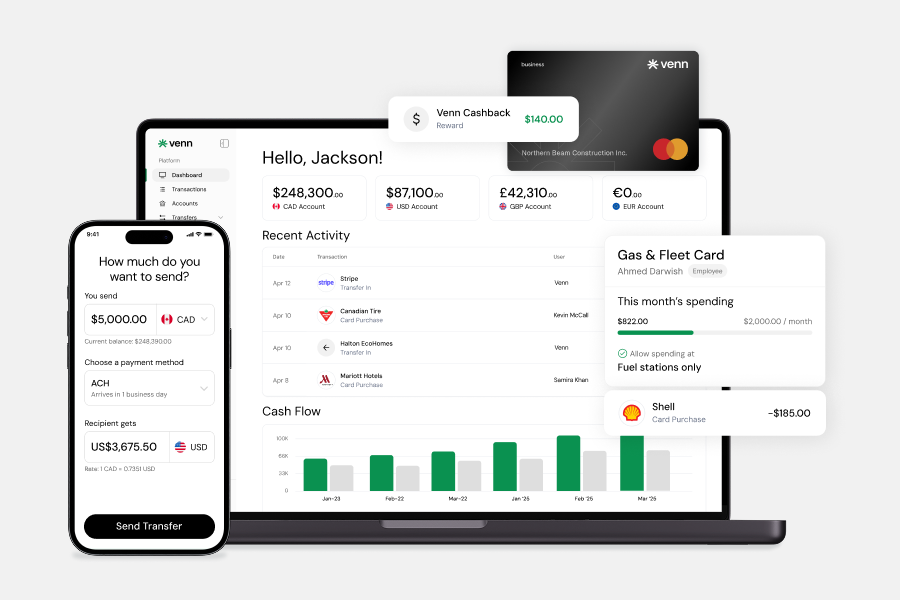
If Stripe payouts create separate CAD, USD, GBP, or EUR workflows, a multi-currency business platform can sit beside your payment stack as an operating layer. Traditional foreign-currency operating accounts work well for some Canadian businesses, especially if your process already fits your bank's reporting and approval tools. Venn is another option worth considering for companies that want to receive, manage, reconcile, and spend multiple working currencies after Stripe settlement.
For finance teams, the value comes from reducing manual cleanup after the payment processing step. Venn supports CAD, USD, GBP, and EUR accounts with compatibility for QuickBooks and Xero. Its expense management features include OCR receipt capture to help match card spend and receipts faster, and vendor payments can be made using free unlimited Interac e-Transfer®.
Currency decisions still need math. Venn's FX markup is plan-based: 0.45% on Essentials, 0.35% on Plus, and 0.25% on Pro or Custom. Its card offers 1% cashback, with plan-based caps on Essentials and Plus and unlimited cashback on Pro or Custom. CAD and USD balances can earn 2% interest, and Venn funds are covered under CDIC insurance protection.
It's worth being clear about what this setup does and doesn't do: it can help with cash management and reconciliation after Stripe pays out, but it doesn't change Stripe's base processing rate, international card fee, or whether Stripe applies a currency conversion fee based on your charge and settlement currency.
What To Compare Before Changing Your Setup
A change in setup is worth making only when the operating cost justifies the added complexity.
Start by working through these questions:
- What share of your sales comes from outside Canada, and is that share growing?
- Do foreign customers pay in CAD, or do you charge them in their local currency?
- Does your Stripe settlement currency match the currency of the sale, or does Stripe convert before payout?
- After payout, do you convert again to pay suppliers, contractors, software bills, or card spend?
- Are Stripe USD to CAD fees, cross-border sales fees, or payout differences making margin harder to forecast?
- Does month-end reconciliation now require manual matching across currencies, exchange rates, and bank records?
If most revenue remains domestic and CAD-based, a simpler setup may still fit. If international sales drive meaningful volume, consider whether payment processing fees are only part of the issue—and whether downstream conversion or reconciliation creates the larger operational drag.
Comparison Table For Settlement And Operating Setups
Use this table to compare how settlement currency choices affect the Stripe fees Canadian merchants see on cross-border sales, including where the Stripe currency conversion fee may still apply.
The Decision Comes Down To Fee Triggers
For Canadian merchants, Stripe fees depend less on a simple "expensive or inexpensive" label and more on which events your payment flow activates. A foreign card may trigger the Stripe international card fee. A mismatch between charge currency and settlement currency may trigger the Stripe currency conversion fee. And after payout, your own treasury process can add another conversion if USD revenue gets changed to CAD, then converted back to USD for suppliers.
That's the real decision point. Map your cross-border sales fees from checkout to payout to operating spend. If settlement and treasury workflows create extra FX steps, it may be worth evaluating whether a multi-currency operating layer such as Venn fits your post-settlement workflow.
Legal Disclaimer And Verification Note
Reviewed October 22, 2026. This guide is for general informational purposes only and does not provide financial, legal, tax, or accounting advice. Comparisons rely on publicly available information believed to be accurate on the review date, but provider pricing, Stripe Canada pricing, settlement currency rules, and support materials can change without notice. Verify Stripe's Canada pricing page, currency conversion details, and settlement support documentation on publication day. Venn is not a bank.
Frequently Asked Questions
Q: Does Stripe charge FX on every foreign sale in Canada?
A: No. Stripe fees in Canada depend on separate triggers, so a foreign customer does not automatically mean Stripe applies a currency conversion fee. The international card fee relates to the card, while the Stripe FX fee depends on whether Stripe needs to convert between the charge currency and settlement currency. See the rate and scenario sections above for the detailed breakdown.
Q: What is the difference between an international card fee and a currency conversion fee?
A: The Stripe international card fee relates to where the customer's card was issued. The Stripe currency conversion fee relates to a mismatch between the currency you charge and the currency Stripe pays out to your business. This distinction matters because cross-border sales fees and Stripe USD-to-CAD fees may apply in different combinations.
Q: Can a Canadian business settle Stripe funds in USD?
A: Setup details matter. Stripe support materials note a Canada-related exception involving USD-denominated bank accounts, but eligibility and configuration can vary by account. If your business has meaningful US revenue, confirm your Stripe settlement currency options directly inside Stripe before changing checkout or banking workflows.
Q: Will a multi-currency business platform eliminate Stripe fees?
A: No. A platform such as Venn may help with downstream currency management and reconciliation after Stripe settlement, given its multi-currency support. It does not change Stripe Canada pricing or Stripe's published card-processing rates.
Q: How should I estimate Stripe fees in Canada before changing my checkout currency?
A: Start by mapping three items: the customer's card origin, the currency charged at checkout, and the Stripe settlement currency. Then compare the expected fee stack against the operational cost of managing additional currencies. If a change reduces payment processing fees in Canada but creates accounting complexity, the net benefit may be smaller than it first appears.
---
**Disclaimer:** This publication is provided for general information purposes only and does not constitute legal, tax, financial, or other professional advice from Venn Software Inc., its subsidiaries, or its affiliates, and is not a substitute for advice from a qualified professional. All comparisons and competitor information reflect publicly available information believed accurate as of October 22, 2026; features, pricing, rates, and terms referenced are subject to change and may differ at the time you read this. All product names, logos, and brands referenced are the property of their respective owners; their mention does not imply affiliation with or endorsement by Venn. Any comparative statements reflect Venn's views and are provided to help readers evaluate options. We make no representations, warranties, or guarantees, express or implied, that the content is accurate, complete, or up to date.

Venn is all-in-one business banking built for Canada
From free local CAD/USD accounts and team cards to the cheapest FX and global payments—Venn gives Canadian businesses everything they need to move money smarter. Join 15,000+ businesses today.
Frequently asked questions
Everything you need to know about the product and billing.
Join 15,000+ businesses banking with Venn today
Streamline your business banking and save on your spend and transfers today
No personal credit check or guarantee.