What Are Multi-Currency Payments How They Work and Use Them
What are multi-currency payments how they work and how to use them to reduce FX costs, pick settlement currency, and simplify reconciliation for your business.

Ahmed Shafik
Co-founder
.png)
Trusted by 15,000+ Canadian businesses
Business banking for Canada
Local CAD and USD accounts, corporate cards with cashback, the lowest FX rates in Canada, free local transfers, and more.
Multi-currency payments allow your customers to pay in their local currency while you choose whether to receive funds in that same currency or convert them to Canadian dollars. For Canadian businesses selling internationally, this capability transforms both customer experience and operational efficiency.
Why does this matter? When a customer in Germany sees prices in euros rather than Canadian dollars, they understand exactly what they're paying. No surprises from their bank's conversion fees. No mental math. Just a straightforward transaction that builds trust and often improves conversion rates.
The challenge for most Canadian businesses isn't accepting international payments. It's managing the complexity that follows: FX markups eating into margins, delayed settlements disrupting cash flow, and reconciliation headaches at month-end. Businesses often pair multi-currency payment acceptance with multi-currency business accounts (like Venn) to reduce conversions and simplify payouts across their entire operation.
This guide covers the complete multi-currency workflow: how payments move from customer to your account, where costs accumulate, and how to set up a system that actually works for your business.
What Are Multi-Currency Payments?
A Simple Definition (With A Real-World Example)
Multi-currency payments give businesses the ability to price, accept, settle, and hold funds in multiple currencies based on their operational needs.
Consider a Toronto-based ecommerce company selling to American customers. With multi-currency payments, they display prices in USD at checkout. The customer pays in USD. The business can then settle those funds in USD, hold them in a USD account, and use that balance to pay American suppliers or run US-based ad campaigns. No conversion required until they actually need Canadian dollars.
This differs fundamentally from simply accepting an international credit card. In that scenario, the customer's bank handles conversion at whatever rate it chooses, often with a 2.5% to 3% markup the customer never explicitly sees.
Multi-Currency Payments vs Cross-Border Payments (Not Always The Same)
These terms overlap but aren't interchangeable. Cross-border payments describe any transaction where the buyer and seller are in different countries. The payment can still be "single-currency" from your perspective if your processor automatically converts everything to CAD before you see it.
Multi-currency payments mean you intentionally support multiple currencies at checkout, at settlement, or both. You're making a deliberate choice about where and when currency conversion happens, rather than leaving it to default settings.
How Multi-Currency Payments Work (Step By Step)
Understanding the payment flow helps you identify where costs accumulate and where you have control.
Step 1: Currency Presentment (What The Customer Sees)
Presentment currency is the currency displayed to your customer at checkout. When you show prices in a customer's local currency, you remove friction. They see a familiar number, understand the cost immediately, and proceed with confidence.
Price psychology matters here. A product priced at €49.99 feels different than one showing $74.23 CAD with a note about conversion. Round numbers in local currencies often perform better than precise conversions.
Step 2: Authorization And Processing
When the customer completes payment, their card or payment method is authorized in the presentment currency. Your payment processor handles this authorization, communicating with the customer's bank to confirm the transaction.
Processing fees and acceptance rates can vary by region and payment method. European cards may have different interchange rates than American ones. Local payment methods (like iDEAL in the Netherlands or Bancontact in Belgium) sometimes offer better rates than international card networks.
Step 3: FX Conversion (If/When It Happens)
Currency conversion can occur at several points, and this is where businesses often lose money without realizing it:
• At the customer's bank (if you price in CAD and they pay with a foreign card)
• Inside your payment processor (if you present in EUR but settle to CAD)
• Later, when you convert balances (if you hold EUR and later need CAD)
Each conversion point typically includes an FX spread or markup. This spread is the difference between the mid-market exchange rate and the rate you actually receive. Spreads of 1% to 3% are common, and they compound when money converts multiple times.
Step 4: Settlement And Payouts (Where The Money Lands)
Settlement currency is what actually arrives in your account. This distinction between presentment and settlement currency represents your biggest lever for controlling costs.
Common scenarios include:
• Present EUR, settle CAD: Simple operationally, but you pay conversion fees on every transaction.
• Present USD, settle USD: No conversion on incoming funds. Use that USD for American expenses.
• Present GBP, settle CAD, convert later: You still pay conversion, but you might time it better.
Your settlement choice affects cash flow timing, fee accumulation, and accounting complexity.
Step 5: Reconciliation And Reporting
Accurate reconciliation requires specific data for each transaction:
• Presentment currency and amount
• Settlement currency and amount
• FX rate applied and its source
• Timestamps for transaction and settlement
• Fee breakdown (processing, FX, other)
• Net deposited amount
When processors send "one-line deposits" combining hundreds of transactions, reconciliation becomes painful. The right tools and account structure make this manageable.
The Business Benefits Of Multi-Currency Payments (And When They Matter Most)
Better Customer Experience And Potentially Higher Conversion
Customers prefer paying in their own currency. They understand the price immediately, face no surprise fees from their bank, and trust the transaction more. Fewer customers abandon checkout when they see familiar currency symbols.
Card declines also decrease when customers aren't confused by unexpected conversion charges appearing on their statements.
Lower Total FX Costs (When Set Up Correctly)
The goal is reducing your "conversion count," the number of times money changes currency between customer payment and your final use of those funds.
If a customer pays in USD, you settle in CAD, then later convert CAD back to USD to pay an American vendor, that money converted twice. Each conversion cost you 1% to 2%. With proper setup, you could have held USD throughout and converted zero times.
More Predictable Cash Flow For International Operations
Holding currency balances in the currencies you actually spend creates operational predictability. If you pay USD for software subscriptions, advertising, and contractors, maintaining a USD balance means those expenses stay consistent regardless of CAD/USD fluctuations.
Costs To Watch: Fees In Multi-Currency Payment Processing
Common Fee Categories (Plain-English Breakdown)
Multi-currency payment costs stack up across several categories:
• Payment processing fees: Typically 2.4% to 2.9% plus a fixed amount per transaction, varying by card type and region
• FX conversion fees/spreads: Often 1% to 3% above mid-market rates, sometimes hidden in the quoted exchange rate
• Wire fees: $15 to $50 for international wires, plus potential intermediary bank fees
• Chargeback and refund costs: Processing fees often aren't refunded; FX rate differences can create additional losses
• Platform or subscription fees: Monthly costs for multi-currency capabilities
A Simple "Fee Stack" Example
Example only, for illustration:
A Canadian business receives a €1,000 payment from a European customer.
Fee TypeAmountRunning TotalPayment processing (2.7%)€27€973FX spread to CAD (2.5%)~$36 CAD~$1,467 CADNet received~$1,431 CAD
If the mid-market rate would have yielded $1,503 CAD, the business lost $72 to fees and spreads, about 4.8% of the original payment.
Now consider if they held euros and later paid a European supplier. No FX conversion needed. The €973 after processing fees stays €973.
Dynamic Currency Conversion (DCC) vs Multi-Currency Pricing
What DCC Is (And Why Customers Often Dislike It)
Dynamic Currency Conversion offers customers the option to pay in their home currency at checkout or at a payment terminal, with conversion happening immediately at a rate set by the merchant's processor.
The problem: DCC rates typically include markups of 3% to 8%. Customers who understand this often decline DCC, preferring to let their own bank handle conversion at better rates. Those who accept often feel deceived when they later realize they overpaid.
When (If Ever) DCC Makes Sense
DCC generates revenue for merchants, which is why some businesses offer it. However, the customer experience cost may outweigh the short-term gain. If you do offer DCC, transparency matters. Clearly display both options and the exchange rate being applied.
True multi-currency pricing, where you set fair prices in local currencies and handle conversion on your end, builds more trust than DCC.
How To Use Multi-Currency Payments: A Practical Setup Guide For Canadian Businesses
Step 1: Map Your Currency Flows (Revenue And Costs)
Start by listing every currency in your business:
Revenue currencies: Where do customers pay from? What currencies do your invoices use?
Expense currencies: What currencies do you pay suppliers, contractors, software subscriptions, and advertising in?
This mapping reveals which currencies you should hold versus convert immediately.
Step 2: Choose Your Presentment Strategy
Your options range from simple to optimized:
• CAD only: Simplest setup. Customers see Canadian prices and their banks handle conversion.
• USD only: Common for businesses with primarily American customers.
• Multiple currencies (USD, EUR, GBP): Match your top customer markets.
For ecommerce, local pricing by geography often improves conversion. Service businesses and agencies might invoice in client currency. Import/export operations should match settlement to supplier currencies where possible.
Step 3: Decide Your Settlement Strategy (The "Big Lever")
Settlement strategy determines how much you pay in conversion fees over time.
Settle to CAD when you need Canadian dollars quickly and don't have significant foreign currency expenses.
Settle to the same currency you charge when you have expenses in that currency. Holding USD to pay USD costs eliminates conversion entirely for that portion of your business.
Step 4: Add Multi-Currency Business Accounts As Your Operating Hub
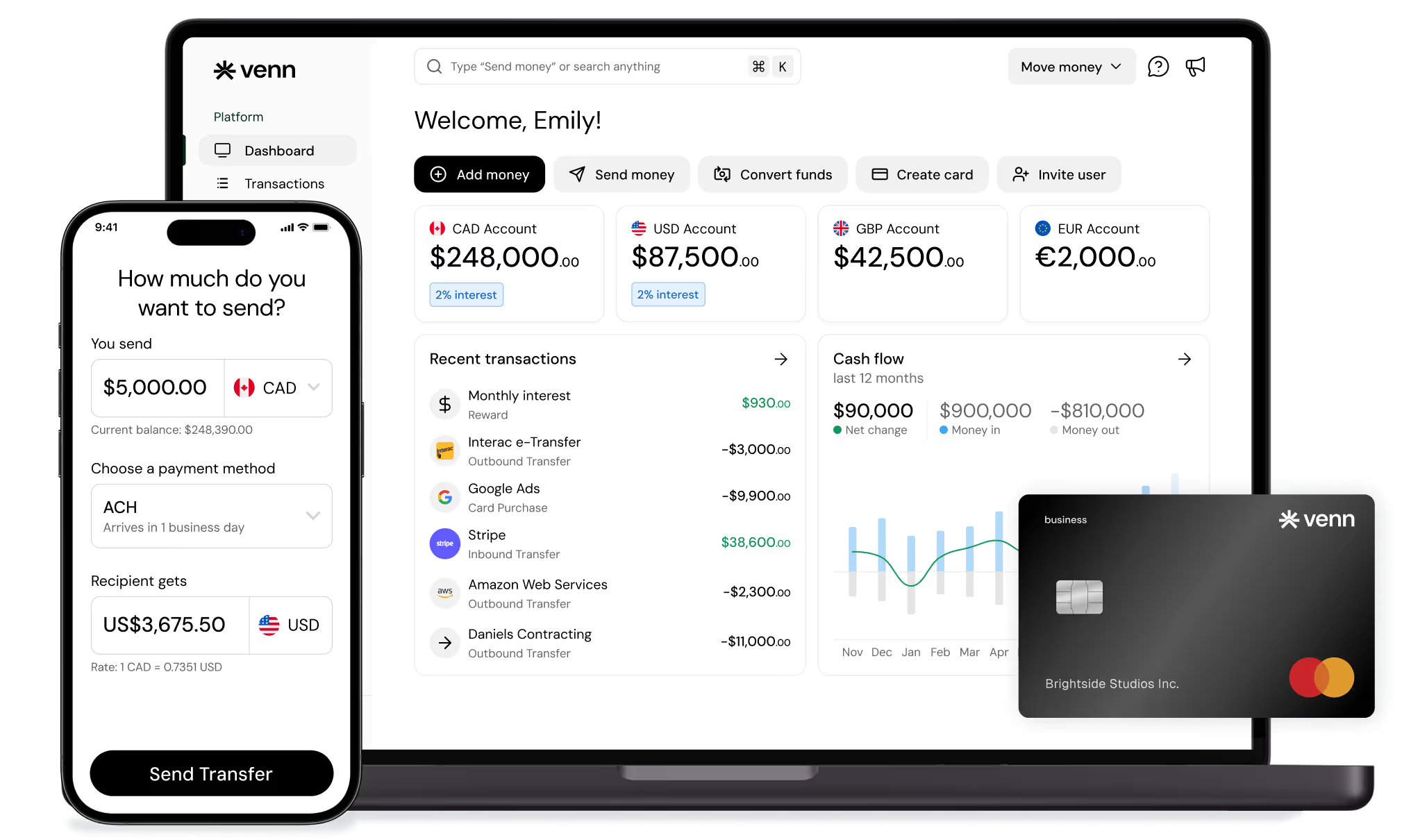
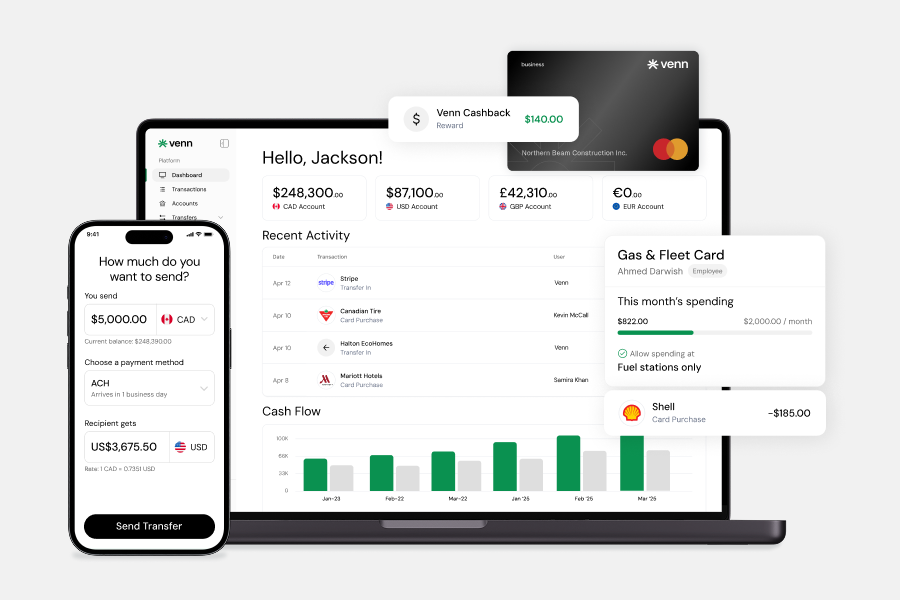
Multi-currency accounts transform how international payments flow through your business. Venn provides Canadian businesses with local-currency accounts that let you receive, hold, and pay in key currencies without unnecessary conversions.
With Venn, you get local CAD and USD accounts, plus access to local EUR and GBP accounts. This means you can receive payments in USD via ACH, hold those funds, and pay American vendors without ever converting to CAD.
The operational advantages compound:
• Send and receive local transfers (ACH in the US, SEPA and Faster Payments in Europe/UK) instead of expensive international wires
• Transfer funds to 180 countries in 36+ currencies
• Wire fees from $6 to $10 globally, with local transfers from $0 to $2 depending on your plan
• Free, unlimited Interac e-Transfer® for Canadian business transfers
Funds in your Venn account are covered under CDIC insurance protection, giving you security alongside operational flexibility.
Step 5: Manage Team Spend In Multiple Currencies
Your payment acceptance strategy should connect to your spending strategy. Venn's card delivers 1% unlimited cashback on all spend while supporting multi-currency operations.
When team members spend in USD, the card draws from your USD balance first, avoiding unnecessary conversion. This applies to:
• Travel expenses in foreign countries
• SaaS subscriptions billed in USD
• International advertising spend
• Contractor payments abroad
The expense management features, including receipt capture and invoice matching, reduce month-end reconciliation work significantly.
Step 6: Connect Accounting Software And Automate Reconciliation
Venn integrates directly with QuickBooks and Xero, creating an automated flow from banking transactions to your books.
Set up your chart of accounts to track:
• FX fees as a separate expense category
• Processing fees distinct from FX costs
• Realized FX gains and losses
Maintain clear audit trails: invoices, receipts, and payout reports should all connect to specific transactions.
Accounting And Reconciliation: How Multi-Currency Payments Show Up In Your Books
Key Concepts To Explain Simply
Your functional currency (likely CAD) is your primary reporting currency. Transaction currency is whatever currency each individual transaction uses.
Realized FX gains/losses occur when you actually convert currency. You bought USD at one rate and converted it back to CAD at a different rate. The difference is realized.
Unrealized FX gains/losses exist on paper when you hold foreign currency balances. The value in CAD terms changes as exchange rates move, but you haven't locked in that gain or loss yet.
Talk to your accountant about how to handle these in your specific situation.
Refunds, Partial Refunds, And Chargebacks Across Currencies
Refunds create complexity because exchange rates change:
• A customer paid €100 when the rate was 1.50 CAD/EUR. You received $150 CAD equivalent.
• They request a refund when the rate is 1.45 CAD/EUR. The €100 refund now costs you $145 CAD equivalent.
• You've lost $5 to rate movement, plus processing fees are rarely refunded.
Keep original transaction metadata and settlement reports. You'll need them for accurate reconciliation and potential disputes.
Options For Multi-Currency Payments: A Quick Comparison
Conclusion
Multi-currency payments serve two purposes: improving customer experience and reducing avoidable FX friction in your operations. Your three key decisions are presentment currency (what customers see), settlement currency (what you receive), and where FX conversion happens in your workflow.
Start by mapping your currency flows. Identify where you earn revenue and where you spend money. Then build an operating structure that minimizes unnecessary conversions.
A multi-currency business account like Venn serves as your operating hub, connecting payment acceptance, currency management, team spending, and accounting into a coherent system.
FAQs
Q: What is the difference between presentment currency and settlement currency?
A: Presentment currency is the currency your customer sees and pays at checkout. Settlement currency is the currency that actually arrives in your account. For example, you might present in EUR (the customer pays €100) but settle in CAD (you receive approximately $150 CAD after conversion). Controlling this difference is key to managing foreign exchange (FX) costs.
Q: Are multi-currency payments the same as cross-border payments?
A: Not exactly. Cross-border payments describe any transaction between parties in different countries. Multi-currency payments specifically mean you support multiple currencies at checkout, settlement, or both. A cross-border payment can still be single-currency if everything automatically converts to CAD.
Q: How do refunds work with multi-currency payments?
A: Refunds are processed in the original presentment currency. If a customer paid €100, they receive €100 back. However, exchange rates may have changed since the original transaction, so the CAD equivalent you lose may differ from what you originally received. Processing fees are typically not refunded.
Q: What is DCC and should I offer it?
A: Dynamic Currency Conversion (DCC) lets customers convert to their home currency at checkout using the merchant’s exchange rate. DCC rates often include 3% to 8% markups, which many customers recognize and dislike. True multi-currency pricing with transparent, fair conversion practices generally builds more trust than DCC.
Q: How can Canadian businesses reduce FX fees legally and transparently?
A: Canadian businesses can reduce foreign exchange (FX) fees by lowering their “conversion count” — holding and spending in the same currencies instead of converting everything to CAD. For example, using multi-currency accounts such as Venn to receive USD, hold USD, and pay USD expenses without converting reduces unnecessary FX charges. Sending local transfers (such as ACH or SEPA) instead of international wires can also lower costs. Finally, compare FX spreads across providers and prioritize transparent pricing.
Venn Mastercard Charge Card is issued by Peoples Trust Company under licence from Mastercard International Incorporated. Mastercard is a registered trademark, and the circles design is a trademark of Mastercard International Incorporated.
---
**Disclaimer:** This publication is provided for general information purposes and does not constitute legal, tax or other professional advice from Venn Software Inc or its subsidiaries and its affiliates, and it is not intended as a substitute for obtaining advice from a financial advisor or any other professional. We make no representations, warranties or guarantees, whether expressed or implied, that the content in the publication is accurate, complete or up to date.
This publication is provided for general information purposes only and does not constitute legal, tax, financial, or other professional advice from Venn Software Inc., its subsidiaries, or its affiliates, and is not a substitute for advice from a qualified professional. All comparisons and competitor information reflect publicly available information believed accurate as of February 13, 2026; features, pricing, rates, and terms referenced are subject to change and may differ at the time you read this. Competitor information is drawn from publicly available sources and has not been independently verified by Venn — we encourage readers to confirm current details directly with each provider. All product names, logos, and brands referenced are the property of their respective owners; their mention does not imply affiliation with or endorsement by Venn. Any comparative statements reflect Venn's views and are provided to help readers evaluate options. We make no representations, warranties, or guarantees, express or implied, that the content is accurate, complete, or up to date.

Venn is all-in-one business banking built for Canada
From free local CAD/USD accounts and team cards to the cheapest FX and global payments—Venn gives Canadian businesses everything they need to move money smarter. Join 15,000+ businesses today.
Frequently asked questions
Everything you need to know about the product and billing.
Join 15,000+ businesses banking with Venn today
Streamline your business banking and save on your spend and transfers today
No personal credit check or guarantee.