How to save on your Stripe payments for Canadian businesses
How to save on your Stripe payments for Canadian businesses with lower cost methods like ACSS, fewer FX fees, fewer disputes, and smarter payouts in 2026

Ahmed Shafik
Co-founder
Trusted by 15,000+ Canadian businesses
Business banking for Canada
Local CAD and USD accounts, corporate cards with cashback, the lowest FX rates in Canada, free local transfers, and more.
Stripe is the default payments infrastructure for thousands of Canadian businesses, and for good reason. Setup is fast, documentation is thorough, and the platform handles everything from one-time checkouts to complex subscription billing. But convenience has a cost, and the headline rate of 2.9% + CA$0.30 for domestic cards tells only part of the story.
Figuring out how to save on your Stripe payments as a Canadian business means looking at two distinct cost buckets. The first is what happens inside Stripe: your payment method mix, the share of international cards you accept, currency conversion charges, dispute fees, and whether your processing volume qualifies for custom pricing. The second is what happens around Stripe: where payouts land, whether USD revenue gets converted immediately or held strategically, how your banking setup handles multi-currency cash flow, and how much time your team spends on reconciliation.
Most businesses focus on the first bucket and ignore the second entirely. This guide covers both, with practical tactics organized by cost driver and business model.
How Stripe Fees Work in Canada
Stripe Canada pricing follows a straightforward base structure, but the effective cost of each transaction depends heavily on how and where your customer pays. Before publication, verify all fee data against Stripe's 2025/2026 pricing page at stripe.com/en-ca/pricing, as rates can change.
Stripe's standard pricing for Canadian businesses currently lists:
• 2.9% + CA$0.30 per successful domestic card transaction
• +0.5% for manually entered card details
• +0.8% for international cards
• +2% when currency conversion is required
Stripe states that standard pricing carries no setup fees or monthly fees. Custom pricing may be available for businesses processing higher volumes.
To show how effective payment cost shifts by method, consider four CA$500 transactions:
| Payment Scenario | Fee Calculation | Approximate Cost |
|---|---|---|
| Domestic card | 2.9% + CA$0.30 | CA$14.80 |
| International card | 3.7% + CA$0.30 | CA$18.80 |
| International card with FX conversion | 5.7% + CA$0.30 | CA$28.80 |
| ACSS/PAD (pre-authorized debit) | 1% + CA$0.40, capped at CA$5.00 | CA$5.00 |
The difference between a domestic card and an FX-converted international card on a single CA$500 payment is nearly CA$14. Across hundreds of monthly transactions, that gap compounds quickly.
Processing fees are only part of the picture. Disputes, refunds, failed payments, and the reconciliation work required to close your books each month all contribute to total payment operations cost. A CA$15 dispute fee on a card transaction, for example, erases the margin on multiple successful payments at the same order value. Payout timing and the currency in which Stripe settles funds also affect what your business ultimately keeps.
What Actually Drives Stripe Costs Higher For Canadian Businesses
Several cost drivers push effective Stripe fees well above the headline card rate of 2.9% + CA$0.30. Understanding which ones apply to your business determines where to focus first.
Over-reliance on cards is the most common issue. Many Canadian businesses default to card payments for recurring billing, retainers, invoices, and higher-value B2B transactions, even when ACSS pre-authorized debit could handle those use cases at a lower cost per transaction.
A high share of international cards adds 0.8% per transaction on top of the standard rate. For businesses selling to U.S. or global customers, this surcharge compounds quickly across monthly volume.
Currency conversion friction creates two separate cost moments that businesses often conflate. Stripe charges a conversion fee at the processing level when the payment currency differs from the payout currency. A separate FX cost occurs later when the business converts its Stripe payout into CAD through its bank or financial platform. These are distinct decisions with distinct costs.
Manual card entry adds another 0.5% per transaction. Businesses that key in card details for phone orders or ad hoc invoices pay more for every one of those payments. Hosted checkout flows and saved payment methods eliminate this cost.
Disputes and operational leakage round out the list. Stripe currently lists CA$15 per dispute received on card transactions, with the fee returned if the merchant wins. Verify current rates at stripe.com before making decisions based on these figures, as Stripe pricing can change.
Some of these costs are unavoidable given your customer mix. Others are operationally preventable with the right payment method choices and checkout setup.
7 Practical Ways To Save On Stripe Payments
Stripe fees in Canada add up in predictable patterns. Most businesses overpay not because the rates are hidden, but because they default to the same payment method for every transaction. These seven tactics address the most common cost drivers.
1. Test ACSS/PAD for Recurring and Higher-Ticket Payments
Stripe lists pre-authorized debit (ACSS/PAD) at 1% + CA$0.40, capped at CA$5.00. Compare that to 2.9% + CA$0.30 for a domestic card payment on a CA$500 invoice: the card costs CA$14.80, while ACSS/PAD costs CA$5.00. The savings compound quickly across subscriptions, retainers, memberships, and B2B invoices. Factor in the additional fees: CA$1.00 for instant bank verification and CA$5.00 for failures or disputes. For high-volume recurring billing, ACSS/PAD still wins on cost in most scenarios. Settlement takes up to five business days, so plan cash flow accordingly.
2. Reserve Cards for Conversion-Critical Checkouts
Cards convert better in fast, low-friction consumer checkout flows. For impulse purchases or first-time buyers, removing card payment can hurt revenue more than it saves in fees. Think in terms of margin by payment type, not a blanket switch.
3. Reduce International Card and FX Exposure
Stripe adds 0.8% for international cards and 2% if currency conversion is required. For businesses selling to U.S. customers, those two charges can stack. Receiving USD payouts into a USD-denominated account, rather than triggering automatic conversion, removes the 2% conversion fee at the processing layer entirely.
4. Ask Stripe About Custom Pricing
Stripe states that custom pricing may be available for businesses with larger monthly processing volumes. If your volume is consistent and your dispute rate is low, a conversation with Stripe's sales team is worth initiating. Even a modest reduction in the base card rate compounds significantly at scale.
5. Cut Disputes Before They Become Fees
Each dispute on a card transaction currently costs CA$15. Prevention is cheaper than winning. Use clear billing descriptors so customers recognize the charge, send subscription reminder emails before renewal, communicate fulfillment timelines proactively, and publish a straightforward refund policy. Fewer disputes mean fewer fees and less operational time spent on responses.
6. Avoid Preventable Manual-Entry Transactions
Manually keyed card payments carry an additional 0.5% fee on top of standard card rates. Stripe adds this because card-not-present, manually entered transactions carry higher fraud risk. Redirect customers to hosted checkout pages, Stripe-generated invoices, or saved-payment flows that use tokenized card data. This eliminates the surcharge and reduces your fraud exposure.
7. Optimize Where Stripe Payouts Land
Saving on Stripe does not stop at checkout. If your business receives USD payouts, depositing into a USD account rather than auto-converting to CAD gives you control over when and how you convert. Holding USD in a multi-currency business account lets you time conversions, pay USD-denominated expenses directly, and avoid repeated conversion friction. This is where your banking setup directly affects your effective payment cost, separate from anything Stripe charges at the transaction level.
Use Lower-Cost Payment Methods in Canada
Not every Canadian transaction needs to run on a card. Choosing the right payment method for each use case is one of the most direct ways to reduce your effective processing cost inside Stripe.
ACSS/PAD is worth testing when the payment is predictable and the customer relationship is established. Recurring SaaS subscriptions, agency retainers, professional services invoices, membership fees, tuition payments, program billing, nonprofit recurring donations, and high-AOV B2B transactions all fit this profile well. Stripe currently lists pre-authorized debits at 1% + CA$0.40, capped at CA$5.00, which can represent meaningful savings compared to card rates on larger or repeat payments.
Cards still make sense in several situations. Fast consumer checkout, lower-ticket ecommerce, urgent one-time transactions, and any flow where checkout conversion rate matters more than raw processing cost are all cases where defaulting to cards is the right call. A lower fee means nothing if it reduces completed purchases.
For vendor payments or bank-based workflows that sit outside Stripe entirely, Interac e-Transfer® remains a familiar option for many Canadian businesses, particularly for one-off supplier payments or situations where a bank-native transfer is preferred over a payment platform.
The table below compares these methods across typical fit, cost pattern, and key tradeoffs to help you match each option to the right part of your payments mix.
Suggested Comparison Table
Each tool in a Canadian payments and operations stack serves a different job. This table maps the most relevant options by fit, cost lever, and tradeoff so you can evaluate where each one belongs in your setup.
| Option | Best Fit | Cost Or Savings Lever | Main Tradeoff | Where It Fits In The Stack |
|---|---|---|---|---|
| Stripe | Online payments infrastructure, ecommerce, SaaS billing | Optimize payment method mix, reduce international card and FX fees, negotiate custom pricing at volume | Adds cost for international cards (+0.8%) and currency conversion (+2%) | Payment acceptance and processing layer |
| Traditional Bank Operating Or Merchant Accounts | Businesses wanting full-service banking plus merchant services under one roof | Bundled pricing may suit lower-volume or relationship-managed accounts | Less pricing transparency; setup and monthly fees common | Banking, operating accounts, and merchant services |
| Moneris | Canadian businesses wanting domestic merchant-services familiarity | Flat-rate ecommerce pricing at 2.85% + $0.30; Simplified Pricing tied to volume and card type | Primarily card-focused; less suited to pure online-first stacks | In-person and ecommerce payment acceptance |
| Helcim | Businesses prioritizing transparent pricing and lower-cost bank payments | Interchange-plus model; ACH/EFT-PAD at 0.5% + 25¢, capped at $6 | Requires comfort with interchange-plus model and variable per-transaction rates | Payment processing with transparent fee structure |
| Square | Merchants wanting commerce software and payments combined | Online card-not-present at 2.8% + 30¢; integrated POS and software tools reduce operational overhead | Less flexible for complex B2B or multi-currency needs | Payments plus point-of-sale and commerce software layer |
| Venn | Businesses managing USD payouts, multi-currency cash flow, and accounting sync | 2.75% interest on CAD balances and up to 3.5% interest on USD balances (learn more); plan-based FX from 0.45% to 0.25%; 1% cashback card; QuickBooks and Xero connectivity | Not a payment processor; does not replace Stripe at checkout | Business finance and operating layer: multi-currency accounts, FX timing, expense management, and accounting reconciliation |
Venn is a technology company, not a bank. Eligible deposits are held at Bank of Montreal and covered by CDIC insurance protection, subject to applicable limits. Venn is currently not available to businesses in Quebec.
Beyond Stripe: Optimize The Banking And Cash-Flow Layer
Saving on payment processing costs does not stop at checkout. For Canadian businesses managing CAD, USD, GBP, and EUR cash flow, the decisions made after Stripe pays out can affect total payment operations cost just as meaningfully as the card rate itself.
Payout currency handling, FX timing, operating account structure, reconciliation workload, and spend controls all contribute to what a business actually pays to move money.
Consider a straightforward example: a Canadian SaaS company receiving USD payouts from Stripe that immediately converts those funds to CAD through a traditional bank account absorbs an FX spread on every payout cycle. Holding USD in a USD-denominated operating account and converting on a planned schedule gives that business more control over timing and cost.
Several categories of platforms address different parts of this problem.
Traditional bank operating accounts offer familiarity and CDIC coverage, but FX spreads at major Canadian banks tend to be wide, and multi-currency account options are limited for smaller businesses.
All-in-one payment platforms such as Square or Moneris bundle merchant services with some operating tools, which suits businesses that want a single vendor for in-person and online payments. They are less focused on treasury or multi-currency cash management.
Transparent processor models such as Helcim use interchange-plus pricing and offer low-cost bank payment options, including ACH/EFT-PAD at 0.5% + 25 cents, capped at $6, which can reduce per-transaction cost for higher-volume businesses.
Modern business finance platforms such as Venn address the banking and operations layer rather than the processing layer.
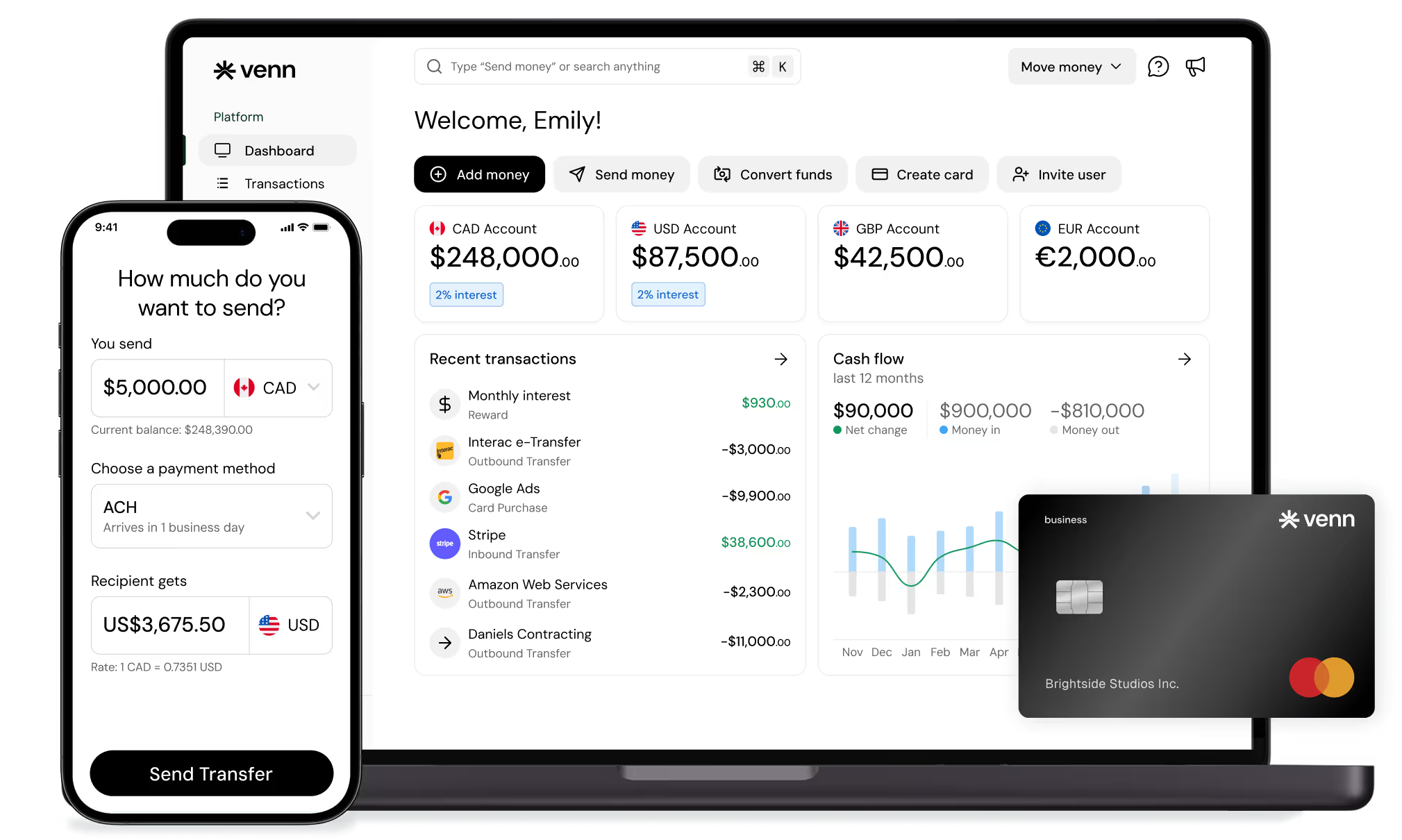
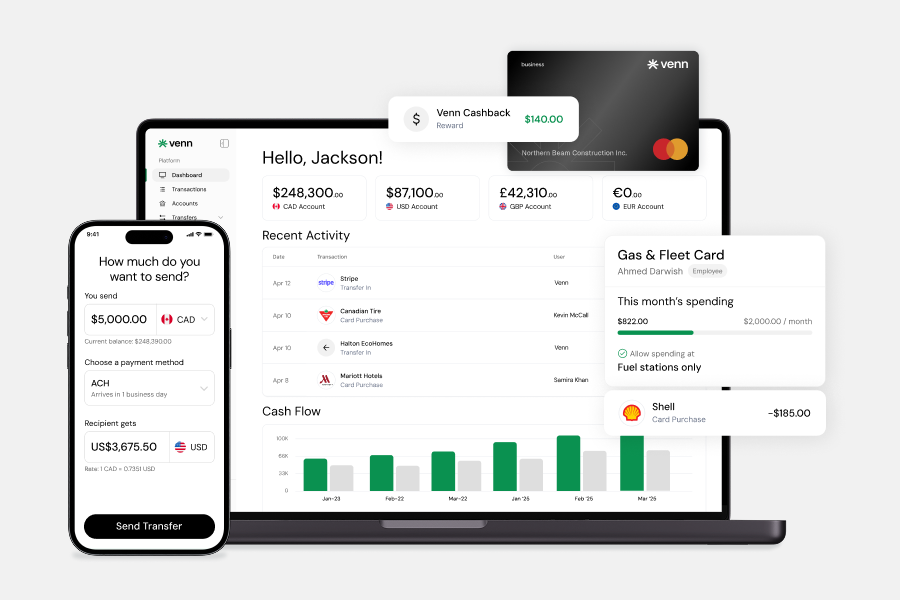
Venn offers CAD, USD, GBP, and EUR accounts, plan-based FX pricing from 0.45% down to 0.25%, and 1% cashback on card spend, with unlimited cashback on the Pro plan and caps on Essentials and Plus.
Venn also includes expense management features with receipt capture, direct QuickBooks and Xero integrations for reconciliation, and Interac e-Transfer® support. Its mobile app also lets teams view available funds, send transfers, and issue cards directly from their phone. Venn is a technology company, not a bank. Account balances are held at Bank of Montreal, and eligible deposits are covered by CDIC insurance protection, subject to applicable limits.
No single platform solves every part of the cost equation. The right approach pairs a payment processor suited to your transaction mix with an operating account structure that minimizes unnecessary FX conversion and supports clean reconciliation.
Which Tactics Matter Most By Business Model
Your business model determines which cost levers will move the needle most. Prioritizing the right two or three tactics saves more than trying to optimize everything at once.
Ecommerce brands should focus on card mix and international card exposure first. If a meaningful share of your customers use non-Canadian cards, that 0.8% international card surcharge compounds quickly. Audit your customer geography, test whether checkout conversion holds when you surface lower-cost payment options, and address any FX conversion happening at the payout stage.
SaaS and membership businesses have the clearest case for testing ACSS/PAD on recurring billing. Combine that with strong dunning logic, subscription reminder emails before renewal dates, and a close look at your USD customer concentration. Failed payments cost you both the fee and the customer relationship.
Professional services firms and agencies typically process fewer, larger transactions. ACSS/PAD fits well here, and the savings per invoice are meaningful at higher amounts. USD payouts and clean reconciliation through QuickBooks or Xero connectivity also reduce the operational cost that rarely shows up in a fee report.
High-AOV B2B businesses benefit most from bank debit economics, proactive dispute prevention, and a conversation with Stripe about custom pricing once volume justifies it. Pair that with a treasury setup that avoids unnecessary currency conversion on payouts.
Conclusion
Saving on your Stripe payments as a Canadian business rarely comes down to one fix. The cheapest payment method is not always the right one, and the businesses that reduce effective payment costs most successfully do so by building a thoughtful mix of payment options, payout workflows, and operating-account practices rather than chasing a single rate.
Start by auditing five areas: your payment method mix, your international card share, your dispute rate, how you handle payout currency, and your banking and reconciliation stack. Each one can quietly inflate your total cost in ways that the headline card rate never reveals.
If your audit surfaces gaps in the banking and cash-flow layer, particularly around USD payouts, multi-currency accounts, or accounting sync, several options are worth evaluating. Traditional bank operating accounts, Moneris, Square, Helcim, and modern business finance platforms like Venn each serve different parts of this problem.
Venn, for example, offers CAD, USD, GBP, and EUR accounts with QuickBooks and Xero connectivity and plan-based FX pricing, which can suit businesses managing cross-border cash flow alongside Stripe. Venn is a technology company, not a bank, and eligible deposits are held at Bank of Montreal and covered by CDIC insurance protection, subject to applicable limits.
No single platform solves everything. The goal is a stack where every layer, from checkout to payout to operating account, works together efficiently. Sign up for Venn
FAQ
Q: What are Stripe's standard fees in Canada?
A: Stripe currently lists 2.9% + CA$0.30 for domestic card payments, with add-ons of 0.5% for manually entered cards, 0.8% for international cards, and 2% when currency conversion is required. Pre-authorized debits are listed at 1% + CA$0.40, capped at CA$5.00. Fees can change, so verify current pricing directly at stripe.com/en-ca/pricing before making decisions based on specific figures.
Q: Is ACSS debit cheaper than card payments on Stripe?
A: For recurring billing or higher-value transactions, ACSS debit can cost meaningfully less than cards, particularly when the card-not-present rate plus any international card surcharge applies. The tradeoff is real: ACSS requires a mandate workflow and can take up to five business days for payment confirmation or payout, which affects cash flow planning.
Q: When should a Canadian business use PAD instead of cards?
A: Pre-authorized debit suits subscriptions, agency retainers, professional service invoices, memberships, and B2B transactions where the customer relationship is established and payment timing is predictable. It works less well for one-time consumer checkouts where speed and familiarity drive conversion.
Q: Can I reduce Stripe FX costs if I get paid in USD?
A: Yes, but the two cost types require different solutions. Stripe's 2% currency conversion fee applies at the processing layer when the payment currency differs from your settlement currency. Post-payout FX costs occur when USD payouts convert to CAD in your operating account. Holding USD in a multi-currency business account, rather than auto-converting on arrival, gives you more control over when and how that conversion happens.
Q: Should I ask Stripe for custom pricing?
A: It is worth requesting if your monthly processing volume is substantial, your dispute rate is low, and you have several months of consistent processing history to support the conversation. Stripe states that custom pricing may be available for higher-volume businesses, so the ask costs nothing and the potential savings compound over time.
Q: What is the difference between reducing Stripe fees and reducing overall payment costs?
A: Stripe fees cover processing: card rates, ACSS costs, dispute fees, and FX conversion at checkout. Overall payment costs include everything downstream: the FX rate your bank applies to USD payouts, reconciliation time, failed payment recovery, dispute management, and the operational overhead of managing cash flow across currencies. Businesses that focus only on processing fees often miss larger savings available in the banking and treasury layer.
Legal and Compliance Note
Fees, availability, interest rates, and platform features for Stripe, Moneris, Square, Helcim, and Venn can change at any time. Verify current pricing directly with each provider before making any business decisions.
Venn is a technology company, not a bank. Account balances are held at Bank of Montreal. Eligible deposits are covered by CDIC insurance protection, subject to applicable limits. Venn is currently not available to businesses in Quebec.
---
**Disclaimer:** This publication is provided for general information purposes only and does not constitute legal, tax, financial, or other professional advice from Venn Software Inc., its subsidiaries, or its affiliates, and is not a substitute for advice from a qualified professional. All comparisons and competitor information reflect publicly available information believed accurate as of June 1, 2026; features, pricing, rates, and terms referenced are subject to change and may differ at the time you read this. All product names, logos, and brands referenced are the property of their respective owners; their mention does not imply affiliation with or endorsement by Venn. Any comparative statements reflect Venn's views and are provided to help readers evaluate options. We make no representations, warranties, or guarantees, express or implied, that the content is accurate, complete, or up to date.

Venn is all-in-one business banking built for Canada
From free local CAD/USD accounts and team cards to the cheapest FX and global payments—Venn gives Canadian businesses everything they need to move money smarter. Join 15,000+ businesses today.
Frequently asked questions
Everything you need to know about the product and billing.
Join 15,000+ businesses banking with Venn today
Streamline your business banking and save on your spend and transfers today
No personal credit check or guarantee.