Mercury alternatives for Canadian Startups in 2026
Compare Mercury alternatives for Canadian Startups. Review CAD and USD support, FX, cards, spend controls, and QuickBooks Xero syncing for teams in 2026.


Trusted by 15,000+ Canadian businesses
Business banking for Canada
Local CAD and USD accounts, corporate cards with cashback, the lowest FX rates in Canada, free local transfers, and more.
Founders searching for Mercury alternatives for Canadian startups usually want what Mercury is known for: clean UX, startup-friendly workflows, and simple USD-first banking for venture-backed teams. That appeal is real, especially for founders selling into the U.S. or raising from U.S. investors.
The Canada gap surfaces quickly. Mercury can be relevant for Canadian founders when the company is formed in the U.S. or a U.S. territory, but it does not serve many Canadian-incorporated startups as a native operating account, and it supports USD only. That means it cannot cover day-to-day CAD needs such as local collections, payroll, vendor payments, and Canadian operating cash management.
In 2026, the practical question is not simply whether Mercury works in Canada. It is which Mercury alternative fits your structure and workflows. This comparison looks at Canada-friendly options through the lens founders actually use: incorporation, CAD and USD support, FX, cards, accounting integrations, cross-border banking, and whether branch access still matters.
What To Look For In A Mercury Alternative In Canada
Start with fit, not features. Many U.S.-centric comparison articles overlook Canadian payment rails and incorporation requirements, which makes them less useful when you need a business bank account for startups in Canada.
Five criteria are worth working through before comparing providers:
• Canadian Eligibility: Confirm the provider supports your legal structure, province, and incorporation type. A Canadian-incorporated startup, a sole proprietor, and a Canadian founder with a U.S. entity may each face different onboarding requirements.
• CAD And USD Operating Needs: Map where money comes from and where it goes. If you collect CAD revenue from Canadian customers, pay Canadian payroll, and also pay U.S. vendors, you need more than a simple USD business account setup.
• FX And Broader Currency Support: Cross-border banking for startups often involves more than one conversion. If you invoice U.S. clients, buy software in USD, or pay contractors abroad, compare FX costs, supported currencies, and whether you can hold balances before converting.
• Cards And Spend Management: Founder cards may work early, but teams need controls as they grow. Look for approval workflows, employee reimbursements, virtual cards, and visibility into recurring SaaS spend.
• Accounting And Finance Workflows: The right fintech business account option should reduce back-office work. Check whether transactions, receipts, reimbursements, and card activity can sync cleanly with your books, especially if you use QuickBooks or Xero.
Comparison Table
The table below offers a quick scan of Mercury alternatives for Canadian startups by operating fit, currency coverage, spend controls, and finance workflow.
Venn
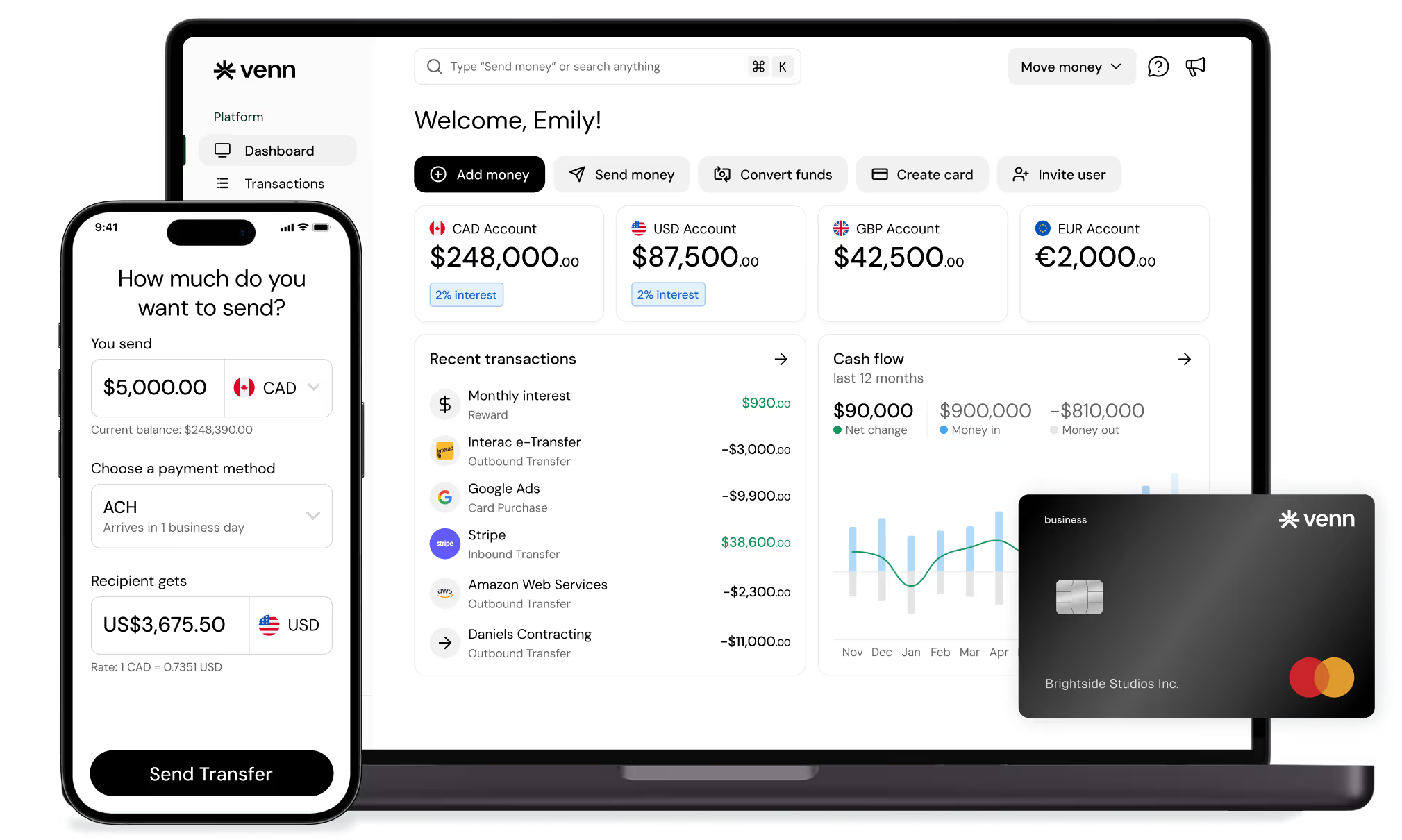
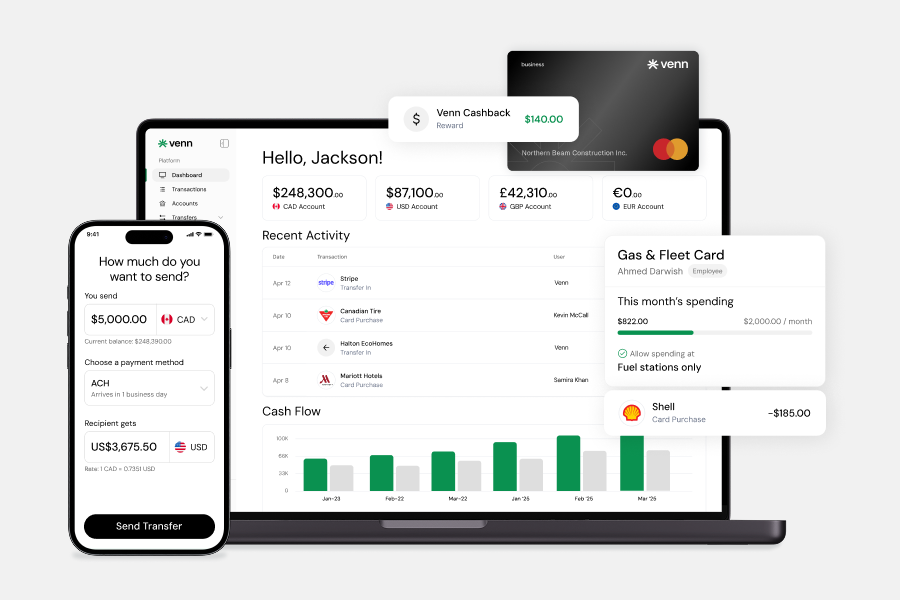
Venn fits Canadian startups that want Canadian operating account capabilities, multi-currency workflows, cards, expense controls, and accounting connectivity in one software-led platform. It is a credible option among Mercury alternatives for Canadian startups, particularly when a team needs CAD operations alongside USD and global payment workflows.
Venn supports Canadian corporations and sole proprietors outside Quebec. Startups can work across CAD, USD, GBP, and EUR, including ACH for USD, SEPA for EUR, and local Canadian payment rails. The platform also includes free unlimited Interac e-Transfer® and free PAD, which can help founders manage day-to-day Canadian startup banking without relying solely on wires.
Pricing is plan-tiered, with FX rates of 0.45%, 0.35%, and 0.25% depending on the selected plan. Venn also offers a current promoted balance interest of 2.75% CAD and 3.00% USD, with up to 3.50% on larger USD balances, subject to campaign terms (learn more). The funding window ends October 15, 2026, and the boosted term runs through July 15, 2027.
For spend management, Venn provides a secured Mastercard charge card with multi-currency matching and 1% cashback, with unlimited cashback on Pro. Teams can issue virtual and physical cards, set spend controls, route approvals, capture receipts with OCR, use AI transaction categorization, and connect with QuickBooks and Xero.
A few practical trade-offs are worth noting. Venn is a platform rather than a traditional branch-based institution, it does not support businesses in Quebec, and its card is balance-backed rather than a conventional revolving credit product. Balances are held at Bank of Montreal and eligible for CDIC protection up to applicable limits.
Airwallex
Airwallex suits startups with heavier global payment needs and broader multi-currency operations. For Canadian companies evaluating Mercury alternatives, it offers a Canada-specific business account designed around international collections, payments, and spend. Canadian businesses can apply using a Business Number, while sole proprietors can apply using a SIN, and the application flow runs entirely online, which can make onboarding more straightforward than opening accounts through many branch-led providers.
Its strongest fit is multi-currency use cases. Teams can collect and hold 20+ currencies, issue multi-currency cards, and manage global vendor or contractor payments from one platform. Airwallex also supports Xero and QuickBooks, giving finance teams a cleaner path to connect transactions with their bookkeeping workflows.
Pricing starts with the free Explore plan, which gives early-stage teams a low-commitment way to test the platform. Some advanced capabilities sit in paid tiers, so startups should review pricing against expected payment volume, card usage, and finance workflow needs before committing.
The main trade-off is focus. Airwallex is oriented toward international payments rather than domestic Canadian day-to-day operations, making it a stronger fit for global-first startups than for teams that primarily need local Canadian operating workflows.
RBC Business Banking
Among Mercury alternatives for Canadian startups, RBC Business Banking fits founders who want a traditional Canadian institution relationship and USD banking through a major incumbent.
RBC offers a U.S. Dollar Business Account, giving startups a familiar way to receive, hold, and pay in USD while staying within a large Canadian banking network. Founders also get access to RBC branches, established treasury and payment infrastructure, and the credibility that can come from working with a major bank. That can matter for companies expecting in-person support, more complex account needs, or future lending conversations as they grow.
RBC currently lists a $9 USD monthly fee for its U.S. Dollar Business Account, with separate per-transaction fees. Startups should review those costs against their expected wire, deposit, and payment volume.
The trade-off is workflow. RBC suits conventional business banking well, but software-first teams may find it less integrated for startup spend management, real-time finance operations, or accounting automation.
TD Business Banking
TD Business Banking is relevant for startups prioritizing cross-border support through a large Canadian incumbent. TD provides business cross-border banking guidance, foreign exchange services, U.S.-related banking pathways, and business wire payments in over 25 currencies. That range can help startups paying U.S. suppliers, receiving international funds, or planning a more formal USD business account setup through an established financial institution.
Pricing depends on the account package, transaction mix, wire activity, and FX services a business uses, so founders should review TD's current business banking fees and discuss expected volumes before opening accounts.
The trade-off is workflow style. TD may suit teams that value account management, branch support, and institution-led advice. For teams accustomed to startup-native platforms, the experience can feel more manual and bank-directed. Broader international needs may also require separate FX or treasury conversations rather than one integrated multi-currency workflow.
BMO Business Banking
BMO Business Banking fits startups that want a traditional Canadian institution with U.S. and international banking support. Its international capabilities include cross-border business banking and payments in over 40 currencies. Startups can also manage CAD and USD accounts online, which can help teams coordinate Canadian operating cash with U.S. receivables, vendor payments, or expansion activity.
As with the other incumbent options, pricing and transaction costs depend on the account mix and services used, so finance teams should review monthly fees, payment charges, and foreign exchange costs against expected volume.
The trade-off is workflow design. Teams seeking an all-in-one software-led finance stack with built-in spend management, approval controls, and accounting automation may find BMO more conventional than newer fintech business account options.
Which Type Of Startup Each Option Fits Best
• Canadian-incorporated startups operating in both CAD and USD: Compare Venn with RBC, TD, and BMO. This is the core decision set if you need a business bank account for startups in Canada while also managing U.S. customers, vendors, or investors. Use the platform sections and table above to weigh software-led workflows against traditional bank infrastructure.
• Global-first startups with heavier multi-currency needs: Look closely at Airwallex. It tends to fit teams that think beyond Canada and the U.S. from day one, especially if cross-border banking sits at the centre of day-to-day finance.
• Teams that value branch access and broader institutional relationships: Consider RBC, TD, or BMO. These options make sense when founder preference, lending conversations, in-person support, or established banking relationships matter as much as digital workflow.
• Canadian founders with U.S.-formed entities: Mercury may still belong on the shortlist. If the company also needs CAD workflows, compare Mercury against the Canada-friendly options above rather than treating any single platform as a complete solution.
How To Choose The Right Mercury Alternative
Start with your entity structure. A Canadian-incorporated startup has different banking needs than a U.S.-formed company with Canadian founders, especially when payroll, tax payments, customer collections, and vendor payments run through Canadian operations. If most money moves in CAD, prioritize a business bank account for startups in Canada that supports local operating workflows before optimizing for a familiar U.S.-style interface.
Next, map your transaction patterns. Do you pay U.S. vendors, receive USD from customers, or hold USD for future spend? If so, compare each Mercury alternative on cross-border banking, FX treatment, and how cleanly it supports USD business account workflows. If you invoice globally or collect in several currencies, broaden the lens to multi-currency options rather than treating USD as the only requirement.
Then assess finance team maturity. Founder-led teams often value simple software-led workflows, while scaling teams may need employee spend controls, approval rules, bookkeeping automation, and business banking integrations. A traditional institution may fit better if you need branch-based support, lending conversations, or a long-term bank relationship.
The best Mercury alternatives are the ones that match how your startup actually operates: incorporation structure, payment volume, currencies, internal controls, and the level of support your finance process requires.
Conclusion
The right choice among Mercury alternatives for Canadian startups comes down to how your company operates. A Canadian-incorporated startup with CAD payroll, local collections, and Canadian finance workflows has different needs than a Canadian founder running a U.S. entity. Software-led platforms tend to fit teams that want faster, more connected finance operations, while traditional Canadian institutions suit startups that value branch access and established banking relationships.
If your priority is Canadian startup banking with CAD and USD workflows, multi-currency operations, and accounting-friendly tools, Venn is worth including in your shortlist alongside the other options covered above. Sign up for a Venn account
FAQ
Q: Can a Canadian startup use Mercury?
A: Only if the business is formed in the U.S. or a U.S. territory. If you have Canadian founders but a U.S.-registered entity, review the Mercury eligibility discussion earlier in this article before deciding whether it fits your operating model.
Q: Why do Canadian startups often need an alternative to Mercury?
A: Many Canadian-incorporated startups need CAD operations, local collections, payroll funding, and Canadian payment rails that go beyond a USD-first account. A search for a Mercury alternative often begins when founders realize their finance stack must support both cross-border activity and day-to-day Canadian startup banking.
Q: What matters most when comparing Mercury alternatives in Canada?
A: Start with eligibility, then assess CAD and USD support, payment rails, foreign exchange (FX) costs, cards, spend controls, and accounting workflows. The best Mercury alternatives should match your incorporation structure, customer locations, vendor payments, and bookkeeping process. For many teams, the right business bank account for startups in Canada depends less on brand recognition and more on how efficiently money moves through the business.
Q: Should a startup choose a platform or a traditional bank?
A: Choose based on how your team works, not on category alone. A fintech business account platform may suit teams that value software-led workflows, multi-currency support, startup spend management, and business banking integrations. A traditional bank may be a better fit when branch access, lending relationships, or conventional cross-border banking matter more. Use the platform sections and comparison table above to narrow your choice.
---
**Disclaimer:** This publication is provided for general information purposes only and does not constitute legal, tax, financial, or other professional advice from Venn Software Inc., its subsidiaries, or its affiliates, and is not a substitute for advice from a qualified professional. All comparisons and competitor information reflect publicly available information believed accurate as of June 1, 2026; features, pricing, rates, and terms referenced are subject to change and may differ at the time you read this. All product names, logos, and brands referenced are the property of their respective owners; their mention does not imply affiliation with or endorsement by Venn. Any comparative statements reflect Venn's views and are provided to help readers evaluate options. We make no representations, warranties, or guarantees, express or implied, that the content is accurate, complete, or up to date.

Venn is all-in-one business banking built for Canada
From free local CAD/USD accounts and team cards to the cheapest FX and global payments—Venn gives Canadian businesses everything they need to move money smarter. Join 15,000+ businesses today.
Frequently asked questions
Everything you need to know about the product and billing.
Join 15,000+ businesses banking with Venn today
Streamline your business banking and save on your spend and transfers today
No personal credit check or guarantee.