Is Accounts Payable Debit or Credit Breakdown for Canadians
Is accounts payable a debit or a credit Breakdown for Canadians. Get the 15 second rule, GST HST ITC entries, and common AP scenarios for accurate books.

Ahmed Shafik
Co-founder
Trusted by 15,000+ Canadian businesses
Business banking for Canada
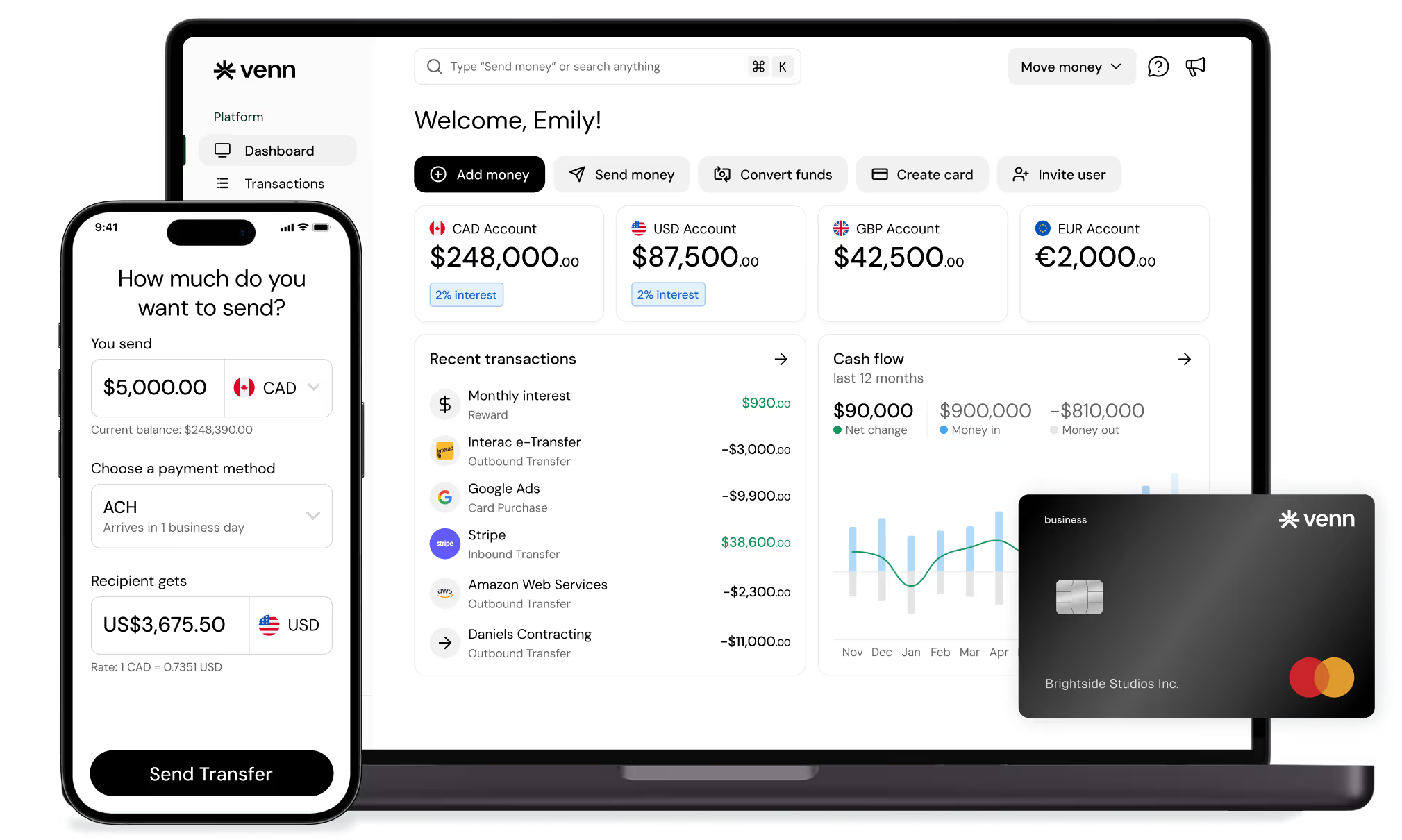
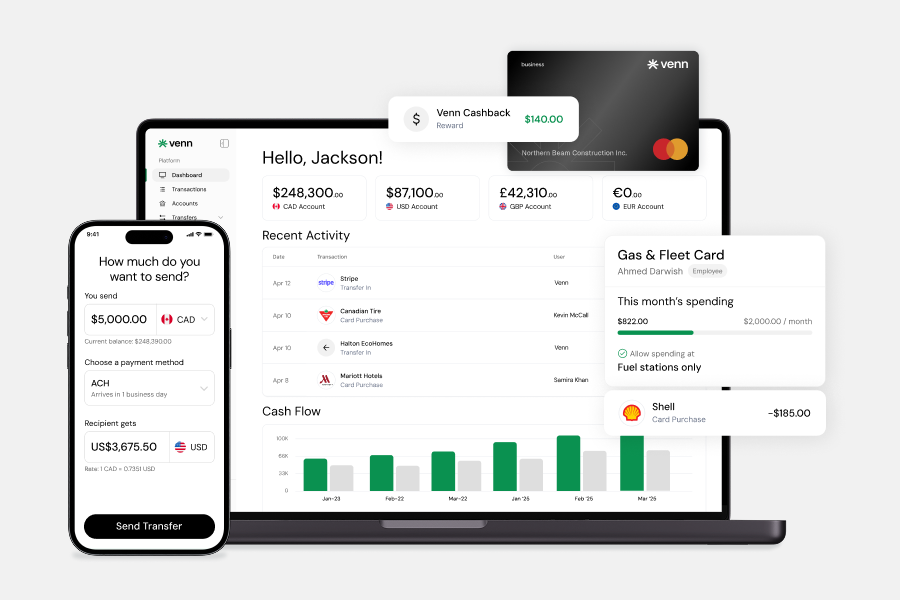
Local CAD and USD accounts, corporate cards with cashback, the lowest FX rates in Canada, free local transfers, and more.
Accounts payable is a credit. More specifically, accounts payable carries a normal credit balance because it represents a liability, which is money your business owes to suppliers and vendors. When you record a supplier invoice, you credit accounts payable. When you pay that invoice, you debit accounts payable to reduce what you owe.
This distinction matters for every Canadian business owner managing their books. Understanding when to debit and when to credit AP keeps your financial statements accurate and your cash flow predictable. Once you grasp the accounting logic, the next challenge becomes operational: actually paying those invoices efficiently and reconciling them at month-end. This is where a purpose-built business banking platform like Venn fits into your financial stack.
The 15-Second Rule: Your Quick Reference
Before diving deeper, here's your decision shortcut:
• Booking a bill from a supplier? Credit AP (increases what you owe)
• Paying the bill? Debit AP (decreases what you owe)
• Receiving a vendor credit memo? Debit AP (reduces your obligation)
• Returning goods to a supplier? Debit AP (lowers the balance)
Keep this mental model handy whenever you're recording transactions. The pattern holds across industries, invoice sizes, and complexity levels.
What Is Accounts Payable?
Accounts payable represents money your business owes to suppliers for goods or services you've already received but haven't paid for yet. It's a promise to pay, recorded on your balance sheet as a current liability.
Think of AP as the accounting reflection of your unpaid bills. Every invoice sitting in your inbox waiting for payment has a corresponding entry in your accounts payable ledger.
Real-world examples across Canadian industries:
• Restaurants: Invoices from food distributors, beverage suppliers, equipment maintenance companies
• Retail and eCommerce: Inventory purchases, packaging materials, 3PL fulfillment invoices
• Professional services: Contractor fees, software subscriptions, marketing agency retainers
• Construction: Subcontractor invoices, material suppliers, equipment rentals (note: holdback requirements vary by province, so consult your accountant for specifics)
AP is the accounting concept. Paying AP is the operational reality. Your business banking platform determines how smooth that process becomes.
Why Accounts Payable Is a Credit
Normal Balance Refresher
Every account type in double-entry bookkeeping has a "normal" balance, meaning the side where increases are recorded:
Accounts payable is a liability. Liabilities increase with credits. Therefore, when your obligation to pay grows, you record a credit to AP.
The Logic Behind Liabilities Increasing With Credits
When you receive an invoice, your business has acquired something of value (inventory, services, supplies) and now owes money in return. This obligation is a liability. Since liabilities live on the credit side of the accounting equation, recording an increase means crediting the account.
Here's a simple illustration before we add tax complexity: Your company receives a $500 invoice for office supplies. You now owe $500 more than before. Your liability increased, so you credit accounts payable by $500.
Accounts Payable Journal Entries: Canadian Examples
Example 1: Recording a Supplier Invoice
Scenario: Your Toronto-based marketing agency receives a $1,000 invoice for graphic design services.
Journal entry:
You're increasing what you owe, so AP is credited. The expense account is debited because expenses have normal debit balances.
Example 2: Paying the Invoice
Scenario: Two weeks later, you pay that $1,000 invoice from your business account.
Journal entry:
AP decreases (debit), and cash decreases (credit). Your obligation is settled, and both sides of your balance sheet reflect the change.
How GST/HST Affects Accounts Payable
Canadian businesses registered for GST/HST can claim Input Tax Credits (ITCs) on eligible purchases. This adds another layer to your journal entries.
The Common Canadian Setup: Expense + ITC + AP
Scenario: Your Ontario business receives an invoice for $1,000 plus 13% HST, totaling $1,130.
Journal entry:
The expense reflects the actual cost. The GST/HST Recoverable account captures the tax you can claim back. Accounts payable records the full amount you owe the vendor.
Important: Tax treatment varies by province, exemption status, and item type. Some purchases don't qualify for ITCs, and rates differ across provinces (5% GST in Alberta, 15% HST in Nova Scotia, for example). Confirm the correct treatment with your bookkeeper or accountant.
Paying the HST-Inclusive Invoice
Journal entry:
The payment clears your liability. The ITC remains in your GST/HST Recoverable account until you file your return and offset it against HST collected.
Reconciling these payables becomes significantly easier when your payments and receipts are organized from the start. Pairing Venn with QuickBooks or Xero keeps payment records clean for bookkeeping and simplifies tax time.
Accounts Payable vs. Accounts Receivable
These two accounts are mirror images of each other, yet they're frequently confused.
Accounts Payable (AP):
• Money you owe to others
• Liability account
• Normal credit balance
• Appears on the right side of your balance sheet
Accounts Receivable (AR):
• Money owed to you by customers
• Asset account
• Normal debit balance
• Appears on the left side of your balance sheet
Memory trick: Payable = you pay. Receivable = you receive.
Accounts Payable vs. Expenses
This distinction trips up many business owners. An expense and a payable are related but serve different purposes.
Expenses record the cost of doing business. They appear on your income statement and reduce your profit. When you debit an expense account, you're recognizing that your business consumed value.
Accounts payable records the unpaid obligation. It appears on your balance sheet and represents what you still owe.
Under accrual accounting, you can have an expense without paying yet. The expense hits your income statement when incurred. The payable sits on your balance sheet until settled. When you finally pay, you reduce AP. You don't re-record the expense.
Accrual vs. Cash Accounting: Does AP Even Show Up?
Under Accrual Accounting
AP is recorded when the bill is incurred, regardless of when payment happens. This method matches expenses to the period when they're earned, giving you a more accurate picture of profitability.
Most growing Canadian businesses use accrual accounting because it provides better insight into financial health and is required for many tax situations.
Under Cash Basis
Expenses are recorded when paid. AP may not be formally tracked in your books because you only recognize transactions when money changes hands. Some small businesses and sole proprietors use this simpler method, but it can obscure your true obligations.
Confirm your reporting method with an accounting professional, especially if you're unsure which approach applies to your business.
Common Accounts Payable Scenarios
Partial payment: You owe $2,000 but pay $500 now. Debit AP for $500, credit cash for $500. The remaining $1,500 stays in AP.
Early payment discount: Your vendor offers 2% off for paying within 10 days on a $1,000 invoice. You pay $980. Debit AP for $1,000, credit cash for $980, and credit a discount account (or reduce the expense) for $20.
Vendor credit memo: A supplier issues a $200 credit for damaged goods. Debit AP for $200, credit the original expense or inventory account for $200.
Foreign currency invoice: You receive a USD invoice from an American software vendor. Record AP in CAD at the exchange rate on the invoice date. When you pay, any difference between the recorded amount and actual payment creates an FX gain or loss.
Many Canadian businesses pay vendors in USD, EUR, or GBP for software subscriptions, international contractors, and imported inventory. Holding multi-currency accounts, like those offered through Venn (CAD, USD, EUR, GBP), lets you pay in the currency you owe. This alignment between your operational payments and AP exposure reduces FX surprises and simplifies reconciliation.
How to Stay on Top of AP: A Simple Process for Canadian SMBs
A Basic AP Workflow
• Capture invoice details: Record vendor name, amount, tax breakdown, due date, and payment terms
• Code correctly: Assign the right expense category or asset account; separate the ITC where applicable
• Approve internally: Implement controls so the right people authorize payments
• Pay on time: Avoid late fees, protect vendor relationships, and manage cash flow strategically
• Reconcile and file: Match payments to invoices, store documentation for audit trails
Where Venn Fits in a Modern Finance Stack
Understanding that AP is a credit is step one. Executing and reconciling those payables efficiently is where operational excellence happens.
Business banking layer: Venn serves as the hub for payables execution and day-to-day spend management. You can pay suppliers through efficient payment rails, track outflows in real time, and reduce operational friction across your finance function.
Corporate card value: The Venn card offers 1% unlimited cashback on eligible business spend. This turns routine operating expenses into a source of value while keeping records organized through built-in expense management features like receipt capture and categorization.
Accounting readiness: Direct integrations with QuickBooks and Xero mean your payment records flow into your accounting software automatically. This reduces manual data entry, speeds up reconciliation, and keeps your AP ledger accurate.
Global payables: For businesses paying international vendors, Venn's multi-currency accounts (CAD, USD, EUR, GBP) let you hold and pay in the currency you owe. Combined with competitive FX rates and local payment rails where applicable, you can execute international AP more predictably.
Conclusion
Accounts payable is normally a credit because it's a liability representing money you owe. When you record a supplier invoice, you credit AP to increase the balance. When you pay that invoice, you debit AP to reduce what you owe.
These two moments, recording and paying, form the core of AP accounting. Master them, add the Canadian GST/HST layer for ITC tracking, and you'll have accurate books that support better business decisions.
Strong AP processes paired with the right financial stack make the difference between scrambling at month-end and operating with confidence. Venn brings together business banking, expense management, and accounting integrations in one platform designed for Canadian businesses.
FAQs
Q: Is accounts payable always a credit?
A: Accounts payable has a normal credit balance, meaning it typically shows as a credit on your books. However, you debit accounts payable when you pay invoices, apply vendor credits, or correct overstatements. The balance can temporarily go to zero or even show a debit if you have overpaid a vendor.
Q: When do you debit accounts payable?
A: You debit accounts payable when paying a bill, receiving a vendor credit memo, returning goods to a supplier, or correcting an entry that overstated what you owe. Any action that reduces your obligation results in a debit to accounts payable.
Q: Is accounts payable an expense?
A: No. Accounts payable is a liability reported on your balance sheet. The related expense is recorded separately on your income statement. Under accrual accounting, the expense typically creates the payable, but they serve different purposes in your financial statements.
Q: How do you record GST/HST on accounts payable?
A: To record GST/HST on a supplier invoice, debit the appropriate expense or asset account for the pre-tax amount, debit GST/HST Recoverable for the tax portion (your input tax credit), and credit accounts payable for the total invoice amount. Confirm the correct treatment with your accountant, as eligibility for input tax credits may vary.
Q: What if I'm on cash basis? Do I still use accounts payable?
A: Under strict cash basis accounting, accounts payable is less central because you record expenses when they are paid rather than when they are incurred. However, many businesses still track accounts payable for internal cash flow management and planning. Your bookkeeping method and accounting software determine the exact approach.
Q: What's the difference between accounts payable and accounts receivable?
A: Accounts payable is money you owe to vendors and is classified as a liability with a normal credit balance. Accounts receivable is money customers owe to you and is classified as an asset with a normal debit balance. One represents your obligations; the other represents amounts owed to your business.
---
**Disclaimer:** This publication is provided for general information purposes and does not constitute legal, tax or other professional advice from Venn Software Inc or its subsidiaries and its affiliates, and it is not intended as a substitute for obtaining advice from a financial advisor or any other professional. We make no representations, warranties or guarantees, whether expressed or implied, that the content in the publication is accurate, complete or up to date.
This publication is provided for general information purposes only and does not constitute legal, tax, financial, or other professional advice from Venn Software Inc., its subsidiaries, or its affiliates, and is not a substitute for advice from a qualified professional. All comparisons and competitor information reflect publicly available information believed accurate as of February 12, 2026; features, pricing, rates, and terms referenced are subject to change and may differ at the time you read this. Competitor information is drawn from publicly available sources and has not been independently verified by Venn — we encourage readers to confirm current details directly with each provider. All product names, logos, and brands referenced are the property of their respective owners; their mention does not imply affiliation with or endorsement by Venn. Any comparative statements reflect Venn's views and are provided to help readers evaluate options. We make no representations, warranties, or guarantees, express or implied, that the content is accurate, complete, or up to date.

Venn is all-in-one business banking built for Canada
From free local CAD/USD accounts and team cards to the cheapest FX and global payments—Venn gives Canadian businesses everything they need to move money smarter. Join 15,000+ businesses today.
Frequently asked questions
Everything you need to know about the product and billing.
Join 15,000+ businesses banking with Venn today
Streamline your business banking and save on your spend and transfers today
No personal credit check or guarantee.