Small Business Bookkeeping Step by Step Finance Guide
Small business bookkeeping step by step guide to take control of your finances. Learn weekly workflows, reconciliations, and month end close for CRA ready books.


Trusted by 15,000+ Canadian businesses
Business banking for Canada
Local CAD and USD accounts, corporate cards with cashback, the lowest FX rates in Canada, free local transfers, and more.
Small Business Bookkeeping: Step-by-Step Guide to Take Control of Your Finances
Bookkeeping intimidates most small business owners. The spreadsheets, the categories, the reconciliations—it feels like a foreign language designed to trip you up at tax time. But here's what experienced entrepreneurs know: bookkeeping isn't a talent. It's a system.
The businesses that maintain clean, reliable books aren't run by accounting prodigies. They follow a repeatable workflow. They dedicate 30-45 minutes weekly to the same tasks. They close their books monthly using the same checklist. And they start with clean inputs—dedicated business accounts and organized card spend—so categorization and reconciliation become dramatically easier.
This guide gives you that system. You'll learn the step-by-step workflow Canadian businesses use to maintain accurate books, avoid common errors, and produce financial reports you can actually trust. Whether you're a professional services firm in Toronto, an ecommerce seller shipping across North America, or a contractor managing jobs in Calgary, these fundamentals apply.
What Bookkeeping Is (And What It Isn't)
Bookkeeping vs Accounting: A Plain-Language Distinction
Bookkeeping and accounting are related but distinct. Confusing them leads to hiring the wrong help or spending time on the wrong tasks.
Bookkeeping is the recording work. You capture transactions, categorize them correctly, reconcile your accounts against bank statements, and maintain organized records. Bookkeeping answers: "What happened with my money?"
Accounting is the interpretation work. Accountants analyze your bookkeeping records to prepare tax returns, create financial projections, advise on business structure, and ensure compliance. Accounting answers: "What does this mean, and what should I do about it?"
For most small businesses, you handle bookkeeping weekly. You engage an accountant quarterly or annually. Get the bookkeeping right, and your accountant works faster and charges less.
Step 0: Choose Your Method and Tools
Cash vs Accrual: A Practical Decision Guide
Before recording anything, decide how you'll recognize revenue and expenses.
Cash basis records transactions when money moves. You sold $5,000 of services but haven't been paid? It doesn't appear as revenue until payment arrives. This method is simpler and shows your actual cash position clearly.
Accrual basis records transactions when they're earned or incurred, regardless of payment. That $5,000 sale appears as revenue when you invoice, even before payment. This method shows a more accurate picture of profitability over time.
Most Canadian small businesses with simple operations and low receivables start with cash basis. Businesses with inventory, significant accounts receivable, or complex timing differences often benefit from accrual. Consult your accountant before deciding—the choice affects tax filings and can be difficult to change later.
Spreadsheet vs Software: When Each Makes Sense
Spreadsheets work for very low-volume businesses—perhaps 20-30 transactions monthly. They're free and familiar.
Accounting software like QuickBooks or Xero makes sense once you need receipt attachments, automatic bank feeds, invoicing, or multi-user access. The time savings compound quickly. For businesses processing 50+ transactions monthly, software pays for itself in hours saved.
Step 1: Set Up Your Financial Foundation
This step prevents 80% of bookkeeping headaches. Most bookkeeping problems trace back to messy inputs: mixed personal and business spending, inconsistent vendor names, multiple accounts without clear purposes.
Open Dedicated Business Accounts
Clean books require clean separation. When personal and business transactions mix, you spend hours untangling them. Every coffee bought with your personal card that was actually a client meeting. Every business subscription charged to your personal account. These create reconciliation nightmares.
Dedicated business accounts give you consistent payee names on statements, clear inflows and outflows, and statements that match your books without detective work.
Recommended Setup for Canadian Businesses:
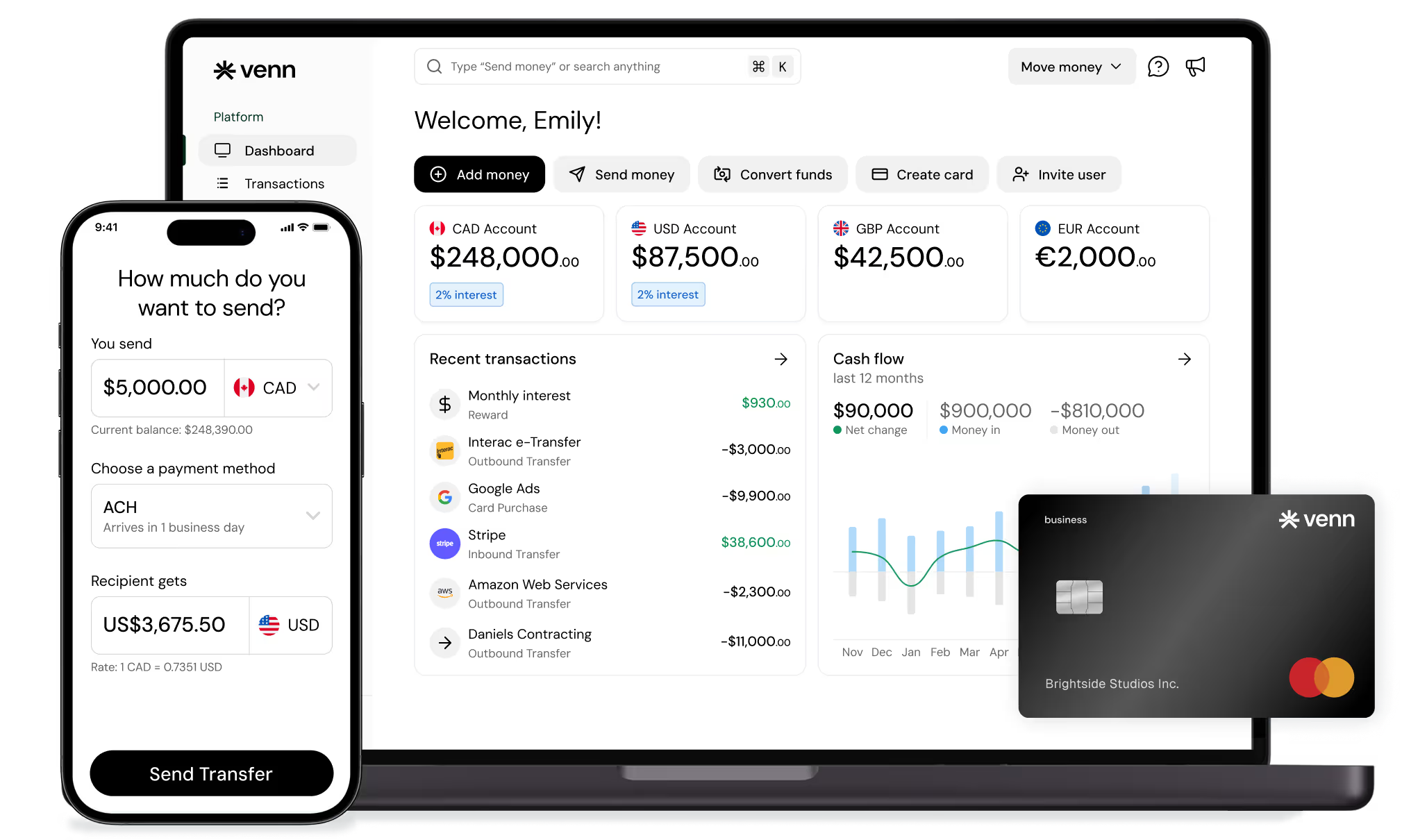
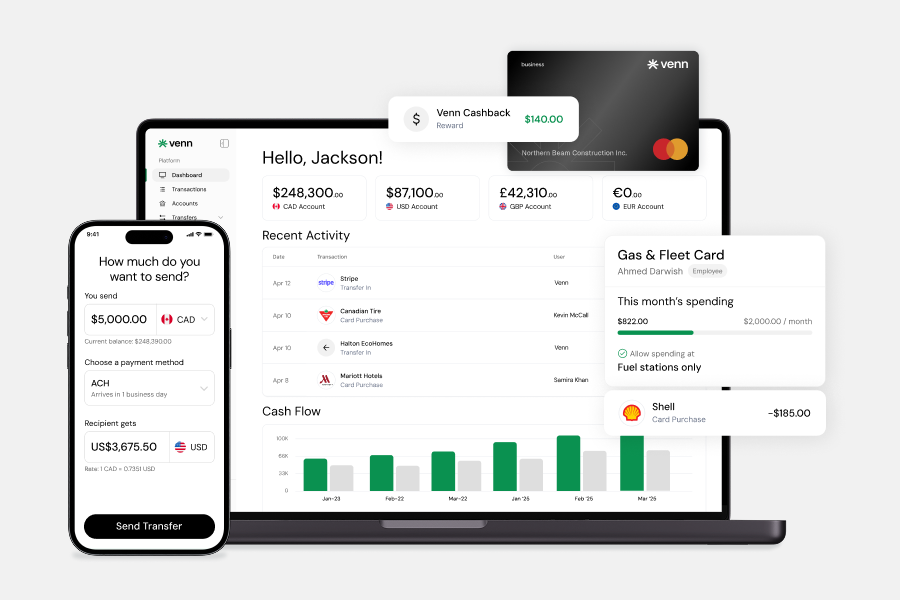
Venn provides the business banking foundation that makes bookkeeping dramatically simpler. As a business banking platform (not available in Quebec), Venn offers:
• Local CAD and real local USD accounts with ACH capability for cross-border operations
• Multi-currency accounts in CAD, USD, EUR, and GBP to reduce unnecessary conversions
• Free, unlimited Interac e-Transfer® for day-to-day vendor payments
• QuickBooks and Xero compatibility for streamlined month-end workflows
• Funds covered under CDIC insurance protection
Starting with this foundation means your transaction data flows cleanly into your accounting system from day one.
Use Corporate Cards to Simplify Expense Categorization
Reimbursement-based expense tracking creates bookkeeping chaos. Employees submit receipts weeks late. Personal and business purchases mix. You lose visibility into spending until statements arrive.
Corporate cards solve this by centralizing business spend in one place with consistent merchant names and real-time visibility. The Venn Mastercard Charge Card adds 1% unlimited cashback while giving you clear expense data for every team member's spending.
Step 2: Create a Simple Chart of Accounts
Your chart of accounts is the list of categories where transactions land. Too few categories and you lose insight. Too many and you waste time deciding where things go.
Starter Categories by Industry
Professional services firms typically need: Revenue, Subcontractors, Software/Subscriptions, Professional Development, Travel, Meals/Entertainment, Office Supplies, Advertising, Insurance, Professional Fees.
Ecommerce businesses add: Cost of Goods Sold, Shipping Costs, Payment Processing Fees, Returns/Chargebacks, Packaging Materials, Platform Fees.
Contractors and trades add: Materials, Tools/Equipment, Vehicle Expenses, Job Supplies, Subcontractor Labor.
Retail businesses add: Inventory Purchases, Merchant Fees, Shrinkage/Loss, Store Supplies.
Categorization Rules That Prevent Month-End Chaos
Establish naming conventions for vendors. "AMZN" and "Amazon" and "Amazon.ca" should all become "Amazon" in your books. Create a simple rule sheet: all software under $500 goes to Software/Subscriptions. All meals with clients go to Meals/Entertainment. When in doubt, use a general "Ask Accountant" category and resolve it monthly rather than guessing.
Step 3: Build Your Weekly Bookkeeping Workflow
Thirty to forty-five minutes weekly keeps your books current and prevents the tax-time scramble. Block this time on your calendar like any other business commitment.
Capture Documents as You Go
Every transaction should have a supporting document. Receipts, invoices, contracts—these prove your expenses to CRA and help you remember what transactions were for six months later.
Snap photos of receipts immediately. Store them in your accounting software or a dedicated folder. The goal is zero mystery transactions when you reconcile.
Using Venn centralizes your spend documentation. When all business purchases flow through one platform, you're not chasing receipts across five different cards and three bank accounts.
Record and Categorize Transactions
Pull your transactions weekly—either through bank feeds or manual entry—and categorize each one.
Income categories: Separate sales revenue from owner investments from loan proceeds. These are fundamentally different and affect your financial statements differently.
Expense categories: Apply your chart of accounts consistently. When you see a new vendor, decide its category once and stick with it.
Multi-currency transactions: Businesses with USD suppliers or customers face extra complexity. Every currency conversion creates potential reconciliation noise. Venn's multi-currency accounts let you hold and transact in USD, EUR, and GBP directly, reducing the FX entries cluttering your books.
Track Accounts Receivable: Invoicing and Getting Paid
If you invoice clients, you have accounts receivable. Basic hygiene matters: sequential invoice numbers, clear payment terms, consistent follow-up on overdue invoices.
Review your AR aging weekly. Which invoices are 30+ days overdue? Who needs a reminder? Uncollected receivables are revenue you've earned but can't spend.
Track Accounts Payable: Bills You Owe
Accounts payable are the mirror image, bills you've received but haven't paid. Track due dates to avoid late fees. Maintain consistent vendor records so you can analyze spending patterns over time.
Step 4: Reconcile Your Accounts
Reconciliation is the truth test. You're comparing what your books say happened against what your bank statements show actually happened. When these match, you can trust your numbers.
How to Reconcile Step-by-Step
• Download your bank statement for the period
• Match each statement line to a transaction in your books
• Identify discrepancies: missing entries, duplicates, wrong amounts
• Confirm opening and closing balances match between your books and the bank
Troubleshooting Common Reconciliation Issues
Duplicate transactions happen when you manually enter something that also came through a bank feed. Delete the duplicate.
Missing transactions appear on your statement but not in your books. Add them and categorize appropriately.
Timing differences occur when you record a transaction in one period but it clears the bank in another. Pending charges and deposits in transit cause this. Document these and they'll clear in the next reconciliation.
FX differences create headaches when your accounting software converts currencies at different rates than your bank. Multi-currency accounts that hold funds in the original currency reduce this friction significantly.
Step 5: Close Your Books Monthly
Monthly close transforms raw transaction data into reliable financial reports. Without it, you're flying blind.
Monthly Close Checklist
• Reconcile all bank accounts and credit cards
• Review and categorize any uncategorized transactions
• Attach missing receipts to transactions
• Review accounts receivable aging—follow up on overdue invoices
• Review accounts payable—ensure nothing is past due
• Perform reasonableness checks: Do payroll, rent, and subscriptions look normal? Any unexpected spikes?
When your banking and spend flow through Venn, month-end close accelerates. Centralized transactions mean less hunting across accounts. Employee spend visibility helps you collect missing receipts faster. Clean inputs produce clean outputs.
Step 6: Read the Three Reports That Tell You If You're Winning
Profit and Loss Statement (Income Statement)
This shows revenue minus expenses over a period. Are you profitable? Which expense categories are growing? How does this month compare to last month or last year?
Look for: Revenue trends, gross margin stability, expense categories growing faster than revenue.
Balance Sheet
This shows what you own (assets) minus what you owe (liabilities), with the difference being your equity. It's a snapshot of financial position at a specific moment.
Look for: Cash position, accounts receivable aging, debt levels, equity trends.
Cash Flow Statement
This explains why your bank balance changed. You can be profitable on paper but cash-poor in reality—or vice versa. The cash flow statement shows where money actually went.
Look for: Operating cash flow (is the core business generating cash?), timing mismatches between profit and cash, major cash uses.
Step 7: The First 30 Days Plan
Week 1: Foundations
Open dedicated business accounts. Set up Venn for your business banking and card spend. Choose your accounting software. These decisions create the infrastructure everything else builds on.
Week 2: Categories and Rules
Draft your chart of accounts based on your industry. Establish vendor naming conventions. Create your "when in doubt" rules for categorization.
Week 3: First Reconciliation
Reconcile your accounts for the first time. Identify recurring errors or confusing transactions. Set a weekly calendar slot for ongoing bookkeeping.
Week 4: Month-End Close and Reporting
Complete your first monthly close. Generate your profit and loss statement. Review cash position. Establish baseline numbers you'll track going forward.
Step 8: When to DIY vs Hire Help
DIY works when: Transaction volume is low, your business model is simple, you have time for weekly maintenance, and you're comfortable with the basics.
Hire a bookkeeper when: Volume exceeds 100+ transactions monthly, you have multi-currency complexity, payroll is involved, you're spending more than 2 hours weekly, or errors are becoming costly.
The best arrangement for many growing businesses: owner handles weekly transaction hygiene, bookkeeper handles monthly review and close. You stay connected to your numbers while getting professional oversight.
Tools Checklist: A Modern Small Business Financial Stack
The recommended stack for Canadian businesses in 2026: Venn for banking and cards, QuickBooks or Xero for accounting, dedicated payroll software if needed, and cloud storage for receipt backup.
Conclusion: Consistency Beats Perfection
Your books don't need to be perfect. They need to be consistent. A weekly routine and monthly close give you control over your finances. You'll know where money goes, whether you're profitable, and what you can afford.
Start with clean inputs. Dedicate time weekly. Close monthly. The system works.
FAQ
Q: How often should I do bookkeeping for my small business?
Weekly transaction recording and categorization typically takes 30–45 minutes. A monthly close, including bank reconciliation and report review, usually takes 1–2 hours. This cadence keeps your books accurate and up to date without becoming a burden.
Q: What's the difference between bookkeeping and accounting?
Bookkeeping focuses on recording and organizing financial transactions. Accounting uses those records to handle tax compliance, financial analysis, and strategic decision-making. Most small businesses manage bookkeeping internally and engage an accountant quarterly or annually.
Q: Do I need bookkeeping software or can I use a spreadsheet?
Spreadsheets can work for very low-volume businesses with simple needs. Once you exceed roughly 50 transactions per month or need features like receipt attachments, bank feeds, or invoicing, software such as QuickBooks or Xero saves significant time and reduces errors.
Q: What records should I keep for CRA purposes?
Canadian businesses are generally required to retain records for at least six years. This includes receipts, invoices, bank statements, contracts, and any documentation supporting income, expenses, and tax filings.
Q: How do I handle USD or other foreign currencies in my bookkeeping?
The simplest approach is minimizing unnecessary currency conversions. Using multi-currency accounts allows you to hold and transact in USD, EUR, or GBP directly, reducing FX-related entries and making reconciliation much easier.
---
**Disclaimer:** This publication is provided for general information purposes and does not constitute legal, tax or other professional advice from Venn Software Inc or its subsidiaries and its affiliates, and it is not intended as a substitute for obtaining advice from a financial advisor or any other professional. We make no representations, warranties or guarantees, whether expressed or implied, that the content in the publication is accurate, complete or up to date.

Venn is all-in-one business banking built for Canada
From free local CAD/USD accounts and team cards to the cheapest FX and global payments—Venn gives Canadian businesses everything they need to move money smarter. Join 15,000+ businesses today.
Frequently asked questions
Everything you need to know about the product and billing.
Join 15,000+ businesses banking with Venn today
Streamline your business banking and save on your spend and transfers today
No personal credit check or guarantee.