How to Set Up Profit First Accounts Step-by-Step in 2026
How to Set Up Profit First Accounts Step-by-Step in 2026 for Canada open 5 to 7 accounts, set TAPs, separate GST HST, and streamline transfers with Venn.

Ahmed Shafik
Co-founder
.png)
Trusted by 15,000+ Canadian businesses
Business banking for Canada
Local CAD and USD accounts, corporate cards with cashback, the lowest FX rates in Canada, free local transfers, and more.
Most Canadian business owners learn cash flow management backwards. Revenue comes in, expenses go out, and whatever remains becomes "profit." The problem? There's rarely anything left.
Profit First flips this formula. Instead of treating profit as a leftover, you allocate it first, then run your business on what remains. The system works because it forces discipline through structure, not willpower.
This guide walks you through setting up Profit First accounts in 2026, choosing your starting percentages, and running your first allocation day. You'll also learn how to handle Canadian tax realities like GST/HST and CRA remittances, plus how to manage the system if you invoice internationally.
The key to making Profit First sustainable is choosing banking infrastructure that makes multiple accounts and regular transfers simple. Modern platforms like Venn eliminate the friction that causes most business owners to abandon the system within months.
The Profit First method was created by Mike Michalowicz and introduced in his book Profit First. Profit First® is a registered trademark of Mike Michalowicz.
What Is Profit First (And Why It Still Works in 2026)?
The Core Formula (And the Behaviour Change It Forces)
Traditional accounting says: Revenue - Expenses = Profit
Profit First reverses this: Revenue - Profit = Expenses
When sales hit your account, you immediately split the money into designated buckets. Profit, owner pay, taxes, and operating expenses each get their allocation before you spend a dollar on anything else. You then run your entire operation from the operating expenses account only.
This isn't about perfect budgeting or complex forecasting. The system works because it removes decision-making from the equation. When your OPEX account runs low, you cut expenses or find more revenue. You don't raid your tax account or skip your own paycheck.
Who Profit First Is Best For (And Who Should Be Careful)
Profit First works exceptionally well for service businesses, agencies, ecommerce brands, and contractors with variable monthly revenue. If you've ever had a strong sales month followed by a cash crunch, this system addresses that pattern directly.
However, if your business is currently behind on payroll, facing severe tax arrears, or in genuine financial crisis, implement Profit First only with professional guidance. The system assumes you can cover basic obligations. It's not a turnaround strategy for businesses that need immediate restructuring.
Before You Open Accounts: Get These Numbers Ready
Your "Real Revenue" Baseline
Before setting percentages, determine your actual revenue. This means money your business earns, not pass-throughs, refunds, or deposits held for others.
For ecommerce businesses, subtract returns and chargebacks from gross sales. For agencies, exclude client reimbursements that flow through your account. You need a clean number representing money your business genuinely earned.
Pull your last three months of bank statements and calculate your average monthly real revenue. This number drives everything else.
Your Non-Negotiables
List every expense you cannot reduce or eliminate in the next 90 days. This includes payroll, rent, essential software, and minimum debt payments.
For Canadian businesses, add your CRA obligations to this list. GST/HST remittances follow specific schedules based on your annual taxable supplies. Payroll source deductions must be remitted monthly or quarterly depending on your remitter type. These aren't optional, and missing them triggers penalties plus interest.
Your non-negotiables set the floor for your operating expenses allocation.
Step 1: Choose Your Profit First Account Structure
The 5 Core Accounts
Every Profit First system starts with these five accounts:
• Income: Where all revenue lands first (the "holding tank")
• Profit: Your guaranteed return on running this business
• Owner's Pay: Your predictable compensation as the operator
• Tax: Set aside for income tax obligations
• Operating Expenses (OPEX): Everything else runs from here
Recommended Canada Add-Ons
Canadian businesses typically need additional accounts beyond the core five:
• GST/HST/PST Holding: Separate from income tax because these remittances follow different schedules and calculations
• Payroll/Remittances: Helpful if you have employees and want to isolate source deductions
• Vault/Savings: For quarterly profit distributions or emergency reserves
How Many Accounts Do You Really Need?
Start with five to seven accounts. Adding complexity before you've run the system for 90 days creates confusion without benefit.
Expand only when your business genuinely requires it. Multiple entities, separate locations, large payroll operations, or significant multi-currency activity might justify additional accounts later.
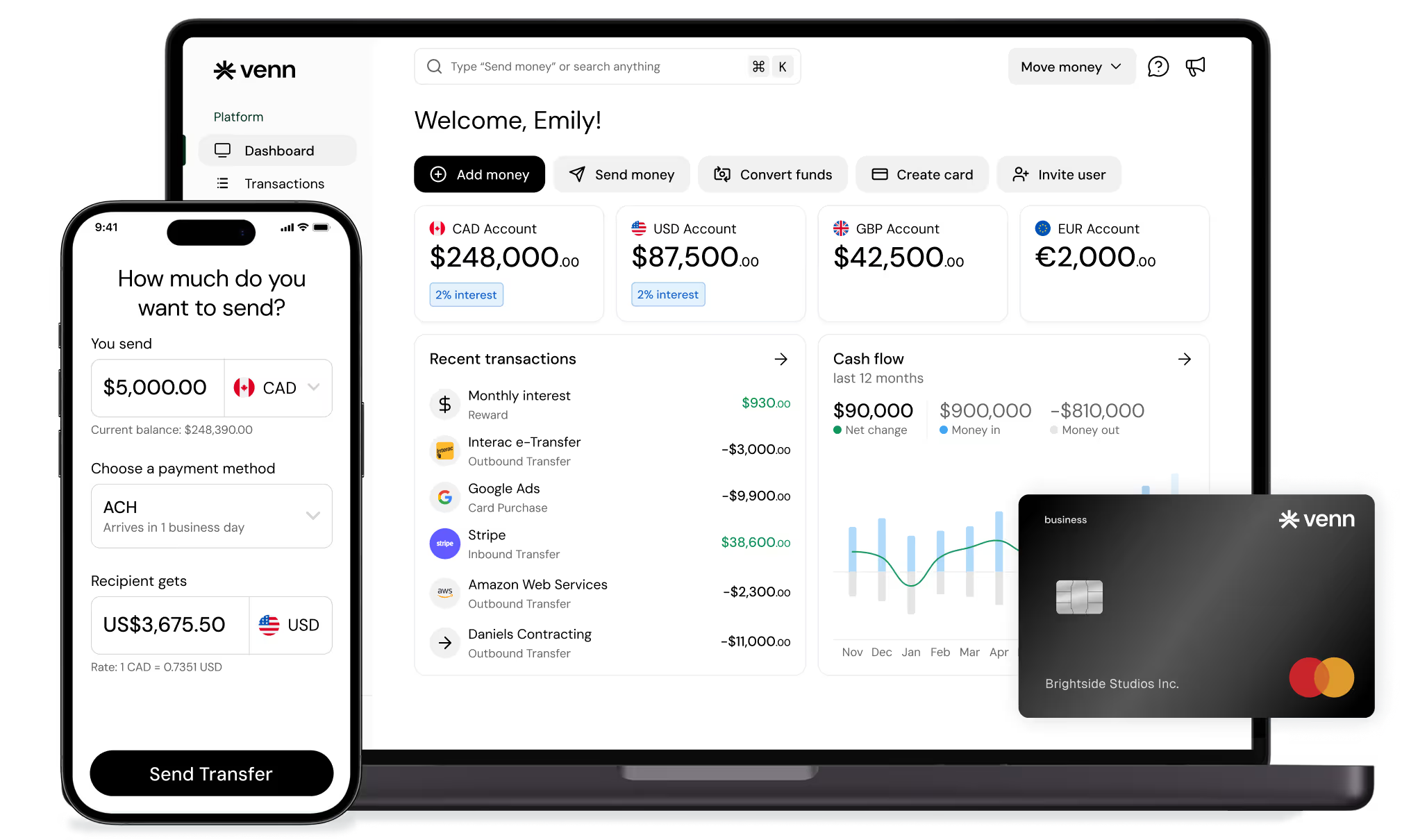
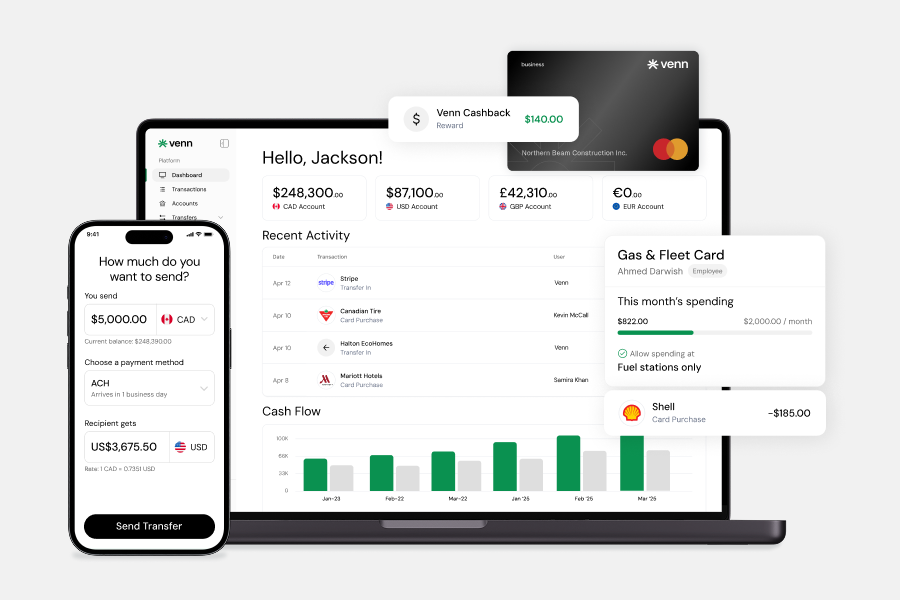
Why Venn Works Well for Profit First Setup
Running Profit First requires a banking platform that makes multiple accounts and regular transfers simple. Venn supports this structure through several practical features.
You can maintain local CAD and USD accounts, which matters if you invoice American clients or pay international suppliers. Managing EUR and GBP needs becomes straightforward for businesses with European operations.
Transfers between accounts happen efficiently, making allocation day a quick process rather than a weekly frustration. The expense management features and corporate card controls help protect your OPEX discipline by keeping spending visible and categorized automatically.
When your banking infrastructure works with your system rather than against it, you're far more likely to maintain the routine long-term.
Step 2: Open Your Accounts (And Name Them Clearly)
Naming Conventions That Prevent Mistakes
Name accounts with numbers and clear labels so transfers go to the right place:
• 01 Income
• 02 Profit
• 03 Owner Pay
• 04 Tax (Income)
• 05 GST/HST
• 06 OPEX
When you're moving money at 7 AM before your first meeting, clarity prevents expensive errors.
One Platform vs Multiple Banks
Consolidating your Profit First accounts on one platform dramatically improves consistency. You see all balances in one view, transfers happen instantly, and allocation day takes minutes instead of an hour.
Splitting accounts across multiple banks introduces delays, complicates reconciliation, and creates friction that erodes your discipline over time. In 2026, modern banking platforms handle multiple accounts without the fees or hassles that once made consolidation impractical.
Multi-Currency Setup for Cross-Border Businesses
If you invoice clients in USD, collect in USD rather than forcing immediate conversion. This preserves your revenue from unnecessary FX spreads and gives you flexibility on timing.
Venn's local currency accounts let you maintain CAD and USD balances side by side. You can allocate within each currency or convert strategically when rates favor you. For businesses paying international suppliers, keeping matching-currency buffers reduces conversion costs on both ends of transactions.
Step 3: Set Your Starting Target Allocation Percentages
A Practical Starter Table
These ranges provide starting points, not universal rules. Your specific percentages depend on your industry, margins, debt load, and growth stage.
These percentages should total 100%. Adjust based on your actual non-negotiables and current financial position.
How to Adjust TAPs Without Breaking Your Business
Change percentages slowly, no more than quarterly. If your OPEX allocation feels impossibly tight, reduce expenses before reducing your Tax or Profit allocations.
The temptation to "borrow" from Tax or Profit accounts during tight months defeats the entire system. Those accounts exist precisely because tight months happen.
Handling Debt in Profit First
If you carry business debt, you have two options. First, carve debt payments from your OPEX allocation intentionally. This keeps your system simpler but requires discipline.
Second, add a separate Debt account with its own allocation percentage. Only do this after you can reliably cover tax obligations and payroll. Paying down debt while falling behind on CRA remittances creates bigger problems than the debt itself.
Step 4: Pick an Allocation Schedule
Common Cadences
Most businesses run allocation day twice monthly, typically the 10th and 25th. This rhythm balances frequency against administrative burden.
High-volume ecommerce businesses often benefit from weekly allocations. When hundreds of transactions hit daily, weekly allocation keeps the Income account from becoming unwieldy.
If you run payroll biweekly, aligning allocation day with payroll simplifies your calendar and ensures Owner's Pay funds are available when needed.
Allocation Day Checklist
Run through this sequence every allocation day:
• Check Income account balance
• Confirm no pending deposits or reversals
• Calculate allocation amounts using your TAPs
• Transfer to Profit account
• Transfer to Owner's Pay account
• Transfer to Tax account
• Transfer to GST/HST account (if separate)
• Leave remainder in OPEX
• Keep a small buffer in Income for timing mismatches
• Note any adjustments needed for next allocation
Make Allocation Day Faster With Modern Banking
The difference between a 5-minute allocation day and a 45-minute one comes down to your banking platform. Venn's transfer capabilities and account visibility make the routine quick.
You see all account balances immediately, move money between accounts without delays, and track where every dollar went. The corporate card controls ensure spending stays within OPEX boundaries, protecting your allocations from unexpected charges.
Step 5: Run Your First Allocation (Worked Examples)
Example 1: Service Business at $20,000/month Revenue
A marketing consultant using 5% Profit, 40% Owner's Pay, 15% Tax, 5% GST/HST, and 35% OPEX would allocate:
• Profit: $1,000
• Owner's Pay: $8,000
• Tax: $3,000
• GST/HST: $1,000
• OPEX: $7,000
The owner now knows they'll take home $8,000 this month regardless of what happens with expenses. That predictability changes how you run your business.
Example 2: Ecommerce Brand at $80,000/month Revenue
An online retailer with higher OPEX needs (inventory, ads, fulfillment) might use 3% Profit, 15% Owner's Pay, 12% Tax, 5% GST/HST, and 65% OPEX:
• Profit: $2,400
• Owner's Pay: $12,000
• Tax: $9,600
• GST/HST: $4,000
• OPEX: $52,000
The higher OPEX percentage reflects inventory and advertising costs. The system still forces discipline because that $52,000 must cover everything.
Example 3: Cross-Border Agency Paid in USD
A design agency earning $50,000 USD monthly from American clients can run Profit First in USD using Venn's multi-currency accounts. Allocations happen in USD, and the owner converts to CAD for personal use when rates are favorable.
This approach eliminates forced conversions on every payment received and gives the business flexibility to pay USD-based contractors or software subscriptions without double conversion costs.
Step 6: Map Profit First to QuickBooks or Xero
The Clean Way to Record Transfers
Profit First transfers between your own accounts are not income or expenses. Record them as transfers in your accounting software.
In QuickBooks, use the Transfer function. In Xero, use the Transfer Money feature. Coding these as expenses or income will corrupt your profit and loss statements.
Owner's Pay withdrawals should be categorized as Owner Draw or Distribution, not salary (unless you're actually on payroll). Confirm the proper treatment with your accountant based on your business structure.
Banking + Accounting Integration as a Modern Advantage
When your banking platform integrates directly with QuickBooks or Xero, transaction categorization happens automatically. You spend less time on data entry and more time running your business.
Venn's accounting integrations mean your Profit First transfers flow into your books cleanly. The expense management features categorize card transactions as they happen, reducing month-end reconciliation work.
Common Profit First Mistakes (And How to Fix Them)
Using OPEX as a catch-all: Every expense feels necessary in the moment. Review OPEX spending weekly and cut anything that doesn't directly support revenue or operations.
Raiding the Tax account: This creates a future crisis. If you can't cover current expenses without Tax funds, your OPEX percentage is wrong or your expenses are too high.
Setting percentages too aggressively: Starting with 15% Profit when you've never saved anything guarantees failure. Begin conservatively and increase quarterly.
Not separating GST/HST: Canadian businesses that combine GST/HST with income tax often face remittance shortfalls. These are different obligations with different timelines.
Forgetting annual expenses: Insurance renewals, software subscriptions, and professional fees hit at specific times. Build these into your OPEX planning or create a separate sinking fund.
A Simple 30/60/90-Day Implementation Plan
Days 1-30: Open accounts, run your first two allocations, and track where OPEX feels tight. Don't change percentages yet.
Days 31-60: Review spending patterns. Identify expenses to reduce. Make one small percentage adjustment if needed.
Days 61-90: Complete your first quarterly review. Consider your first profit distribution. Refine percentages based on actual data.
Conclusion
Profit First works because it replaces willpower with structure. You open the right accounts, set reasonable starting percentages, and run allocation day consistently. The system handles the rest.
Start simple. Five to seven accounts, conservative percentages, and twice-monthly allocations. Refine quarterly based on what you learn.
The banking layer matters more than most guides acknowledge. When transfers are fast, visibility is clear, and expense management is built in, you'll actually maintain the routine. Venn provides the multi-currency accounts, efficient transfers, and expense controls that make Profit First sustainable for Canadian businesses operating in 2026's global economy.
FAQ
Q: How many Profit First accounts do I need to start?
Most Canadian businesses should begin with five to seven accounts. The core five are Income, Profit, Owner’s Pay, Tax, and Operating Expenses (OPEX). In Canada, you should also add a dedicated GST/HST account, and a Payroll account if you have employees. Run the system for at least 90 days before adding more complexity.
Q: What Profit First percentages should I use in 2026?
Percentages depend on revenue size, margins, and growth stage. Early-stage businesses often start with 1–5% allocated to Profit, while more established businesses may target 10–15%. The key is starting conservatively and adjusting quarterly, not monthly, so changes reflect real performance rather than short-term volatility.
Q: Should I separate GST/HST from income tax in Canada?
Yes. GST/HST and income tax have different calculation methods, filing schedules, and remittance rules. Combining them in a single tax account frequently causes cash shortfalls and missed deadlines. Keeping GST/HST in its own account ensures that collected tax is never accidentally spent.
Q: Can I do Profit First if I get paid in USD?
Yes. The cleanest approach is using a platform with local USD accounts, such as Venn, and running your Profit First allocations in USD. You can then convert to CAD strategically rather than on every deposit, reducing FX costs and improving control over timing.
Q: How often should allocation day be?
Twice per month works well for most businesses. High-volume ecommerce or businesses with daily inflows may prefer weekly allocations. Aligning allocation days with payroll timing simplifies cash flow management and reduces the risk of shortfalls.
Q: How do I record Profit First transfers in QuickBooks or Xero?
Use the Transfer function rather than income or expense categories. Transfers between your own accounts should not appear on the profit and loss statement. Owner’s Pay should be recorded as an Owner Draw or Distribution, depending on your structure. Always confirm the correct treatment with your accountant.
This article is for informational purposes and does not constitute accounting, tax, or legal advice. Consult a qualified professional for guidance specific to your situation.
---
**Disclaimer:** This publication is provided for general information purposes and does not constitute legal, tax or other professional advice from Venn Software Inc or its subsidiaries and its affiliates, and it is not intended as a substitute for obtaining advice from a financial advisor or any other professional. We make no representations, warranties or guarantees, whether expressed or implied, that the content in the publication is accurate, complete or up to date.
Profit First® is a registered trademark of Mike Michalowicz, who created the method and detailed it in his book Profit First. Venn is not affiliated with or endorsed by Mike Michalowicz or the Profit First brand; this article is an independent guide to applying the method.

Venn is all-in-one business banking built for Canada
From free local CAD/USD accounts and team cards to the cheapest FX and global payments—Venn gives Canadian businesses everything they need to move money smarter. Join 15,000+ businesses today.
Frequently asked questions
Everything you need to know about the product and billing.
Join 15,000+ businesses banking with Venn today
Streamline your business banking and save on your spend and transfers today
No personal credit check or guarantee.