How to open a business account for a law practice in Canada
How to open a business account for a law practice in Canada, including trust vs operating accounts, law society rules, required documents, and setup steps.

Ahmed Shafik
Co-founder


Trusted by 15,000+ Canadian businesses
Business banking for Canada
Local CAD and USD accounts, corporate cards with cashback, the lowest FX rates in Canada, free local transfers, and more.
Opening a business account for a law practice involves more than standard small-business paperwork. Because lawyers routinely handle client money before earning it, many firms need two distinct account types: a trust account for client funds and a general operating account for firm revenue and expenses.
The distinction matters for compliance, not just bookkeeping. Depositing a retainer into your operating account, for example, can trigger a professional conduct issue before you have billed a single hour. Canadian law societies treat trust accounts as regulated accounts with specific rules around institutional eligibility, interest remittance, recordkeeping, and reporting. Those rules vary by province. Ontario requires prescribed conditions for mixed trust accounts and mandates interest remittance to the Law Foundation. Alberta requires firms to obtain approval before operating a trust account. BC distinguishes clearly between pooled trust accounts and general operating accounts.
If you have encountered the term IOLTA while researching this topic, that is a U.S. framework. Canadian law-society materials use terms such as mixed trust account, pooled trust account, separate interest-bearing trust account, and general account. This guide uses Canadian terminology throughout and covers what solo practices, new firms, and law-office finance teams need to know before opening any account in 2026.
Do You Need A Trust Account, An Operating Account, Or Both?
Before you compare providers or gather documents, you need to answer one foundational question: what kind of money will this account actually hold?
A trust account holds client funds connected to legal services. Retainers paid before work is billed, settlement funds awaiting distribution, and other money a client entrusts to the firm temporarily all belong here. In a pooled or mixed trust account, interest typically flows to the relevant Law Foundation rather than the firm. A separate interest-bearing trust account may benefit a specific client when properly instructed.
An operating account, sometimes called a general account, is where the firm receives billed fees and pays its own expenses: payroll, rent, software subscriptions, and taxes.
Use this quick decision aid to classify your needs before you do anything else:
• You likely need a trust account if your practice receives retainers, settlement funds, or any client money held temporarily before it is earned or disbursed.
• You may not need a trust account if you collect payment only for work already billed and disbursements already incurred. Ontario's Law Society guidance confirms that a trust account is not required when a lawyer does not receive trust funds.
• Most firms need an operating account regardless, even when they also maintain trust.
The risk of skipping this step is real. Depositing an unbilled retainer into a general account instead of trust is a compliance violation, not just a bookkeeping error. Solve the account-type question first, then move on to choosing a provider.
What A Trust Account Is
A law firm trust account holds client money connected to legal services. Retainers paid before work begins, settlement proceeds awaiting distribution, and other funds a lawyer temporarily controls on a client's behalf all belong in trust, not in the firm's general account.
Canadian law societies recognize several trust account types. A mixed trust account, sometimes called a pooled trust account, holds funds for multiple clients in a single account. Interest earned on those pooled balances typically flows to the relevant Law Foundation rather than to individual clients. A separate interest-bearing trust account holds funds for a single client, and when a client provides proper written instructions, that interest may flow directly to them instead.
Provincial and territorial law societies regulate trust account rules, and requirements vary meaningfully across jurisdictions. The account structure, interest remittance obligations, and recordkeeping standards that apply in Ontario differ from those in Alberta or British Columbia. Confirming the rules with your own law society before opening any account is the only reliable starting point.
What An Operating Account Is
The operating account, also called the general account, holds firm money. Billed fees, earned reimbursements, payroll, rent, software subscriptions, insurance premiums, and vendor payments all flow through this account. It covers the day-to-day financial operations of the practice itself.
This is a critical distinction from a trust account, which holds client funds. Operating money and client money must never mix. Even firms that maintain a trust account for retainers or settlement funds still need a separate operating account to receive earned fees and pay business expenses. For solo lawyers and small firms especially, keeping these two accounts clearly separated is both a compliance requirement and a practical necessity for clean bookkeeping and monthly reconciliation.
Decision Box
Use these bullets to quickly identify which accounts your law practice needs:
You likely need a trust account if you:
• Collect retainers before completing the work
• Hold settlement funds on behalf of a client
• Receive any client money to hold temporarily before it is earned or disbursed
You may not need a trust account if you:
• Only receive payment for work already billed
• Only collect reimbursement for disbursements already incurred on a client's behalf
Most firms need an operating account regardless:
• Even practices that maintain a trust account still require a separate general account for firm revenue, payroll, rent, and overhead
• Trust money and operating money must never share the same account
Trust account rules vary by province. Ontario, Alberta, and BC each set distinct requirements around account designation, interest remittance, and recordkeeping obligations. Your provincial or territorial law society is the authoritative source for your specific situation.
Check Your Provincial Law Society Rules Before Opening Anything
Before you compare institutions or fill out a single application, confirm your trust-account obligations with your provincial or territorial law society. This step is non-negotiable because trust-account requirements are not a banking preference you can satisfy with any convenient provider.
Law-society rules govern which institutions qualify to hold client trust funds, how accounts must be designated, what records you must maintain, and how interest is handled. In Ontario, mixed trust accounts must meet prescribed conditions, and interest remits to the Law Foundation. In Alberta, a law firm must receive approval to operate a trust account before practice begins. In BC, the Law Society distinguishes clearly between pooled trust accounts and general operating accounts, each with its own bookkeeping obligations.
No financial institution is automatically suitable for lawyer trust accounts across Canada. A provider that works well for a general operating account may not satisfy the reporting, remittance, or designation requirements your law society imposes on client funds.
Solve compliance first. Every other account decision follows from there.
Why This Step Comes First
Provincial law society rules directly determine which institutions can hold your trust funds, how interest gets remitted, and what records you must maintain. Choosing a provider before confirming those requirements can force you to reopen accounts, reissue client notifications, and redo compliance paperwork.
The differences across provinces are concrete. Ontario requires mixed trust accounts to meet prescribed institutional conditions, mandates annual reporting, and directs Law Foundation interest remittance. Alberta requires law firms to obtain approval and authorization to operate a trust account before practice begins. BC distinguishes pooled trust accounts from general accounts and requires careful trust bookkeeping for each.
These are not minor administrative details. They define which financial institutions qualify, what documentation you must provide, and how your accounting records must be structured from day one. Solving the compliance question first means every subsequent decision, from institution selection to operating account setup, builds on a foundation that will hold up to law society review.
Documents You'll Usually Need To Open A Law Firm Business Account
Use this checklist before starting any application, whether you're approaching a traditional bank, a credit union, or a financial platform for your operating account. Exact requirements vary by provider, province, business structure, and whether you're opening a trust account or a general operating account. Having everything ready before you begin reduces delays and avoids repeat onboarding requests.
Standard documents most providers require:
• Government-issued photo ID for each authorized signatory
• Business registration documents or articles of incorporation
• Business name registration (if operating under a trade name)
• Proof of business address
• Social Insurance Number or Business Number, depending on structure
Additional documents a law practice may need:
• Law society membership confirmation or proof of good standing
• Law firm name and legal structure details (sole proprietorship, partnership, or professional corporation)
• Trust account designation instructions, where applicable
• Province-specific approval or authorization forms (Alberta, for example, requires law-firm approval to operate a trust account before practice begins)
For trust accounts specifically, some institutions may request a Law Society status letter or third-party confirmation before completing setup. Ontario law society guidance notes this as a possibility during the trust account opening process.
If you're opening both a trust account and an operating account, gather documents for both at the same time. The business registration and signatory information typically applies to both, but trust-account paperwork carries additional compliance requirements that vary by province.
Standard Business Banking Documents
Most Canadian financial institutions ask for a similar core set of documents, though exact requirements vary depending on your practice structure, whether you are a sole proprietor, partnership, or professional corporation.
Use this checklist as a starting point before contacting your chosen provider:
• [ ] Government-issued photo ID for each signing authority
• [ ] Business registration or incorporation documents
• [ ] Professional corporation or partnership agreement, where applicable
• [ ] Authorized signer details, including roles and signing limits
• [ ] Business address verification
• [ ] Any additional onboarding information requested by the specific institution
Law practices may also need to provide law-society membership confirmation or proof of good standing, particularly when opening a designated trust account. Some institutions request this separately from standard business documentation.
Because requirements differ across providers and practice structures, confirm the full document list directly with your chosen institution before your appointment or online application.
Extra Documents A Law Practice May Need
Beyond standard business registration and government-issued ID, law practices often need to provide additional documentation when opening a lawyer business account, particularly for trust-account setup.
Institutions may request proof of law-society status or a lawyer identification number to confirm the applicant is a licensed practitioner in good standing. You will also need to clearly state the law-firm name, legal structure (sole proprietorship, partnership, or professional corporation), and the intended account designation, specifically whether the account will function as a mixed trust account, a pooled trust account, or a general operating account.
For trust accounts, some institutions require trust-account designation instructions in writing, along with any province-specific approval or reporting forms. In Ontario, for example, the bank may request a third-party status letter or Law Society identification before proceeding. Alberta requires firms to obtain authorization to operate a trust account before accepting client funds at all.
Trust-account setup typically involves more manual review than opening a standard operating account. Institutions need to confirm that the account structure supports proper recordkeeping, interest remittance to the relevant Law Foundation, and monthly reconciliation obligations.
Before accepting any client funds, verify the exact documentation requirements with both your provincial law society and your chosen financial institution. Requirements vary by province, and the cost of getting this wrong extends well beyond paperwork.
Step By Step: How To Open The Right Account For A Law Practice
Opening the right accounts for a Canadian law practice follows a specific sequence, and skipping steps creates compliance risk. The workflow below moves in a deliberate order: confirm your legal structure and trust obligations first, then select providers, gather documents, set up any required trust account, and finally optimize your operating account for day-to-day financial efficiency.
That order matters because trust obligations are non-negotiable. Choosing a provider before confirming your law society's requirements can mean selecting an institution that cannot support the account designations, interest remittance, or recordkeeping your province requires. Solving the compliance question first keeps every subsequent decision grounded in what your practice actually needs.
The six steps that follow walk through each stage in detail.
Step 1: Confirm Your Practice Structure
Your legal structure determines which account types are available to you and which documents you need to gather. Sole proprietors, partnerships, and professional corporations each follow different registration paths, carry different documentation requirements, and may qualify for different account products depending on the provider and province.
Before comparing any account options, confirm the following details for your practice:
• Legal name as registered with your provincial authority
• Business registration or incorporation status
• CRA Business Number
• Authorized signatories and their identification documents
• Ownership structure, including any partners or shareholders
This matters practically because some operating-account providers support incorporated businesses and sole proprietors but exclude partnerships, or restrict eligibility by province. Wealthsimple Business Chequing, for example, is available to incorporated businesses only and does not currently support sole proprietorships or partnerships. Settling your structure before you evaluate features prevents you from shortlisting providers that cannot actually serve your practice.
Step 2: Decide Which Accounts You Need
Most new law firms need both a trust account and an operating account from day one. If your practice will receive retainers, settlement funds, or any other client money held temporarily, those funds require trust treatment. Earned fees and billed amounts belong in your general operating account, where you also pay overhead like rent, payroll, and software.
If you only collect payment for work already billed and disbursements already incurred, you may not need a trust account at all. However, most practices that expect retainers should open both accounts before accepting a single client payment. Setting up the operating account alone and depositing client funds into it is one of the most common compliance errors new firms make.
A simple way to frame the decision:
• Trust account: holds client money you have not yet earned or disbursed
• Operating account: holds billed fees the firm has earned and pays firm expenses
• Both: the right starting point for any practice that anticipates receiving retainers or settlement funds
Confirm which account types your practice requires with your provincial law society before opening anything.
Step 3: Shortlist Institutions Based On Compliance Fit
Your shortlisting criteria should differ depending on which account type you are evaluating.
For a trust account, prioritize traditional banks or credit unions that can support the full trust-account designation process. Confirm that the institution can provide proper source documents, monthly statements, Law Foundation interest remittance instructions, and any reporting documentation your law society requires. Compliance fit comes before cost or convenience at this stage.
For an operating account, the evaluation shifts. Compare monthly fees, accounting integrations with tools like QuickBooks or Xero, payment options, card controls, multi-currency support, and overall workflow efficiency. These factors matter more once the trust-account question is resolved.
Running both evaluations separately keeps your shortlist focused and prevents a single institution's operating-account features from influencing a decision that should be driven entirely by trust-account compliance requirements.
Step 4: Gather Documents And Signatories
Assemble your full document package before contacting any institution. For most law practices, this means government-issued photo ID for every authorized signatory, business registration or incorporation records, professional corporation documents if applicable, and ownership details for all principals. If the institution requires it, include proof of good standing from your law society.
Keep the following checklist on hand:
• Government-issued photo ID for each signer
• Business registration certificate or articles of incorporation
• Professional corporation records, if the firm operates as a PC
• Authorized signatory list with full legal names and roles
• Ownership structure details for all principals
• Law society membership or status confirmation, if requested by the institution
Two issues consistently delay onboarding: missing signatory details and business names that do not match exactly across documents. If your law society registration shows a slightly different firm name than your incorporation certificate, resolve that discrepancy before you apply. Institutions flag mismatches during identity verification, and correcting them mid-application adds days to the process.
Step 5: Open The Trust Account First If You Need One
If your firm will receive client funds, trust-account compliance takes priority over every other financial decision. Set up the trust account, confirm it meets your provincial law society's requirements, and verify that the institution can support the designation, statements, and interest-remittance obligations your law society mandates. Only after that foundation is in place should you turn your attention to operating-account features, accounting integrations, or expense management tools. Solving compliance first protects your clients and your licence. Optimizing your financial stack comes second.
Step 6: Add An Operating Account And Expense Stack
With trust compliance addressed, you can evaluate your operating account on purely practical terms. Compare options based on payments infrastructure, corporate cards, expense controls, accounting integrations, multi-currency workflows, and reporting capabilities.
Traditional banks and credit unions remain a natural fit for firms that want to consolidate trust and operating accounts under one institution. Venn offers CAD, USD, GBP, and EUR accounts, 2.75% interest on CAD balances and up to 3.5% interest on USD balances (learn more), 1% cashback, and QuickBooks and Xero integrations, making it a practical choice for firms managing cross-border billing or multi-currency vendor payments. Wealthsimple Business Chequing suits incorporated firms that want straightforward CAD operations, CRA bill pay, Interac e-Transfer®, and no monthly fees, though it does not support sole proprietorships, partnerships, or USD wires.
Match the account to your actual workflow volume, software stack, and payment needs rather than defaulting to whichever institution holds your trust account.
Compare Business Account Options For A Canadian Law Practice
Most law practices need at least two accounts: a trust account for client funds and an operating account for firm revenue and expenses. The right provider for each depends on your practice structure, province, and operational needs. This table covers the three most relevant options for Canadian law firms.
For trust accounts, traditional banks and credit unions remain the primary comparison set because provincial law societies, including those in Ontario, Alberta, and BC, set specific conditions around which institutions can hold mixed trust funds and how interest remittance and reporting must work. Solve trust-account compliance first, then evaluate operating-account options based on your firm's payment, integration, and multi-currency requirements.
Ready to Streamline Your Operating Account?
If your trust account compliance is already confirmed with your law society and chosen institution, the next step is building an operating account workflow that keeps pace with your firm. Venn supports Canadian corporations and sole proprietorships outside Quebec with multi-currency accounts, a 1% cashback card, QuickBooks and Xero integrations, and 2.75% interest on CAD balances and up to 3.5% interest on USD balances (learn more). Efficient, secure, and built for modern business operations. Sign up for Venn
Common Mistakes To Avoid When Opening A Law Firm Account
Many account problems at law firms are entirely preventable. They typically trace back to three recurring errors: choosing a financial institution before confirming law-society compatibility, depositing client retainers into the general account instead of a designated trust account, and running the practice without a defined monthly reconciliation workflow.
Choosing the wrong institution first. Trust accounts carry specific institutional requirements that vary by province. Confirming that your chosen provider can support trust-account designation, proper statements, and Law Foundation interest remittance must happen before you sign any account agreement.
Commingling client funds. Depositing retainers or settlement funds into your operating account is one of the most serious compliance errors a firm can make. Client money belongs in trust. Billed fees belong in general. Keeping that separation clean protects both your clients and your standing with your law society.
Using one account for too many purposes. Some firms attempt to run trust and operating activity through a single account, or use the trust account to pay firm expenses. Both practices create recordkeeping failures that surface quickly during a law-society audit.
Skipping a reconciliation workflow. Opening the accounts is only the first step. Without a structured monthly reconciliation process tied to your accounting records, errors accumulate and compliance gaps widen. Build that workflow before the first client deposit arrives, not after.
Common Mistakes When Opening A Law Firm Account
Most setup errors fall into a few predictable patterns. The most consequential: opening only one account when the practice requires both a trust account and a general operating account. Retainers and settlement funds belong in trust from the moment they arrive. Depositing them into the operating account, even briefly, constitutes commingling client funds with firm funds and triggers law-society compliance exposure.
A second common error is using the trust account for non-client or non-legal money. Trust accounts exist solely for client funds connected to legal services. Running firm expenses or personal transactions through that account violates its designated purpose.
Firms also frequently choose a financial institution before confirming law-society compatibility. Not every provider can satisfy trust-account designation requirements, interest remittance obligations to the Law Foundation, or source-document standards. Confirm institutional fit first.
Finally, many practices underestimate the operational discipline required after accounts are open: establishing clear authorized signatory permissions, maintaining source documents for every trust transaction, and completing monthly reconciliation workflows. These are not optional administrative tasks. They are core compliance obligations under Canadian law-society rules.
What To Look For In An Operating Account Once Compliance Is Covered
With trust-account obligations resolved, the operating account becomes the financial engine of the firm. This is where billed fees land, where payroll runs, where vendor payments and tax remittances go out, and where day-to-day cash flow lives. Choosing the right operating account means evaluating features against how a law practice actually moves money, not just how a generic small business does.
Key features worth comparing include:
• Accounting integrations: Direct connections to QuickBooks or Xero reduce manual reconciliation and keep your general ledger accurate across billing cycles.
• Approval workflows and spend controls: Corporate cards with configurable limits let practice managers authorize expenses without losing visibility into who spent what and when.
• Multi-currency support: Firms with international clients or cross-border disbursements benefit from CAD, USD, and other currency accounts held in one place.
• Interest on operating balances: Some providers offer yield on idle CAD and USD cash, which adds up across billing gaps and slower months.
• Payments flexibility: Confirm support for Interac e-Transfer®, wire transfers, and CRA bill payments before committing to any provider.
Operational Features Worth Comparing
Once trust-account compliance is settled, your operating account becomes a daily workflow tool. In 2026, firms increasingly expect integrated finance operations rather than disconnected accounts, cards, and accounting tools.
When comparing options, evaluate each of the following:
• Accounting integrations: Direct sync with QuickBooks or Xero reduces manual reconciliation time.
• Card controls and spend limits: Per-card or per-employee limits prevent unauthorized purchases.
• Approval workflows: Multi-step authorization matters for firms with partners or office managers sharing spend authority.
• Sub-accounts: Separate balances for payroll, taxes, or disbursements without opening multiple institutions.
• Multi-currency support: CAD, USD, GBP, and EUR accounts in one platform benefit firms with cross-border client work.
• Vendor transfer options: Domestic and international wire capabilities keep supplier payments on schedule.
• Interac e-Transfer®: Free unlimited Interac e-Transfer® transactions reduce per-payment costs on high-volume months.
• Interest on operating balances: Some providers offer yield on eligible CAD and USD balances sitting in your general account.
• Corporate card cashback: A 1% cashback rate on firm spending compounds meaningfully across software, travel, and vendor invoices.
• Receipt capture and spend controls: Built-in receipt matching and category-level controls simplify monthly reconciliation and reduce bookkeeping errors.
Venn As An Operating Account Option
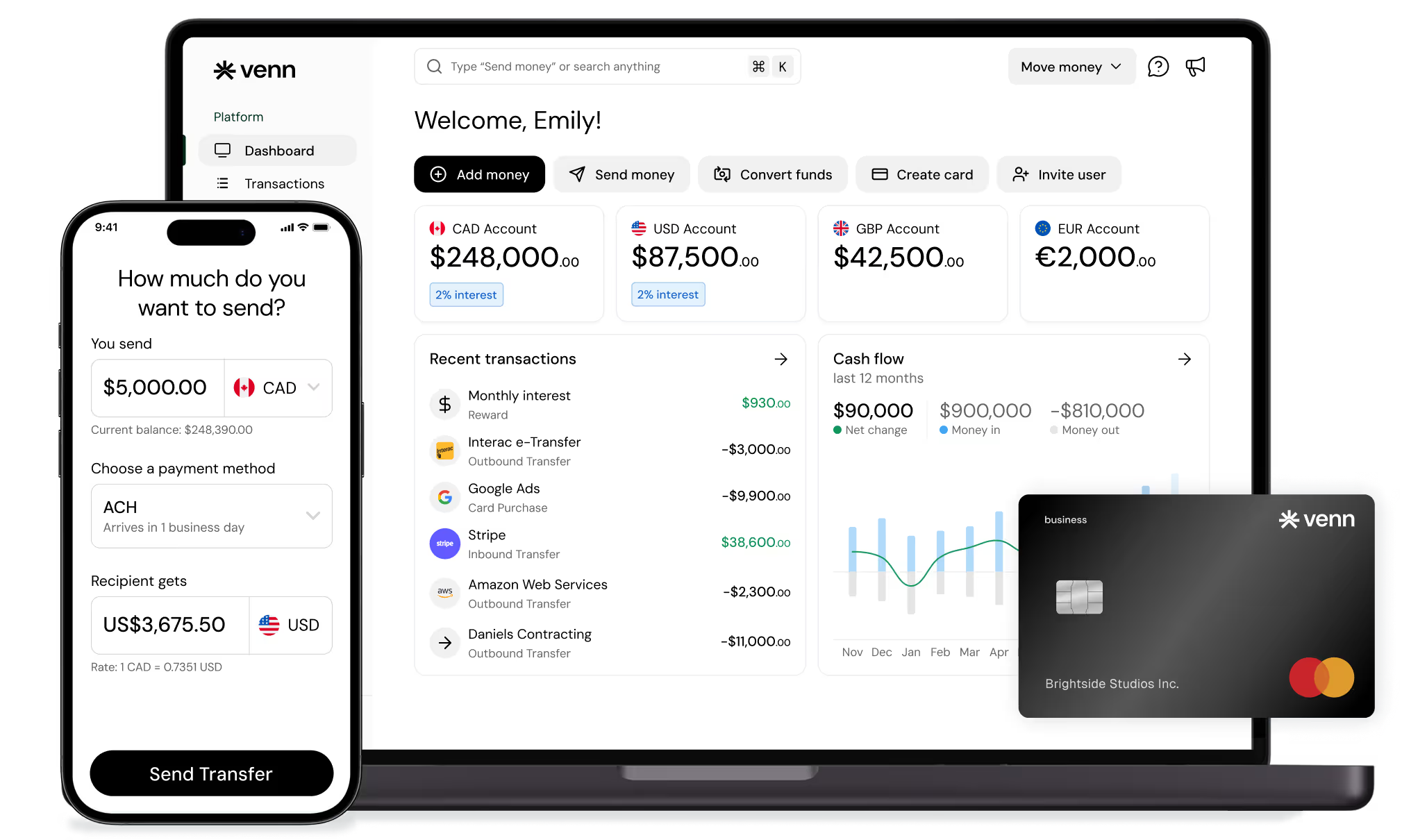
For Canadian law firms that have resolved their trust-account requirements and are now focused on operating-account efficiency, Venn offers a set of financial-operations features worth evaluating. Venn supports multi-currency accounts in CAD, USD, GBP, and EUR, which suits firms that handle cross-border client work or pay international vendors. Competitive FX rates and a corporate card with 1% unlimited cashback give firms more control over everyday spending, while OCR receipt capture simplifies expense documentation at the point of purchase. Venn's mobile app also lets firms access funds, send transfers, and create cards directly from their phones.
On the accounting side, Venn connects directly with QuickBooks and Xero, reducing manual reconciliation work for bookkeepers and office managers. Free unlimited Interac e-Transfer® is included for vendor payments, and spend management tools let authorized signatories set controls across the team.
Eligible deposits held through Venn are covered under CDIC insurance protection, subject to applicable limits and requirements. Venn is a technology company, not a bank or financial institution, and does not itself hold deposits. Given that trust-account suitability depends on province-specific law-society rules and institutional requirements, Venn is best evaluated as an operating-account and financial-operations solution rather than a trust-account provider.
Wealthsimple Business Chequing As An Operating Account Option
Wealthsimple Business Chequing works as a straightforward operating account for incorporated law firms that want simple CAD operations without a monthly fee. The account supports CRA bill payments, Interac e-Transfer®, and direct linkage to QuickBooks, which covers the core bookkeeping workflow most small firms need for their general account.
Interest reaches 2.75% on CAD balances and up to 3.5% on USD balances (learn more), depending on combined assets held across Wealthsimple products. For a firm parking earned fees between payroll runs or vendor payments, that yield on idle operating cash adds up without requiring any additional setup.
The limitations are worth noting clearly. Wealthsimple Business Chequing is available to incorporated businesses only. Sole proprietorships and partnerships do not qualify. The account does not currently include a business credit card, and it does not support sending or receiving USD wire transfers. For firms with cross-border billing, vendor payments in foreign currencies, or a need for corporate card controls, those gaps matter.
Within its scope, Wealthsimple Business Chequing suits an incorporated law practice that runs a clean CAD operating account, pays CRA directly from the platform, and wants accounting records to flow into QuickBooks without manual entry. It is not a trust-account solution, and firms should confirm all trust-account requirements with their provincial law society before selecting any provider for that purpose.
FAQ
Q: Does Every Canadian Law Firm Need A Trust Account?
A: No. If your practice does not receive trust funds, such as retainers or settlement money held on a client's behalf, a trust account may not be required. Ontario guidance confirms this directly. That said, rules vary by province, so confirm your specific obligations with your provincial or territorial law society before deciding.
Q: Can I Use One Account For Both Client Funds And Firm Expenses?
A: No. Trust money and operating money must be kept in separate accounts. Commingling client funds with firm revenue violates law-society rules across provinces, including Ontario and BC. Your trust account holds client money, while your general operating account receives billed fees and covers business expenses.
Q: What Documents Do Banks Usually Ask For?
A: Most institutions require government-issued ID for each authorized signatory, business registration or incorporation documents, and signer information. For trust accounts specifically, some institutions also request law-society status confirmation or a third-party status letter to satisfy their onboarding requirements.
Q: Can I Open A Law Firm Account Online?
A: Often yes for operating accounts, where digital onboarding is increasingly standard. Trust-account setup, however, may require additional verification steps or manual review depending on the institution and your province's requirements. Confirm the process directly with your chosen financial institution before assuming a fully online path is available.
This article is for general information only. It does not constitute legal, accounting, trust-compliance, or financial advice. Trust-account rules, reporting obligations, and institutional requirements vary by province and law society. Verify all requirements with your provincial or territorial law society and your chosen financial institution before opening any account.
---
**Disclaimer:** This publication is provided for general information purposes and does not constitute legal, tax or other professional advice from Venn Software Inc or its subsidiaries and its affiliates, and it is not intended as a substitute for obtaining advice from a financial advisor or any other professional. We make no representations, warranties or guarantees, whether expressed or implied, that the content in the publication is accurate, complete or up to date.

Venn is all-in-one business banking built for Canada
From free local CAD/USD accounts and team cards to the cheapest FX and global payments—Venn gives Canadian businesses everything they need to move money smarter. Join 15,000+ businesses today.
Frequently asked questions
Everything you need to know about the product and billing.
Join 15,000+ businesses banking with Venn today
Streamline your business banking and save on your spend and transfers today
No personal credit check or guarantee.