Best Bank Account for Canadian Law Firms in 2026 Guide
Best Bank Account for Canadian Law Firms in 2026 compares trust and operating options from RBC Scotiabank TD and Venn plus FX cards and QuickBooks Xero.

Ahmed Shafik
Co-founder


Trusted by 15,000+ Canadian businesses
Business banking for Canada
Local CAD and USD accounts, corporate cards with cashback, the lowest FX rates in Canada, free local transfers, and more.
Finding the best bank account for Canadian law firms in 2026 is more complicated than choosing a business chequing account for a typical small business. Law firms carry a specific obligation that most other professional services firms do not: they must keep client funds completely separate from the firm's own money.
That distinction, between a trust account and an operating account, shapes every banking decision a firm makes. Trust accounts hold client retainers, settlement funds, and other money that belongs to clients until it is earned or disbursed. Operating accounts handle the firm's own revenue, payroll, vendor payments, and day-to-day expenses. Mixing the two is not just poor practice; it violates law society rules across every province.
No single provider is the right fit for every firm. The best choice depends on a combination of factors: trust-account compliance requirements, branch and advisor access, lending and merchant services, payment workflows, foreign exchange capabilities, card and expense controls, and accounting integrations with tools like QuickBooks or Xero. Provincial rules also vary, so firms in Ontario, BC, and Alberta each face different trust-account obligations.
This comparison covers traditional banks and modern operating-account platforms to help legal professionals and firm administrators build a banking setup that fits how their practice actually works.
What Canadian Law Firms Should Look For In A Bank Account
Business banking for lawyers involves a set of requirements that most generic small-business accounts were never designed to meet. Before shortlisting any provider, a firm should evaluate candidates against criteria specific to legal practice.
Trust-account suitability sits at the top of that list. Provincial law society rules govern how client funds must be held, and those rules vary significantly across Ontario, BC, Alberta, and other provinces. Any account used for a law firm trust account Canada must meet the requirements of the relevant law society, not just general banking regulations. Verify suitability directly with your law society before opening any account for this purpose.
Beyond trust obligations, a law firm operating account needs to support day-to-day practice efficiently. Key criteria include:
• Payment rails: EFT, wire transfers, and Interac e-Transfer® capabilities for paying disbursements, vendors, and counsel
• CRA payment support: direct remittance of payroll deductions, HST, and corporate tax
• Bookkeeping integrations: compatibility with QuickBooks or Xero to support clean month-end reconciliation and clear separation of trust and operating activity
• Corporate cards and expense management: spend controls and approval workflows across lawyers and administrative staff
• FX and multi-currency support: especially relevant for firms billing U.S. clients, retaining foreign experts, or paying international software vendors
• Branch and advisor access: important for firms that need relationship banking, lending, or in-person trust-account setup
• Eligibility: some platforms restrict access to incorporated entities only, which excludes sole practitioners and partnerships
The right combination of features depends on whether the firm prioritizes trust-account compliance infrastructure, modern operating-account workflows, or both.
Quick Comparison Table
Canadian law firms typically need two distinct banking functions: a trust account that meets law society requirements and an operating account built for day-to-day billing, payments, and bookkeeping. The table below maps each provider to those needs so you can shortlist options by what your firm actually requires.
Best Bank Accounts For Canadian Law Firms In 2026
The providers below are not ranked as a universal winner. Each one fits a different set of firm priorities, and the right choice depends on what your practice actually needs from a banking relationship.
Traditional institutions like Scotiabank, RBC, and TD remain the strongest options where trust-account infrastructure, branch access, credit facilities, and dedicated advisor support matter most. Provincial law society rules governing trust accounts vary significantly, and these banks have built products specifically around that compliance context.
Modern platforms like Venn are better suited to operating-account workflows: billing, vendor payments, multi-currency accounts, card spend controls, and accounting integrations with QuickBooks or Xero.
Many firms find that a two-account setup serves them best. A traditional bank handles trust-account compliance and relationship banking, while a modern operating platform manages the day-to-day financial workflows of running the firm. That split is worth considering before settling on a single provider.
Scotiabank
Scotiabank is a strong fit for law firms that want lawyer-specific banking support paired with dedicated trust-account infrastructure.
Its professional banking program connects firms with specialists who understand the operational and compliance demands of legal practice. That relationship-driven model suits firms that prefer working with an advisor rather than navigating a self-serve digital portal. Scotiabank also offers a trust and sub-account plan designed to manage multiple client trust accounts under a single structure, which makes it particularly relevant for real estate, estates, and other trust-heavy practices where tracking individual client funds is a daily requirement.
Business card options are available through the program, and the broader commercial banking suite covers credit, merchant services, and cash management for growing firms.
The limitations are worth noting. Setup tends to be advisor-led, meaning pricing and account structures typically require a direct conversation rather than transparent online disclosure. Firms that prioritize fully digital operating workflows may find the day-to-day experience less streamlined compared to platforms built around software integrations and automated bookkeeping. Scotiabank suits firms where trust-account compliance and branch-backed support take priority over digital-first convenience.
RBC
RBC is a strong option for Canadian law firms that need trust-account infrastructure, delegated banking, and relationship-driven support from a major institution.
Its dedicated business trust account is designed to hold client funds separately from operating funds, which is a core requirement for most Canadian legal practices. Firms managing multiple matters or entities can use RBC Express to set up delegated banking access, assign transaction authorities to administrative staff, and maintain tighter controls over approvals. This makes RBC particularly well-suited to multi-lawyer firms where several people need account access at different permission levels.
RBC also offers professional banking specialists who work with legal and professional services clients, along with FX services for firms that pay foreign experts, receive retainers from international clients, or operate across borders.
The main limitation is transparency. Full pricing, trust account setup requirements, and eligibility details typically require a direct conversation with an RBC advisor rather than a straightforward online review. Firms should also confirm that any trust account arrangement meets their provincial law society's specific requirements before proceeding, as those rules vary across Ontario, BC, Alberta, and other provinces.
TD
TD suits law firms that prioritize financing, merchant services, and branch-backed support as their practice grows. Through its professional banking solutions, TD offers business accounts, credit facilities, and dedicated support for professional services clients, including lawyers building out their operations.
For firms adding headcount, expanding office space, or launching new service lines, TD's credit solutions and merchant services infrastructure provide practical tools to support that growth. Its broad branch network across Canada means firms can access in-person support without relying entirely on digital channels, which matters for practices that handle complex transactions or need relationship-level guidance.
Where TD is less explicit than Scotiabank or RBC is in its publicly available trust-account infrastructure. Available sources do not detail lawyer-specific trust account programs with the same clarity as those two institutions. Firms with trust-account obligations, particularly those in Ontario, BC, or Alberta where law society rules are specific and non-negotiable, should verify TD's current trust-account capabilities directly with a TD business advisor and confirm compliance with their provincial law society before committing to a setup.
Venn
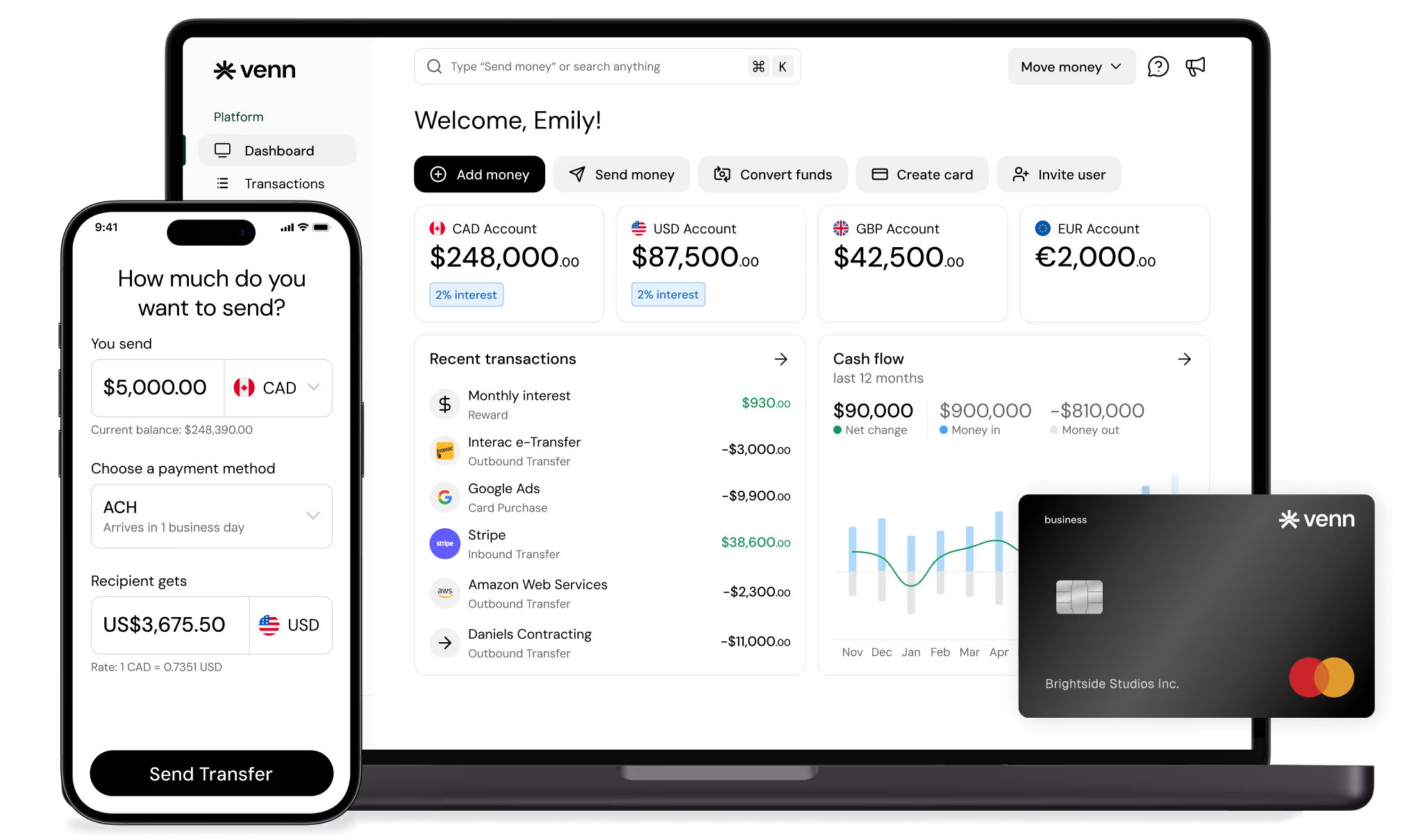
Venn is a technology company and business banking platform that can serve as a strong operating account for modern Canadian law firms, particularly where cross-border payments, digital spend control, and accounting efficiency are priorities. It is not a bank, and firms should not assume it functions as a trust-account solution without first verifying suitability with their law society and Venn directly.
For law firms billing U.S. clients or paying foreign experts and software vendors, Venn's multi-currency structure is a practical fit. Firms get dedicated CAD, USD, GBP, and EUR accounts, with FX markups ranging from 0.45% on the Essentials plan down to 0.25% on Pro. That compares favourably to the markups of up to 3% common at major Canadian banks. The multi-currency Mastercard charge card automatically draws from the matching currency balance, which eliminates unnecessary conversions on cross-border transactions.
On the operating side, Venn earns 2.75% interest on CAD balances and up to 3.5% interest on USD balances (learn more) with no minimum balance requirement, and the card structure returns 1% cashback from the first dollar spent. Free unlimited Interac e-Transfer® sending and receiving is included on all plans. The mobile app also lets teams access funds, send transfers, and issue cards directly from their phones.
For firms using Xero or QuickBooks, Venn connects directly to both platforms and includes OCR receipt capture, expense approvals, and spend controls across cards. That combination meaningfully reduces manual reconciliation work at month-end.
Venn Account Balances are held at Bank of Montreal®, a CDIC member, and are eligible for CDIC deposit insurance up to applicable limits. Venn supports both corporations and sole proprietorships, but is not currently available to businesses in Quebec.
Wealthsimple
Wealthsimple suits incorporated law firms that want a straightforward, low-fee CAD operating account without the overhead of traditional business banking.
Launched in March 2026, Wealthsimple's Business Chequing Account carries no monthly fee and no minimum balance requirement. It supports CRA payments directly, which is a practical advantage for firms managing corporate tax obligations. Interac e-Transfer® sending and receiving are included at no cost, and the account connects to accounting software through Plaid-supported tools, making basic bookkeeping workflows manageable.
The limitations matter for law firms evaluating this option. Wealthsimple currently accepts incorporated businesses only, excluding sole practitioners and partnerships. There is no business credit card available, and current help documentation does not support USD wires. The platform also carries no trust-account positioning, which means firms with client trust obligations will need a separate solution.
For firms that need multi-currency accounts, FX capabilities, corporate cards, or QuickBooks and Xero integrations, Venn offers a broader operating-account workflow. Wealthsimple's strength is simplicity and zero monthly cost for incorporated practices focused on CAD operations and CRA payments.
Which Option Is Best By Firm Type?
No single provider suits every Canadian law firm. The right choice depends on your practice model, client base, and whether trust-account compliance or operating efficiency drives your banking priorities.
Solo or small local firms benefit most from Scotiabank or TD, where branch access, professional banking specialists, and trust-account infrastructure are available under one relationship.
Trust-account-heavy practices in real estate or estates work should prioritize Scotiabank or RBC. Both explicitly market trust-account solutions and offer the advisor support that compliance-sensitive practices require.
Remote-first boutiques with cross-border payments may find the strongest setup by pairing Venn as an operating account with a traditional bank for trust obligations. Venn's CAD, USD, GBP, and EUR accounts, low FX markups, and QuickBooks and Xero compatibility suit firms billing U.S. clients or paying foreign vendors regularly.
Incorporated firms focused on low fees should consider Wealthsimple, provided they do not need a corporate card, USD accounts, or Xero integration today.
Growing firms that need lending, merchant services, or expanded credit facilities are better served by TD or RBC, where those tools are already part of the professional banking relationship.
Do You Need Separate Trust and Operating Accounts?
For many Canadian law firms, this question sits at the heart of the entire banking decision. Client trust funds and firm operating funds serve fundamentally different purposes, and mixing them creates serious professional and regulatory risk.
Provincial requirements vary, but the obligations are concrete. Ontario requires client trust monies to be deposited immediately into a designated trust account held in the name of the licensee or firm. British Columbia restricts trust accounts to funds directly related to legal services. Alberta requires pooled trust accounts to be maintained with an approved depository in the province. These are not optional guidelines.
Every firm should confirm its specific obligations with its provincial law society and accountant before selecting any banking provider.
In practice, many firms find that a two-account setup serves them best. A traditional bank handles the trust-account infrastructure, branch access, and compliance-aligned account structures that law society rules demand. A modern operating platform handles the day-to-day work: billing, vendor payments, card spend, foreign exchange, and bookkeeping efficiency. These two needs rarely map cleanly onto a single provider, and trying to force them to often means compromising on one or the other.
How We Chose These Accounts
Accounts were evaluated using publicly available product information as of June 8, 2026. The criteria covered law-firm relevance, trust-account suitability, operating-account functionality, fee transparency, accounting integrations, card and expense features, payment rails, cross-border support, and advisor or branch access. Each provider was assessed against the practical needs of Canadian law firms, from solo practitioners managing client retainers to multi-lawyer practices handling partner distributions and foreign disbursements.
This article is editorial guidance only. It is not legal, accounting, or banking advice. Trust-account rules vary by province, and firms should confirm requirements directly with their law society and a qualified accountant before selecting any banking provider.
Fintech platforms including Float, Wise, Keep, and Loop were not given dedicated sections. This comparison focuses on the core providers most relevant to Canadian law firm banking decisions, where trust-account infrastructure, branch access, and full operating-account functionality are the primary evaluation factors.
Conclusion
Choosing the best bank account for Canadian law firms in 2026 comes down to what your practice actually needs, not which provider has the lowest monthly fee. Firms with active trust-account obligations should prioritize Scotiabank or RBC, both of which offer dedicated trust infrastructure and specialist advisor support. Firms that need financing, merchant services, or branch-backed growth support will find TD a practical fit. Incorporated firms focused on low overhead can evaluate Wealthsimple for basic operating needs.
Rather than defaulting to one provider, shortlist two or three options based on your compliance requirements, payment workflows, and accounting setup. Many firms benefit from pairing a traditional bank for trust-account compliance with a separate operating account for billing, vendor payments, and expense management.
Firms exploring modern operating-account functionality, including CAD, USD, GBP, and EUR accounts, lower FX costs, card spend controls, and QuickBooks or Xero automation, can learn more about whether Venn fits their workflow at venn.ca. Venn Account Balances are held at Bank of Montreal, a CDIC member, and are eligible for CDIC deposit insurance up to applicable limits. Venn is a technology company, not a bank, and is not currently available to businesses in Quebec.
FAQ
Q: Do Canadian law firms need separate trust and operating accounts?
A: In most cases, yes. Provincial law societies require lawyers to keep client funds in a designated trust account, separate from the firm's own operating funds. Trust-account obligations vary by province and practice type, so firms should confirm specific requirements with their law society and accountant before setting up any banking arrangement.
Q: Can an online business account replace a lawyer trust account?
A: Not necessarily. Digital platforms may be well suited to managing operating funds, but their suitability for client trust funds depends on provincial rules and the specific product structure. Firms should verify directly with their law society and the provider before using any digital account for trust purposes.
Q: Which bank is best for solo lawyers in Canada?
A: It depends on the solo practitioner's priorities. A lawyer who needs trust-account compliance and branch access may be better served by Scotiabank or TD Bank Group, while a remote-first sole practitioner focused on low fees and accounting efficiency may find a modern operating account more practical for day-to-day billing and vendor payments.
Q: What matters most for law firms with U.S. clients or vendors?
A: USD account capabilities, foreign exchange costs, transfer rails, and clean accounting workflows matter more than headline monthly fees. Firms paying U.S. experts or receiving retainers in USD benefit from a platform that holds USD balances natively, reducing conversion costs and simplifying reconciliation across cross-border transactions.
Q: Are bookkeeping integrations important for law firms?
A: Yes, particularly for firms that want cleaner month-end closes, accurate expense reconciliation, and clear separation between trust and operating activity. Direct integrations with QuickBooks or Xero reduce manual data entry and make it easier to produce the financial records that compliance and tax reporting require.
---
**Disclaimer:** This publication is provided for general information purposes and does not constitute legal, tax or other professional advice from Venn Software Inc or its subsidiaries and its affiliates, and it is not intended as a substitute for obtaining advice from a financial advisor or any other professional. We make no representations, warranties or guarantees, whether expressed or implied, that the content in the publication is accurate, complete or up to date.
This publication is provided for general information purposes only and does not constitute legal, tax, financial, or other professional advice from Venn Software Inc., its subsidiaries, or its affiliates, and is not a substitute for advice from a qualified professional. All comparisons and competitor information reflect publicly available information believed accurate as of June 2, 2026; features, pricing, rates, and terms referenced are subject to change and may differ at the time you read this. All product names, logos, and brands referenced are the property of their respective owners; their mention does not imply affiliation with or endorsement by Venn. Any comparative statements reflect Venn's views and are provided to help readers evaluate options. We make no representations, warranties, or guarantees, express or implied, that the content is accurate, complete, or up to date.

Venn is all-in-one business banking built for Canada
From free local CAD/USD accounts and team cards to the cheapest FX and global payments—Venn gives Canadian businesses everything they need to move money smarter. Join 15,000+ businesses today.
Frequently asked questions
Everything you need to know about the product and billing.
Join 15,000+ businesses banking with Venn today
Streamline your business banking and save on your spend and transfers today
No personal credit check or guarantee.