Wealthsimple Business Alternatives for Canadians in 2026
Wealthsimple Business Alternatives for Canadians in 2026 compares Venn and top banks by fees, FX, cards, CRA payments, and integrations to choose faster.

Ahmed Shafik
Co-founder

Trusted by 15,000+ Canadian businesses
Business banking for Canada
Local CAD and USD accounts, corporate cards with cashback, the lowest FX rates in Canada, free local transfers, and more.
Wealthsimple Business has earned genuine attention from Canadian incorporated businesses in 2026. Its appeal is straightforward: no monthly fee, interest on balances tied to combined asset tiers, free CRA payments, Interac e-Transfer® support, connectivity with QuickBooks and Wave, and up to eight chequing accounts under one business profile.
For companies that want a clean, low-cost CAD chequing experience, it sets a credible benchmark.
That said, the right Wealthsimple Business alternative depends entirely on what your business actually needs to operate. If your priorities include branch access, lending relationships, business cards with spend controls, CAD and USD workflows, competitive FX rates, or deeper accounting automation through tools like Xero, a different platform will serve you better. Sole proprietors and partnerships also need to look elsewhere, since Wealthsimple Business restricts eligibility to incorporated entities.
This guide compares the strongest Canadian business account alternatives across those operational dimensions so you can match the right solution to your business model.
Quick Comparison: Wealthsimple Business Alternatives in Canada
The table below covers the five most relevant options for Canadian businesses evaluating Wealthsimple Business alternatives in 2026. Each platform serves a distinct operational profile, so scan the "Best For" and "Key Trade-Off" columns first to narrow your shortlist.
A few points worth noting before you read further. Venn is a technology company, not a bank. Account balances are held at Bank of Montreal, a CDIC member institution, and eligible deposits are covered by CDIC insurance up to applicable limits. FX rates range from 0.45% on the Essentials plan down to 0.25% on Pro.
The traditional banks listed above carry real advantages in areas Venn does not cover, including in-person cash handling, established lending relationships, and direct CRA payment support. Those factors matter depending on how your business actually operates day to day.
Why Businesses Look Beyond Wealthsimple
Wealthsimple Business draws attention for good reason. It charges $0 per month, supports up to 8 business chequing accounts, and offers up to 2.25% interest on balances, though that ceiling applies only at the "Generation" tier, which requires $500,000 or more in combined Wealthsimple assets.
For businesses that stay within those parameters, the value is real. Direct CRA payments come standard, Interac e-Transfer® sending is free up to $25,000 per day, and the platform connects with both QuickBooks and Wave for accounting workflows. Wires are supported, and the overall setup is straightforward enough that many incorporated Canadian businesses open an account without friction.
As operations grow, however, some businesses find the product's scope too narrow for their needs. Wealthsimple Business does not support sole proprietorships or partnerships, which immediately excludes a significant portion of Canadian business owners from eligibility.
Businesses with cross-border payment workflows will find no USD or multi-currency account support currently available. Xero users will also notice the integration is absent, which matters for finance teams that have standardized on that platform.
None of this makes Wealthsimple the wrong choice. It makes it a specific choice, one that fits incorporated businesses operating primarily in CAD with straightforward domestic payment needs.
Best Wealthsimple Business Alternatives for Canadians in 2026
This shortlist is built for Canadian companies that have evaluated Wealthsimple Business and need to compare it against options that go further. Rather than cataloguing every fintech on the market, the list focuses on broader business solutions and traditional banks that serve meaningfully different needs.
Each option below is evaluated across the same criteria: best for, pricing approach, everyday payments, interest or yield, cards and spend management, accounting integrations, eligibility, and main trade-off. That consistency makes it easier to filter by what your business actually requires, not by brand recognition alone.
There is no universal winner here. The right choice depends on whether your company needs simple domestic chequing, branch access and lending relationships, cross-border payments, lower FX costs, business cards with spend controls, or deeper accounting automation. A business running payroll in CAD and filing CRA payments has different priorities than an agency billing USD clients or an importer managing GBP and EUR supplier payments. Some fintech alternatives such as Float address specific spend-management use cases, but this list stays focused on platforms and institutions that cover a wider range of operating needs.
Venn
Venn suits Canadian businesses that need multi-currency operations, competitive FX rates, corporate cards with spend controls, and direct accounting integrations in a single platform.
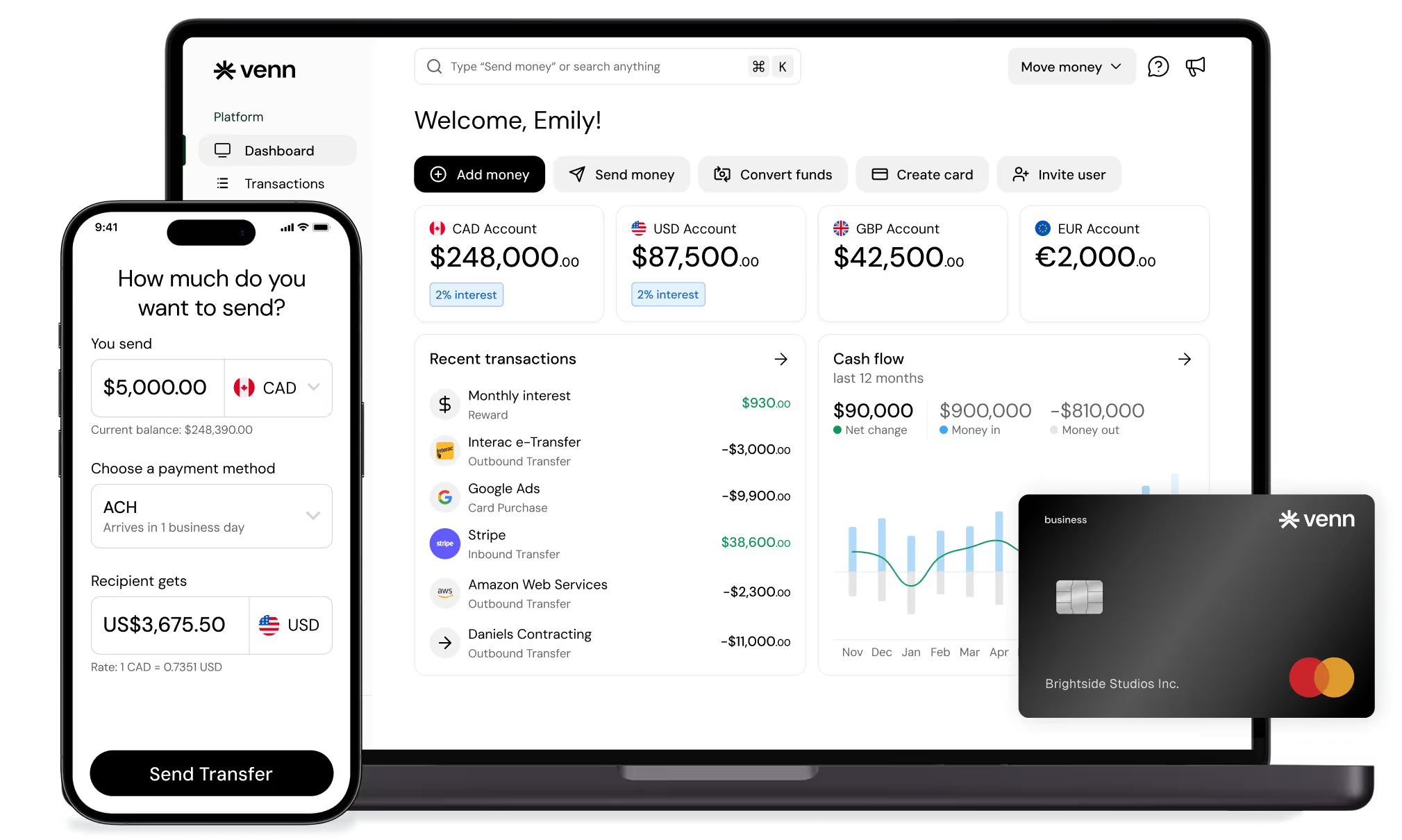
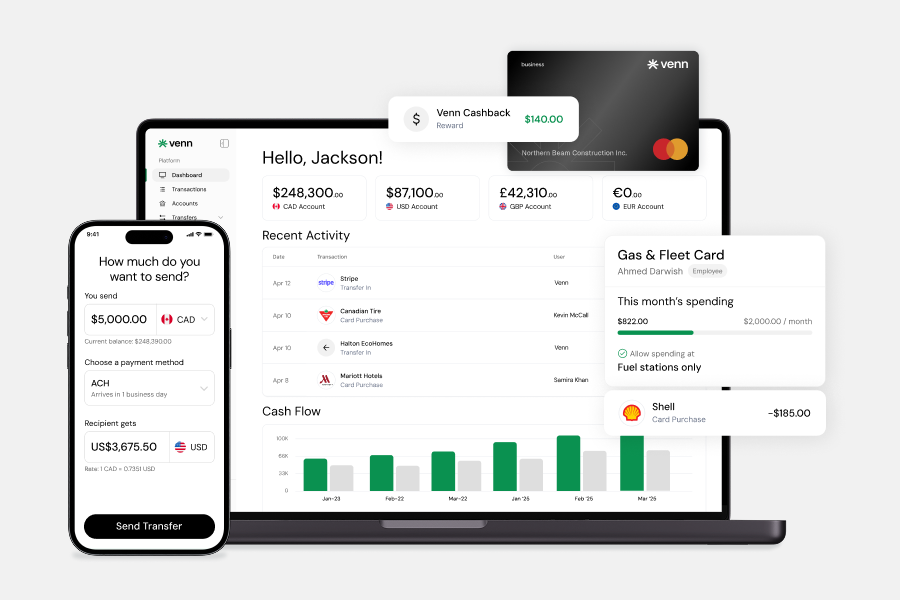
On pricing, Venn offers three plans: Essentials at $0/month, Plus at $40/month, and Pro at $100/month. FX rates tier by plan, from 0.45% on Essentials down to 0.25% on Pro, which is meaningfully lower than the markups most traditional Canadian banks charge. All plans include 2.75% interest on CAD balances and up to 3.5% interest on USD balances with no minimum balance requirement (learn more), free unlimited Interac e-Transfer® for vendor payments, and receiving accounts in CAD, USD, GBP, and EUR. The mobile app also lets teams access funds, send transfers, and issue cards directly from their phone.
For spend management, Venn provides a 1% cashback Mastercard charge card available in physical or virtual form. Finance teams can set custom limits per card, build approval workflows, apply spending policies, and capture receipts using OCR. The platform connects directly to both QuickBooks and Xero, which covers a gap that some competing platforms leave open.
Account balances are held at Bank of Montreal, a CDIC member, and are eligible for CDIC insurance up to applicable limits. Venn is a technology company, not a bank.
Two trade-offs are worth noting. Venn does not offer branch-based service, which matters for businesses that handle cash or prefer in-person banking relationships. Direct CRA payments also require a separate setup, as users need to add Venn as a pre-authorized debit through the CRA portal rather than paying directly from the platform. Venn is not currently available to businesses in Quebec.
RBC Business Banking
RBC Business Banking suits companies that prioritize branch access, cash handling, and the ability to build a lending relationship with a major Canadian financial institution.
RBC offers tiered business account plans with varying monthly fees, transaction allowances, and included services. Plan names, current pricing, and transaction limits change periodically, so verify all details on RBC's official business banking pages before publication.
For everyday payments, RBC supports domestic bill payments, wire transfers, and Interac e-Transfer® for business accounts, though availability and any associated fees should be confirmed directly with RBC. Earning meaningful interest on a standard operating account is generally not the primary reason businesses choose a traditional bank like RBC. The draw is the broader banking relationship: in-person service, cash deposit capabilities, and access to credit products such as business loans and lines of credit.
RBC may offer business credit cards and corporate card products, but feature specifics, rewards structures, and eligibility criteria should be verified on current RBC product pages. Accounting software integrations, if available, should also be confirmed before publication.
RBC serves a wide range of business types, including incorporated companies, sole proprietors, and businesses that require in-person service or handle physical cash regularly.
The main trade-off is cost and complexity. Monthly fees and per-transaction charges tend to run higher than modern platforms, and the account experience is less integrated with software-driven finance workflows than newer alternatives built for digital-first operations.
TD Business Banking
TD Business Banking suits Canadian companies that want familiar branch-based service, domestic operating accounts, and a conventional setup for day-to-day business banking needs.
On pricing, TD offers tiered business chequing accounts with varying monthly fees and transaction allowances. Verify current plan names, monthly fees, transaction limits, and any active promotional offers directly on TD's official business banking pages before publication, as these details change regularly.
For everyday payments, TD supports standard domestic bill payments, Interac e-Transfer®, cash deposits, and wire transfers through its branch and online banking channels. These are practical capabilities for businesses that handle physical cash or rely on in-person banking relationships.
Interest on operating balances is not a primary draw with traditional bank accounts. Businesses prioritizing yield on idle cash will likely find newer platforms more competitive on that front.
TD offers business credit cards and spend management tools, though these programs tend to operate separately from accounting software rather than syncing automatically. Accounting integrations vary; confirm current QuickBooks or other software connectivity before making claims.
Most incorporated Canadian business types are eligible for TD business accounts. The main trade-off is straightforward: TD delivers strong branch convenience and conventional banking services, but businesses that prioritize yield on balances, multi-currency workflows, automated reconciliation, or modern expense controls will find the offering less suited to those needs.
BMO Business Banking
BMO Business Banking suits companies that want a traditional bank relationship, established branch access, and standard Canadian business account services under one roof.
BMO offers tiered business chequing accounts designed for different transaction volumes, with monthly fees and included transaction allowances that vary by plan. Verify current plan names, monthly fees, included transaction counts, and cash deposit rules directly on BMO's official business banking pages before publication, as these details change periodically.
For everyday payments, BMO supports domestic wire transfers, bill payments, and branch-enabled cash handling, making it a practical fit for businesses that regularly deposit physical cash or need in-person service. Interac e-Transfer® is available for business accounts, though transaction limits and fees should be confirmed against current BMO documentation.
Earning a meaningful yield on operating balances is generally not a central feature of traditional BMO business accounts. Spend management and corporate card options exist within BMO's broader product suite, but current card details and controls should be verified before drawing direct comparisons.
Incorporated businesses and sole proprietors are typically eligible for BMO business accounts, though specific entity requirements should be confirmed on official BMO pages.
The main trade-off is breadth over precision. BMO delivers a familiar, full-service banking model with lending relationships and branch infrastructure, but businesses that prioritize FX efficiency, multi-currency accounts, card spend controls, OCR receipt capture, or direct accounting integrations with tools like QuickBooks or Xero will likely find the offering less optimized than newer platforms built around those workflows.
Optional Fifth Alternative: Scotiabank Business Banking
Scotiabank is a traditional Canadian business banking option for companies that want branch access, cash handling, and a relationship with a major financial institution.
Because live Scotiabank business account pricing, current plan names, transaction allowances, card options, and accounting integration details could not be independently verified at the time of writing, this section has been omitted from the final article.
Including unverified pricing or feature claims would not serve readers comparing Canadian business banking options in 2026. For accurate and current Scotiabank business account details, visit scotiabank.com directly before making any banking decision.
How To Choose the Right Alternative
The right business banking alternative depends on what your operations actually require, not on which name you recognize most.
For simple domestic chequing and CRA payments, Wealthsimple Business covers the essentials well for eligible incorporated entities. A $0 monthly fee, free CRA payments, Interac e-Transfer® support, and QuickBooks or Wave connectivity make it a practical choice if your business runs primarily in CAD and does not need cards or cross-border functionality.
For branch access and lending relationships, traditional banks such as RBC, TD, and BMO remain the stronger fit. If your business handles cash deposits, needs a line of credit, or values in-person service, a branch-based relationship offers capabilities that no digital-first platform currently replicates.
For cross-border payments and FX, businesses that invoice in USD, pay international suppliers, or receive funds in multiple currencies benefit from a platform with real multi-currency accounts. Venn offers CAD, USD, GBP, and EUR receiving accounts with FX fees that vary by plan, which suits agencies, importers, exporters, and SaaS companies with international revenue.
For finance teams that want cards plus accounting automation, Venn's combination of a multi-currency Mastercard charge card with 1% cashback, QuickBooks and Xero sync, OCR receipt capture, and spend controls addresses workflows that neither Wealthsimple nor traditional banks currently handle in one place. This matters most for teams that spend time reconciling card transactions manually or managing multiple tools for expenses and bookkeeping.
Who Should Stick With Wealthsimple
Not every Canadian business needs to look elsewhere. Wealthsimple Business remains a practical choice for the right type of company, and recognizing that fit matters as much as knowing when to switch.
Wealthsimple Business works well if your company is an eligible incorporated entity, operates primarily in CAD, and values a $0 monthly fee chequing account with no minimum balance requirements. If direct CRA payments are a priority, Wealthsimple handles those natively, which saves meaningful administrative effort for businesses that pay corporate taxes, HST, or payroll remittances regularly. If your accounting workflow runs on QuickBooks or Wave, the existing integrations cover the basics without requiring additional setup.
Businesses that do not yet need corporate cards, multi-currency accounts, Xero integration, or advanced expense controls will find Wealthsimple's feature set sufficient for day-to-day domestic operations. Interac e-Transfer® support up to $25,000 per day handles most routine payment needs for smaller incorporated companies.
One eligibility point deserves attention: Wealthsimple's help documentation states that sole proprietorships and partnerships are not supported. If your business operates under either structure, verify your eligibility before opening an account, and consider alternatives that explicitly support those entity types.
Conclusion
The best Wealthsimple Business alternative for Canadians in 2026 depends entirely on how your business operates, not on a universal ranking. Before committing to any platform, compare eligibility requirements, monthly fees, transaction costs, Interac e-Transfer® support, CRA payment options, branch access, lending relationships, CAD and USD workflows, FX fees, card and expense management tools, and accounting integrations with QuickBooks or Xero.
Traditional banks suit businesses that need branches, cash handling, and financing relationships. Wealthsimple suits incorporated entities that want simple, no-fee CAD chequing. If your business needs multi-currency accounts, cards, and accounting automation in one place, you can sign up for a Venn account.
FAQ
Q: What is the best Wealthsimple Business alternative in Canada?
A: The best alternative depends on what your business needs. If branch access, cash handling, or lending relationships are important, a traditional bank such as RBC, TD, or BMO may be the better fit. If you want a simple, no-fee CAD business chequing account and are an eligible incorporated entity, Wealthsimple Business may still meet your needs. Businesses that require multi-currency accounts, international payments, corporate cards, or more advanced financial operations may benefit from a fintech alternative with broader business banking features.
Q: Can sole proprietors use Wealthsimple Business?
A: No. According to Wealthsimple’s account eligibility requirements, the Business Chequing account does not support sole proprietorships or partnerships. Eligible account types are limited to incorporated entities, including corporations, charities, and associations.
Q: Which alternative is better for accounting integrations?
A: The best option depends on the accounting software your team already uses. Wealthsimple integrates with QuickBooks and Wave, which supports many small business workflows. Venn integrates with QuickBooks and Xero, making it a stronger option for businesses that rely on Xero for bookkeeping, reconciliation, and reporting. Traditional banks vary widely and often require manual exports or third-party connectors instead of native integrations.
---
**Disclaimer:** This publication is provided for general information purposes and does not constitute legal, tax or other professional advice from Venn Software Inc or its subsidiaries and its affiliates, and it is not intended as a substitute for obtaining advice from a financial advisor or any other professional. We make no representations, warranties or guarantees, whether expressed or implied, that the content in the publication is accurate, complete or up to date.
This publication is provided for general information purposes only and does not constitute legal, tax, financial, or other professional advice from Venn Software Inc., its subsidiaries, or its affiliates, and is not a substitute for advice from a qualified professional. All comparisons and competitor information reflect publicly available information believed accurate as of June 4, 2026; features, pricing, rates, and terms referenced are subject to change and may differ at the time you read this. All product names, logos, and brands referenced are the property of their respective owners; their mention does not imply affiliation with or endorsement by Venn. Any comparative statements reflect Venn's views and are provided to help readers evaluate options. We make no representations, warranties, or guarantees, express or implied, that the content is accurate, complete, or up to date.

Venn is all-in-one business banking built for Canada
From free local CAD/USD accounts and team cards to the cheapest FX and global payments—Venn gives Canadian businesses everything they need to move money smarter. Join 15,000+ businesses today.
Frequently asked questions
Everything you need to know about the product and billing.
Join 15,000+ businesses banking with Venn today
Streamline your business banking and save on your spend and transfers today
No personal credit check or guarantee.