How does interest work on a business account in Canada
How does interest work on a business account Learn daily balance calculations, monthly crediting, fees, and account types Canadian businesses should compare.

Ahmed Shafik
Co-founder

Trusted by 15,000+ Canadian businesses
Business banking for Canada
Local CAD and USD accounts, corporate cards with cashback, the lowest FX rates in Canada, free local transfers, and more.
How does interest work on a business account? In Canada, some business accounts earn interest, but many everyday business chequing or operating accounts earn little or none. That means idle cash may or may not generate earned interest, depending on the account design. This guide explains business account interest in plain terms, including how banks calculate interest, when it is credited, how the daily balance method affects earnings, how fees can reduce value, and which account types Canadian businesses should compare. Traditional business savings products often suit surplus cash, while some digital-first operating platforms now include interest on day-to-day balances.
What Does Interest on a Business Account Actually Mean?
Interest on a business account is money a financial institution pays on eligible funds in the account, based on the account’s terms, balance, rate, calculation method, and payment schedule.
If you are asking, “How does interest work on a business account?”, start with product design. Not every business account earns interest, and many operating accounts prioritize payments, deposits, and cash movement over yield. Business account interest applies only when the account terms say eligible balances can earn it.
Check four mechanics before comparing rates:
• Which balance counts: daily closing balance, average balance, tiered balance, or only funds above a minimum balance.
• What annual rate applies: a fixed, promotional, tiered, or variable interest rate.
• How banks calculate interest: often using a daily balance method.
• When interest is credited: for example, calculated daily paid monthly.
The headline rate matters, but the account rules decide your actual earned interest on business account funds.
Which Types of Business Accounts Usually Earn Interest?
Business account interest usually depends on the category of account, not just the institution. In Canada, the main options to compare are business chequing or operating accounts, business savings accounts, and GICs or term deposits.
The right fit depends on how you use your cash. Choose an operating account when liquidity matters, a business savings account when you want a separate bucket for surplus funds, and a GIC or term deposit when you can set cash aside for a defined term.
Business Chequing and Operating Accounts
Many Canadian business chequing accounts focus on payments, payroll, deposits, bill payments, and everyday cash movement. They often pay little or no business chequing account interest because the account design prioritizes transaction capacity over yield.
That pattern is changing. Some digital-first operating accounts now pay interest on active balances, which can help businesses earn interest without moving cash into a separate savings product. This matters when asking, “How does interest work on a business account?” The answer depends first on the account type. A traditional chequing account may treat cash as transactional, while a newer operating account may apply a variable interest rate to eligible day-to-day balances.
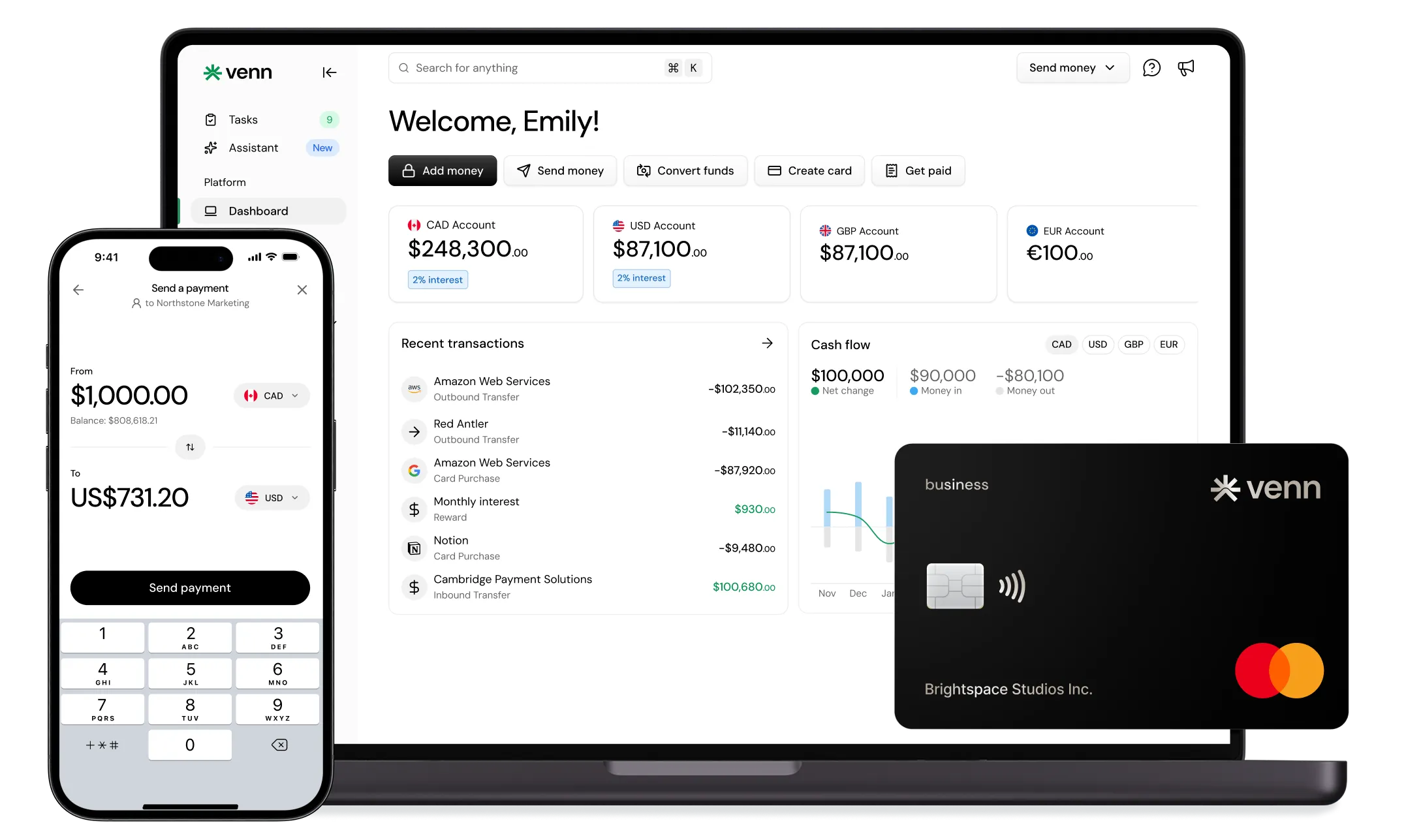
Two Canadian examples show the range. Wealthsimple Business Chequing offers an interest-earning option for incorporated businesses, with rates tied to combined Wealthsimple assets. Venn currently markets 2.75% interest on CAD balances and up to 3.5% interest on USD balances across plans (learn more), with no minimum balance. Neither structure fits every company, so compare how each account handles liquidity, eligibility, currencies, and operating workflows.
Business Savings Accounts
A business savings account usually works best as a parking place for surplus cash, not as the account that runs payroll, supplier payments, and daily receivables. Owners often pair it with a business chequing account so operating funds stay accessible while idle cash has a chance to earn business savings account interest.
RBC positions its Business Essentials Savings Account as a complement to an everyday operating account. TD takes a similar approach, positioning its Business Savings Account as a complement to business chequing. That framing matters when asking, “How does interest work on a business account?” In practice, the account type shapes the answer. If cash will sit unused for tax instalments, seasonal inventory, or a short-term reserve, a savings account may suit that purpose better than leaving every dollar in the main operating account.
GICs and Term Deposits
For cash the business does not need right away, GICs and term deposits can become part of the business account interest conversation. They usually require the company to commit funds for a defined term, which may limit access before maturity or make early withdrawals less flexible.
That trade-off matters. A business should first map its operating cash needs, payroll cycles, tax obligations, and emergency buffer. Only then can it decide whether surplus cash belongs in a liquid account or in a term product with a set timeline.
How Is Interest Calculated on a Business Account?
Most business account interest uses the daily balance method. The basic formula is:
• daily balance × annual interest rate ÷ 365
The institution calculates a small amount of earned interest for each day, then usually totals those daily amounts and credits them monthly. This is why cash flow timing matters. A balance held for 30 days earns more than the same balance held for 3 days.
For a steady-balance example, assume your business keeps $50,000 in an account for 30 days at a 3% annual interest rate:
• $50,000 × 0.03 ÷ 365 = $4.11 per day
Over 30 days, that equals about $123.30 before fees and tax treatment.
For a changing-balance example, assume your balance is $80,000 for 15 days, then payroll reduces it to $30,000 for 15 days, at the same 3% rate:
• $80,000 × 0.03 ÷ 365 × 15 = $98.63
• $30,000 × 0.03 ÷ 365 × 15 = $36.99
Total monthly interest is about $135.62.
Canadian providers describe these mechanics differently.
• RBC calculates deposit interest on the applicable portion of the daily closing credit balance in each tier, pays it on the second business day of each month, and describes it as simple interest.• TD describes its business savings interest as tiered and daily. • Wealthsimple describes its rate as annualized, calculated daily and paid monthly. • Venn materials describe CAD and USD balance interest as calculated daily and paid monthly, with interest posting language tied to monthly payment. Earn up to 3.5% interest
Simple Interest vs Compound Interest
Simple interest calculates interest on the principal balance for the period. If your business keeps eligible funds in an account, the institution applies the stated rate to that balance based on the product’s rules, then credits the earned interest according to its schedule.
Compound interest allows future interest to build on previously credited interest. In practice, that means once interest gets added to the account, later calculations may treat that credited interest as part of the balance that can earn more interest.
For a concrete Canadian example, RBC explicitly describes its Business Essentials Savings Account as using a simple interest calculation. That disclosure matters because “business account interest” can sound similar across products, while the calculation method can differ.
You may also see terms like APY or AER in international content when researching how does interest work on a business account. Canadian businesses should focus on the annual rate, how often interest is calculated, and when it gets paid in the product disclosures.
What Changes How Much Interest You Actually Earn?
The amount of earned interest on a business account depends on more than the posted annual rate. Balance size matters first: a larger daily balance usually produces more interest, but tiered structures can change the rate applied to each dollar. RBC and TD use tiered business savings structures, so the effective return depends on where your balance falls within those tiers.
Account type also matters. A business savings account interest rate may look attractive, but the account may suit surplus cash better than daily payments. A business chequing account interest offer can be more useful when funds need to stay operational. Wealthsimple’s business chequing rate changes with combined assets, while Venn currently presents 2.75% interest on CAD balances and up to 3.5% interest on USD balances (learn more). Like other variable interest rate offers, rates can change over time.
Fees can reduce the real yield. Monthly fees, debit fees, wire fees, transfer fees, minimum-balance conditions, and manual movement between accounts can offset a higher headline rate.
Cash-flow timing creates another gap between advertised and actual returns. Seasonal businesses, agencies waiting on receivables, retailers with inventory cycles, and payroll-heavy firms may value liquidity as much as rate, because interest often follows the daily balance method rather than a month-end snapshot.
Example Scenarios To Include
1. Stable Idle Cash
A consulting firm keeps $50,000 in surplus cash in an interest-bearing business account for a full 30-day month. If the account uses the daily balance method, the same balance counts each day. This makes the estimate straightforward: daily interest adds up across the month, then the institution credits it according to the account terms.
2. Fluctuating Operating Balance
A retailer starts the month with $80,000, runs payroll mid-month, then collects customer invoices near month-end. The closing balance may look healthy, but business account interest depends on the balance held each day. Lower balances after payroll reduce the month’s earned interest, even if cash returns later.
3. High-Activity Savings Account
A business moves cash into a business savings account for yield but uses it like a chequing account, making frequent debits and transfers. Transaction fees can reduce net interest, so the headline rate tells only part of the story.
4. Cross-Border Operator
A Canadian business receives USD from international clients and wants that operating cash to stay productive while bills, payroll, and supplier payments continue. In this case, the practical question is not only how does interest work on a business account, but whether the account structure supports how the company actually receives, holds, and uses cash. This is where multi-currency operating needs can shape the later comparison, including Venn’s relevance as discussed below.
How To Compare Interest-Bearing Business Accounts in Canada
There is no universal winner when asking, “How does interest work on a business account?” because cash cycles differ.
Venn
Venn is relevant for Canadian businesses that want interest on operating balances alongside broader financial operations tools. Venn is a technology company, not a bank or financial institution, and eligible deposits with Venn are covered by CDIC insurance protection up to applicable limits through BMO.
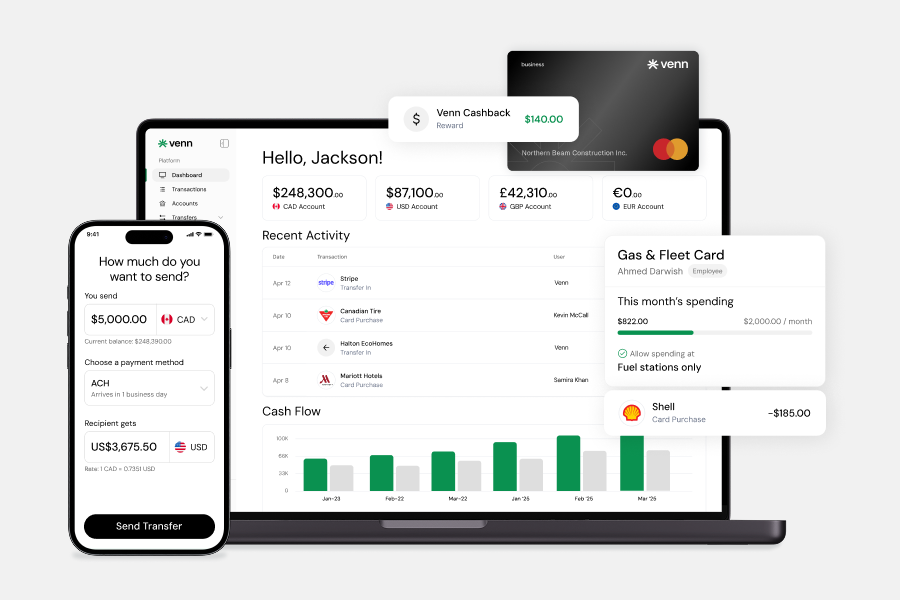
For businesses comparing business account interest, Venn may fit when cash management, payments, currency needs, and team spending all sit close together. It supports CAD, USD, GBP, and EUR accounts, which can help companies that invoice clients, pay suppliers, or manage operating balances across currencies. Venn also offers competitive, plan-tiered FX rates, without requiring businesses to rely on a separate foreign exchange workflow.
Venn offers 2.75% interest on CAD balances and up to 3.5% interest on USD balances (learn more).
Beyond interest, Venn includes expense management features such as cards, approvals, spend controls, and OCR receipt capture. It integrates directly with QuickBooks and Xero, helping finance teams keep transactions, receipts, and reconciliation workflows connected. Vendor payments can also run through free unlimited Interac e-Transfer®.
Venn’s card program offers 1% cashback with plan-based caps, including unlimited cashback on Pro and Custom where available in current pricing. Venn is not currently available to businesses in Quebec.
Wealthsimple Business Chequing
Wealthsimple Business Chequing may fit incorporated businesses that want a simple digital operating account with interest. It serves corporations rather than sole proprietors or partnerships, so eligibility should be the first filter before comparing business chequing account interest against other Canadian options.
The account has no monthly fees, which can help preserve the value of earned interest on a business account. For companies that make regular tax remittances, CRA bill payments add practical value because operating cash can stay in the same workflow instead of moving between separate tools. QuickBooks connectivity also supports cleaner bookkeeping, especially when interest income, payments, and transfers need to reconcile without extra manual work.
This option is more CAD-centric, so businesses with primarily Canadian receivables, payables, and tax obligations may find the fit more natural than firms that need a broader multi-currency operating setup. When comparing how does interest work on a business account across providers, weigh the interest feature alongside eligibility, fees, payment needs, accounting workflows, and the currencies your business actually uses.
RBC Business Essentials Savings
RBC Business Essentials Savings may fit businesses that want a dedicated savings account beside a traditional operating account and value established branch-bank familiarity. For owners comparing business savings account interest, the key question is how much cash can sit untouched after payroll, rent, tax remittances, supplier payments, and near-term working capital needs.
RBC includes two free debits or cheques per month before fees on this savings account. That makes transaction planning part of the yield conversation. If a company regularly moves money in and out, debit activity can reduce the practical value of earned interest on a business account, even when the headline rate looks useful.
The account structure suits surplus cash better than all-in-one daily operations. Businesses with frequent payments, approvals, card spend, or accounting workflows may prefer to keep this type of account for reserves while using a separate operating setup for day-to-day movement.
TD Business Savings Account
TD Business Savings Account may fit businesses that want a traditional savings complement and branch-bank familiarity. For owners comparing business savings account interest, the key detail is not only whether the account earns interest, but how account activity affects the net benefit.
TD lists per-transaction costs for credits and withdrawals on its business savings account. That matters if your business plans to move money in and out often, such as transferring funds for payroll, supplier payments, tax instalments, or seasonal cash needs. Each charge can reduce the practical value of earned interest, especially on smaller balances or accounts with frequent transactions.
When evaluating how does interest work on a business account, treat transaction volume as part of the calculation. A savings account with regular activity may produce a different result than the headline rate suggests once credit and withdrawal costs apply.
What To Look For Beyond the Headline Interest Rate
Use the rate as a starting point, then test the account against how your business actually moves cash.
• Where does interest apply? Does the provider pay business account interest on operating balances, savings balances, or only a separate business savings account?
• How does the rate work? Is it flat, tiered, promotional, or conditional on a minimum balance or relationship size?
• How do banks calculate interest? Look for the daily balance method, especially if your cash fluctuates around payroll, tax payments, or invoice collections.
• When do you receive it? “Calculated daily, paid monthly” differs from quarterly crediting or other payment schedules.
• What fees reduce net yield? Check monthly fees, withdrawal costs, transfer charges, and limits that can dilute earned interest on a business account.
• Do you need branch access? Traditional savings products may suit businesses that deposit cash or need in-person service.
• Will you receive or keep USD? Currency needs can matter as much as the posted rate.
• Do you need accounting connections? If bookkeeping speed matters, review workflow fit alongside interest.
• Do you need cards or approvals for a team? Some businesses may prefer a broader operating stack over a standalone savings account. If that describes your company, revisit the Venn section above for the operating-account context.
Common Mistakes To Avoid
Do not assume every business chequing account interest offer works the same way, or that every operating account earns interest at all. Some accounts pay little or none, while others apply conditions.
Avoid comparing only the headline rate. A variable interest rate, tiered rate, minimum balance rule, or promotional period can change your actual return. Daily-balance calculations matter too. If interest is calculated daily and paid monthly, a large balance that sits for only three days earns far less than the same balance held all month.
Watch the costs around the rate. Monthly fees, debit fees, withdrawal limits, and transfer charges can reduce earned interest on a business account. Be careful with large USD balances if the product does not support USD well, and avoid using a business savings account like an operating account without checking debit costs. For broader context, see the comparison table above.
Conclusion
Interest on a business account depends on math and product design. The math explains how banks calculate interest, often using daily balances and monthly credits. Product design determines which balances qualify, how liquid your cash stays, and whether the account supports your operating needs.
Before choosing an account, estimate your average idle balance, map your transaction volume, and decide how much access and structure your business needs. Branch banking, software integrations, multi-currency support, and a dedicated savings bucket can all change the right fit. If your operating model calls for a digital-first approach, Sign up for a Venn account.
FAQs
Q: Do business chequing accounts earn interest?
A: Some do, but many business chequing accounts earn little or no interest. Business chequing account interest depends on the provider, account type, balance rules, and whether the account is built for daily operations or surplus cash.
Q: How is business account interest calculated?
A: Most calculations start with your eligible balance and an annual interest rate. A common daily balance method is: daily closing balance × annual interest rate ÷ 365. The daily interest amounts are then added together for the payment period.
Q: Is business account interest calculated daily or monthly?
A: Many Canadian business accounts calculate interest daily and pay it monthly, but you should always confirm the account terms. "Calculated daily, paid monthly" means changes to your balance throughout the month can affect the interest your business account earns.
Q: What is the difference between interest rate and APY?
A: The interest rate is the stated annual rate used to calculate interest. APY (Annual Percentage Yield), sometimes called the effective yield, reflects the impact of compounding and shows what your return could look like over a year if earned interest also earns interest.
Q: Do fees reduce the value of an interest-bearing business account?
A: Yes. Monthly fees, transaction fees, withdrawal charges, and minimum balance requirements can reduce or even eliminate the interest earned on a business savings account. Compare the net return, not just the advertised interest rate.
Q: Should I keep surplus cash in a business savings account or an operating account?
A: A business savings account is generally a good choice when surplus cash can remain separate and you want a dedicated interest-earning balance. An interest-bearing operating account may be a better fit when day-to-day liquidity, payments, approvals, or accounting workflows are the priority.
---
**Disclaimer:** This publication is provided for general information purposes only and does not constitute legal, tax, financial, or other professional advice from Venn Software Inc., its subsidiaries, or its affiliates, and is not a substitute for advice from a qualified professional. All comparisons and competitor information reflect publicly available information believed accurate as of June 1, 2026; features, pricing, rates, and terms referenced are subject to change and may differ at the time you read this. All product names, logos, and brands referenced are the property of their respective owners; their mention does not imply affiliation with or endorsement by Venn. Any comparative statements reflect Venn's views and are provided to help readers evaluate options. We make no representations, warranties, or guarantees, express or implied, that the content is accurate, complete, or up to date.

Venn is all-in-one business banking built for Canada
From free local CAD/USD accounts and team cards to the cheapest FX and global payments—Venn gives Canadian businesses everything they need to move money smarter. Join 15,000+ businesses today.
Frequently asked questions
Everything you need to know about the product and billing.
Join 15,000+ businesses banking with Venn today
Streamline your business banking and save on your spend and transfers today
No personal credit check or guarantee.