Difference between a Fintech and a regular bank in Canada
What is the difference between a Fintech and a regular bank in Canada? Compare fees, CDIC safety, regulation, and the best hybrid setup for SMBs in 2026.

Ahmed Shafik
Co-founder
.png)
Trusted by 15,000+ Canadian businesses
Business banking for Canada
Local CAD and USD accounts, corporate cards with cashback, the lowest FX rates in Canada, free local transfers, and more.
Canadian business owners face a fundamental question when setting up their financial operations: should you work with a traditional bank, a fintech, or both? The answer depends on your specific needs around cost, speed, safety, and day-to-day operations.
This guide explains the key differences between fintechs and banks in Canada, breaks down the regulatory landscape, and helps you make an informed decision for your business. Modern business banking platforms like Venn combine banking, payments, corporate cards, and accounting workflows in one place, representing how the line between these categories continues to blur in ways that benefit Canadian businesses.
What Is A Fintech In Canada?
Fintechs Are Financial Technology Companies, But Not Always Banks
"Fintech" refers to companies that use technology to deliver financial services. In Canada, fintechs operate across payments processing, corporate cards, lending, expense management, foreign exchange, invoicing, and accounting automation.
The critical distinction: most fintechs are not banks themselves. Many partner with regulated financial institutions, such as trust companies or chartered banks, to provide account functionality and deposit protections. This partnership model allows fintechs to focus on building better software experiences while leveraging established financial infrastructure.
Common Fintech Strengths For Canadian Businesses
Fintechs typically excel in areas where traditional banks have historically underinvested:
• Faster onboarding: Open an account in minutes rather than weeks
• Modern user experience: Intuitive dashboards, mobile-first design, real-time notifications
• Transparent pricing: Clear fee schedules without hidden charges
• Automation and integrations: Direct connections to QuickBooks, Xero, and other business tools
• Cross-border capabilities: Multi-currency accounts and competitive foreign exchange rates
Venn exemplifies this approach as a Canadian business banking platform that helps businesses manage CAD and foreign currency operations, pay suppliers efficiently, and streamline accounting workflows through direct integrations.
What Is A Regular Bank In Canada?
What Bank Typically Means In Canada
When Canadians refer to "banks," they usually mean federally chartered institutions regulated by the Office of the Superintendent of Financial Institutions (OSFI). These include the Big Five (RBC, TD, Scotiabank, BMO, CIBC) and other Schedule I, II, and III banks.
Traditional banks offer a full-service bundle: deposits, lending, branch networks, wealth management, trade finance, and specialized commercial products. Their strengths include breadth of services, established processes, and physical locations for complex transactions.
Where Traditional Banks Can Feel Friction-Heavy For SMBs
For small and medium-sized businesses, traditional banks often present operational challenges:
• Higher fees and FX spreads: Currency conversion markups and wire fees can add up quickly for businesses with international operations
• Slower payment workflows: Manual processes for approvals, limited automation, and rigid cutoff times
• Fragmented tools: Separate platforms required for expense management, payables, and cross-border operations
• Limited integrations: Weak or manual connections to accounting software, requiring duplicate data entry
Fintech vs Bank: The Key Differences That Matter
Side-By-Side Comparison For Business Owners
The Biggest Confusion: Digital Banks, Neobanks, And Fintechs
These terms get used interchangeably, but they mean different things:
• Digital bank: A bank (often a subsidiary of a traditional institution) that operates primarily online
• Neobank: A fintech that offers bank-like services, typically through partnerships with licensed institutions
• Fintech: The broadest category, covering any technology company in financial services
The branding can be misleading. What matters is understanding who provides the underlying account and what protections apply to your funds.
Safety And Regulation Map: Who Oversees What In Canada
Understanding The Regulatory Framework
Canada's financial system involves multiple oversight bodies, each with distinct responsibilities:
OSFI (Office of the Superintendent of Financial Institutions): The prudential regulator for federally regulated financial institutions. OSFI ensures banks, trust companies, and insurance companies maintain adequate capital and manage risks appropriately. They coordinate with other bodies to maintain financial system stability.
FCAC (Financial Consumer Agency of Canada): Provides consumer protection oversight for banks and other federally regulated financial entities. FCAC ensures these institutions comply with consumer protection measures and plays a role in the evolution of consumer-driven banking.
CDIC (Canada Deposit Insurance Corporation): Provides deposit insurance for eligible deposits at CDIC member institutions. Coverage applies automatically to qualifying deposits up to $100,000 per category.
Bank of Canada: Increasingly central in payments oversight and playing a role in consumer-driven banking implementation as outlined in government communications.
CDIC Insurance: What Business Owners Should Know
CDIC coverage protects eligible deposits automatically when held at member institutions. Key points for business owners:
Coverage categories: CDIC insures deposits separately in different categories, each up to $100,000. Business accounts held in the name of a corporation or partnership are covered separately from personal deposits.
Member institution vs app brand: This distinction matters enormously. The fintech app you use may not be the CDIC member. Your funds may be held at a partner trust company or bank that carries the actual CDIC membership. Venn, for example, provides access to accounts where funds are covered under CDIC insurance protection.
How to verify coverage:
• Search the CDIC member list at cdic.ca
• Confirm which institution holds your deposits (not just the app name)
• Ask support for written confirmation of the CDIC member and how your deposits are structured
Open Banking And Consumer-Driven Banking In Canada
As of early 2026, Canada continues developing its consumer-driven banking framework. Budget 2025 materials from the Government of Canada outline the framework and implementation direction, with the Bank of Canada and FCAC playing oversight roles.
Consumer-driven banking will enable secure, consent-based sharing of financial data with approved providers. For SMBs, this means easier switching between providers, faster underwriting for credit products, and smarter cash-flow management tools. Implementation timelines remain subject to regulatory processes.
Where Fintechs Usually Beat Banks And Where Banks Still Win
Fintech Advantages When The Fit Is Right
Fintechs typically outperform traditional banks in operational efficiency:
Better automation: Payables approvals, receipt capture via OCR, automatic categorization, and real-time reconciliation reduce manual work significantly.
Clearer multi-currency workflows: Purpose-built systems for holding, sending, and receiving foreign currencies without excessive conversion friction.
Faster setup and modern controls: Card controls by team member, project, or spending category. Real-time visibility into who spent what, where.
A modern business financial stack might look like this: Venn (banking + corporate card + multi-currency) combined with QuickBooks or Xero (accounting), your payroll provider, and invoicing tools. Each component does what it does best, connected through integrations.
Traditional Bank Advantages
Banks remain the better choice for certain needs:
• Complex lending relationships: Lines of credit, commercial mortgages, and equipment financing often require established banking relationships
• In-person services: Some transactions, particularly around business formation or complex legal structures, benefit from branch visits
• Broader product catalogue: Trade finance, letters of credit, specialized foreign exchange hedging, and treasury management for larger operations
The Reality For Many Businesses: A Hybrid Stack
Most Canadian businesses in 2026 benefit from using both. Keep a traditional bank relationship for lending and specialized services while using a fintech platform for day-to-day operations, expense management, and cross-border transactions.
How Venn Fits Into A Modern Canadian Business Financial Stack
Venn As The Day-To-Day Operating Hub
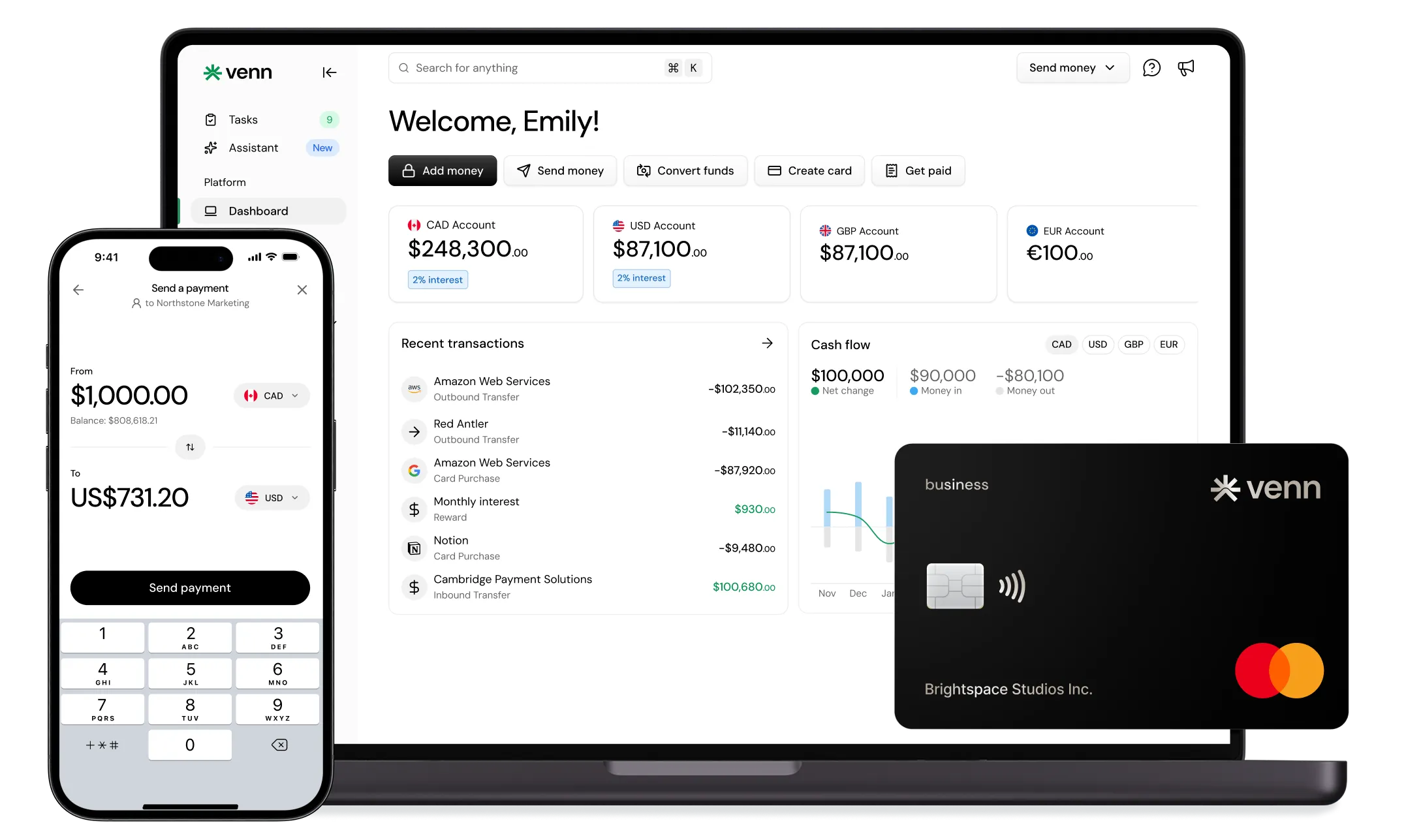
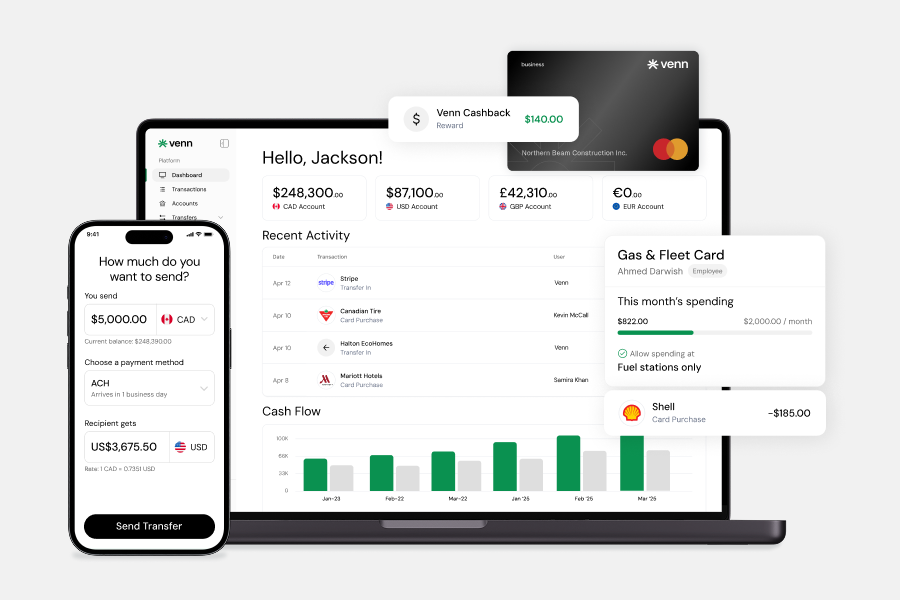
Venn functions as a business banking platform that brings together banking, corporate cards, and payments in one interface. Rather than juggling separate tools for expense management, payment processing, and currency conversion, businesses manage everything from a single dashboard.
The platform provides real-time visibility into cash flow, spending by category or team member, and upcoming payment obligations. This operational leverage translates directly into faster month-end closes and better financial decisions.
Corporate Card Value: 1% Unlimited Cashback
Venn's corporate card offers 1% unlimited cashback on all purchases with no caps or category restrictions. For businesses spending on SaaS subscriptions, advertising, shipping, or supplier payments, this creates predictable returns on operating expenses.
The cashback accumulates automatically and can offset costs across your operations. Combined with detailed spend data that flows directly into your accounting software, the card becomes a tool for both savings and visibility.
Multi-Currency Capabilities For Global Businesses
Venn provides CAD, USD, EUR, and GBP accounts, allowing businesses to hold, receive, and send funds in multiple currencies. This matters for:
• Receiving international payments: Get paid in your customer's currency without immediate conversion
• Paying foreign suppliers: Pay in their local currency to negotiate better rates and avoid double conversion
• Reducing FX friction: Convert when rates are favorable rather than at the moment of each transaction
Cross-border payments via ACH, EFT, and wires support common business workflows. Free unlimited Interac e-Transfer® for domestic vendor payments eliminates a common cost center for Canadian businesses.
Accounting Integrations: QuickBooks And Xero Compatibility
Direct integrations with QuickBooks and Xero mean transactions sync automatically. This eliminates manual data entry, speeds up reconciliation, and creates a cleaner audit trail.
For finance teams, this integration transforms month-end close from a multi-day scramble into a streamlined process. Receipts captured via OCR attach to transactions automatically, and categorization rules reduce repetitive work.
Practical Use Cases
Ecommerce and retail: Pay suppliers in USD, reduce FX friction on inventory purchases, and reconcile marketplace payouts efficiently.
Professional services: Invoice international clients, manage contractor payouts across borders, and track project-based expenses.
Marketing and tech agencies: Handle multi-currency SaaS spend, set card controls by team or project, and maintain clear visibility into client-billable expenses.
Import businesses: Coordinate wire payments with supplier shipment timing, manage FX exposure, and track landed costs accurately.
How To Choose Between A Fintech And A Bank
Questions To Ask Any Provider
Before committing to any financial services provider, get clear answers to these questions:
• Who is the underlying regulated institution (if applicable)?
• What protections apply to funds, and how is the structure organized?
• What are total costs including FX markup, wire fees, and account fees?
• What payment rails are supported (EFT, ACH, wires, Interac e-Transfer®)?
• What integrations exist with QuickBooks and Xero, and what does the reconciliation workflow look like?
• What is the support and escalation path when issues arise?
FAQ
Q: Are fintechs regulated in Canada?
A: Yes, but regulation depends on the specific activities a fintech performs. Payment processors, lenders, and securities dealers each fall under different regulatory frameworks. The Office of the Superintendent of Financial Institutions (OSFI), Financial Consumer Agency of Canada (FCAC), provincial securities commissions, and FINTRAC may all have oversight depending on the services offered. Always confirm which regulatory body oversees the specific service you are using.
Q: Are fintechs CDIC insured?
A: Not always directly. CDIC coverage may apply when a fintech partners with a CDIC member institution to hold customer deposits. The coverage follows the member institution, not the app brand. Verify coverage by searching the CDIC member list and confirming which institution actually holds your funds.
Q: Is open banking available in Canada yet?
A: As of early 2026, Canada’s consumer-driven banking framework is still under development. Federal Budget 2025 materials outline the government’s implementation direction, with oversight roles expected for the Bank of Canada and the Financial Consumer Agency of Canada (FCAC). Full implementation timelines remain subject to the regulatory process. Check Government of Canada sources for the latest updates.
Q: Should my business use a fintech, a bank, or both?
A: Many Canadian businesses benefit from a hybrid approach. Use a traditional bank for lending relationships and specialized financial services. Add a fintech platform such as Venn for day-to-day financial operations, expense management, corporate cards, and multi-currency capabilities. This combination provides the stability of traditional banking with the operational efficiency of modern financial technology.
Q: What happens if a fintech goes out of business?
A: If your funds are held at a CDIC member institution through the fintech’s partnership structure, deposit insurance protection still applies even if the fintech company shuts down. Deposits are typically protected up to $100,000 per insured category. This is why understanding which financial institution actually holds your funds is more important than relying on the app brand alone.
---
**Disclaimer:** This publication is provided for general information purposes and does not constitute legal, tax or other professional advice from Venn Software Inc or its subsidiaries and its affiliates, and it is not intended as a substitute for obtaining advice from a financial advisor or any other professional. We make no representations, warranties or guarantees, whether expressed or implied, that the content in the publication is accurate, complete or up to date.
This publication is provided for general information purposes only and does not constitute legal, tax, financial, or other professional advice from Venn Software Inc., its subsidiaries, or its affiliates, and is not a substitute for advice from a qualified professional. All comparisons and competitor information reflect publicly available information believed accurate as of March 5, 2026; features, pricing, rates, and terms referenced are subject to change and may differ at the time you read this. All product names, logos, and brands referenced are the property of their respective owners; their mention does not imply affiliation with or endorsement by Venn. Any comparative statements reflect Venn's views and are provided to help readers evaluate options. We make no representations, warranties, or guarantees, express or implied, that the content is accurate, complete, or up to date.

Venn is all-in-one business banking built for Canada
From free local CAD/USD accounts and team cards to the cheapest FX and global payments—Venn gives Canadian businesses everything they need to move money smarter. Join 15,000+ businesses today.
Frequently asked questions
Everything you need to know about the product and billing.
Join 15,000+ businesses banking with Venn today
Streamline your business banking and save on your spend and transfers today
No personal credit check or guarantee.