Construction Cash Flow Management in Canada for Contractors
Learn strategies for construction cash flow management in Canada. Handle delayed payments, retainage, and subcontractors to keep your projects moving.

.png)
Trusted by 15,000+ Canadian businesses
Business banking for Canada
Local CAD and USD accounts, corporate cards with cashback, the lowest FX rates in Canada, free local transfers, and more.
Running a profitable construction project on paper means nothing when you can't make payroll. This disconnect between project profitability and actual cash availability represents one of the most challenging aspects of managing a construction business in Canada.
Construction companies face a unique timing challenge. You pay subcontractors before receiving client payments, manage mandatory holdback requirements that lock up 10% of your revenue for months, and navigate progress billing delays that can stretch your cash reserves to the breaking point. These aren't just minor inconveniences. They're structural challenges built into how the construction industry operates.
The good news? While you can't change how the industry works, you can dramatically improve how you manage cash flow through these challenges. This guide covers the three major cash flow obstacles Canadian contractors face: payment delays, retainage requirements, and subcontractor payment coordination. More importantly, it provides practical solutions that go beyond generic advice to address the real barriers construction businesses encounter.
Success in construction cash flow management isn't just about better accounting or stricter contracts. It requires having the right financial infrastructure to move money quickly, track project-specific cash positions, and automate the complex payment flows that construction businesses manage daily. Let's examine how to build a cash flow management system that actually works for the realities of Canadian construction.
Why Cash Flow Management Is Critical for Construction Businesses
Construction operates on negative cash flow cycles. You pay for materials, labour, and subcontractors before receiving payment for completed work. This fundamental timing mismatch makes cash flow management not just important but essential for survival.
Statistics from the Canadian Construction Association show that over 80% of construction business failures stem from cash flow problems, not lack of profitability. A contractor can have full project pipelines and healthy margins yet still struggle to meet payroll or pay suppliers on time.
The domino effect amplifies these challenges. One delayed payment from a general contractor impacts every subcontractor on the project. Those subcontractors then delay payments to their suppliers. The entire project ecosystem suffers from a single payment bottleneck.
Canadian contractors face additional complexity from provincial variations in payment timelines, holdback requirements, and lien legislation. What works in Ontario might not apply in Alberta, making standardized cash flow management even more challenging for contractors working across provincial borders.
The Three Major Cash Flow Challenges Facing Canadian Contractors
Construction cash flow problems rarely exist in isolation. Payment delays, holdback requirements, and subcontractor management create interconnected challenges that compound each other. Understanding how these three factors interact helps explain why traditional cash flow advice often falls short for construction businesses.
1. Payment Delays and Slow Progress Billing
Client payment delays despite completed milestones represent the most immediate cash flow challenge. Even when work meets specifications and timelines, payment can lag by 30, 60, or even 90 days.
Slow invoice processing and approval chains compound these delays. Large organizations often have multiple layers of approval, each adding days or weeks to payment timelines.
Documentation disputes frequently delay payment release, even for undisputed portions of the work. Missing signatures, incomplete lien waivers, or questions about change orders can hold up entire progress payments.
2. Holdbacks and Retainage Requirements
Mandatory provincial holdback percentages lock up significant capital. Most provinces require 10% holdback on all progress payments, meaning you only receive 90% of your earned revenue until project completion.
Extended holdback periods stretch cash even further. The typical 45-60 day holdback release period after substantial completion means waiting months to receive money you've already earned and likely paid taxes on.
Cash trapped in holdbacks across multiple simultaneous projects can represent hundreds of thousands or even millions in inaccessible working capital for larger contractors.
3. Managing Subcontractor and Supplier Payments
Coordinating payments to multiple parties with different terms creates administrative and financial complexity. Each subcontractor may have different payment expectations, lien waiver requirements, and documentation needs.
Pressure to pay subcontractors before receiving client funds puts contractors in an impossible position. Delay payment and risk mechanics' liens or damaged relationships. Pay on time and risk running out of operating cash.
The risk of mechanics' liens looms large when payment timing goes wrong. Missing provincial lien deadlines or failing to obtain proper waivers can result in liens that complicate project completion and future financing.
Understanding Canadian Construction Holdbacks and Their Impact on Cash Flow
Holdbacks exist to protect project owners from deficiencies and unpaid subcontractor claims. While the concept makes sense, the execution creates significant cash flow pressure for contractors who must fund operations while 10% of revenue remains locked away.
Provincial requirements vary slightly but follow similar patterns. Federal projects and most provinces mandate a 10% holdback on all progress payments. Some provinces like Manitoba allow for annual holdback release on multi-year projects, while others require holding the full amount until substantial completion. The timing for holdback release typically involves substantial completion certification plus a lien expiry period. In Ontario, this means 45 days after substantial completion publication. Saskatchewan extends this to 60 days. These timelines assume no liens are filed and all documentation is perfect.
Recent prompt payment legislation updates in Ontario, Saskatchewan, and Nova Scotia have introduced new requirements and adjudication processes. While these laws aim to speed up payments, they also add compliance complexity that contractors must navigate carefully.
Tax implications of holdbacks create additional cash flow pressure. Holdbacks become taxable when invoiced, not when received. This means paying GST/HST and income tax on money you won't see for months. For a $1 million project phase, you're paying tax on $100,000 that sits in the owner's account. Revenue recognition rules mean you can't defer this tax liability simply because payment is delayed.
The cumulative impact across multiple projects becomes staggering. Consider a mid-sized contractor with 10 active projects averaging $2 million each. At any given time, $2 million in holdbacks remains inaccessible. That's $2 million in working capital that could fund payroll, purchase materials, or take on new projects. Instead, it sits idle while the contractor scrambles to fund operations through credit lines or delayed supplier payments.
Common Causes of Payment Delays in Construction Projects
Incomplete or inaccurate documentation tops the list of payment delay causes. Missing lien waivers, unsigned change orders, or incomplete statutory declarations give clients easy reasons to delay payment. Even minor documentation gaps can hold up six-figure progress payments.
Client cash flow issues or financing delays create payment problems beyond your control. When a developer's construction loan hits snags or a government client faces budget freezes, your perfect project execution won't accelerate payment.
Disputes over work quality or scope completion provide cover for payment delays even when most work is undisputed. A disagreement over 5% of the work shouldn't delay payment for the other 95%, but it often does. These disputes drag on while contractors bear the cash flow burden.
Consider this common scenario: You complete a $500,000 project phase on schedule. The client's project manager is satisfied, but corporate approval requires CFO sign-off. The CFO is traveling for two weeks. Upon return, they question three line items totaling $15,000. Instead of paying the undisputed $485,000, they hold the entire payment pending resolution. Your payroll is due next week.
Complex approval processes in larger organizations add layers of delay. Government projects might require departmental reviews, compliance checks, and multiple signatures. Each step adds days or weeks to payment timelines that already stretch beyond reasonable limits.
Change orders and variations not properly documented create payment nightmares. Verbal authorizations to proceed with additional work seem efficient on site but become payment barriers when documentation is requested months later. Administrative delays and processing bottlenecks occur even in well-intentioned organizations. Accounts payable departments juggle hundreds of invoices. Construction invoices with their complexity and high values often get extra scrutiny, pushing them to the bottom of processing queues.
Seasonal timing issues like fiscal year-ends and holiday periods predictably slow payments. Government clients rushing to close books or skeleton staff during summer vacations mean June and December payments consistently lag.
Essential Financial Documents for Construction Payment Management
Proper documentation prevents disputes and accelerates payment. Having these documents ready before invoicing eliminates common payment delay excuses.
Detailed contracts with clear payment terms and schedules form the foundation. Net 30 days might be standard in other industries, but construction contracts should specify exact milestone payment amounts and timing. Include specific consequences for late payment.
Progress billing invoices with supporting documentation must be comprehensive. Attach photo documentation, inspection reports, and percentage completion certifications. Make it impossible to question work completion.
Lien waivers (partial and final) protect owners and accelerate payment. Provide conditional waivers with each invoice and final waivers upon payment receipt. Use standardized forms accepted in your province.
Change order authorizations must be written and signed before work proceeds. Email confirmations work, but formal change orders prevent "I never authorized that" disputes months later.
Statutory declarations confirming payment to all subcontractors and suppliers become critical for final payments. Keep running records to produce these quickly.
Proof of payment to subcontractors increasingly requested by sophisticated owners. Bank statements or cancelled cheques proving subcontractor payment prevent double payment liability concerns.
GST/HST documentation must be perfect. Construction services crossing provincial boundaries or involving multiple tax rates require careful documentation to prevent payment delays over tax concerns.
Maintaining organized, complete documentation seems tedious during busy project phases. But the first time proper documentation accelerates a six-figure payment by weeks, the value becomes clear. Digital document management systems make this process far more manageable than paper-based filing systems of the past.
Leverage Modern Financial Infrastructure
Traditional banking limitations actively hinder construction cash flow management. Single business accounts make project tracking nearly impossible. Five-day wire transfer clearing times don't match construction payment urgency. High transaction fees drain cash from every payment cycle.
Modern financial infrastructure designed for business complexity changes the game entirely. Multiple accounts at no additional cost enable true project-based cash segregation. When you can open separate accounts for each major project, cash flow tracking becomes automatic. No more spreadsheet gymnastics trying to allocate funds mentally across projects sharing one account.
Faster payment methods eliminate the waiting game. Same-day or next-day EFT payments to subcontractors replace five-day wire delays. When a subcontractor calls needing payment to make their own payroll, you can actually help instead of apologizing for bank delays.
Accounting software integration removes manual payment processing. Connect QuickBooks or Xero directly to your banking platform. Approved invoices trigger automatic payments without manual data entry or paper cheques. This automation doesn't just save time; it ensures subcontractors get paid exactly when promised.
Real local CAD and USD accounts simplify cross-border projects. Many contractors work with US suppliers or clients but suffer from fake "USD accounts" that actually hold CAD and trigger conversions on every transaction. True USD accounts eliminate these hidden costs and delays.
Transaction cost reduction directly improves cash flow. Traditional banks charge $15-30 per wire transfer. Sending 20 subcontractor payments costs $300-600 in fees alone. Modern platforms reduce this to $0-2 per payment, keeping cash in your business instead of padding bank profits.
If you're wondering, "how can I save my business money in 2026" then make sure to read our 2026 guide.
Legal Protections and Recourse for Payment Delays
Understanding your legal rights empowers better payment negotiations. While legal action should remain a last resort, knowing your options strengthens your position when payments lag.
Mechanics' lien rights across Canadian provinces provide powerful collection tools. Each province sets different deadlines and requirements, but the core right remains: unpaid contractors can register liens against project properties. In Ontario, you have 60 days from last work to preserve lien rights. Alberta extends this to 90 days. Missing these deadlines eliminates your strongest collection tool.
Prompt payment legislation revolutionizes payment timelines in covered provinces. Ontario's Construction Act requires owners to pay general contractors within 28 days of proper invoicing. General contractors must then pay subcontractors within 7 days of receiving payment. Saskatchewan and Nova Scotia have similar provisions. These laws include adjudication processes for disputes, providing faster resolution than court proceedings.
Formal payment demands trigger statutory timelines and demonstrate seriousness. Written demands citing specific prompt payment provisions or contract terms often motivate payment better than friendly reminder calls. Include specific amounts, due dates, and consequences of continued non-payment.
The construction lien registration process requires precision. File with the correct land registry office, serve required parties within mandated timelines, and perfect your lien through court action if necessary. One procedural mistake can invalidate your lien.
Deciding between legal action and negotiation depends on relationship value and payment likelihood. Litigation burns bridges but might be necessary for significant amounts. Negotiation preserves relationships but might result in accepting discounted payments. Consider the client's payment history, project pipeline, and market reputation when choosing your approach.
Remember that exercising legal rights doesn't make you difficult. You performed the work and deserve payment according to agreed terms. Professional enforcement of payment terms actually improves industry payment practices overall.
How GST/HST Affects Construction Cash Flow
GST/HST collection and remittance timing creates hidden cash flow pressure. You must remit GST/HST based on invoice dates, not payment receipt. This means sending tax dollars to CRA for invoices you haven't been paid yet.
The cash flow gap becomes significant on large projects. Invoice $1 million in progress billing and you owe $130,000 in HST (in Ontario) regardless of when payment arrives. If payment delays 60 days, you're financing the government's tax revenue from your operating cash.
Multi-provincial projects complicate tax cash flow further. Different HST rates mean careful tracking of where work occurs. A project spanning Ontario (13%) and Alberta (5%) requires precise allocation to avoid over-remitting tax.
Place of supply rules for construction services generally follow where work is performed, not where customers are located. But exceptions exist for design services, equipment rentals, and other components that might follow different rules.
Input tax credits provide some relief but require careful timing optimization. Accelerate material purchases before remittance deadlines to maximize credits. But this strategy requires available cash, creating a circular problem.
Working with experienced construction accountants helps optimize GST/HST timing. They might recommend specific invoicing schedules, accelerated input tax credit claims, or installment remittance options that ease cash flow pressure. The complexity justifies professional guidance.
Technology and Tools for Construction Payment Management
Construction has historically lagged in financial technology adoption, treating accounting software as sufficient for financial management. But the landscape is changing as contractors realize that better financial infrastructure directly improves project profitability and business sustainability.
Construction Accounting Software Integration
QuickBooks, Xero, and construction-specific platforms like Sage 300 Construction or Procore provide essential project tracking capabilities. These systems enable job costing, progress billing, and basic cash flow reporting that every contractor needs.
Project-based accounting capabilities within these platforms help track true job profitability. Allocating costs correctly across projects, tracking change orders, and monitoring budget versus actual spending provides vital business intelligence.
Automated invoicing from accounting software accelerates billing cycles. Set up recurring progress bills, automatically attach required documentation, and email invoices the moment milestones complete. This automation eliminates the "too busy to invoice" cash flow killer.
Real-time cash flow visibility becomes possible when accounting software is properly configured. Dashboard views of cash position, receivables aging, and upcoming payables help managers make informed decisions daily rather than flying blind between month-end reports.
Modern Business Banking Platforms
Traditional banking wasn’t built for construction, and it shows. Conventional business accounts are rigid, slow, and expensive, forcing contractors to operate financial systems that fight against how projects actually run.
Single-account banking structures make real project visibility almost impossible. When multiple jobs run through one account, tracking which dollars belong to which project becomes a manual nightmare. Teams rely on spreadsheets, constant reconciliation, and guesswork to understand cash positions, a risky approach in an industry where timing matters.
Payment infrastructure is just as outdated. Standard wires often take days to land, even when work needs to continue today. A delay paying a supplier or subcontractor doesn’t just slow accounting, it slows the entire job site. Meanwhile, fees pile up fast. Paying subcontractors through traditional banking can cost hundreds per month in wire fees alone, directly eating into working capital.
On top of that, limited automation keeps teams stuck in admin. Even if accounting software tracks what needs to be paid, someone still has to log into banking, re-enter data, push payments one-by-one, and reconcile everything after. For most construction firms, that means hours lost every week to repetitive financial work instead of running projects.
Modern financial platforms are finally solving this, with tools designed around how contractors actually operate.
With multi-account capabilities at no added cost, businesses can create dedicated accounts per project. Client payments land directly into project accounts, expenses flow out of the same pool, and cash clarity is instant. No spreadsheets. No guesswork. Just real-time financial truth.
Fast payments match the urgency of the field. Same-day or next-day transfers keep materials moving, subcontractors paid, and schedules on track. Interac e-Transfer® covers smaller or frequent payments instantly with zero fees, making day-to-day cash movement painless.
Deep integrations with accounting platforms automate what used to consume hours. Approvals happen in QuickBooks or Xero, and payments execute automatically, eliminating duplicate data entry, reducing errors, and tightening financial controls.
True CAD and USD accounts prevent unnecessary currency losses, especially for cross-border suppliers or US-based clients. Funds stay in the right currency without hidden conversion costs.
And lower transaction fees directly protect margin. Replacing $15–$30 wire fees with $0–$2 EFTs adds up fast, freeing meaningful working capital every month.
The impact in the real world is massive. A contractor running five active projects can operate five dedicated project accounts plus one operating account. Money flows in and out with perfect visibility. Subcontractors get paid faster. Bank fees drop to near zero. And leadership always knows exactly where every project stands financially.
This is what modern financial infrastructure looks like for construction: faster cash movement, real-time project clarity, automation instead of admin, and more working capital staying in the business — where it belongs.
Digital Payment Methods
Interac e-Transfer® works perfectly for smaller payments under $10,000. The near-instant delivery and zero cost make it ideal for deposit payments, small supplier invoices, or final payment adjustments. The $10,000 daily limit requires planning for larger payments.
EFT payments handle regular subcontractor payments efficiently. While not instant like Interac e-Transfer®, next-day or two-day clearing beats traditional wire timelines. The low cost (typically $0-2) makes EFT practical for routine payments.
Wire transfers still serve a purpose for large, urgent payments. International supplier payments or six-figure subcontractor draws might justify wire fees when speed is critical. But wires should be the exception, not the default payment method.
The key is matching payment method to purpose. Urgent small payments use Interac e-Transfer®. Regular domestic payments use EFT. Only large, time-critical payments justify wire fees. This strategic approach can reduce payment processing costs by 80% or more while actually accelerating payment delivery.
Best Practices for Managing Subcontractor Payments
Standardized subcontractor agreements with clear payment terms prevent disputes before they start. Template agreements should specify payment timing, required documentation, and consequences for performance issues. Consistency across subcontractors simplifies administration.
Proactive payment schedule communication builds trust and prevents surprise cash demands. Share your expected payment receipt dates and commit to specific subcontractor payment dates contingent on client payment. When delays occur, communicate immediately rather than hoping subcontractors won't notice.
Consistent payment methods and timing establishes reliability. If you promise EFT payments every second Friday following client payment receipt, stick to that schedule religiously. Subcontractors can plan their own cash flow around predictable payment patterns.
Detailed payment records protect against disputes and support lien waiver requests. Track not just payment amounts but methods, dates, and clearing confirmations. Digital payment records through modern banking platforms provide indisputable payment proof.
Requesting lien waivers promptly upon payment protects your payment position. Don't wait until project completion to gather waivers. Conditional waivers with each progress payment and final waivers upon final payment create clean documentation trails.
Payment timing must be built into project planning from the start. If key subcontractors require faster payment terms, factor this into project pricing and cash flow projections. Surprises during projects create crises; planning prevents them.
The cost of payment delays extends beyond interest charges. Damaged subcontractor relationships result in higher future pricing as subcontractors build risk premiums into bids. Lost subcontractor capacity when they take other work impacts project schedules. The soft costs often exceed the hard costs of financing payments.
Balancing your cash flow needs with subcontractor relationships requires honest communication. Most subcontractors understand the industry's payment challenges. They appreciate transparency about payment timing over vague promises. When you must delay payments, explain why and provide realistic revised timelines.
Technology streamlines payment processing and reduces administrative burden significantly. Consider this scenario comparison: Traditional approach requires printing checks for 15 subcontractors, obtaining signatures, mailing or delivering checks, then waiting 3-5 days for clearing. Total time invested: 4-5 hours of administration plus a week of clearing time. Modern approach using automated payments processes the same 15 payments in minutes, with same-day or next-day delivery. The time savings alone justifies upgrading payment infrastructure.
Creating a Construction Cash Flow Management System
Building a sustainable cash flow management system requires methodical implementation rather than dramatic overhaul. Start with assessment, add structure incrementally, and refine based on results.
Step 1: Audit your current state. Map your actual payment timelines across recent projects. Document how long clients really take to pay, not what contracts specify. Calculate the total capital locked in holdbacks across active projects. Identify your biggest payment bottlenecks, whether documentation, client processes, or banking delays.
Step 2: Implement project-level tracking. Separate project finances using dedicated accounts or rigorous accounting categorization. Every project needs its own cash flow forecast and tracking. This granular visibility reveals which projects generate cash and which consume it.
Step 3: Standardize documentation. Create templates for contracts, invoices, change orders, and lien waivers. Build documentation packages that accompany every invoice automatically. Standardization reduces errors and accelerates payment approval.
Step 4: Automate where possible. Connect accounting software to banking platforms for payment automation. Set up recurring invoices for regular progress draws. Use digital document management to eliminate paper shuffling. Every manual process you eliminate improves payment timing.
Step 5: Build cash reserves. Target 2-3 months of operating expenses in reserve to buffer payment volatility. This seems impossible when cash is tight, but becomes achievable as other improvements take hold. Start with one week's reserves and build systematically.
Step 6: Forecast religiously. Weekly cash flow projections looking out 13 weeks provide adequate visibility. Include multiple scenarios: best case with on-time payments, expected case with typical delays, and worst case with extended delays. Update projections as payments arrive or delays emerge.
Step 7: Review and optimize. Monthly reviews of payment performance identify improvement opportunities. Which clients consistently pay late? Which payment methods cost most in fees? Where do documentation delays occur? Continuous refinement improves results over time.
Start small with one improvement at a time rather than attempting complete overhaul. Perhaps begin with automated invoicing, then add project-based accounts, then implement payment automation. Incremental progress beats paralysis from overwhelming change.
How Venn Supports Construction Businesses With Cash Flow Management
Modern financial infrastructure designed for business complexity looks different from traditional banking adapted for business use. Construction companies need specific capabilities that match their project-based operations.
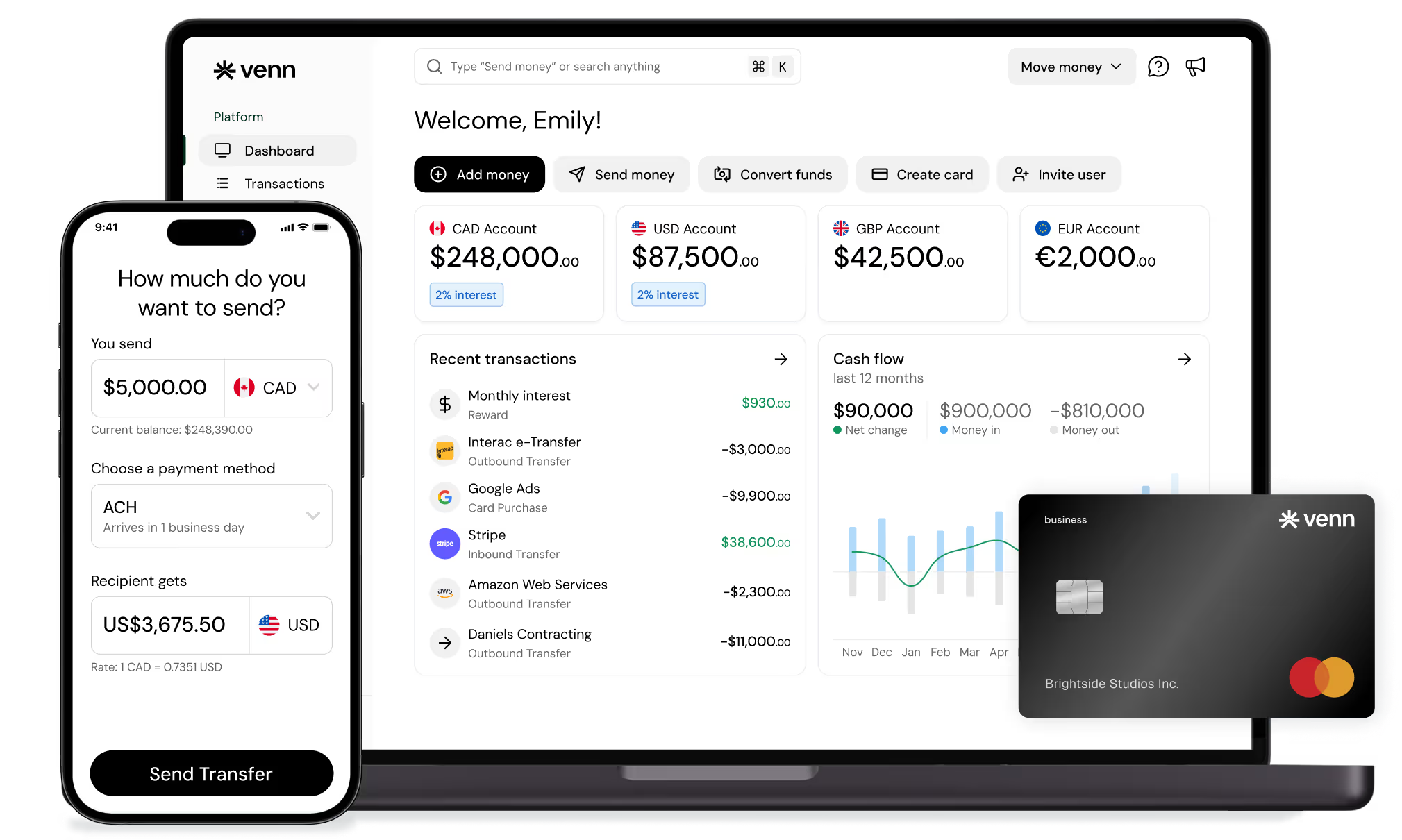
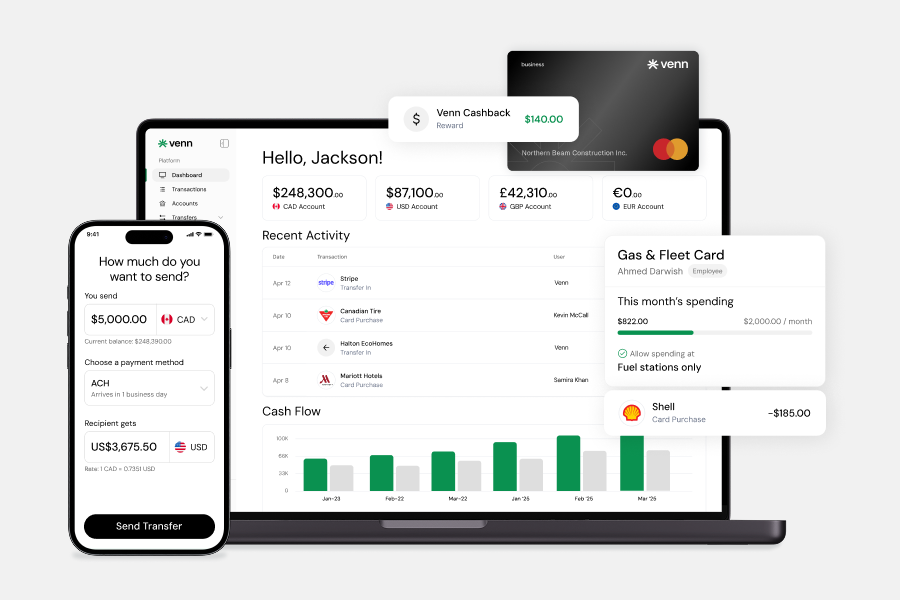
Project-based account structure transforms cash flow visibility. Venn enables opening multiple CAD accounts at no additional cost. Separate accounts for each major project eliminate commingled funds and mental accounting. When the Toronto office tower project receives a $500,000 progress payment, it goes into that project's dedicated account. Paying that project's subcontractors from the same account creates clear audit trails and automatic project profitability tracking.
Fast, affordable payments keep projects moving without draining cash through fees. Same-day or next-day EFT payments cost just $0-2 depending on your plan, replacing $15-30 wire fees. Free unlimited Interac e-Transfer® handles smaller supplier payments instantly. When a concrete supplier needs payment to schedule tomorrow's pour, you can actually deliver instead of apologizing for bank delays.
Automated payables eliminate the administrative burden of construction payments. Direct connection to QuickBooks or Xero means approved invoices trigger automatic payments. No more Friday afternoons spent manually entering 30 subcontractor payments. Set approval workflows, payment dates, and let automation handle execution while you focus on project management.
Multi-currency capabilities serve contractors working cross-border projects. Real local USD accounts, not CAD accounts pretending to hold USD, eliminate hidden conversion costs. When US clients pay in USD or you need to pay US suppliers, funds stay in USD until you choose to convert. This prevents the thousand-dollar conversion losses hidden in traditional "USD account" structures.
Funds safeguarded with CDIC protection provides peace of mind for project funds. All funds are safeguarded and covered under CDIC insurance protection, delivering the security construction businesses require. Your progress payments and operating funds receive the same protection as traditional bank deposits.
Designed for business complexity means features that match how construction companies actually operate. Unlike consumer banking stretched to serve business needs, every capability addresses real business requirements. Multiple users with different permission levels. Detailed transaction reporting for project accounting. Integration with the accounting software you already use.
Construction cash flow management requires financial infrastructure that matches the complexity of your operations. When your banking platform understands project-based business, cash flow management transforms from constant struggle to systematic process.
Frequently Asked Questions About Construction Cash Flow Management
Q: How long should I wait before taking action on a delayed construction payment?
A: Review your contract first, but generally begin action after 10 days past due. Send a friendly reminder around day 10, a formal notice around day 20, and escalate using prompt payment laws or contractual remedies by day 30. In provinces with prompt payment legislation, statutory timelines may require faster action. Avoid letting overdue payments age beyond 30 days without escalation.
Q: Can I stop work if a construction client doesn’t pay on time?
A: It depends on your contract and provincial laws. Some contracts explicitly grant suspension rights for non-payment. Without clear suspension rights, stopping work may breach your contract even if payment is late. Always consult a construction lawyer before suspending work. Best practice is to include clear payment suspension terms in all contracts.
Q: What’s the difference between a holdback and retainage in construction?
A: In Canada, holdback and retainage generally mean the same thing: a percentage of progress payments withheld until project completion to protect owners from liens and ensure performance. “Holdback” is the dominant Canadian term, typically 10%, though requirements vary by province.
Q: How do I calculate how much cash reserve my construction business needs?
A: Start with at least 3 months of operating expenses as your baseline reserve target. Then add about 20% of your typical accounts receivable to protect against delayed payments. For example: $200,000 monthly expenses × 3 = $600,000, plus 20% of $500,000 receivables = $100,000, for a total target of $700,000. Build toward this gradually.
Q: What’s the fastest way to pay subcontractors in Canada?
A: Interac e-Transfer® is the fastest, typically arriving within 30 minutes, but daily limits often cap payments around $10,000. For larger amounts, same-day or next-day EFT through modern business banking platforms offers the best balance of speed and cost. Traditional wire transfers are slower (often 3–5 days) and more expensive.
---
**Disclaimer:** This publication is provided for general information purposes and does not constitute legal, tax or other professional advice from Venn Software Inc or its subsidiaries and its affiliates, and it is not intended as a substitute for obtaining advice from a financial advisor or any other professional. We make no representations, warranties or guarantees, whether expressed or implied, that the content in the publication is accurate, complete or up to date.

Venn is all-in-one business banking built for Canada
From free local CAD/USD accounts and team cards to the cheapest FX and global payments—Venn gives Canadian businesses everything they need to move money smarter. Join 15,000+ businesses today.
Frequently asked questions
Everything you need to know about the product and billing.
Join 15,000+ businesses banking with Venn today
Streamline your business banking and save on your spend and transfers today
No personal credit check or guarantee.