Cheapest Way to Pay International Suppliers from Canada 2026
Cheapest Way to Pay International Suppliers from Canada 2026 cut FX markups and SWIFT fees with local USD EUR GBP accounts and ACH SEPA payments for SMBs.

Ahmed Shafik
Co-founder

Trusted by 15,000+ Canadian businesses
Business banking for Canada
Local CAD and USD accounts, corporate cards with cashback, the lowest FX rates in Canada, free local transfers, and more.
Paying international suppliers shouldn't drain your margins. Yet for many Canadian businesses, cross-border payments quietly erode profits through hidden fees, inflated exchange rates, and unnecessary wire charges. The advertised transfer fee tells only part of the story.
The cheapest method depends on three factors: the total cost (fees plus FX markup plus intermediary charges), the payment corridor (US, Europe, or elsewhere), and your operational workflow. For most Canadian businesses paying recurring supplier invoices, the answer involves holding funds in the supplier's local currency and using local payment rails whenever possible.
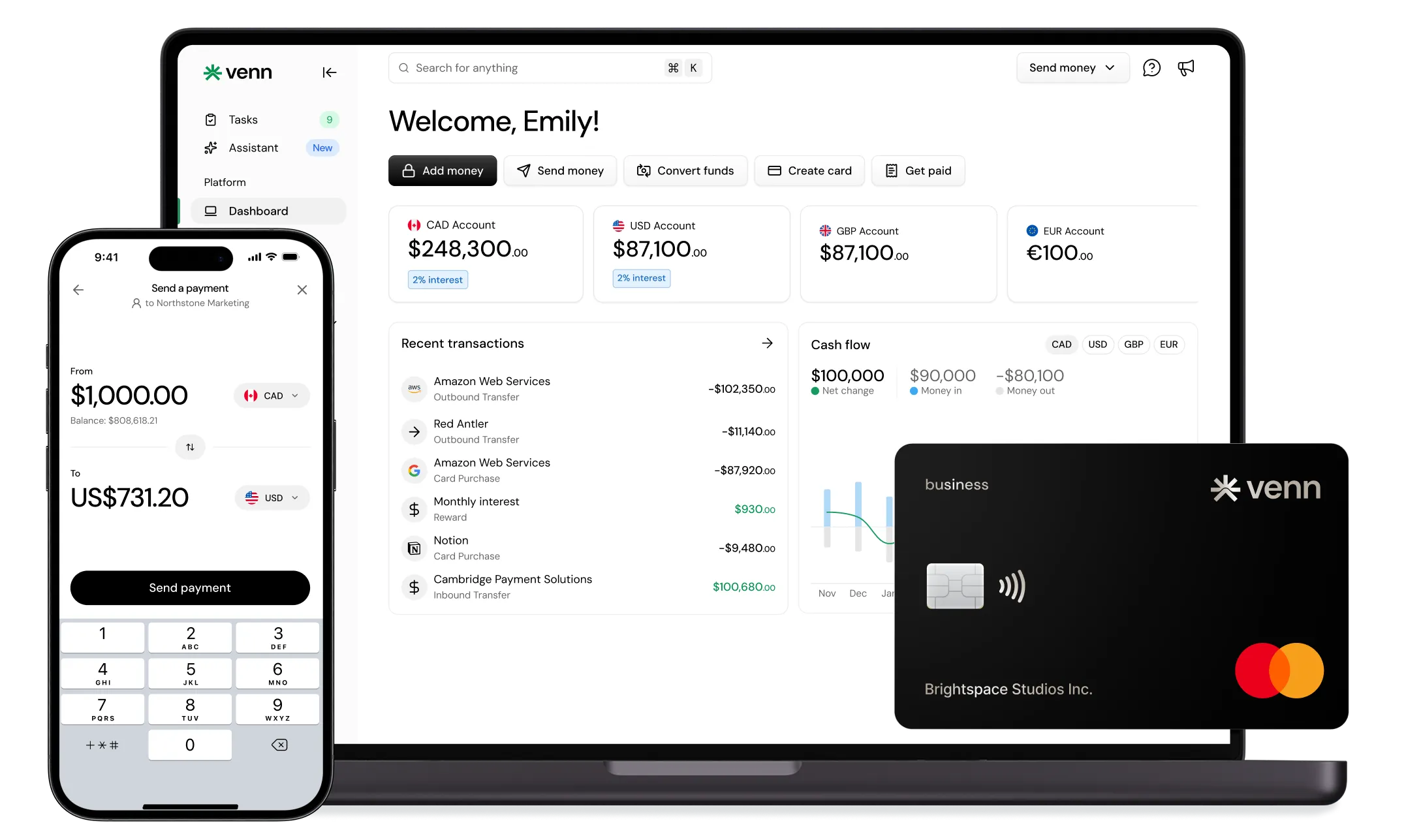
A modern multi-currency business banking platform like Venn can reduce these costs significantly. By maintaining CAD, USD, EUR, and GBP accounts and accessing local rails like ACH for US payments, Canadian businesses avoid forced currency conversions and expensive SWIFT intermediary fees. Combined with accounting integrations for QuickBooks and Xero, this approach cuts both direct costs and administrative overhead.
What Is the Cheapest Way to Pay an International Supplier From Canada?
The cheapest approach combines two strategies: minimize FX markup and avoid SWIFT wire friction whenever possible.
For US suppliers, paying from a real local USD account via ACH typically costs a fraction of traditional wire transfers. For European suppliers, using SEPA or Faster Payments from local EUR or GBP accounts achieves similar savings. When wires remain necessary, choosing a provider with transparent, competitive FX rates matters more than finding the lowest advertised transfer fee.
For many Canadian businesses, using a multi-currency business banking platform like Venn to pay from local currency accounts reduces both FX and wire-related costs. Venn provides real local accounts in CAD, USD, EUR, and GBP, enabling access to domestic payment rails that traditional Canadian banks cannot offer.
The Real Cost of International Supplier Payments
Understanding the true cost requires examining each component separately.
Transfer Fees
Most providers charge a flat fee or percentage per transaction. Canadian banks typically charge $25 to $50 for outgoing international wires. Online transfer providers may charge less, sometimes as low as $5 to $15. Venn charges $6 to $10 for global wires depending on your plan, with ACH and EFT transfers costing $0 to $2.
FX Spread and Markup
This hidden cost often exceeds the transfer fee, especially on larger payments. Canadian banks commonly mark up exchange rates by 1.5% to 3% above the mid-market rate. On a $50,000 payment, a 2.5% markup costs $1,250 in hidden fees.
Venn offers FX rates between 0.25% and 0.45% depending on plan, among the lowest available to Canadian businesses.
SWIFT Wire Chain Costs
International wires pass through correspondent banks, each potentially deducting fees. These intermediary charges range from $15 to $30 per bank in the chain. Your supplier may receive less than you sent, creating confusion and requiring additional payments to cover shortfalls.
Recipient Bank Fees
The supplier's bank may charge "lifting fees" to receive international wires, typically $10 to $25. These fees reduce the amount your supplier receives unless you've agreed to cover them.
OUR, SHA, and BEN Fee Allocation
When sending wires, you choose who pays which fees:
• OUR: You pay all fees (sender, intermediary, and recipient)
• SHA: Fees are shared (you pay sending fees, recipient pays receiving fees)
• BEN: Recipient pays all fees (deducted from the transfer amount)
Most supplier relationships work best with OUR or SHA to ensure your supplier receives the full invoice amount.
How to Calculate Total Cost
Use this formula to compare providers accurately:
Total Cost = (Amount × FX Markup %) + Transfer Fee + Intermediary Fees + Recipient Fees
Example 1: $5,000 Payment via Traditional Bank Wire
• FX markup (2.5%): $125
• Wire fee: $45
• Intermediary fees: $30
• Recipient fee: $15
• Total: $215 (4.3% of payment)
Example 2: $5,000 Payment via Venn (USD Account + ACH)
• FX markup (0.35%): $17.50
• ACH fee: $2
• No intermediary or recipient fees
• Total: $19.50 (0.39% of payment)
The difference grows dramatically with larger invoices. A $50,000 payment could cost over $1,500 through traditional channels versus under $200 through an optimized approach.
Compare the Main Ways to Pay International Suppliers From Canada
Bank Wires (SWIFT) From a Canadian Bank
Traditional SWIFT wires remain the default for many businesses, particularly for large or urgent payments requiring wide acceptance.
The reliability comes at a cost. Major Canadian banks charge $30 to $50 per outgoing wire plus significant FX markups. Intermediary banks along the SWIFT network may deduct additional fees, and the recipient's bank often charges for incoming international wires.
Operational friction adds hidden costs as well. Some banks require branch visits for large wire transfers. Processing times range from one to five business days, and tracking payments through the correspondent bank network proves difficult. For businesses sending regular supplier payments, these inefficiencies compound.
Online Money Transfer Providers
Specialized transfer services offer more transparent pricing than traditional banks. Fees are clearly displayed, and FX rates typically beat bank offerings.
These providers work well for occasional payments. However, they may not integrate cleanly with your business banking and accounting workflows. You're managing yet another platform, another login, and another reconciliation process. For businesses with frequent international payments, this fragmentation creates operational overhead.
Paying From Local Currency Accounts
This approach delivers the lowest costs for businesses with recurring supplier relationships in specific currencies.
When you pay a US supplier from a USD account via ACH, you eliminate FX conversion entirely on that transaction. You converted CAD to USD once, at a competitive rate, then pay multiple suppliers without additional conversion costs. The same logic applies to EUR suppliers via SEPA or GBP suppliers via Faster Payments.
Venn excels here by providing real local accounts in multiple currencies. Unlike many Canadian banks and fintechs that offer "USD accounts" still operating through SWIFT, Venn's US account can send and receive ACH domestically. This distinction matters enormously for cost and speed.
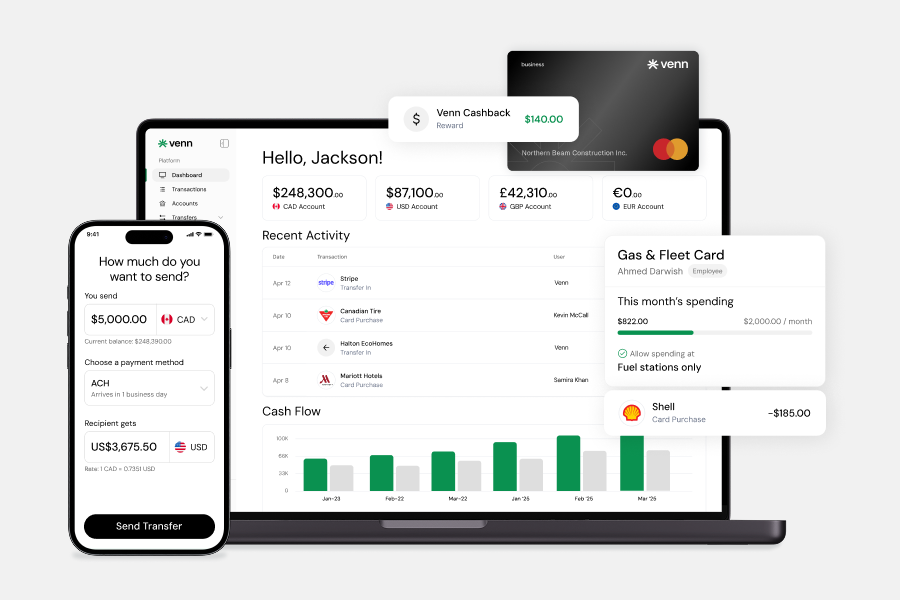
With Venn, you can hold CAD, USD, EUR, and GBP balances. Pay US suppliers via ACH for $0 to $2. Send SEPA payments to European suppliers. Convert between currencies at 0.25% to 0.45% FX markup. The combination of low conversion costs and local rail access makes this the cheapest approach for most scenarios.
Card Payments
Credit and charge cards occasionally make sense for supplier payments, particularly for SaaS subscriptions, smaller vendors, or situations where cash flow timing matters.
Card payments aren't typically the cheapest option for supplier invoices due to merchant acceptance fees. However, they offer benefits beyond pure cost comparison: cashback rewards, expense tracking, and simplified reconciliation.
Venn's 1% unlimited cashback card provides value here. The card automatically uses the currency you're paying in first, reducing FX fees on international purchases. For businesses managing team expenses alongside supplier payments, this integrated approach simplifies operations while generating meaningful cashback on all spend.
Cryptocurrency and Stablecoins
Some businesses explore crypto for international payments, attracted by potentially lower fees and faster settlement.
This option carries significant caveats. Volatility risk exists even with stablecoins. Accounting and tax treatment remains complex. Supplier acceptance is limited. Regulatory compliance requires careful attention. For most Canadian businesses, traditional payment methods optimized for cost remain more practical.
Comparison Table: Cheapest Method by Scenario
| Method | Best For | Speed | Main Cost Drivers | Hidden Costs to Watch | Where Venn Fits |
|---|---|---|---|---|---|
| Bank SWIFT wire | Large, urgent payments | 1–5 days | Wire fee + FX spread | Intermediary fees, recipient fees, OUR/SHA/BEN | Use Venn for competitive FX and $6–10 wires |
| Online transfer provider | Occasional payments | 1–3 days | FX spread + flat fee | Rate markups on larger amounts | Hold local currencies in Venn to reduce conversions |
| Local rails from local currency accounts | Frequent supplier payments (USD/EUR/GBP) | Same or next day | Low FX + minimal transfer fees | Fewer hidden charges | Core Venn strength: real local accounts with ACH, SEPA, Faster Payments |
| Card payments | SaaS, subscriptions, smaller vendors | Instant | Card fees, potential FX | Merchant fees sometimes passed through | Venn card for 1% cashback + multi-currency spend |
Step-by-Step: How to Pay an International Supplier Without Mistakes
Information You Need From Your Supplier
Collect these details before initiating payment:
• Legal business name exactly as registered with their bank
• Full business address
• Bank name and address
• SWIFT/BIC code (8 or 11 characters)
• IBAN (for European suppliers) or account number and routing code (for US/other)
• Currency they want to receive
• Invoice number or payment reference
• Any country-specific requirements (tax IDs, purpose codes)
How to Send Payment
• Add the supplier as a beneficiary in your payment platform
• Select the appropriate payment method (ACH, SEPA, wire) based on destination
• Choose the source currency account (pay from local currency when possible)
• Review the FX rate and total fees before confirming
• Add the invoice reference in the payment description
• Send remittance advice to your supplier with payment confirmation and reference number
• Save proof of payment for your records
Reconciliation Best Practices
Clean reconciliation prevents disputes and simplifies accounting:
• Use consistent reference formats across all payments
• Match each payment to its corresponding invoice immediately
• Maintain separate currency accounts to avoid confusion
• Reconcile weekly rather than monthly to catch discrepancies early
Venn integrates directly with QuickBooks and Xero, automating much of this process. Payments sync automatically, and having separate CAD, USD, EUR, and GBP accounts creates clear audit trails for each currency.
How Venn Reduces the Total Cost of International Supplier Payments
Multi-Currency Accounts That Eliminate Forced FX
Many Canadian businesses face a "forced conversion" trap. They receive USD from customers, convert to CAD because their bank account only holds Canadian dollars, then convert back to USD to pay American suppliers. Each conversion costs 1.5% to 3% at typical bank rates.
Venn eliminates this waste. Hold balances in CAD, USD, EUR, and GBP. Receive payments in the appropriate currency. Pay suppliers without unnecessary conversions. When you do need to convert, Venn's 0.25% to 0.45% FX rates minimize the cost.
Real Local US Account With ACH Capability
This feature distinguishes Venn from most Canadian banking options. Venn provides a real US account that can send and receive ACH domestically, not a "USD account" that still operates through SWIFT.
The practical impact is substantial. Pay US suppliers via ACH for $0 to $2 instead of $25 to $50 wire fees. Receive payments from US customers without inbound wire fees. If you use Stripe, avoid the 1.5% cross-border fee by receiving directly into your local US account.
Most Canadian banks and fintechs cannot offer this capability. Even major US banks providing accounts to Canadian businesses often route through SWIFT, triggering wire fees on what should be domestic US transfers.
Transparent Transfer Options
Venn's pricing structure favors businesses making frequent international payments:
• Global wires: $6 to $10 depending on plan
• ACH/EFT transfers: $0 to $2 depending on plan
• Free unlimited Interac e-Transfer® on all plans
• Inbound wires: Free
• FX rates: 0.25% to 0.45% depending on plan
Suppliers receive payments same or next business day for ACH and local rail transfers, compared to three to five business days through some competitors.
Spend and Expense Management
Beyond supplier payments, Venn provides a comprehensive business banking layer. The 1% unlimited cashback card has no minimum spend requirements, unlike competitors requiring $25,000 monthly spend for cashback benefits.
The card automatically uses the currency you're paying in first, reducing FX fees on international purchases. For teams managing expenses across multiple currencies, this automation prevents costly conversion mistakes.
OCR receipt capture and invoice matching streamline accounting work, reducing the administrative burden on finance teams.
Accounting Integration
Venn connects directly with QuickBooks and Xero, automating reconciliation and payables workflows. This integration transforms Venn from a standalone payment tool into the banking layer of your financial stack.
Payments sync automatically. Multi-currency transactions categorize correctly. Month-end close becomes faster and more accurate.
Common Mistakes That Make "Cheap" Payments Expensive
Choosing providers based on advertised transfer fees alone. A $5 transfer fee means nothing if the FX markup costs $500 on a $20,000 payment. Always calculate total cost.
Ignoring OUR/SHA/BEN implications. Choosing BEN to save on fees often backfires when suppliers complain about receiving less than invoiced and demand additional payments.
Sending wires when local rails work. Paying a US supplier via SWIFT wire when ACH would cost a fraction as much wastes money on every transaction.
Poor payment references. Vague or missing references cause supplier confusion, payment disputes, and wasted time resolving issues.
Maintaining single-currency accounts. Converting back and forth between currencies for every transaction multiplies FX costs unnecessarily.
FAQs
Q: What’s cheaper: a bank wire or paying from a local currency account?
A: Paying from a local currency account via domestic payment rails (like ACH for US payments) is almost always cheaper. You avoid wire fees, intermediary bank charges, and often get better FX rates when you do need to convert.
Q: How long do international supplier payments take from Canada?
A: SWIFT wires typically take one to five business days. ACH payments to US suppliers usually arrive the same or next business day. SEPA payments to European suppliers generally complete within one business day.
Q: What information do I need to pay a supplier via SWIFT/IBAN?
A: You need the supplier’s legal business name, business address, bank name and address, SWIFT/BIC code, IBAN (or account number and routing code), preferred currency, and invoice reference number.
Q: What are intermediary bank fees and can I avoid them?
A: Intermediary bank fees are charges deducted by correspondent banks that process SWIFT wires between your bank and your supplier’s bank. You can often avoid them by using local payment rails (such as ACH or SEPA) instead of SWIFT whenever possible.
Q: Should I pay suppliers in CAD or their local currency?
A: Pay suppliers in their local currency whenever possible. This gives you control over the FX conversion—choosing when and at what rate to convert—rather than leaving the exchange rate to your supplier’s bank, which typically applies less favorable rates.
Q: How do I keep FX and supplier payments clean in QuickBooks or Xero?
A: Use a banking platform that integrates directly with your accounting software. Maintain separate accounts for each currency, use consistent payment references, and reconcile accounts regularly to catch discrepancies early.
Funds held with Venn are covered under CDIC insurance protection. Venn is a registered Payment Service Provider (PSP) in Canada, compliant with RPAA legislation.
FX rate comparisons based on internal analysis of total markups and FX fees charged by major Canadian financial institutions as of January 2026.
---
**Disclaimer:** This publication is provided for general information purposes and does not constitute legal, tax or other professional advice from Venn Software Inc or its subsidiaries and its affiliates, and it is not intended as a substitute for obtaining advice from a financial advisor or any other professional. We make no representations, warranties or guarantees, whether expressed or implied, that the content in the publication is accurate, complete or up to date.
This publication is provided for general information purposes only and does not constitute legal, tax, financial, or other professional advice from Venn Software Inc., its subsidiaries, or its affiliates, and is not a substitute for advice from a qualified professional. All comparisons and competitor information reflect publicly available information believed accurate as of February 26, 2026; features, pricing, rates, and terms referenced are subject to change and may differ at the time you read this. All product names, logos, and brands referenced are the property of their respective owners; their mention does not imply affiliation with or endorsement by Venn. Any comparative statements reflect Venn's views and are provided to help readers evaluate options. We make no representations, warranties, or guarantees, express or implied, that the content is accurate, complete, or up to date.

Venn is all-in-one business banking built for Canada
From free local CAD/USD accounts and team cards to the cheapest FX and global payments—Venn gives Canadian businesses everything they need to move money smarter. Join 15,000+ businesses today.
Frequently asked questions
Everything you need to know about the product and billing.
Join 15,000+ businesses banking with Venn today
Streamline your business banking and save on your spend and transfers today
No personal credit check or guarantee.